
Castel dell'Ovo
Castel dell'Ovo
Italy · Campania · Near Naples
Built 1154 · Norman-Aragonese, Medieval fortress
This page is part of an independent travel guide and is not affiliated with, endorsed by, or operated by Castel dell'Ovo.
© Unsplash
Quick Facts
- Hours
- Mon–Sat 09:00-19:30. Sun 09:00-14:00
- Guided tour from
- €130
- Duration
- 1-1.5 hours
- Best time
- Spring
- Nearest city
- Naples
Featured Tour
Naples: Refined Chiaia District Walking Tour
Cancellation available · Instant confirmation
Highlights
- ✦Free entry to one of Naples' most iconic landmarks — a castle that has stood on this rocky islet since the age of ancient Rome
- ✦Climb to the upper terraces for sweeping views of the Bay of Naples, Vesuvius, and the city's celebrated waterfront
- ✦Explore the atmospheric Norman and Aragonese halls, chapels, and vaulted corridors carved into the living rock
- ✦Walk the Borgo Marinari — the fishing village that shelters beneath the castle walls, with its seafood restaurants and sailboat harbour
- ✦Discover the legendary egg hidden in the castle's foundations, whose fate, according to Neapolitan legend, is tied to the fate of the city itself
Skip the queue with a guided tour
Skip-the-line tickets & expert guides
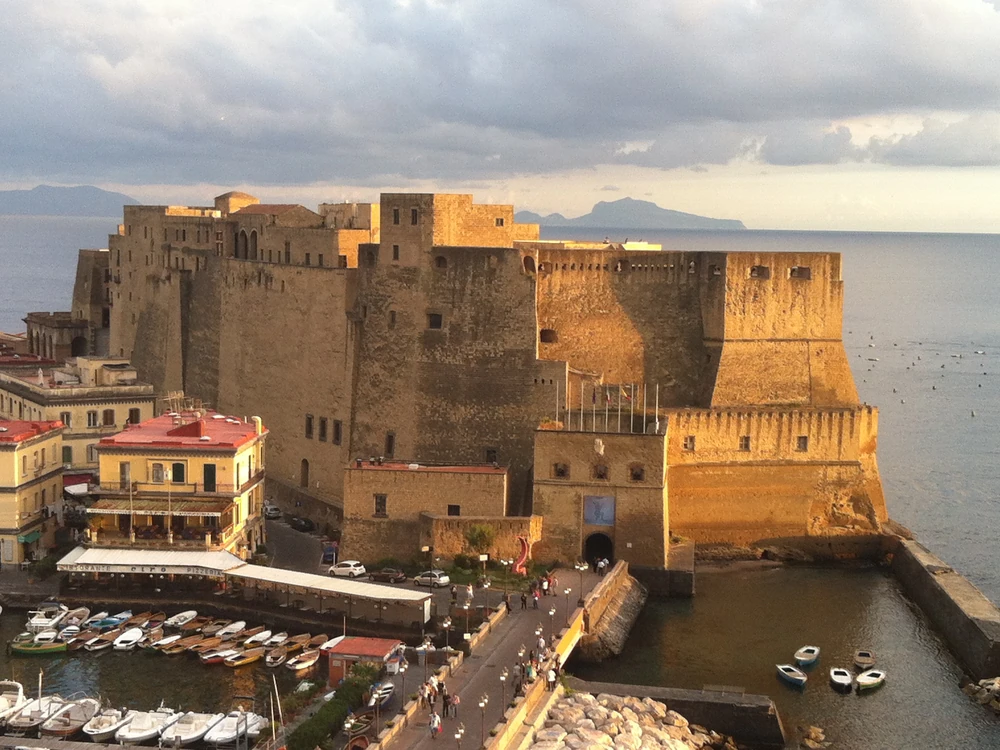
Jutting into the Bay of Naples on a small volcanic islet connected to the mainland by a narrow causeway, Castel dell'Ovo is the oldest standing fortress in Naples and one of the most recognizable silhouettes on Italy's most theatrical waterfront. Its name — the Castle of the Egg — derives from a medieval legend involving the Roman poet Virgil, who was believed in the Middle Ages to have been a powerful magician. According to the tale, Virgil hid a magic egg in the foundations of the castle, and as long as the egg remains unbroken, Naples will survive.
The site has been occupied since antiquity. In the first century BC, the Roman general Lucullus built a spectacular villa on the islet, transforming it into one of the most luxurious private residences in the ancient world. The villa eventually became imperial property and was used as a place of exile — Romulus Augustulus, the last emperor of the Western Roman Empire, was deposed and sent here in 476 AD, effectively ending a thousand years of Roman rule from this small rock in a Neapolitan bay.
The fortification visible today was built by the Norman king William I of Sicily in 1154, subsequently reinforced by the Hohenstaufen emperors and extensively modified by the Angevins and Aragonese during their successive domination of southern Italy. Charles I of Anjou moved the royal treasury here in the 13th century, and for decades Castel dell'Ovo was the most heavily guarded site in the kingdom. The castle passed through Spanish, French, and Bourbon hands before becoming a military installation in the unified Italian state, a function it retained until 1976 when it was opened to the public.
Today admission is free, making it one of Naples' most accessible landmarks. The interior offers a sequence of atmospheric halls, chapels, and terrace walks through Norman and Aragonese stonework, with views at every turn of the Bay of Naples framed in ancient archways. The upper terraces provide arguably the finest panorama of the bay available from sea level — Vesuvius rising behind the city, the islands of Capri, Ischia, and Procida visible on clear days, and the Neapolitan waterfront stretching north toward Pozzuoli in one sweeping arc.
History
The history of Castel dell'Ovo begins not in the medieval period but in antiquity. The rocky islet of Megaride was chosen by the Roman nobleman Lucullus in the 1st century BC as the site of an extraordinary villa, featuring fishponds carved into the volcanic rock and gardens planted with exotic plants from across the Mediterranean world. After Lucullus's death, the property passed through various hands until it became part of the imperial estates.
The island entered its most historically significant moment in 476 AD, when the Germanic chieftain Odoacer deposed the teenage emperor Romulus Augustulus and sent him into comfortable exile in Lucullus's former villa. This moment is conventionally taken as the fall of the Western Roman Empire — one of the most consequential events in world history — unfolding on this quiet rock in Naples Bay.
The Norman king William I of Sicily built the first proper fortification on the site in 1154, establishing the castle as a stronghold of the new Norman Kingdom of Sicily. Subsequent rulers — the Hohenstaufen, the Angevins, the Aragonese, and the Spanish viceroys — each added to and modified the structure, creating the layered medieval fortress visible today. Charles I of Anjou used it as a royal treasury, and the Aragonese king Alfonso V sheltered here during his conquest of Naples in 1442. The castle declined in strategic importance after the construction of Castel Nuovo on the mainland, becoming primarily a prison and military depot before its current use as a cultural and exhibition space.
How to Visit
Getting there: Castel dell'Ovo is on the Borgo Marinari waterfront in the Chiaia district, about 2km west of Naples' historic centre. From Napoli Centrale station, take Metro Line 1 to Municipio or Piazza Amedeo, or buses R3/140 to Via Caracciolo. The seafront walk from Piazza del Plebiscito takes about 20 minutes and is one of the finest urban walks in Italy.
Tickets: Entry is free. No booking required — walk across the causeway and enter through the main gate during opening hours (Mon–Sat 09:00–19:30, Sun 09:00–14:00). The GetYourGuide Chiaia district walking tour includes the castle exterior as part of a 3-hour guided walk through Naples' elegant waterfront neighbourhood.
Practical tips: Visit in the morning before the midday heat in summer. Allow 1–1.5 hours for the interior halls and the upper terraces, which give arguably the finest bay-level panorama in Naples — Vesuvius, Capri, and the city waterfront all visible at once. The Borgo Marinari below the walls is one of Naples' most atmospheric lunch spots.
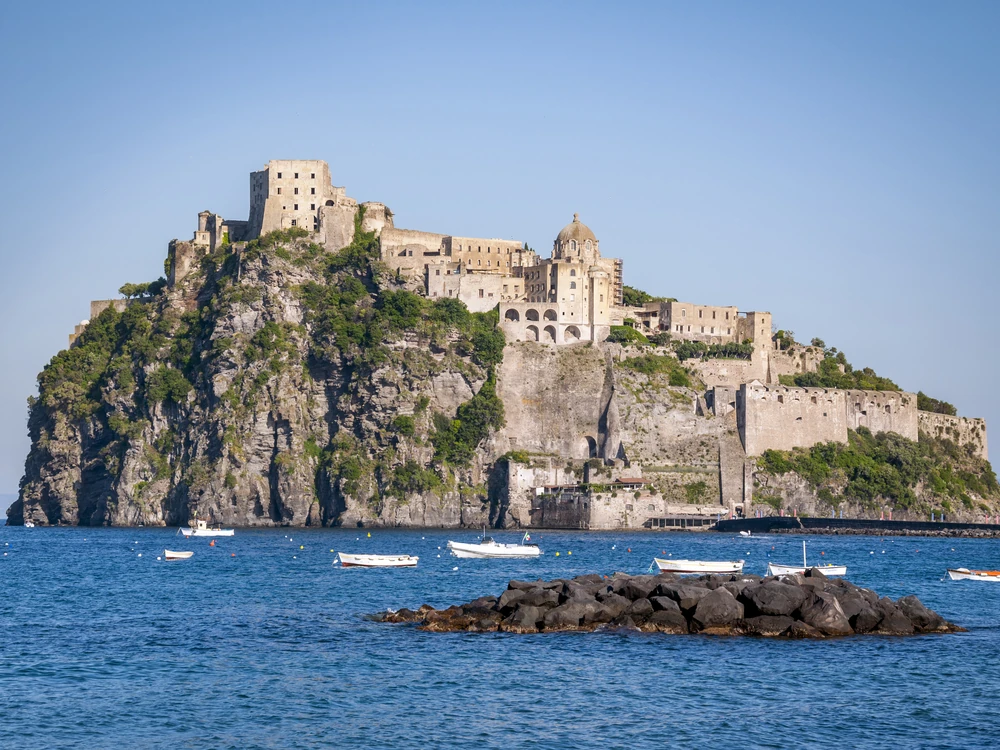
Combine with: Castel Sant'Elmo on the Vomero hill (25 minutes by funicular) and Aragonese Castle on Ischia (ferry from Molo Beverello) for a Bay of Naples coastal fortresses itinerary.
Frequently Asked Questions
Yes — admission to Castel dell'Ovo is completely free of charge. No booking is required. You simply walk across the causeway and enter through the main gate during opening hours.
Location
Via Eldorado 3, 80132 Naples, Italy
Nearby Castles



Tours & Tickets
Powered by GetYourGuide
From
€130/ person