
Castello Ginori di Querceto
Castello Ginori di Querceto
Italy · Tuscany, Pisa province — Montecatini Val di Cecina/Bibbona, near Bolgheri, coastal Maremma · Near Bolgheri
Built 1000 · Neo-Medieval revival (1930s) over a medieval and Renaissance core — the site traces its origins to c.1000 AD as a frontier settlement belonging to the church of Massa Marittima; the 1577 villa built by the Lisci family was the estate's main residential building for over three and a half centuries before Marchese Lorenzo Ginori undertook a deliberate Neo-Medieval remodelling in the 1930s, giving the estate its current castle silhouette with towers, crenellations, and a fortified gate; the 250-hectare estate encompasses vineyards, olive groves, and cereal fields in the coastal Val di Cecina, distinct from the inland Chianti and Val d'Orcia wine-estate clusters already covered on this site
This page is part of an independent travel guide and is not affiliated with, endorsed by, or operated by Castello Ginori di Querceto.
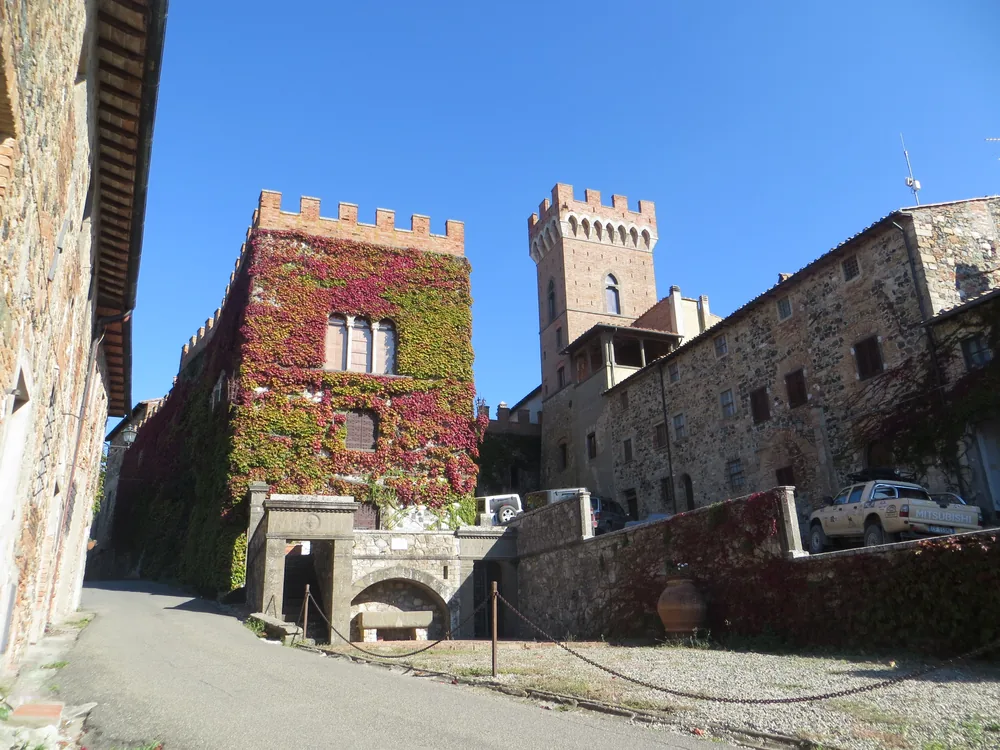
© Castles & Palaces
Quick Facts
- Hours
- Mon–Sun By appointment
- Guided tour from
- €62
- Duration
- 2 hours (GetYourGuide wine tasting experience with archaeologist guide)
- Best time
- April to October
- Booking
- Required — book 2+ days ahead
- Nearest city
- Bolgheri
Featured Tour
Wine Tasting in a Romantic Castle with Archaeologist Guide
Cancellation available · Instant confirmation
Highlights
- ✦Continuous Ginori-Lisci family ownership since the 16th century — in 1786 the last Lisci heir, Francesca, married Marchese Lorenzo Ginori, combining the Lisci's Volterra-frontier estate (held since 1543) with the Ginori family; the estate has been Ginori property for nearly 240 years, and Lisci-Ginori family ownership stretches back to the Florentine conquest of Volterra in the 16th century
- ✦1930s Neo-Medieval rebuild — in the 1930s, Marchese Lorenzo Ginori deliberately remodelled the 1577 Lisci villa as a Neo-Medieval castle, adding towers, crenellations, and a fortified gate; the result is a castle that looks medieval but is a 20th-century family design choice, with the honesty of a private estate built for living rather than for tourism
- ✦Archaeologist-guided wine tasting — the GetYourGuide experience is guided by a specialist with an archaeological background rather than a standard wine professional, connecting the estate's millennium of documented history to the landscape and the wines in a way that distinguishes it from standard Tuscan winery visits
- ✦The site's first Bolgheri/coastal Maremma wine castle — while the site already covers wine-estate castles in Chianti ([Brolio](/castles/italy/brolio-castle), [Poppiano](/castles/italy/castle-of-poppiano)) and inland Tuscany, Querceto is the first entry from the coastal Val di Cecina and the Bolgheri wine country, where the Super Tuscans — Sassicaia, Ornellaia, Masseto — were invented in the late 20th century
- ✦Medieval frontier history — Querceto is documented from c.1000 AD as a frontier position belonging to the church of Massa Marittima; by 1208 the Val di Cecina had passed to Volterra's control, valued for its strategic position and salt-water springs; Florentine conquest of Volterra in the 16th century brought the Lisci family and the beginning of the estate's continuous noble tenure
- ✦250-hectare working estate — wine, olive oil, and grain are all produced on the property, maintaining the mixed-agriculture model of the historic Tuscan estate rather than the monoculture vineyard that characterises most of the Bolgheri Super Tuscan producers
Skip the queue with a guided tour
Skip-the-line tickets & expert guides
Castello Ginori di Querceto occupies a 250-hectare estate in the Val di Cecina, a valley that descends from the metalliferous hills of the Maremma to the Tyrrhenian coast a few kilometres from Bolgheri — the small village that lent its name to one of Italy's most celebrated modern wine designations. The castle is the site's first entry from this coastal Tuscany wine country, geographically and stylistically distinct from the Chianti and Val d'Orcia wine-estate castles already covered, and it represents a tradition of family-owned agricultural estate with deep medieval roots rather than the recent prestige-branding of the Super Tuscan zone immediately to the west.
The site's history goes back to approximately 1000 AD, when Querceto is documented as a settlement belonging to the church of Massa Marittima — the coastal mining city that was, in the early medieval period, one of the more significant urban centres of southern Tuscany before Siena's rise. By 1208 the Val di Cecina's castles and settlements had passed from ecclesiastical to communal control, when Volterra — the Etruscan hilltop city that dominates the valley from the north — acquired the area as part of its territorial expansion, valuing Querceto's position on the valley floor and the salt-water springs that made the site economically productive. The valley corridor, running roughly southwest from Volterra to the coast, was a significant commercial and military route in the medieval period, and controlling its castles was a consistent goal of the competing powers — Volterra, Pisa, Florence, and the minor local lordships — that struggled over the Maremma for three centuries.
Florentine conquest of Volterra came definitively in the 15th and 16th centuries, and with it the redistribution of the former Volterran commune's assets to Florentine noble families. Around 1543, the Lisci family of Volterra acquired Querceto — a noble lineage of the city that had roots in the Volterran commune and that received the estate as part of the post-conquest reshuffling of the Val di Cecina's landed property. The Lisci built a proper residential villa on the site in 1577, the building that would remain the estate's core for the next three and a half centuries. In 1786 the last Lisci heir — Francesca, without male issue to carry the family forward — married Marchese Lorenzo Ginori, bringing Querceto and its dependencies into the Ginori family, who have held it ever since. The Ginori are one of Florence's old merchant and ceramic families: the same family gave its name to the Richard Ginori porcelain manufactory (founded 1735), though the Querceto estate's history is agricultural rather than manufacturing.
The current castle appearance dates to the 1930s, when another Marchese Lorenzo Ginori undertook a deliberate Neo-Medieval remodelling of the 1577 Lisci villa. He added towers, crenellations, a fortified gate, and the medieval silhouette that the estate presents today — a common pattern in Italian estate architecture of the Fascist era, when the Neo-Medieval revival served both aesthetic and ideological functions. The result is a castle that is visually convincing but 20th-century in its current form, built for family occupation and estate management rather than for any defensive purpose. The 250 hectares produce wine, olive oil, and grain in the mixed-agriculture model of the historic Tuscan fattoria — a broader base than the monoculture wine estates that dominate the nearby Bolgheri designation.
The GetYourGuide experience at Querceto is distinguished from standard Tuscan winery visits by its guide: not a sommelier or an estate manager but an archaeologist, who connects the estate's thousand years of documented history — the Volterran frontier, the medieval salt-water springs, the Florentine conquest, the Lisci and Ginori tenures — to the landscape the visitor walks through and the wines they taste at the end. The 2-hour format includes a walk through the castle and estate grounds with this archaeological and historical narration, followed by a tasting of the estate's current wines.
For context within the site's Tuscan wine-estate coverage: [Brolio Castle](/castles/italy/brolio-castle), in the Chianti Classico zone east of Siena, is the Ricasoli family's estate and the historical origin of the Chianti Classico classification. [Castello Tricerchi](/castles/italy/castello-tricerchi) is an Umbrian-border wine castle. [Castle of Poppiano](/castles/italy/castle-of-poppiano) is in the Colli Fiorentini zone south of Florence. Querceto is the first of these coastal Maremma estates — the zone where Sassicaia and Ornellaia established the Super Tuscan category in the 1970s–1980s, though Querceto's own production is more traditionally oriented than the prestige Bolgheri designations.
History
Querceto appears in documents around 1000 AD as a frontier settlement belonging to the church of Massa Marittima, sitting in the Val di Cecina at the edge of the metalliferous hills that made this corner of the Maremma economically significant. By 1208 the valley's settlements had passed to the control of Volterra, the dominant Etruscan hilltop city of northern Maremma. Florentine conquest of Volterra in the 15th and 16th centuries redistributed the city's territorial assets, and around 1543 the Lisci family of Volterra acquired the Querceto estate. They built a villa on the property in 1577 as the main residential building.
The estate passed from the Lisci to the Ginori family in 1786, when the last Lisci heir, Francesca, married Marchese Lorenzo Ginori — a connection that brought Querceto into one of Tuscany's most prominent noble families. The building received its current castle appearance in the 1930s, when Marchese Lorenzo Ginori undertook a Neo-Medieval remodelling of the 1577 villa, adding towers, crenellations, and a fortified gate to produce the castellated silhouette it presents today.
The Ginori family continues to own and operate the 250-hectare estate, producing wine, olive oil, and grain from land that has been continuously cultivated for over a millennium.
How to Visit
Getting there: Querceto is in the Val di Cecina near Montecatini Val di Cecina, approximately 12km east of Cecina (on the Via Aurelia coastal road) and 20km south of Volterra. By car: from Cecina take the SS68 toward Volterra; from Bolgheri 20km southwest. Limited public transport — a car is recommended.
Tickets: The estate is visit-by-appointment only; walk-in access is not available. The GetYourGuide guided experience "Wine Tasting in a Romantic Castle with Archaeologist Guide" combines a 2-hour estate and castle walk with an archaeologist guide and a wine tasting — it is the primary visitor access point. Book in advance via GetYourGuide or directly at castelloginori.com.
Practical tips: Harvest season (September–October) is the most atmospheric time for a wine-estate visit in the Val di Cecina — book well in advance as appointment availability is tightest then. The estate is a working agricultural property, not a museum: wear comfortable footwear suitable for walking estate paths and vineyard terrain.
Combine with: Brolio Castle in the Chianti Classico zone (~80km east) — the Ricasoli family's estate and the historic origin of Chianti Classico. Castello Tricerchi near Montalcino (~90km southeast) — a Templar-founded wine castle with Brunello di Montalcino tastings.
Frequently Asked Questions
The estate's GetYourGuide experience is designed to connect the wine tasting to the thousand-year history of the Querceto site — from its medieval Volterran frontier origins through the Lisci and Ginori family tenures to the current agricultural estate. An archaeologist-guide can read the landscape and the castle buildings in ways a wine professional typically cannot: identifying the traces of the medieval settlement, explaining the Val di Cecina's strategic importance in the context of the Volterra-Florence conflict, and connecting the current wine production to the long history of the same land. The tasting itself is included but framed by this broader historical narrative rather than by technical wine analysis.
Location
Querceto, 57020 Montecatini Val di Cecina, Italy
Nearby Castles
Tours & Tickets
Powered by GetYourGuide
From
€62/ person