
Fortezza Nuova
Fortezza Nuova di Livorno
Italy · Tuscany, Livorno — Venezia Nuova canal district · Near Livorno
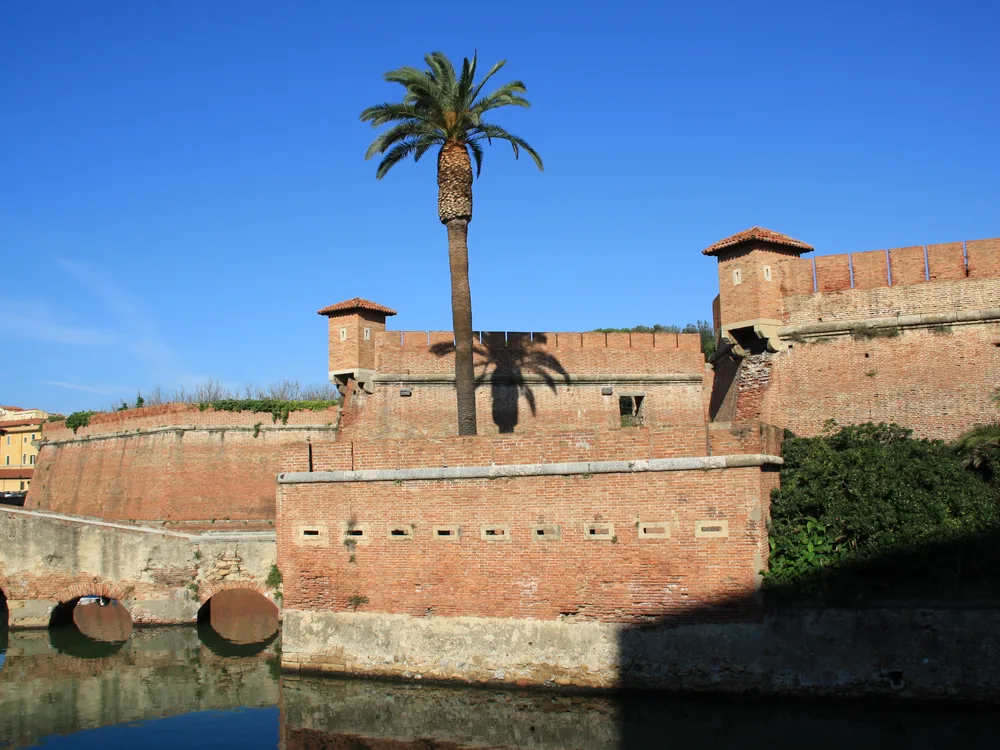
Built 1590 · Late-Renaissance star-fort (trace italienne) — commissioned in 1590 by Grand Duke Francesco I de' Medici and designed by Bernardo Buontalenti with input from Don Giovanni de' Medici; a five-bastion pentagonal fortification built over approximately 15 years in the Venezia Nuova district; around 60% of the structure was demolished in 1690 to allow the expansion of the surrounding canal district; the surviving curtain walls, two bastions, and the moat now form an island park in the middle of the Venezia Nuova canal network, accessible by two drawbridges
This page is part of an independent travel guide and is not affiliated with, endorsed by, or operated by Fortezza Nuova.
© Castles & Palaces
Quick Facts
- Hours
- Mon–Sun Park open daily (free access)
- Guided tour from
- €10
- Duration
- 30–45 minutes (self-guided walk); 1 hour (GetYourGuide guided inside-the-walls tour)
- Best time
- Spring and autumn
- Nearest city
- Livorno
Featured Tour
Livorno: Inside the Walls — Exclusive Fortezza Nuova Tour
Cancellation available · Instant confirmation
Highlights
- ✦Bernardo Buontalenti's design — the most prolific Medici architect of the late 16th century, responsible for the Villa Pratolino, the Uffizi's Tribuna, and the Forte Belvedere in Florence, designed the Fortezza Nuova as a five-bastion star-fort; Buontalenti specialised in the trace italienne (Italian fortification method) that was transforming European military architecture in this period
- ✦Dual function: military defence and Medici prestige showcase — the fortress was deliberately used to receive and impress visiting dignitaries — princes, cardinals, popes, and emperors who came to Livorno; the combination of defensive architecture and diplomatic theatre was standard Medici practice in this period
- ✦Only 40% survives — in 1690, roughly 60% of the structure was demolished to allow the expansion of the Venezia Nuova canal district; what remains — two bastions, the curtain walls between them, and the moat — is now an island park in the middle of the canal network, accessible via two drawbridges
- ✦Island park in the Venezia Nuova canals — the surviving fortress walls now enclose a public garden on a canal island; the moat that originally surrounded the fortress has become the canal channels of the Venezia Nuova district, and walking the surviving ramparts gives views across the waterway network in all directions
- ✦The GetYourGuide inside-the-walls tour — an exclusive guided visit that goes beyond the public park to access the interior of the surviving bastions and the spaces within the walls, with historical narration on the fortress's construction, its Medici diplomatic function, and its partial demolition
- ✦Livorno's unusual urban history — Livorno was essentially built from scratch by the Medici as a new commercial port city from the late 16th century; unlike most Tuscan cities it has no medieval urban fabric, and the Fortezza Nuova is one of the primary surviving monuments of this planned-city origin
Skip the queue with a guided tour
Skip-the-line tickets & expert guides
The Fortezza Nuova di Livorno — the New Fortress — was commissioned in 1590 by Grand Duke Francesco I de' Medici as one of the pair of fortresses defending Livorno, the new commercial port city the Medici were simultaneously building from almost nothing on the Tyrrhenian coast of Tuscany. The architect was Bernardo Buontalenti, the most versatile and prolific designer in Medici service in the late 16th century: the same man who designed the Villa Pratolino (now destroyed), the Tribuna of the Uffizi, the Forte Belvedere above Florence, and the grotto in the Boboli Gardens. Don Giovanni de' Medici — an illegitimate son of Cosimo I and a military engineer in his own right — contributed to the design.
The fortress was a five-bastion pentagonal star-fort, the trace italienne form that had been transforming European fortification since the early 16th century. The trace italienne — angled bastions projecting from the curtain walls to eliminate dead ground and allow enfilading fire along the walls — was Italian in origin and the dominant model for European military architecture in the century between 1500 and 1600; Buontalenti, who had worked on Florence's own city defences, was thoroughly versed in it. Construction proceeded over approximately 15 years, completing around 1604. The fortress sat at the edge of the Venezia Nuova district — the quarter of canals and merchant warehouses that the Medici were building simultaneously on filled land north of the original port.
The stated purpose was defending Livorno from pirate raids — Barbary corsairs were an ongoing threat to the Tyrrhenian coast through the late 16th century — but the operational function of the fortress from almost the beginning was diplomatic as much as military. The Medici used the Fortezza Nuova to receive visiting dignitaries: princes, cardinals, popes, and Holy Roman Emperors who came to Livorno for various political, commercial, and religious purposes. The theatrical possibilities of a new and impressive military fortress — the trace italienne in stone, gleaming on the edge of the canal district — served Medici prestige in the same way as their Florentine palaces, their art commissions, and their garden architecture. Military architecture was not merely functional for the Medici; it was another medium for projecting power and cultural ambition.
The fortress's military usefulness faded over the 17th century as Livorno's strategic situation changed. In 1690 the decision was made to demolish approximately 60% of the structure to allow the expansion of the Venezia Nuova canal district that had grown up around it — the commercial and residential pressures of a prosperous trading city outweighed the value of a fortress that was increasingly redundant. Three of the five bastions and much of the curtain wall between them were taken down; what remained — roughly two bastions, the walls connecting them, and the moat — was left as an isolated fragment in the middle of the new canal network.
In 1972 the city of Livorno converted the surviving walls and the enclosed space into a public park. This is how most visitors encounter the Fortezza Nuova today: not as a military monument with furnished interiors and interpretation panels, but as a canal-island garden with surviving rampart walls above the water. The moat that surrounded the original fortress has been absorbed into the Venezia Nuova canal system; the park is accessible via two drawbridges from Piazza della Repubblica. Walking the surviving bastions gives views across the canal network of the Venezia Nuova — one of the most attractive and undervisited urban waterscapes in Tuscany, frequently compared to a smaller and less famous version of Venice's canal district.
The GetYourGuide guided tour — marketed as 'Inside the walls, the exclusive New Fortress tour' — provides access to areas of the surviving structure beyond the public park, with historical narration covering the fortress's construction, its Medici diplomatic function, the partial demolition of 1690, and the transformation into a park. The 1-hour format distinguishes it from an unguided walk and makes it the primary way to understand the fortress's history rather than simply use it as a park.
Livorno is an unusual city in the Italian context: it was essentially planned and built by the Medici from the 1570s as a purpose-built free port, with no significant medieval urban layer beneath it. The Medici's Livornina edict of 1593, offering legal protections and commercial freedoms to traders of all faiths (including Jews, who were restricted in most Italian cities), made Livorno one of the most cosmopolitan commercial cities in the Mediterranean. The Fortezza Nuova is one of the primary surviving monuments of this planned-city origin, alongside the Fortezza Vecchia (the older fortress in the port) and the Venezia Nuova canal district that surrounds it.
History
Grand Duke Cosimo I de' Medici began the planned development of Livorno as a new free port in the 1570s, recognising that Tuscany needed a proper commercial harbour that its existing ports could not provide. Grand Duke Francesco I commissioned the Fortezza Nuova from Bernardo Buontalenti — with Don Giovanni de' Medici contributing to the design — in 1590, and the five-bastion star-fort in the Venezia Nuova district was constructed between then and around 1604. The 1593 Livornina edict of Ferdinando I de' Medici, offering freedom of trade and religion to all faiths, made Livorno the most cosmopolitan port in the Tyrrhenian and gave the fortress the commercial city it was designed to protect.
The fortress's military function declined through the 17th century as the strategic situation in the western Mediterranean changed; it continued to serve for receiving visiting dignitaries. In 1690 approximately 60 percent of the structure was demolished to allow expansion of the Venezia Nuova canal district — a pragmatic sacrifice of military architecture to commercial urbanism. Two bastions and the connecting walls survived, enclosing the open space that now constitutes the park.
The City of Livorno converted the surviving structure and its enclosed area into a public park in 1972, accessible via two drawbridges from Piazza della Repubblica. Entry is free.
How to Visit
Getting there: Livorno is directly connected to Pisa by train (20 minutes) and to Florence (approximately 90 minutes). From Livorno Centrale station the Fortezza Nuova is about 20 minutes on foot through the city centre, or 5 minutes by bus toward Piazza della Repubblica. The canal district is easily walked once you arrive.
Tickets: Free entry. The public park within the surviving walls is freely accessible via the two drawbridges from Piazza della Repubblica. The GetYourGuide tour is a 1-hour exclusive guided visit inside the walls, accessing areas beyond the public park with historical narration on the fortress's Medici origins and partial demolition — worth booking if you want more than a walk through the park.
Practical tips: A self-guided walk along the surviving ramparts takes 30–45 minutes and gives views over the Venezia Nuova canal network in all directions. Spring and autumn are the most pleasant seasons; summer afternoons can be very hot and the park exposed. Late afternoon light is the best for canal photography. The fortress is a relaxed, low-key stop — there are no interior rooms or museum collections, just the park, the walls, and the canal views.
Combine with: Castello Ginori di Querceto — a working estate castle in the Livorno hills near Bolgheri, about 50 km south, pairable as part of a Tuscan coast day.
Frequently Asked Questions
In 1690, the Venezia Nuova canal district that had grown up around the Fortezza Nuova needed more space to expand. Three of the five bastions and much of the curtain wall between them were demolished to allow the canal network to develop around the site. The decision reflected the fact that the fortress had lost its primary military utility by the late 17th century, while the commercial and residential pressure of a thriving trading city made the space more valuable for urban development than for a fortress that was no longer operationally necessary. The surviving two-bastion fragment was retained because it was still structurally significant and the moat was integrated into the canal system.
Location
Piazza della Repubblica, 57125 Livorno, Italy
Nearby Castles
Tours & Tickets
Powered by GetYourGuide
From
€10/ person