
Fortress of Bard
Forte di Bard
Italy · Valle d'Aosta · Near Aosta
Built 1830 · 19th-century Alpine fortress on a spur of rock controlling the Dora Baltea gorge in the Valle d'Aosta; built 1830–1838 by the Kingdom of Sardinia on the site of a medieval fortification; Napoleon Bonaparte passed through the same gorge in May 1800 and ordered the original fortress demolished after bypassing it; the rebuilt fortress now houses three museums — the Museum of the Alps, the Museum of Fortifications, and the historic prison block; accessible by cable car from the village below
This page is part of an independent travel guide and is not affiliated with, endorsed by, or operated by Fortress of Bard.
© Castles & Palaces
Quick Facts
- Hours
- Tue–Fri 10:00–18:00. Sat & Sun 10:00–19:00. Closed Mon
- Entry via GetYourGuide
- €15
- Duration
- 3 hours
- Best time
- May to October
- Nearest city
- Aosta
Featured Tour
Fortress: Prisons, Museum of Fortifications and Alps Museum
Cancellation available · Instant confirmation
Highlights
- ✦The fortress Napoleon Bonaparte ordered demolished in 1800 after it blocked his artillery for days during the crossing of the Alps — the story of the muffled cannon wheels dragged through the village at night is one of the great operational anecdotes of the Napoleonic campaigns
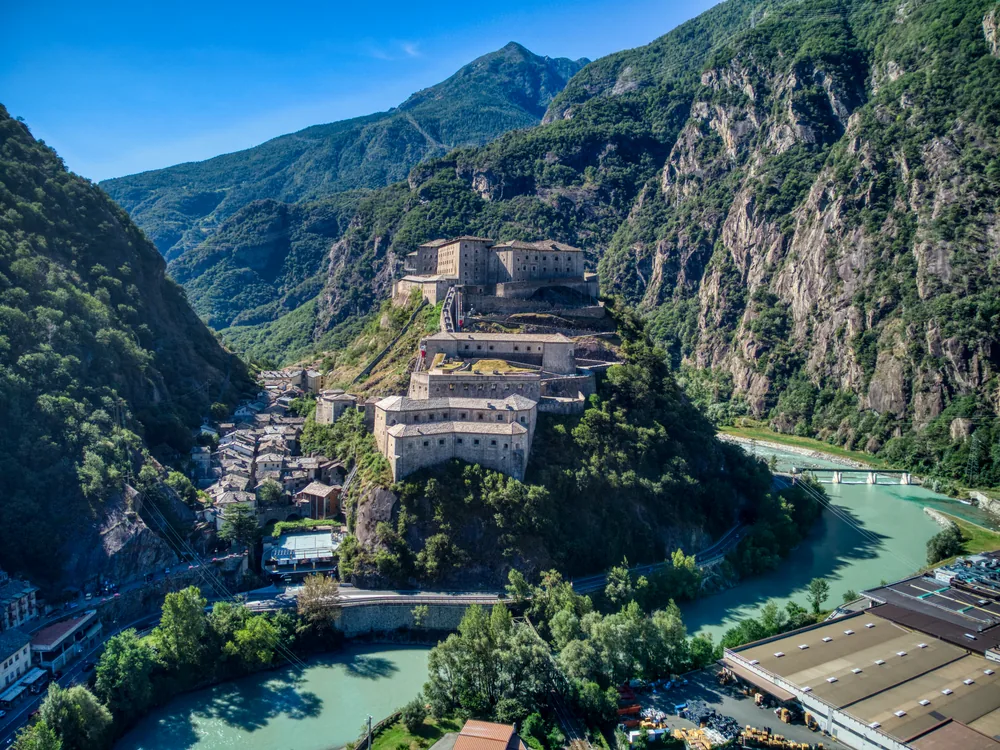
- ✦Built 1830–1838 by the Kingdom of Sardinia in three connected sections (Opera Ferdinanda, Opera Vittorio, Opera Carlo Alberto) rising in tiers up a sheer rock spur above the Dora Baltea gorge
- ✦Three distinct museum spaces: the Museum of the Alps (human and natural Alpine history), the Museum of Fortifications (Alpine military architecture from Rome to the 20th century), and the historic prison block with intact cells and exercise yards
- ✦The GetYourGuide entry ticket is valid for 3 months from purchase — flexible access to the full fortress complex
- ✦Set at the eastern entrance to the Valle d'Aosta, at the narrowest point of the Dora Baltea gorge, commanding a view down the valley toward the Po plain and up toward Mont Blanc and the high Alps
Skip the queue with a guided tour
Skip-the-line tickets & expert guides
In May 1800, Napoleon Bonaparte faced a strategic problem. He was moving the French Army of Reserve across the Alps via the Great St. Bernard Pass, intending to descend into the Po Valley and strike at the Austrian rear. The route down from the pass followed the narrow Dora Baltea gorge — a corridor of rock so tight that in places the river and the road left almost no space between the cliff face and the walls of the ancient fortress of Bard. The fortress was held by a small Austrian garrison of around four hundred men. Napoleon could not get his artillery through. His solution was characteristic: he had the cannon wheels muffled with straw and the gun carriages dragged through the village at night while diversionary fire kept the Austrian garrison occupied on the walls above. The operation took several days. When Napoleon eventually reached Milan and defeated the Austrians at the Battle of Marengo, he did not forget Bard. He ordered the fortress demolished. The Austrians rebuilt it as soon as Napoleon fell.
The Kingdom of Sardinia rebuilt Fort Bard between 1830 and 1838, on and around the spur of rock where medieval and earlier fortifications had stood for centuries. The resulting structure is one of the best-preserved early 19th-century military fortifications in the Alps — a complex of three connected sections named after members of the Savoy dynasty: the Opera Ferdinanda (lower), the Opera Vittorio (middle), and the Opera Carlo Alberto (upper), rising in tiers up the rock face and connected by internal stairways, cable inclines, and a modern cable car from the village below. The walls are not romantic in the medieval sense — they are rational, thick, functional, designed for the artillery age — but the position they occupy is spectacular.
The three museum spaces within the fortress are distinct in character and collectively substantial. The Museum of the Alps covers the human and natural history of the entire Alpine arc — geology, flora, fauna, the lives of mountain communities from prehistory to the present, Alpine warfare across two world wars, and the transformation of the high mountains from obstacle to destination across three centuries of tourism. The Museum of Fortifications documents the military architecture of the Alpine defence system: from Roman frontier works through medieval tower houses and Savoy bastioned fortifications to the 20th-century concrete bunker systems of the Italian-French and Italian-Austrian borders. The historic prison block — used as a military prison from the 1830s through the early 20th century — preserves intact cells, exercise yards, administrative spaces, and solitary confinement areas, with interpretive material on the prisoners held here, the conditions of confinement, and the specific history of Alpine military justice.
The GetYourGuide entry ticket (valid 3 months) covers access to all three museum spaces. The three-month validity is genuinely useful: the fortress is worth returning to for temporary exhibitions, which cycle annually alongside the permanent collections. The cable car from the village of Bard operates throughout opening hours and makes the upper levels of the fortress accessible to all visitors.
The Valle d'Aosta is Italy's smallest and least-visited region — a single deep valley running west from the Po plain into the Alps toward the foot of Mont Blanc, Monte Rosa, and the Matterhorn. It contains an extraordinary density of medieval castles: Fénis, Sarre, Issogne, Saint-Pierre, Aymavilles, Verrès, and others, built by the Challant family and their successors as a cascading defensive system from the 11th to the 16th century. Fort Bard sits at the eastern entrance to the valley, where the gorge was narrowest and the strategic logic of fortification was most obvious. A circuit of Valle d'Aosta castles, combining Fort Bard with Fénis (the most complete and least altered of the valley's medieval castles, 25 km west) and Issogne (a late 15th-century aristocratic residence with well-preserved interiors, immediately west of Bard), makes one of the most concentrated medieval and early modern castle itineraries in northern Italy, covering five centuries of mountain defensive architecture in a single day.
History
The rock spur at Bard has been used as a fortified position since at least the medieval period, when successive lords of the valley held the site as the key to controlling access between the Po plain and the Alps. The original medieval fortress was the structure that blocked Napoleon Bonaparte in May 1800: a small Austrian garrison used it to delay the passage of the French Army of Reserve for several days, forcing Napoleon to have his artillery muffled and dragged through the village under cover of darkness. On reaching the Po plain, Napoleon ordered the original fortress demolished — an order carried out.
After Napoleon's fall, the Kingdom of Sardinia rebuilt the fortress between 1830 and 1838 on a much larger scale, creating three connected sections on the rock spur (the Opera Ferdinanda, Opera Vittorio, and Opera Carlo Alberto) designed for the requirements of modern artillery warfare. The rebuilt fortress served as a military installation and later as a military prison through the early 20th century. After a period of dormancy, it was comprehensively restored and reopened as a museum complex in the 2000s, with three permanent collections covering Alpine natural history, Alpine fortification history, and the prison block.
How to Visit
Getting there: The fortress is on the SS26 highway between Ivrea (30 km southeast) and Aosta (50 km northwest). A car is the practical option — public transport to Bard is limited. The fortress is signed from the main valley road and parking is available in the village.
Tickets: Walk-up entry €15 adult, free for children. The GetYourGuide entry ticket covers all three museum spaces and is valid for 3 months from purchase — useful if you want to return for a temporary exhibition — book in advance.
Practical tips: The cable car from the village connects to all fortress levels and operates throughout opening hours, making the upper museums wheelchair accessible. The fortress is closed on Mondays. Allow 3 hours to cover all three museums (Alps, Fortifications, Prison). The fortress hosts rotating temporary exhibitions — check fortedibard.it for current programming before your visit.
Combine with: Sacra di San Michele, the 10th-century abbey-fortress 60 km south on the other side of Turin, for an Aosta Valley and Piedmont fortress day.
Frequently Asked Questions
In May 1800, Napoleon's French Army of Reserve was crossing the Alps via the Great St. Bernard Pass when it encountered the Fortress of Bard, held by a small Austrian garrison, blocking the only viable route down the Dora Baltea gorge. Napoleon could not move his artillery past the fortress; his solution was to muffle the cannon wheels with straw and drag them through the village at night while diversionary fire occupied the defenders. The delay cost him several days. After defeating the Austrians at the Battle of Marengo and securing northern Italy, Napoleon ordered the fortress demolished in retaliation. The Kingdom of Sardinia rebuilt it between 1830 and 1838 on a larger scale.
Location
Forte di Bard, 11020 Bard, AO, Italy
Nearby Castles
Tours & Tickets
Powered by GetYourGuide
From
€15/ person