Le Castella Fortress
Castello Aragonese di Le Castella
Italy · Calabria, Crotone province — Isola di Capo Rizzuto, on the Ionian Sea coast · Near Crotone
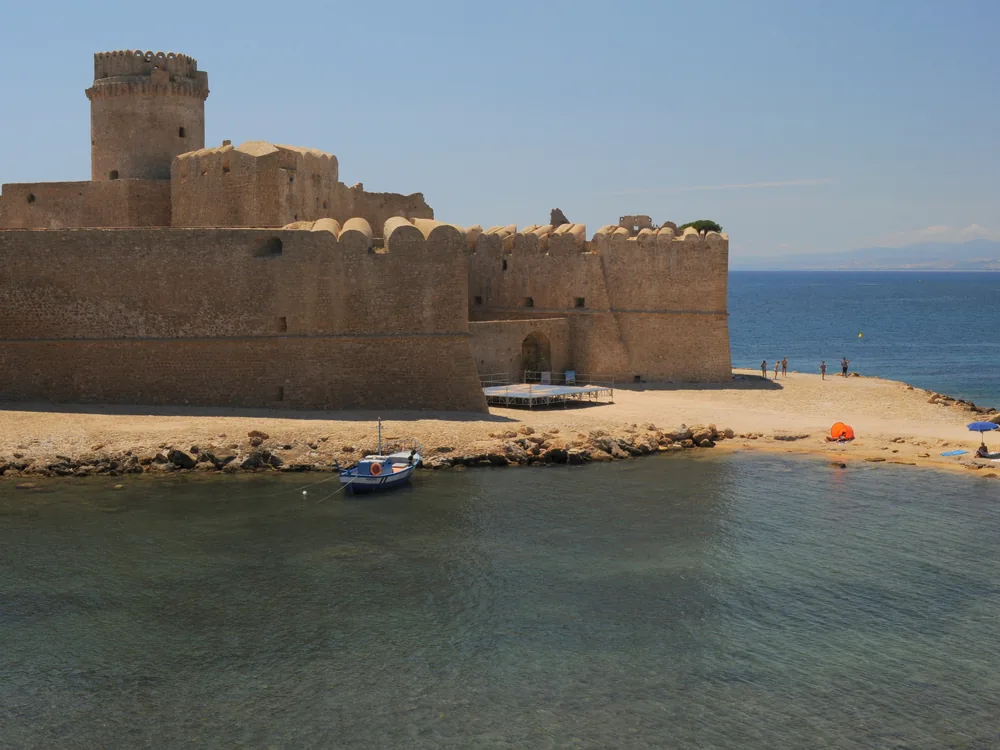
Aragonese coastal fortress (15th–16th century) on a Greek/Roman fortification site — the rocky islet off the Calabrian coast has been fortified since at least the 5th century BC; Greek colonists of Magna Graecia built the original fortification; subsequent Roman, Byzantine, Norman, and Angevin phases each modified the structure; the current castle form is primarily the result of a major Aragonese rebuild in the early 16th century, when the Kingdom of Naples (under Aragonese sovereignty) reinforced Calabria's Ionian coastal defences against Ottoman naval raids; the castle sits on a small rocky tidal islet connected to the mainland, within the Capo Rizzuto Marine Protected Area
This page is part of an independent travel guide and is not affiliated with, endorsed by, or operated by Le Castella Fortress.
© Castles & Palaces
Quick Facts
- Hours
- Daily 09:00–20:00
- Day trip from
- €150
- Duration
- 30–60 minutes (exterior walk and views); half-day within the GetYourGuide private tour
- Best time
- May to October
- Nearest city
- Crotone
Featured Tour
Capo Colonna, Santa Severina and Le Castella: Private History and Seaside Tour
Cancellation available · Instant confirmation
Highlights
- ✦2,500 years of fortification history — the Le Castella site has been fortified continuously since at least the 5th century BC, through Greek, Roman, Byzantine, Norman, Angevin, and Aragonese phases; it is one of the longest-occupied defensive sites on the Italian Ionian coast
- ✦Hannibal's refuge — during the Second Punic War, after Rome began to regain the strategic initiative in Italy, Carthaginian general Hannibal is said to have used the Le Castella promontory as a refuge; the site's natural defensibility made it useful for the same purpose 300 years after the Greeks first built here
- ✦Barbarossa's 1536 raid — the Ottoman corsair admiral Hayreddin Barbarossa attacked Le Castella with a fleet of thirty galleys in 1536, part of the wave of Barbary raids that battered Calabria's Ionian coast through the mid-16th century; the raid was one of the most significant Ottoman naval strikes on the Italian mainland in the 16th century
- ✦The tidal islet setting — the castle occupies a small rocky islet connected to the mainland by a short path, making the fortress visually dramatic from the beach and the surrounding sea; at dawn and sunset the castle's silhouette against the Ionian is one of the most photographed images in Calabria
- ✦Capo Rizzuto Marine Protected Area — the sea around Le Castella forms part of one of Italy's largest marine protected areas, with exceptionally clear water and significant marine biodiversity; the fortress and the marine reserve together make the site attractive for visitors interested in both history and coastal nature
- ✦Private tour to three Calabrian sites — the 7-hour day trip from the Crotone area also visits Capo Colonna (the Temple of Hera Lacinia, the surviving column of one of Magna Graecia's most significant sanctuaries) and Santa Severina (a hilltop village with its own Norman-Byzantine castle and a round Byzantine baptistery)
Tickets & tours
Book through GetYourGuide
Le Castella is among the oldest continuously fortified sites in Italy. The rocky islet off the Calabrian Ionian coast — just large enough to support a castle, connected to the mainland by a short causeway — has been occupied and defended for roughly 2,500 years, a span that begins with Greek colonial fortification in the 5th century BC and runs through Roman, Byzantine, Norman, Angevin, and Aragonese phases before reaching the 16th-century military architecture that most visitors see today. Each power that controlled Calabria found the same strategic logic in the site: a naturally defensible rock position above a good anchorage, on a coast where control of the sea lanes mattered enormously for trade, communication, and military operations.
The Greek colonists who first built here were part of the Magna Graecia network — the southern Italian and Sicilian settlements of Greek city-states that made the western Mediterranean's coasts a projection of the Aegean world. The local Greek colony was Croton (modern Crotone), one of the most powerful cities of Magna Graecia in its 6th–5th century BC prime, and Le Castella's promontory served as one of its coastal outworks. After Greek power faded and Rome absorbed Calabria, the site remained militarily useful; Roman occupation is attested in the archaeological record.
The most celebrated episode in the pre-medieval history of the site involves Hannibal. After his victories at Trebia, Lake Trasimene, and Cannae (216 BC) failed to bring Rome to the negotiating table, the Carthaginian general's strategic situation in Italy progressively worsened as Roman forces regained control of the peninsula. In the final years of his Italian campaign, Hannibal's army was confined to Calabria, and the coastline and its natural defensive positions — including Le Castella — served as refuge points. The tradition that Hannibal sheltered at Le Castella is long-standing in the local historical record; it is consistent with the period's military geography but cannot be confirmed with documentary precision.
After Rome's fall, Calabria passed through Byzantine administration for several centuries, during which the existing fortifications were maintained and modified. The Norman conquest of southern Italy in the 11th century brought a new set of fortifications, and the Angevin rule that followed the Norman period continued the pattern of coastal defence investment. The current castle form, however, is primarily the result of a major Aragonese rebuild in the early 16th century, when the Kingdom of Naples — under Aragonese sovereignty after the House of Aragon took Naples from the Angevins in 1442 — undertook systematic reinforcement of Calabria's Ionian coastal defences in response to the intensifying threat of Ottoman naval raids from the eastern Mediterranean.
The Ottoman attack of 1536 tested these new defences. Hayreddin Barbarossa — born in Greece, trained as a corsair in the Aegean, and by 1536 the commanding admiral of the Ottoman fleet and the scourge of the western Mediterranean — led a fleet of approximately thirty galleys along the Calabrian Ionian coast, raiding the coastal settlements and targeting their fortifications. Le Castella was one of the raid's objectives. The same Barbarossa had already raided Corfu in 1537 (attacking Angelokastro), Capri (the Castello Barbarossa there still bears his name), and numerous points along the Italian Tyrrhenian coast. The 1536 Le Castella attack was part of this sustained Ottoman naval pressure on the Italian south that ran from the 1480s through the late 16th century.
Today the castle's tidal islet setting is what most visitors encounter first. The path from the mainland beach leads across the short causeway to the castle gate, and the view back to the Calabrian coast from the castle walls — across the extraordinarily clear Ionian water of the Capo Rizzuto Marine Protected Area — makes the site's natural attraction clear. The Capo Rizzuto reserve is one of the largest marine protected areas in Italy, and the sea quality around Le Castella reflects this protected status.
**Interior access note:** The GetYourGuide private tour listing includes 'Entrance ticket to Le Castella Fortress' and 'Admission ticket to Santa Severina Castle' in its inclusions list, but a separate 'Know Before You Go' section in the same listing states that 'Admission to the Le Castella Fortress and Santa Severina Castle is optional and requires an entrance fee,' and the itinerary widget marks both castle visits as 'Optional' stops. This inconsistency appears in the operator's own listing. Independent research suggests that access to the castle grounds (exterior) is free or at nominal cost, but this could not be confirmed with full confidence. Whether the tour price includes guaranteed interior access should be confirmed with the operator at the time of booking.
For Calabrian context: [Rocca Imperiale Castle](/castles/italy/rocca-imperiale-castle), approximately 150 kilometres north on the Tyrrhenian coast of Calabria, represents the region's other castle tradition — the Norman-Swabian inland hilltop fortress rather than the Aragonese coastal tower. The two castles are too far apart for a convenient combined visit but represent the full geographic range of Calabria's surviving medieval fortifications.
History
5th century BC: Greek fortification by colonists of Croton (Magna Graecia), the most powerful Greek city in southern Italy at that period. Roman period: Site maintained as part of the Roman coastal defence infrastructure. Late antiquity/Byzantine period: Continued occupation and modification. 11th century: Norman conquest of Calabria; existing fortifications incorporated into Norman defence system. 13th–14th century: Angevin rule; castle maintained as coastal defence. Early 16th century: Major Aragonese rebuild under the Kingdom of Naples, reinforcing Ionian coastal defences against Ottoman naval raids. 1536: Hayreddin Barbarossa attacks Le Castella with a fleet of thirty galleys — one of the most significant Ottoman naval strikes on the Italian mainland coast in the 16th century. Post-16th century: Castle maintained as a monument; incorporated into the Capo Rizzuto Marine Protected Area zone. Present day: One of the most visited historic sites in Calabria and one of the region's most photographed castle silhouettes.
How to Visit
Getting there: Le Castella is approximately 30km south of Crotone on the Ionian coast. By car via the SS106 coastal road (approximately 40 minutes). Public transport from Crotone is limited, especially off-season — a car is strongly recommended.
Tickets: Entry to the castle grounds appears to be free or at nominal cost; confirm on arrival. The GetYourGuide private day tour covers Capo Colonna (Temple of Hera Lacinia), Santa Severina hilltop castle, and Le Castella in 7 hours. Note: the operator's listing contains a contradiction — the 'Includes' section lists castle entry, but the 'Know Before You Go' section states castle admission is optional and requires a separate fee. Confirm interior access with the operator when booking.
Practical tips: The tidal islet causeway is flat and paved — easy walking access from the village beach. Visit at dawn or sunset for the most dramatic silhouette views across the Ionian. The surrounding Capo Rizzuto Marine Protected Area has exceptionally clear water; bring snorkelling gear if combining sea and castle.
Combine with: Rocca Imperiale Castle.
Frequently Asked Questions
The tradition that Hannibal used Le Castella as a refuge during the final years of his Italian campaign (218–203 BC) is consistent with the military geography of the period and long-established in local historical accounts. Hannibal's army was confined to Calabria after his strategic situation in Italy deteriorated following Rome's recovery, and the defensible coastal sites of the Ionian coast — including Le Castella — would have been natural refuge points. However, the connection is not confirmed by surviving ancient documentary sources with the precision historians would prefer; it is a well-founded tradition rather than a definitively attested fact.
Location
Le Castella, 88841 Isola di Capo Rizzuto, Italy
Nearby Castles
Tours & Tickets
Powered by GetYourGuide
From
€150/ person