
Palazzo Madama
Palazzo Madama e Casaforte degli Acaja
Italy · Piedmont, Turin · Near Turin
Built 25 · The building spans 2,000 years of architectural history in a single structure: Roman gate towers of the Augusta Taurinorum (25 BCE) form the core; a medieval castle (Casaforte degli Acaja) was built around and over the Roman remains in the 13th–14th centuries; the castle was enlarged and modified as a residence for the widowed 'Madames Reales' (mothers of the reigning Savoy dukes) in the 16th–17th centuries; Juvara's Baroque west facade and grand ceremonial staircase (1718–1721) were added for Maria Giovanna Battista of Savoy-Nemours without demolishing the medieval east face, leaving the building with two completely different exteriors and five identifiable chronological layers; the building now houses the Museo Civico d'Arte Antica di Torino; part of the UNESCO 'Residences of the Royal House of Savoy' inscription (1997)
This page is part of an independent travel guide and is not affiliated with, endorsed by, or operated by Palazzo Madama.
© Castles & Palaces
Quick Facts
- Hours
- Tue–Sun 10:00–18:00. Closed Mon
- Guided tour from
- €69
- Duration
- 2–3 hours
- Best time
- Year-round
- Nearest city
- Turin
Featured Tour
Turin: Guided Tour of the Palazzo Madama + Historic Café
Cancellation available · Instant confirmation
Highlights
- ✦Palazzo Madama is architecturally unique in Europe: the building's western Baroque facade (1718–1721, by Filippo Juvara) and its eastern medieval face are completely different structures that share the same building — Juvara's commission was to create a ceremonial entrance without demolishing the medieval towers, leaving a palace with two entirely different exteriors representing 500 years of architectural change in the same footprint
- ✦The Roman gate towers of Augusta Taurinorum (the Roman Turin, founded 25 BCE) form the structural core of the building: the two towers of the eastern Porta Praetoria survive up to their original height inside the medieval masonry, making Palazzo Madama one of the very few European buildings where Roman walls form load-bearing elements of a functioning post-medieval structure
- ✦The building's name — 'Palazzo delle Madame' — comes from its use as a residence for the widowed mothers of reigning Savoy dukes: Cristina di Borbone (Madame Reale) in the 17th century, and Maria Giovanna Battista of Savoy-Nemours (who commissioned the Juvara facade) in the early 18th century; its history as a 'female' space in a dynasty that privileged male succession gives it an unusual political texture
- ✦The Museo Civico d'Arte Antica di Torino, housed in the palace since 1934, contains one of the strongest medieval and decorative arts collections in northern Italy, including the Book of Hours of the Duke of Berry (Très Riches Heures de Jehan de France, Duc de Berry — the original pages are at Chantilly, but Palazzo Madama holds related Savoy court material), Gothic ivory reliefs, Flemish tapestries, and the largest collection of medieval Piedmontese goldsmithwork in existence
- ✦The building stands at the geometric centre of Piazza Castello, the main square of Turin's historic centre, with the Royal Palace immediately behind it — the two buildings represent the double face of Savoy power in Turin: Palazzo Madama the ceremonial arrival point, the Royal Palace the working residence; their relationship across the piazza is the spatial logic on which Turin's historic centre was organised
Skip the queue with a guided tour
Skip-the-line tickets & expert guides
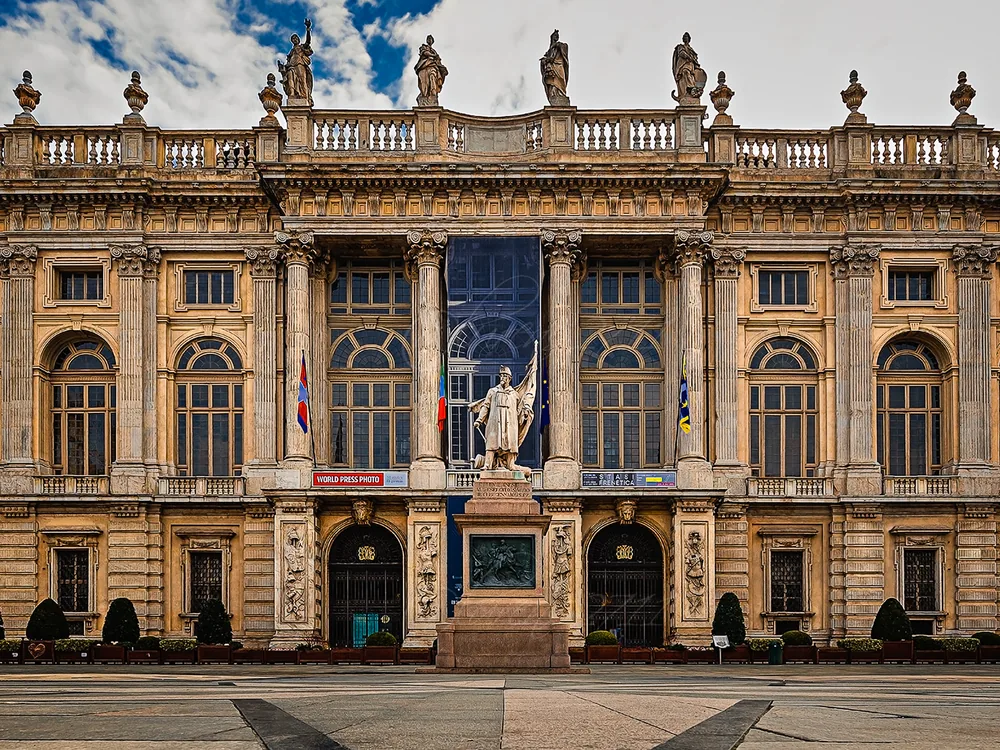
Palazzo Madama stands at the centre of Piazza Castello in Turin, which is to say it stands at the centre of the historic city. The square — the urban pivot around which the Savoy dynasty organised their capital — has the palace in its middle, the Royal Palace behind it to the east, the Teatro Regio to the north, and the Porta Palatina (another Roman gate, still standing) visible in the distance beyond. Palazzo Madama is the building that most visitors photograph from the piazza without quite understanding what they are looking at: a symmetrical Baroque facade of grand Piedmontese calculation, pierced by arched windows and rising to a balustrade cornice with statues, completed in 1721 by Filippo Juvara. Walk around the building to the east side and the historical layering becomes apparent: the Baroque facade is attached to a complex of medieval towers and walls in a completely different register, heavier and more severe, representing the Casaforte degli Acaja from which Palazzo Madama grew. And inside those medieval towers, for those who look at the archaeological reports, are the Roman gate towers of Augusta Taurinorum, the colony founded in 25 BCE. The building contains 2,000 years of Turin's architectural history in a single structure.
The Roman presence at the core of the building is not metaphorical. When Augustus established Augusta Taurinorum in 25 BCE as a Roman military colony in the Po valley foothills, he laid out the city on the standard Roman rectangular grid and built the walls and gates that defined it. The Porta Praetoria — the main eastern gate of the Roman town — was constructed with two flanking towers that survive inside the later medieval masonry up to their original Roman height. The medieval builders incorporated the Roman towers rather than demolishing them because Roman stonework was solid and useful; the result, visible today in the archaeological sections of the museum, is a building where Roman brickwork at one level passes into medieval stonework at the next.
The name 'Palazzo Madama' — the palace of the 'Madames' — refers to the role the building played for successive women of the Savoy dynasty who held political power as regents or dowager duchesses. In the 17th century, Cristina di Borbone, widow of Vittorio Amedeo I and regent for her son, used the castle as her residence and base of political operations, reinforcing its identity as a 'female' political space within a dynasty that formally privileged male succession. It was the next 'Madama Reale' — Maria Giovanna Battista of Savoy-Nemours, mother of Vittorio Amedeo II — who commissioned Filippo Juvara to create the ceremonial Baroque entrance. Juvara's instruction was to make the building worthy of royal ceremony without demolishing the medieval castle that stood behind. His solution — the great Baroque facade and the monumental ceremonial staircase behind it, attached to the existing medieval walls without disturbing them — produced the building's characteristic dual identity and is considered one of the high points of Piedmontese Baroque.
The interior contains Juvara's grand staircase, rising through two storeys under a vaulted ceiling, which is itself a significant architectural object. The museum rooms above contain the collections of the Museo Civico d'Arte Antica di Torino: medieval and Renaissance decorative arts, Flemish tapestries, Gothic ivory reliefs, Piedmontese goldsmithwork, illuminated manuscripts, and a painting collection including works by Antonello da Messina. The collections do not have the name recognition of the Turin museums dedicated to Egyptian antiquities or the Savoy royal collection, but the quality of the medieval material — particularly the goldsmithwork and the ivories — is of a level not commonly found outside national museums.
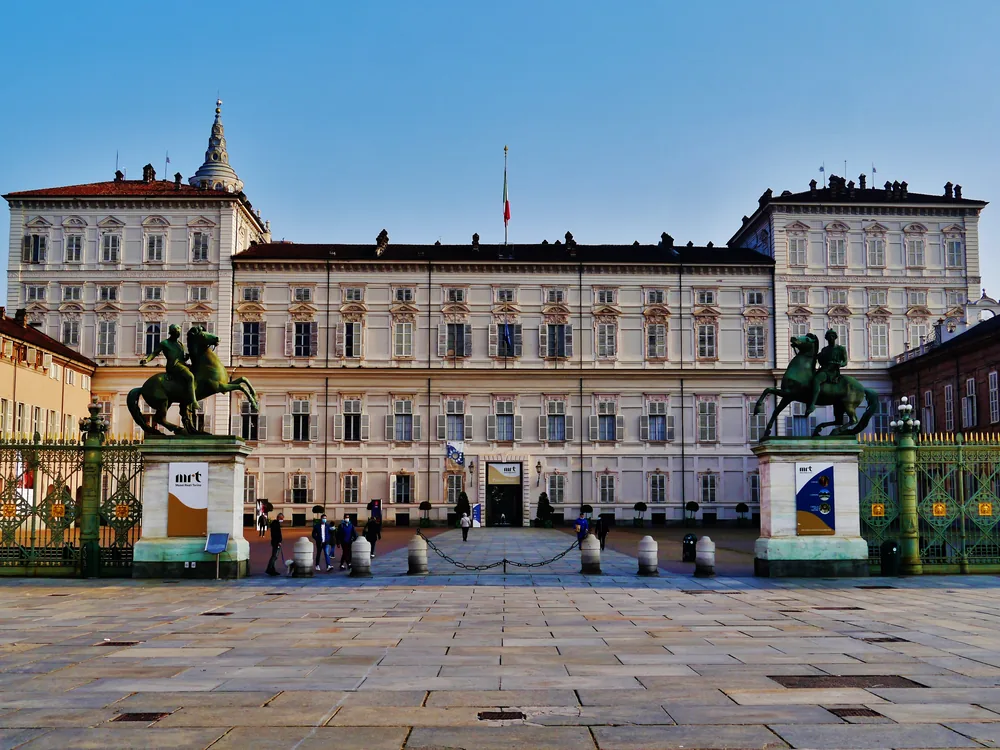
The UNESCO inscription that covers Palazzo Madama is the 1997 'Residences of the Royal House of Savoy' listing, which encompasses fourteen Savoy properties in and around Turin and the Piedmont region. The inscription recognises the ensemble of Savoy residences as a collective expression of dynastic architectural patronage rather than certifying Palazzo Madama alone. [Turin Royal Palace](/castles/italy/turin-royal-palace), immediately to the east across Piazza Castello, is the more formally regal of the two buildings and is also part of the UNESCO ensemble.
The guided tour is a dedicated Palazzo Madama experience — not a shared link with any other site — and covers the history of all five architectural layers as well as the principal museum rooms. For visitors with limited time or specialist interests in medieval decorative arts, the Piedmontese goldsmithwork collection alone makes the museum worth the entry price.
History
The Roman colony of Augusta Taurinorum was established in 25 BCE, and the eastern gate — the Porta Praetoria — was built with two flanking towers whose foundations survive within the current building. The late Roman emperors reinforced the defensive circuit in the 4th century CE. In the 13th and 14th centuries, the Casaforte degli Acaja was built around and over the Roman towers, using the remaining Roman masonry as foundation and structural fill in a layering of cultures that the building still displays.
The House of Savoy acquired the building in 1402. During the 16th and 17th centuries it became a residence for the 'Madames Reales' — the widowed mothers of reigning Savoy dukes who exercised regency power in their sons' minorities. Cristina di Borbone, the most politically forceful of these, ruled Piedmont-Savoy through the regency of the 1630s and 1640s from this building, and it is from her and her successors that the Palazzo Madama takes its name. Filippo Juvara added the Baroque western facade and the ceremonial staircase in 1718–21 for Maria Giovanna Battista of Savoy-Nemours, without disturbing the medieval eastern side — producing the visual paradox of a Baroque palace front and a medieval castle back that visitors navigate today. The Savoy Senate was housed here in the 18th and 19th centuries, and the Italian Senate met briefly in the building following unification in 1861.
The Museo Civico d'Arte Antica was established in 1934. UNESCO inscription as part of the Residences of the Royal House of Savoy followed in 1997. The museum is open Tuesday to Sunday.
How to Visit
Getting there: Palazzo Madama stands at the centre of Piazza Castello in Turin's historic core, within walking distance of most central accommodation. The nearest metro stop is Porta Nuova (Line 1, ~10 minutes' walk south); numerous bus routes serve Piazza Castello directly. Turin's main rail terminal, Porta Nuova station, is about 1 km south on foot.
Tickets: Walk-up entry €10 adult, free for under-18s. The GetYourGuide guided tour is a dedicated 2-hour museum tour covering all five architectural layers — Roman towers, medieval casaforte, and Juvara's Baroque staircase — as well as the principal collection rooms.
Practical tips: The museum is closed Mondays, 1 January, and 25 December; open Tuesday–Sunday 10:00–18:00, last entry 30 minutes before closing. The building is entirely indoors and visits well year-round. Allow 2–3 hours to move through all chronological layers: start with the Roman towers on the ground floor, ascend Juvara's staircase, and allow time for the Flemish tapestries and Piedmontese goldsmithwork collection.
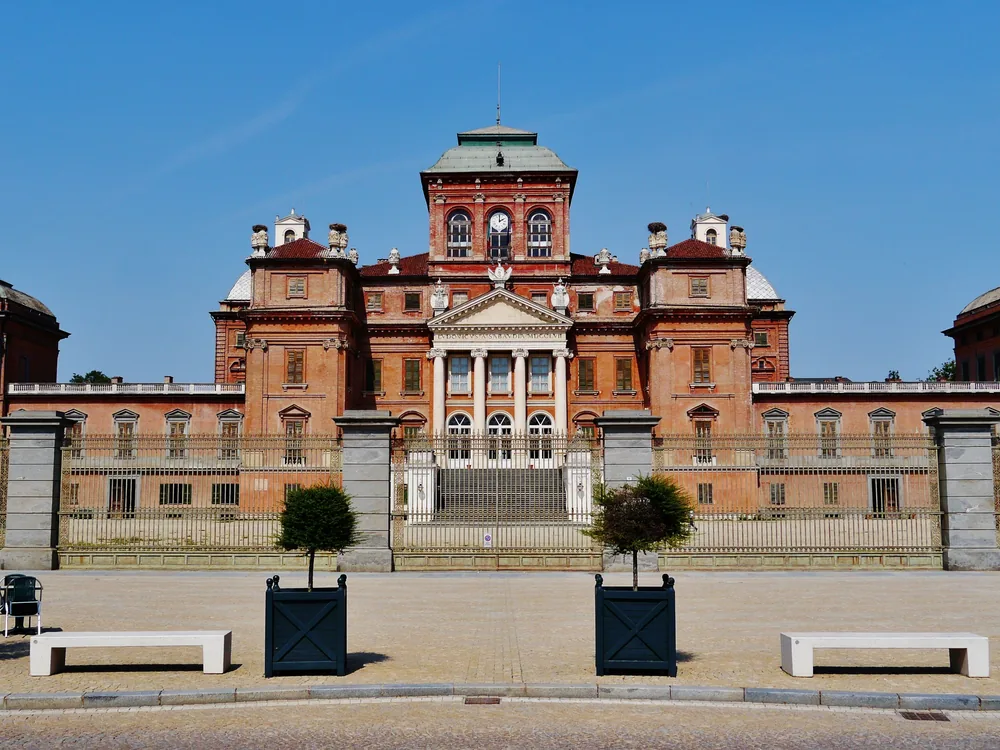
Combine with: Turin Royal Palace is directly across Piazza Castello — both buildings share the UNESCO inscription and together give the full picture of Savoy dynastic architecture in Turin. Racconigi Castle is a further Savoy residence 40 km south.
Frequently Asked Questions
The 1997 UNESCO inscription 'Residences of the Royal House of Savoy' covers fourteen Savoy properties in and around Turin and Piedmont, including Palazzo Madama, the Turin Royal Palace, the Palazzina di Caccia di Stupinigi, the Venaria Reale, and others. The inscription recognises the ensemble of Savoy dynastic residences as a collective architectural achievement, not each property individually. Palazzo Madama is specifically named as a contributing element because of its architectural significance and its historical role as a Savoy political residence.
Location
Piazza Castello, 10122 Turin, Italy
Nearby Castles
Tours & Tickets
Powered by GetYourGuide
From
€69/ person