
Palazzo Schifanoia
Palazzo Schifanoia
Italy · Emilia-Romagna, Ferrara (UNESCO historic centre) · Near Ferrara
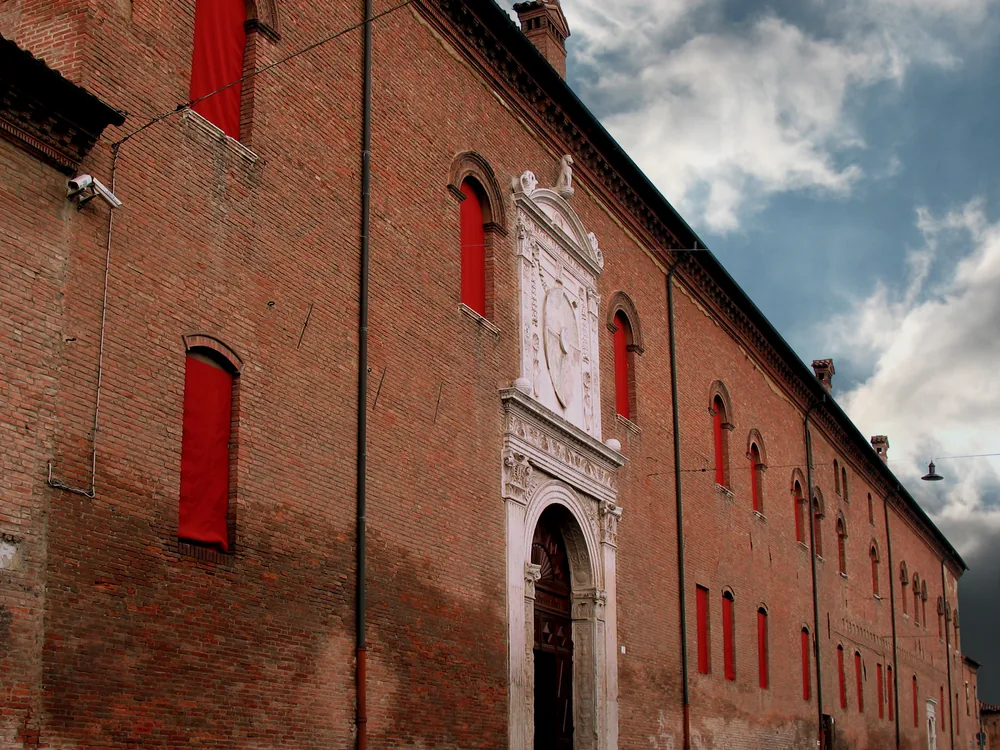
Built 1385 · Este-family late medieval palace built 1385 as a single-storey banqueting retreat; substantially enlarged in Renaissance style from c.1465 under Duke Borso d'Este; plain brick exterior typical of Ferrarese Renaissance; the interior Salone dei Mesi is the architectural monument
This page is part of an independent travel guide and is not affiliated with, endorsed by, or operated by Palazzo Schifanoia.
© Castles & Palaces
Quick Facts
- Hours
- Tue–Sun 10:00–18:00. Closed Mon
- Guided tour from
- €14
- Duration
- 1–2 hours (Salone dei Mesi fresco cycle and Este coin and medal collection)
- Best time
- Year-round
- Nearest city
- Ferrara
Featured Tour
Ferrara: Guided Visit to Palazzo Schifanoia
Cancellation available · Instant confirmation
Highlights
- ✦Salone dei Mesi (Hall of the Months) — painted 1469–70 by Francesco del Cossa, Ercole de' Roberti, and other Ferrarese masters under Cosmè Tura's iconographic programme; seven of the twelve months survive, each organized in three horizontal registers of gods, zodiac figures, and contemporary Ferrarese court life
- ✦Three-register iconographic programme — the unique structure layers pagan classical deities (top), astrological decans drawn from Greek, Indian, Persian, and Egyptian astronomical tradition (middle), and scenes of daily life under Borso d'Este's rule (bottom), a secular cosmology justifying the duke's governance through cosmic order
- ✦Francesco del Cossa's letter — the primary artist complained to Borso d'Este about being paid at the same flat rate as the other workshop painters; the surviving letter is one of the most important documents on workshop practice and patron-artist relations in 15th-century Italy
- ✦The name — 'Schifanoia' means 'escape from boredom' in 14th-century Ferrarese; begun in 1385 as a private banqueting retreat for Alberto V d'Este, deliberately informal in character compared to the Castello Estense in the city centre
- ✦Same UNESCO historic centre as Castello Estense — both fall within Ferrara's 1999 World Heritage inscription; combined ticket available; the two buildings represent the public (Castello) and private (Schifanoia) faces of Este rule
Skip the queue with a guided tour
Skip-the-line tickets & expert guides
The name means escape from boredom — schifare la noia, in the dialect of 14th-century Ferrara — and it tells you something about the Este family's sense of their own court life that this was what they chose to call a palace. The Palazzo Schifanoia began in 1385 as a single-storey retreat commissioned by Alberto V d'Este, Marquis of Ferrara: a banqueting pavilion and recreation house at the southeastern edge of the city, outside the walls, where the ducal court could escape the formalities of the Castello Estense and hold their private celebrations. It was built small, as a deliberate contrast to the Este family's great fortress-palace in the centre of Ferrara, and its name insisted on its informal character.
The building that visitors enter today is not Alberto's retreat. The transformation that made Palazzo Schifanoia one of the most important secular Renaissance buildings in Italy happened under Alberto's successor, Duke Borso d'Este, who inherited Ferrara in 1450 and set about the systematic glorification of his rule through artistic patronage. From around 1465, Borso enlarged the palazzo substantially: he added a piano nobile above the original ground floor, extended the building's footprint, and reoriented its principal rooms toward the courtyard. The result was a proper palace, not a pavilion — though the informal, pleasure-seeking character embedded in its name was preserved in its function.
The centerpiece of Borso's enlargement, and the reason Palazzo Schifanoia occupies a singular place in the history of European art, is the Salone dei Mesi — the Hall of the Months. Painted between 1469 and 1470 by a workshop that included Francesco del Cossa, Ercole de' Roberti, and other artists of the Ferrarese school under designs by Cosmè Tura (the Este court painter and one of the founders of the distinctly linear, jewel-hard Ferrarese Renaissance style), the Salone dei Mesi covers the room's walls with a painted programme of extraordinary complexity, ambition, and iconographic originality.
Each wall section corresponds to a calendar month and is organized in three horizontal registers. The uppermost register shows a classical deity presiding from a triumphal car — a combination of Roman mythology, late antique astronomy, and Renaissance heraldic invention that draws on Greek, Latin, and Arabic astronomical traditions simultaneously. The middle register shows the zodiac sign corresponding to the month and, surrounding it, the three decans — the ten-day divisions of the zodiac sign — each represented by a figure drawn from a tradition that traces from Hellenistic Egypt through Indian and Persian astronomy into medieval Europe. The lower register depicts scenes of contemporary Ferrarese court life under Borso d'Este's patronage: jousting, hunting, the duke receiving petitioners, musicians playing at court, merchants trading in the city, workers in the fields.
The effect of these three registers in combination is of a secular cosmology in which the court of Ferrara exists simultaneously in mythological time (the Olympian gods above), astrological time (the zodiac marking the cosmic calendar), and historical present (the duke's city going about its life below). The fresco programme is a statement of political theology — a declaration that Borso d'Este's reign is legitimized by cosmic order, the planets turning above his court and the people of Ferrara prospering under his government. It is also, in its lower register, one of the most detailed and vivid records of daily life in a 15th-century north Italian city.
Seven of the original twelve month-sections survive; the sections corresponding to October through February were lost, probably in later modifications to the building. The surviving seven — March through September — cover approximately two and a half walls of the Salone in the condition their 15th-century painters left them, with later restorations limited to consolidation rather than repainting. The colours remain exceptionally vivid in the protected interior environment.
The attribution of the individual sections to specific painters took art historians decades to resolve. Francesco del Cossa, the most gifted artist in the group, wrote a letter to Borso d'Este complaining that he had been paid at the same rate as the other artists despite, in his view, superior work — a document of considerable interest both for its evidence about workshop payment practices and for the light it throws on the patron-artist relationship in 15th-century Ferrara. Del Cossa subsequently left Ferrara for Bologna. Ercole de' Roberti is believed responsible for several of the later sections, and Cosmè Tura's overall design responsibility is inferred from the programme's internal consistency.
The palazzo sits within the boundaries of Ferrara's UNESCO-inscribed historic centre — the same designation (1999) that covers the nearby Castello Estense, approximately ten minutes' walk to the northwest. The two buildings represent the public and private faces of Este rule: the Castello was the seat of government and military power, a fortress-palace at the city's heart; Schifanoia was the retreat, outside the original city walls, where the same dynasty spent its leisure and concentrated its cultural investment. Visiting both on the same day gives a fuller picture of how the Este court organized its physical and cultural world than either building provides alone.
The GetYourGuide guided visit (€14) provides English-speaking guide access to the Salone dei Mesi with art-historical commentary on the fresco programme, the Ferrarese school, and the Este patronage context. The visit is 1.5 hours. As a new listing with no verified individual GetYourGuide reviews at the time of writing, the star rating cannot be confirmed under the site's review accuracy standard.
Ferrara is on the Bologna–Venice railway line (approximately 30 minutes from Bologna, 40 minutes from Padua). Palazzo Schifanoia is 700 metres southeast of the Castello Estense, walkable in 10 minutes through the historic centre. A full Ferrara day — Castello Estense in the morning, Palazzo Schifanoia after lunch — pairs naturally with a railway approach from Bologna or Padua.
History
Alberto V d'Este, Marquis of Ferrara, commissioned the Palazzo Schifanoia in 1385 as a single-storey banqueting and leisure retreat — a building whose very name, schifare la noia (escape from boredom), announced its purpose with a candour unusual even in the pleasure-focused culture of the Italian Renaissance courts. The scale changed dramatically from around 1465, when Duke Borso d'Este undertook a substantial enlargement that added the piano nobile and the Salone dei Mesi — the Hall of the Months — as the principal ceremonial space of a fully articulated ducal residence.
The Salone dei Mesi received its celebrated fresco cycle between 1469 and 1470, painted by Francesco del Cossa, Ercole de' Roberti, and associates under an iconographic programme devised by the court astrologer Cosmè Tura. Each of the twelve bays depicted one month of the year in three horizontal registers: the gods and classical allegories above, the astrological signs in the middle, and the courtly life of the Este — falconry, tournaments, processions — below. It is one of the most complete visual records of 15th-century courtly culture to survive anywhere in Italy. Seven of the twelve monthly sections remain; five were lost when the hall was subdivided and portions of the fresco walls were destroyed.
The Palazzo Schifanoia lies within Ferrara's historic centre, inscribed as a UNESCO World Heritage Site in 1999, the same designation that covers the Castello Estense.
How to Visit
Getting there: Via Scandiana 23, Ferrara; 700m southeast of Castello Estense (10-minute walk through the historic centre). Ferrara is on the Bologna–Venice railway: 30 minutes from Bologna, 40 minutes from Padua.
Tickets: Walk-up entry €6 adult, €3 child. The GetYourGuide tour — Ferrara — offers a guided visit; book in advance.
Practical tips: Year-round (indoor museum).
Combine with: Castello Estense (same Este heritage, same UNESCO inscription, same city — combined ticket available at the Schifanoia desk).
Full day: Train from Bologna or Padua → Castello Estense morning → Palazzo Schifanoia afternoon → return.
Frequently Asked Questions
The name combines the Italian verb 'schifare' (to avoid, to escape) with 'noia' (boredom, tedium) — translating as 'escape from boredom' or 'banish boredom.' It was a common name for pleasure retreats and hunting lodges in late medieval and Renaissance Italy, reflecting the intended character of the building as a recreational escape from courtly formality. Alberto V d'Este used an existing vocabulary when he chose the name in 1385.
Location
Via Scandiana 23, 44121 Ferrara, Italy
Nearby Castles
Tours & Tickets
Powered by GetYourGuide
From
€14/ person