
Castello Estense
Castello Estense di Ferrara
Italy · Emilia-Romagna · Near Ferrara
Built 1385 · Medieval moated castle, Este dynasty
This page is part of an independent travel guide and is not affiliated with, endorsed by, or operated by Castello Estense.
© Unsplash
Quick Facts
- Hours
- Daily 09:30-17:30
- Guided tour from
- €204
- Duration
- 1.5-2 hours
- Best time
- Spring
- Nearest city
- Ferrara
Featured Tour
Ferrara: Private Walking Tour with Local Guide
Cancellation available · Instant confirmation
Highlights
- ✦One of Italy's most complete moated medieval castles, rising four-towered from a water-filled moat in the living centre of Ferrara
- ✦A UNESCO World Heritage Site as part of the historic city of Ferrara — the Este dynasty's court was among the most cultured in Renaissance Italy
- ✦Explore the dungeons where Parisina Malatesta and Ugo d'Este were imprisoned and executed in 1425, one of the Renaissance's most famous tragedies
- ✦Admire the frescoed Sala dei Giochi and the reconstructed Este apartments, offering a vivid picture of Renaissance courtly life
- ✦Walk the hanging gardens on the castle's upper terraces, with views across Ferrara's distinctive Renaissance urban grid
Skip the queue with a guided tour
Skip-the-line tickets & expert guides
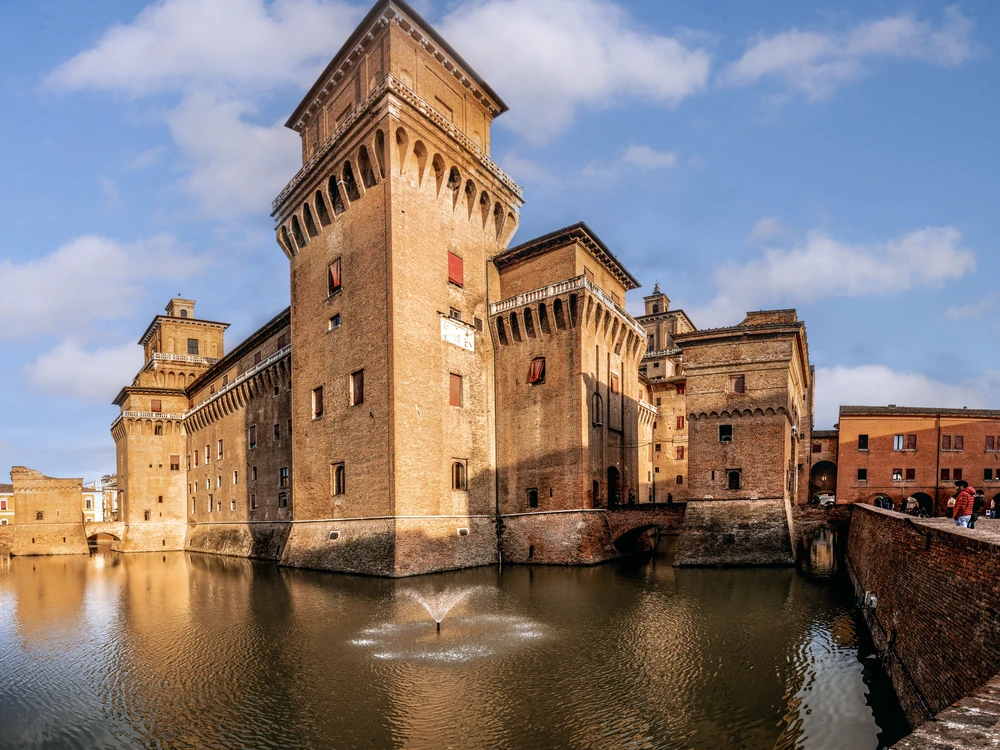
Rising from a water-filled moat in the precise centre of Ferrara, the Castello Estense is one of the most perfectly preserved medieval moated castles in Italy and the most dramatic monument of a city that was among the most brilliant courts of the Italian Renaissance. Built in 1385 by Niccolò II d'Este as a fortress-residence for the Este dynasty — the ruling family of Ferrara for three centuries — the castle combines the functional logic of a military stronghold with the aesthetic ambitions of a family that counted Ariosto, Tasso, and Titian among its cultural clients.
The castle's exterior is immediately impressive: four massive towers connected by crenellated curtain walls, the whole reflected in the moat below, the ensemble rising from the busy commercial streets of central Ferrara with a drama that has not diminished in six centuries. The drawbridge and portcullis are original, and crossing them — as Ferrara's citizens still do daily, since the castle also houses regional government offices — is a physical encounter with the Renaissance that few Italian monuments can match.
The interior reveals layers of Este patronage. The frescoed rooms commissioned by the Este dukes include the celebrated Sala dei Giochi, decorated with scenes of courtly games and pastimes, and the Camera della Duchessa, where the ceiling paintings survive in remarkable condition. The dungeons below hold darker stories: the medieval prison cells where Parisina Malatesta and her stepson Ugo d'Este were held and executed by Niccolò III in 1425 after being discovered in an affair — a scandal that inspired Byron's poem Parisina and resonates through the castle's stones.
Ferrara itself is one of Italy's most underrated cities, its Renaissance street plan intact and its historic centre nearly free of modern intrusions. The castle anchors the city's central Piazza della Repubblica and is within walking distance of the Cathedral, the Palazzo dei Diamanti, and the Jewish Ghetto. Combined with Ferrara's exceptional cycle paths — the city is known as Italy's most bicycle-friendly — the castle makes a deeply satisfying day trip from Bologna (30 minutes by train) or Venice (90 minutes).
History
Ferrara's Este dynasty rose to prominence in the 13th century, establishing a signoria — a form of personal lordship — over the city that would last until 1598. By the 14th century, the Este were among the most powerful lords in northern Italy, and Niccolò II commissioned the Castello Estense in 1385 following a popular uprising that nearly destroyed the dynasty. The castle was simultaneously a refuge from the city's population and a symbol of Este power over it — a tension that defines the building's character.
Under successive Este lords — Leonello, Borso, Ercole I, Alfonso I, and Alfonso II — the castle was transformed from a military fortress into one of the most culturally sophisticated court residences in Europe. Ludovico Ariosto, author of the Orlando Furioso, served at the Este court and is commemorated throughout the city. Titian painted Alfonso I d'Este and his wife Lucrezia Borgia (whose marriage to Alfonso brought the notorious Borgia family into the Este orbit). The court attracted musicians, poets, architects, and artists from across Italy.
The Este dynasty ended in 1597 when Duke Alfonso II died without a legitimate heir, and Pope Clement VIII claimed the city for the Papal States. The Este were expelled, taking their art collection to Modena, and Ferrara entered a long period of papal administration and gradual decline. The castle passed to the papacy and eventually to the Italian state. Since 1999, the city of Ferrara — including the castle — has been listed as a UNESCO World Heritage Site, recognised for its extraordinary Renaissance urban planning and architecture.
How to Visit
Getting there: Ferrara station is about 15 minutes' walk or a short bus ride from the castle in the city centre. Ferrara is 30 minutes from Bologna by direct train and about 60 minutes from Padua.
Tickets: Entry costs €12 for adults (children €5); buy at the castle ticket office with no advance booking required. The GetYourGuide private walking tour of Ferrara is a 3-hour guided walk centred on the Castello Estense, covering the castle alongside Ferrara's Cathedral, Palazzo dei Diamanti, and historic centre.
Practical tips: Allow 1.5–2 hours for the interior. The dungeons where Parisina Malatesta and Ugo d'Este were imprisoned in 1425 are the most charged rooms — don't rush through. Bikes are widely available for rent near the station; Ferrara's flat streets and excellent cycle paths make cycling the natural way to reach the Palazzo Schifanoia (15 minutes away), whose Ferrarese Renaissance fresco cycle is essential viewing.
Combine with: Castle of Torrechiara near Parma (about 1.5 hours west by car) for an Emilia-Romagna moated Renaissance castles day.
Frequently Asked Questions
Yes — Ferrara's historic centre, including the Castello Estense, was inscribed as a UNESCO World Heritage Site in 1995 (extended 1999) under the title 'Ferrara, City of the Renaissance, and its Po Delta.' The UNESCO inscription covers the remarkable integrity of Ferrara's Renaissance urban plan.
Location
Piazza della Repubblica 1, 44121 Ferrara, Italy
Nearby Castles
Tours & Tickets
Powered by GetYourGuide
From
€204/ person