
Castle of Torrechiara
Castello di Torrechiara
Italy · Emilia-Romagna · Near Parma
Built 1448 · 15th-century Italian military and residential architecture (Quattrocento); corner towers connected by curtain walls; interior frescoes by Benedetto Bembo in the Camera d'Oro (1462)
This page is part of an independent travel guide and is not affiliated with, endorsed by, or operated by Castle of Torrechiara.
© Castles & Palaces
Quick Facts
- Hours
- Tue–Sun 08:30–19:00. Closed Mon
- Guided tour from
- €29
- Duration
- 1–2 hours
- Best time
- April to October
- Nearest city
- Parma
Featured Tour
Guided visit of Parma and Torrechiara Castle
Cancellation available · Instant confirmation
Highlights
- ✦Built between 1448 and 1460 by condottiere Pier Maria Rossi as a monument to his 30-year relationship with Bianca Pellegrini d'Arluno, his lifelong companion outside marriage
- ✦The Camera d'Oro — frescoed in 1462 by Benedetto Bembo, brother of the humanist Pietro Bembo, depicting the castle itself with Pier Maria and Bianca among the architectural detail
- ✦Four corner towers with machicolations and a curtain wall built to the latest 15th-century standards of Italian military architecture
- ✦A formerly water-filled moat that would have made any siege approach extremely difficult, despite the castle's romantic origins
- ✦Sweeping views over the Parma stream valley and the vine-covered Apennine foothills, unchanged since Pier Maria Rossi's lifetime
Skip the queue with a guided tour
Skip-the-line tickets & expert guides
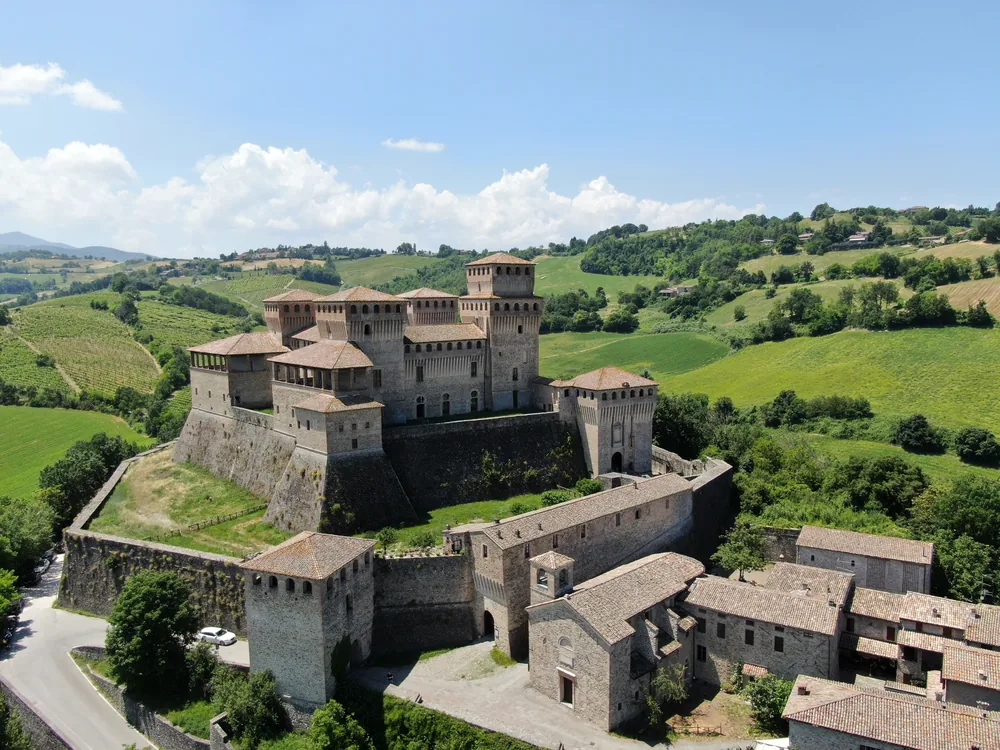
Torrechiara is the Italian castle most visitors find by accident — driving south from Parma into the Apennine foothills, following a road that suddenly reveals a hill crowned with four towers and a pale brick-coloured curtain wall, reflected in the remnants of a moat. It is one of the most complete 15th-century castles in Italy, and unusually for a fortress of this seriousness, its story is fundamentally a love story.
Torrechiara was built between 1448 and 1460 by Pier Maria Rossi, Count of San Secondo — one of the most powerful lords of the Po Valley and a condottiere, a mercenary general who fought in the service of both the Sforza of Milan and the Este of Ferrara at different points in his career. He commissioned the castle not primarily as a military necessity, though it is militarily formidable, but as a monument to his relationship with Bianca Pellegrini d'Arluno, his companion of thirty years who was never his wife — Rossi maintained a separate, politically necessary marriage elsewhere. Every element of Torrechiara, down to the choice of decorative motifs, was conceived with Bianca in mind.
The great masterpiece of the interior is the Camera d'Oro, the Golden Room, painted in 1462 by Benedetto Bembo, brother of the more celebrated humanist Pietro Bembo. The frescoes depict the castle itself as it appeared that year, with Pier Maria and Bianca shown among the painted architectural detail — a painted autobiography of a love affair, set inside the very building it portrays. The gold leaf that gave the room its name has largely faded over five centuries, but the frescoes themselves survive in remarkable condition, among the finest secular fresco cycles of the Quattrocento in northern Italy.
Despite its romantic commission, Torrechiara is a thoroughly serious military structure. The four corner towers, fitted with machicolations for dropping projectiles on attackers below, the connected curtain walls and the internal courtyard all follow the latest 15th-century principles of Italian military engineering. Pier Maria Rossi had spent his career fighting and studying fortifications across Italy, and he knew precisely what a defensible castle required. The moat, now dry, would have made any siege approach a slow and costly undertaking.
After Pier Maria Rossi's death in 1482, the castle passed through several noble families before coming under state ownership in the 20th century. The exterior remains essentially intact, and the interior preserves the Camera d'Oro along with several other decorated rooms and a small museum of material recovered through archaeological excavation on the site. A Franciscan monastery occupies part of the complex today, a quieter coda to a building built, five centuries ago, for one of the most consuming personal devotions in Italian Renaissance history.
History
Pier Maria Rossi, Count of San Secondo and condottiere for the Sforza of Milan and the Este of Ferrara, began construction of Torrechiara in 1448, completing it by around 1460. The castle was conceived primarily as a residence built around his relationship with Bianca Pellegrini d'Arluno, his companion for thirty years, even as Rossi maintained a separate political marriage elsewhere — a private devotion expressed publicly through the building's decoration, most strikingly in the Camera d'Oro frescoed by Benedetto Bembo in 1462.
Following Rossi's death in 1482, the castle passed through a succession of families over the following centuries, gradually losing its residential importance as the political landscape of the Po Valley shifted around it. It came under Italian state ownership in the 20th century, by which point its exterior fortifications and the Camera d'Oro had survived largely intact, sparing it the heavy romantic reconstruction that altered many other Italian castles during the same period. A Franciscan monastery was established within part of the complex, and the castle today operates as a state-run museum open to the public.
How to Visit
Getting there: Torrechiara is 15km south of Parma by road, about a 20-minute drive. No direct public transport; a car or taxi is necessary. Parma itself is 1 hour from Bologna by train, making Torrechiara a natural half-day extension of a Parma visit.
Tickets: Entry costs €6 for adults (children €2); buy at the door with no booking required. The GetYourGuide guided tour of Parma and Torrechiara covers Parma city and the castle over 7 hours with a guide included.
Practical tips: Oct–Mar the castle closes at 17:00; closed Mondays year-round. The Camera d'Oro is in the upper tower — the narrow stairs are part of the experience; allow time to linger in front of the frescoes. The return drive to Parma through the Colli di Parma DOC wine country is worth slowing down for.
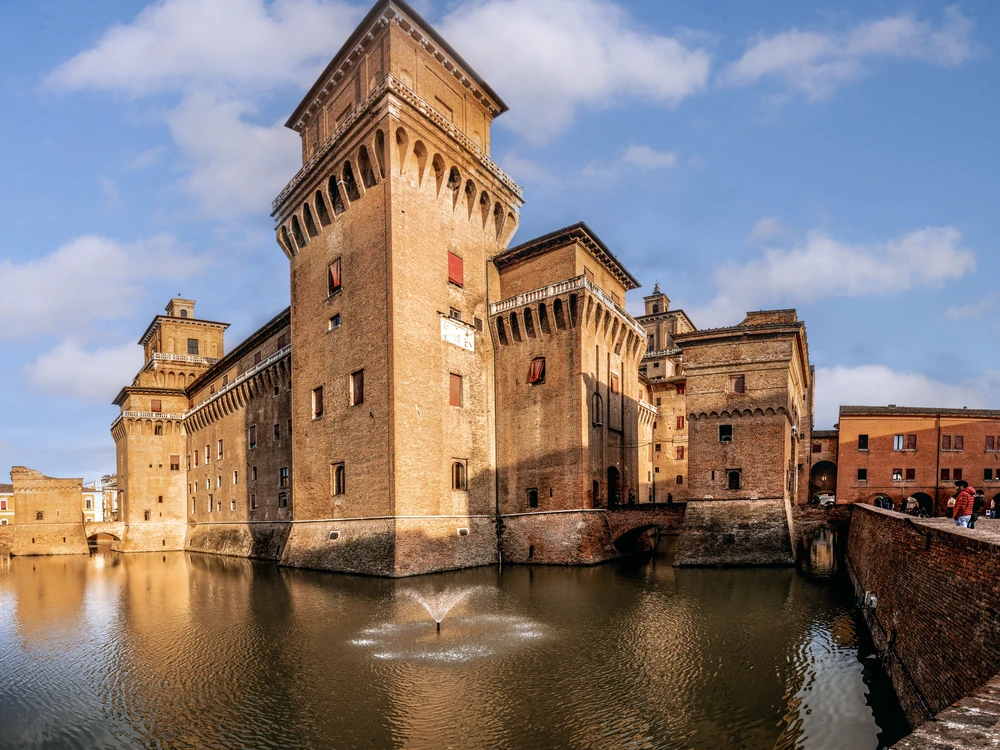
Combine with: Castello Estense in Ferrara (about 1.5 hours east) for a full Emilia-Romagna moated castle day.
Frequently Asked Questions
Pier Maria Rossi, Count of San Secondo, built Torrechiara between 1448 and 1460 primarily as a monument to his thirty-year relationship with Bianca Pellegrini d'Arluno, his lifelong companion outside his political marriage. The castle's most famous room, the Camera d'Oro, was frescoed in 1462 with imagery referencing the couple directly, making the building's romantic purpose explicit even though it also functioned as a serious military fortress.
Location
Str. del Castello, 1, 43010 Torrechiara PR, Italy
Nearby Castles
Tours & Tickets
Powered by GetYourGuide
From
€29/ person