
San Leo Fortress
Fortezza di San Leo
Italy · Emilia-Romagna / Montefeltro · Near Rimini
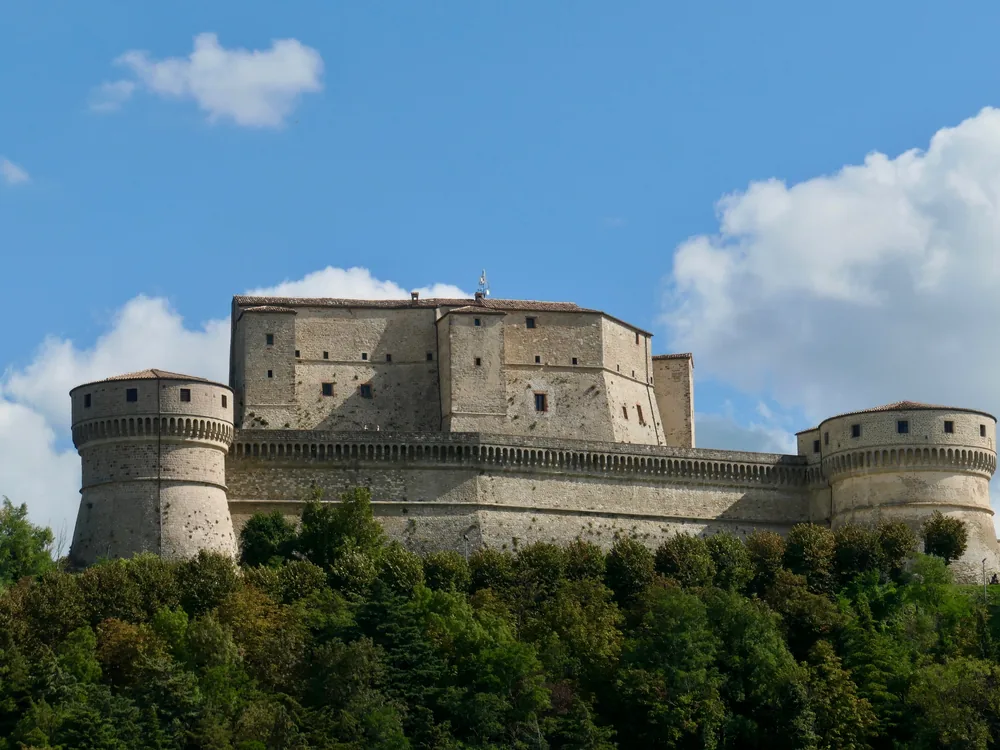
Built 1479 · Late Renaissance military fortress, considered one of Francesco di Giorgio Martini's masterworks — the architect (1439–1501), a Sienese polymath who was painter, sculptor, architect, and military engineer simultaneously, designed San Leo's current fortress between 1479 and 1488 for Federico da Montefeltro and his successor; the fortress exemplifies the Italian transition from medieval tower castle to artillery-era bastion fort, with the compact, low-profile, angled-bastion design that would influence military architecture for two centuries; the exceptional position — a sheer sandstone rock rising 650m — is the defining element of the site, making it one of the most dramatically sited fortresses in Italy
This page is part of an independent travel guide and is not affiliated with, endorsed by, or operated by San Leo Fortress.
© Castles & Palaces
Quick Facts
- Hours
- Daily 09:00–18:30
- Entry via GetYourGuide
- €16
- Duration
- 1–1.5 hours (fortress and prison sections accessible; the route covers the rock top and internal areas)
- Best time
- April to October
- Nearest city
- Rimini
Featured Tour
San Leo Fortress: Self-Guided Entry Ticket
Cancellation available · Instant confirmation
Highlights
- ✦Francesco di Giorgio Martini's design — one of the great Renaissance polymath's finest military engineering works, designed between 1479 and 1488 for Federico da Montefeltro; the compact, low-profile bastion design adapts the natural rock pinnacle into a unified defensive system that is both architecturally innovative and visually extraordinary; Martini's treatise on military architecture ('Trattati di architettura ingegneria e arte militare') was one of the foundational texts of Renaissance military engineering, and San Leo is the best surviving example of his built work
- ✦The Count of Cagliostro's prison — Giuseppe Balsamo (1743–1795), who called himself Count Alessandro di Cagliostro, was one of the most extraordinary confidence men in European history: alchemist, occultist, Freemason, healer, and impostor who moved through the courts of Europe from London to St Petersburg offering magical transformations and claiming ancient secret knowledge; convicted of heresy by the Roman Inquisition in 1791, he was sentenced to death (commuted to life imprisonment) and imprisoned in the San Leo Fortress, where he died in 1795 — possibly murdered by his guards; his prison cell is one of the highlights of the fortress visit
- ✦The sheer rock pinnacle — the fortress sits atop a sheer sandstone rock rising approximately 650m above sea level, with vertical drops on all sides that made the site militarily almost impregnable to assault — the only approach was (and is) a narrow path from San Leo village below; Dante mentioned the rock in the Divine Comedy ('Purgatorio' I, in a simile for difficult ascent); the views from the fortress top over the Valmarecchia valley, San Marino, and the Adriatic horizon are exceptional
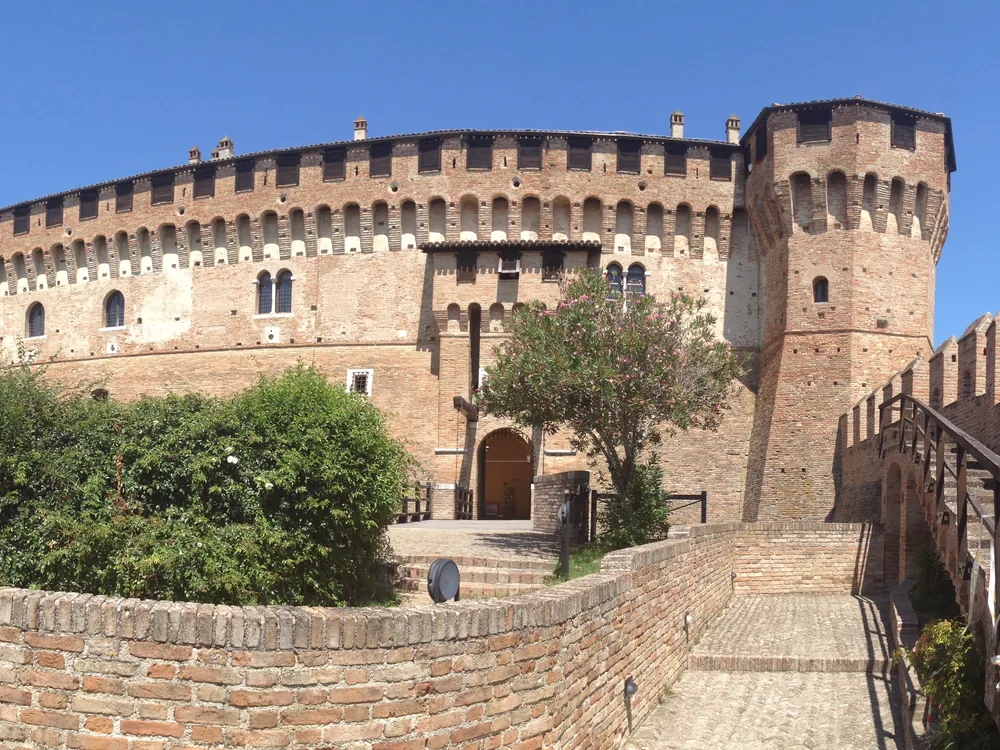
- ✦Near Gradara Castle (~45km northeast) — Gradara is the other major castle in the southern Emilia-Romagna / Marche border zone; Gradara (on this site) is noted for Paolo and Francesca; San Leo for Cagliostro and Martini's architecture; both are accessible from Rimini in a day
- ✦Self-guided entry — the GetYourGuide ticket provides access to the fortress circuit including the Cagliostro prison cell, the parapets, and the collection of arms and artworks housed in the fortified rooms; audio guide available in Italian and English at the site
Skip the queue with a guided tour
Skip-the-line tickets & expert guides
The San Leo Fortress occupies the top of a sheer sandstone pinnacle in the Montefeltro region of central Italy — a near-vertical rock rising above the village of San Leo and the Valmarecchia valley, with sight lines to San Marino (immediately to the south) and, on clear days, to the Adriatic coast. The combination of the site's natural impregnability with a Renaissance military engineering design of exceptional quality has made San Leo one of the most admired late 15th-century fortifications in Italy. The designer was Francesco di Giorgio Martini, the Sienese architect, sculptor, painter, and military engineer who was simultaneously Leonardo da Vinci's most important contemporary in the applied sciences of the period.
Francesco di Giorgio Martini (1439–1501) designed the San Leo Fortress between 1479 and 1488, commissioned first by Federico da Montefeltro (the Duke of Urbino whose portrait in profile is one of the most famous images of the Renaissance) and continued by his son Guidobaldo. The context was the transition in European military architecture from the high vertical walls of the medieval castle — which gunpowder artillery could breach relatively easily — to a new generation of low, thick-walled, bastion-based fortresses that could resist sustained cannon fire and provide positions for counter-battery artillery. The Italian military engineers of the 15th century, working through the specific conditions of the Italian wars, developed this new form, and Francesco di Giorgio Martini was among its most innovative practitioners. His 'Trattati di architettura ingegneria e arte militare' (Treatises on Architecture, Engineering and Military Art), written in the 1480s and 1490s, codified the new approach in a text that influenced military architects across Europe for a century.
At San Leo, Martini integrated the fortress into the natural rock formation: the sandstone pinnacle itself became part of the defensive system, with the sheer vertical drops eliminating the need for walls on the most exposed faces and concentrating the fortification effort on the approaches. The compact quadrilateral plan with angular bastions, the low profile against cannon fire, and the controlled single approach from the village below made San Leo effectively impregnable to assault without extraordinary siege engineering. It was never successfully stormed.
The military history of the site is extensive — San Leo changed hands between the Papal States, the Montefeltro, the Della Rovere, and eventually the unified Italian state — but the story that has attached most firmly to the fortress's contemporary identity is that of the Count of Cagliostro. Giuseppe Balsamo was born in Palermo in 1743 and reinvented himself as Count Alessandro di Cagliostro, claiming ancient noble lineage and occult knowledge accumulated across a lifetime of mysterious travels. The career he built was extraordinary: moving through the aristocratic and intellectual circles of London, Paris, Warsaw, St Petersburg, and dozens of other cities, he offered alchemical services, magical healing, and initiation into a claimed Egyptian Freemasonry that he presented as superior to the conventional variety. His involvement in the Affair of the Diamond Necklace (1785–86) — the pre-Revolutionary French court scandal involving a fraudulent purchase of jewels in the Queen's name — made him temporarily famous across Europe and contributed to the credibility crisis of the French monarchy on the eve of Revolution.
Convicted of heresy by the Roman Inquisition in 1791, initially sentenced to death (commuted to life imprisonment after he recanted), Cagliostro was confined at San Leo Fortress. The cell in which he was held — a small, damp, poorly lit space in the fortress rock with no direct access to the exterior, ventilated by a small aperture in the ceiling — is one of the accessible sections of today's fortress visit. He died there in 1795, under circumstances that remain somewhat unclear; some accounts suggest he was killed by his guards rather than dying of natural causes. Alexandre Dumas used Cagliostro as a character in several novels; Goethe used him as inspiration for the character of Mephisto; his name became synonymous, in the late 18th and 19th centuries, with the figure of the brilliant impostor and occult charlatan.
The GetYourGuide-listed self-guided entry ticket provides access to the full fortress circuit: the Cagliostro prison cell, the bastion walks, the parapets with their panoramic views, and the collection of arms and artworks in the fortified rooms. The fortress is approximately 45km from Gradara Castle (on this site) and both can be covered from Rimini in a single day.
History
San Leo rock site occupied from antiquity; early Christian significance (San Leone bishop of the area lived in a cave on the rock, 3rd–4th century). Medieval castle developed from the 10th century. Acquired by Federico da Montefeltro of Urbino; current fortress designed by Francesco di Giorgio Martini 1479–1488. Passed between the Della Rovere, the Papal States, and others through the 16th century. Used as a state prison from the 17th century. Giuseppe Balsamo (Count of Cagliostro) imprisoned 1791–1795, died at San Leo. Incorporated into unified Italy 1860. Now managed as a museum fortress by the comune of San Leo.
How to Visit
Getting there: From Rimini, drive approximately 40 minutes southwest on the SP258 toward San Leo village (~40 km). No practical public transport connects Rimini to San Leo; a car is essential. From San Leo village, a 10–15 minute steep uphill path leads to the fortress entrance.
Tickets: Walk-up entry €8 adult, €5 child. The GetYourGuide self-guided entry ticket covers the full fortress circuit including the Cagliostro prison cell, bastion parapets, and the arms collection — book in advance to guarantee access.
Practical tips: Shade on the exposed rock is minimal; visit in the morning or late afternoon to avoid peak heat, especially July and August. Allow 1–1.5 hours for the complete circuit. Summer hours extend to 19:30 (June–September), making an early-evening visit worthwhile for softer light over the Valmarecchia valley.
Combine with: Gradara Castle (~45 km northeast toward Rimini, famed for the story of Paolo and Francesca da Rimini).
Frequently Asked Questions
Giuseppe Balsamo (1743–1795), who operated as Count Alessandro di Cagliostro, was an 18th-century Sicilian confidence man and occultist who built a European career offering alchemical healing, Egyptian Freemasonry, and magical services to aristocratic and Enlightenment-era clients across London, Paris, Warsaw, and St Petersburg. His involvement in the 1785–86 Diamond Necklace Affair in France — a scandal that damaged Marie Antoinette's reputation — made him briefly famous across Europe. The Roman Inquisition convicted him of heresy and Freemasonry in 1791 and initially sentenced him to death; the sentence was commuted to life imprisonment, and he was confined in the San Leo Fortress, where he died in 1795 under disputed circumstances. His cell — a small damp room in the fortress rock — is accessible to visitors as part of the self-guided circuit.
Location
Via Leopardi, 61018 San Leo RN, Italy
Nearby Castles
Tours & Tickets
Powered by GetYourGuide
From
€16/ person