
Mdina
L-Imdina / Città Notabile
Malta · Northern Region, Malta — central highland plateau · Near Valletta
Built 870 · Fortified walled medieval city on a hill — Mdina is not a single castle or palace building but an entire walled city of approximately 0.4 square kilometres, whose perimeter walls enclose a dense urban fabric of Norman-Arab, medieval Gothic, and Baroque palaces, churches, and convents; the fortifications were established by the Arabs in the 9th century and substantially rebuilt by the Normans from 1090; the current walls and bastions reflect 16th–17th century reinforcement by the Order of St John and the Knights of Malta; the dominant architectural character within the walls is Baroque (17th–18th century) layered over a Norman street plan
This page is part of an independent travel guide and is not affiliated with, endorsed by, or operated by Mdina.
© Castles & Palaces
Quick Facts
- Hours
- Mon–Sun Open access
- Guided tour from
- €25
- Duration
- 1.5–3 hours (walking the walled city — longer if visiting cathedral, Palazzo Falson, and extending to Rabat); the GetYourGuide guided walking tour runs 2.5 hours including Rabat catacombs
- Best time
- October to April
- Nearest city
- Valletta
Featured Tour
Malta: Mdina and Rabat Walking Tour with Catacombs
Cancellation available · Instant confirmation
Highlights
- ✦The Silent City — Mdina's defining characteristic: private motor vehicles are banned entirely within the walls (only residents and emergency services may drive); the result is a medieval city whose streets are as quiet as they were five centuries ago; the absence of traffic noise, the echo of footsteps on limestone, and the rarity of commercial signage combine to produce an atmosphere that has no equivalent in Malta
- ✦Free entry to the walled city — unlike most European medieval town centres that charge for access, Mdina's public streets and piazzas are freely accessible at any hour; the financial cost of visiting is zero; individual sites within the walls (the Cathedral, Palazzo Falson, the museums) have separate entry fees
- ✦Palazzo Falson — a Norman house-museum within the walls, one of the oldest continuously inhabited buildings in Malta (see [Palazzo Falson](/castles/malta/palazzo-falson) for the full page): a 15th-century palazzo turned private museum with Maltese silverware, Dürer prints, Arab carpets, and the idiosyncratic collection of its last private owner; physically located inside Mdina and an essential companion to the city visit
- ✦Mdina Cathedral (St Paul's Cathedral) — the Baroque cathedral at the city's centre, built between 1702 and 1720 to designs by Lorenzo Gafà on the site of an earlier Norman church, with one of the finest Baroque interiors in Malta: painted vault ceilings, woodwork inlaid with lapis lazuli and marble, and the crypt holding Maltese noble burials
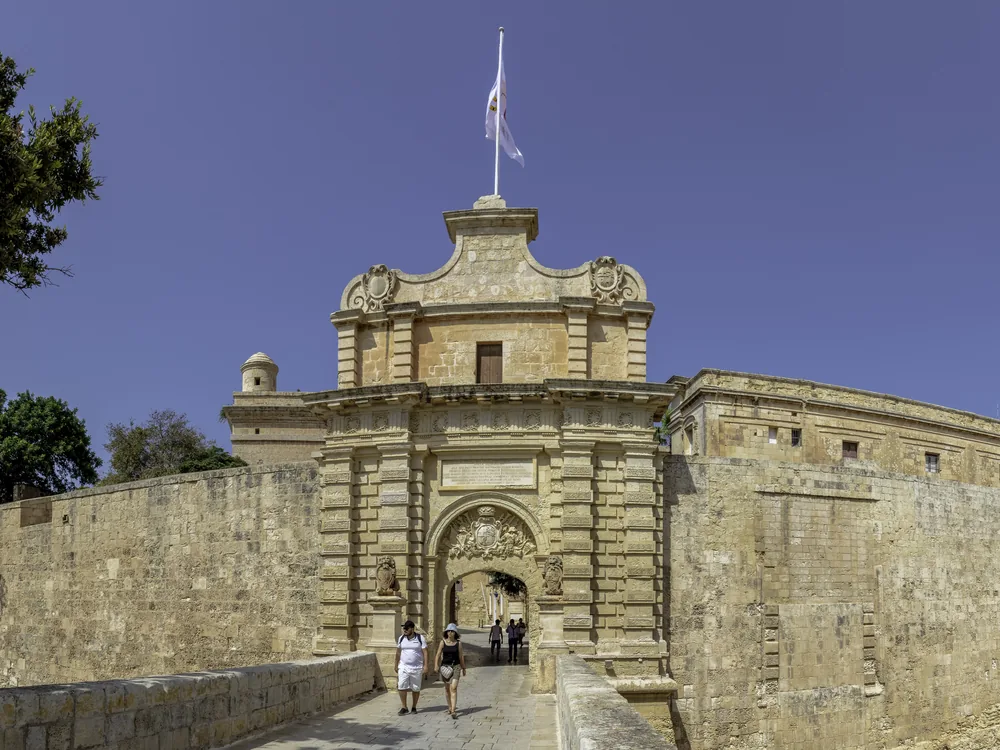
- ✦Mdina Gate and Vilhena Palace — the main entrance to the walled city is an 18th-century Baroque gate replacing the earlier Norman-Arab gateway; directly inside it, Vilhena Palace (early 18th century) now houses the Mdina Museum of Natural History. The gate's stone bridge across the former dry moat is the photographic arrival moment for almost every visitor
- ✦Rabat — the suburb directly outside Mdina's walls, technically a separate town but historically the overspill settlement beyond the city's fortified perimeter: St Paul's Grotto (where the Apostle is said to have taken refuge after his shipwreck on Malta in 60 AD), the Wignacourt Museum, and extensive Roman catacombs are all within 10 minutes' walk of the Mdina Gate
Skip the queue with a guided tour
Skip-the-line tickets & expert guides
Mdina is not a castle. It is an entire walled city — approximately 400 by 300 metres of medieval urban fabric perched on a ridge at the centre of the Maltese island, enclosed within limestone walls and bastions, entered through a single Baroque gate across a dry moat, and inhabited by approximately 300 permanent residents who live, uniquely among Malta's population, without private motor vehicles. Its popular name, the Silent City, captures something real: within the walls, the absence of traffic noise, the hush of narrow alleys, and the weight of a built environment that has not fundamentally changed since the 17th century produce an atmosphere that is unlike anywhere else in Malta and unlike most urban heritage experiences in Europe.
Mdina's origins as a fortified settlement predate its medieval character substantially. The site's ridge position at the geographical centre of Malta made it a natural stronghold from prehistoric times; there was a Roman settlement here, and the Roman-period town of Melite occupied the same ground. After the Arab conquest of Malta in 870 AD, the walled city was established in essentially its current plan — a compact urban area with a fortified perimeter, the street pattern reflecting the Arab urban tradition of narrow lanes and closed courtyard houses. The Normans conquered Malta in 1090 under Roger I of Sicily and substantially rebuilt the walls and public buildings, adding churches and palaces in the Norman-Arab hybrid style that characterises early medieval Maltese architecture. Palazzo Falson, today a house-museum within the walls, preserves the most complete example of this Norman domestic architecture in Malta.
The city was the capital of Malta through the Arab and Norman periods and into the medieval Christian era, when it bore the official name Città Notabile (Noble City). The Knights Hospitaller — the Order of St John, who were granted Malta by Holy Roman Emperor Charles V in 1530 — initially based their administration at Mdina before the founding of Valletta in 1566. The shift of the capital to Valletta (built on the Grand Harbour's promontory, more strategically positioned for the sea-based conflicts of the 16th century) permanently reduced Mdina's administrative importance. The city retained its noble Maltese families — the palaces within the walls belonged to the old Maltese aristocracy, who maintained their residences here while political and commercial life moved to Valletta — and its ecclesiastical character, but it ceased to grow. The 300-person population today is not much larger than it was in the 17th century.
The architectural character within the walls is predominantly Baroque, the result of intense building and renovation activity in the 17th and 18th centuries. The Cathedral of St Paul, built 1702–1720 to designs by the Maltese architect Lorenzo Gafà on the foundations of a Norman church, is the centrepiece of the city's built environment: a Baroque facade, twin towers, and an interior of considerable richness — barrel-vaulted and coffered ceiling, marble floors, wooden choir stalls, and a crypt holding the burials of the old Maltese nobility. The buildings flanking the main street (Triq Villegaignon) are a sequence of aristocratic palaces, their facades presenting the austere limestone grandeur characteristic of Maltese Baroque: minimal ornament, heavy doorframes, iron balconies, and interiors whose courtyard gardens are occasionally glimpsed through half-open gates.
Palazzo Falson, immediately off the main piazza, is the site's other mandatory stop. Built in the 15th century on Norman foundations, it remained in private hands until 2007, when it opened as a museum presenting the collection of its last owner, Olof Frederik Gollcher — an idiosyncratic assemblage of Maltese silverware, early Dürer engravings, Arab carpets, medieval manuscripts, and domestic objects accumulated through decades of private collecting. The building itself, with its Norman windows, heavy stone staircase, and roof terrace over the city, is as interesting as the collection. Palazzo Falson is the castle page dedicated to the physical building; Mdina is the walled city it stands within — they are the same place viewed at different scales.
The practical advice for Mdina visits is temporal. The city's streets are freely accessible and always open, but the experience varies dramatically by time of day. Cruise-ship groups from Valletta arrive between 10:00 and 14:00, filling the main thoroughfares and creating queues at the Cathedral and Palazzo Falson. Early morning (before 09:00) and late afternoon/evening (after 17:00, when the day-trippers have departed) are when the Silent City earns its name — the alleys genuinely empty, the limestone takes on a golden tone in the lower sun, and it becomes possible to understand why this place is on Malta's UNESCO Tentative List.
The GetYourGuide guided walking tour covers Mdina and the adjacent town of Rabat in 2.5 hours, including the catacombs and St Paul's Grotto — the most efficient combination of the two sites for a first visit. It is the strongest contextual introduction to both the city and the medieval history of Malta.
History
Bronze Age and Roman settlement on the Mdina ridge. Arab conquest of Malta 870 AD; walled city established in current plan. Norman conquest 1090 (Roger I of Sicily); walls rebuilt, Norman-Arab architecture established. Città Notabile serves as Malta's capital through Norman and medieval period. Knights Hospitaller granted Malta 1530; capital transferred to newly built Valletta 1566. Mdina retains its noble families and ecclesiastical character but ceases to grow. Baroque cathedral built 1702–1720 (Lorenzo Gafà). 18th–19th century: palaces and convents rebuilt in Baroque style. Population stabilises at ~300. Mdina included on Malta's UNESCO Tentative List. Palazzo Falson opens as museum 2007.
How to Visit
Getting there: From Valletta take bus 201, 202, or 203 from the Bus Terminus — roughly 35 to 45 minutes; the fare is €1.50 (€2 in summer peak). By car from Valletta, take the central highway towards Rabat, around 20 minutes; park just outside the Mdina Gate in the Rabat car park. A taxi from Valletta costs approximately €15 to €20.
Tickets: Free entry. The walled city's public streets are open at all hours at no cost. Individual sites inside the walls charge separately: St Paul's Cathedral ~€5, Palazzo Falson ~€10, Mdina Museum (Vilhena Palace) ~€5. The GetYourGuide tour — a 2.5-hour guided walk through Mdina and Rabat with Roman catacombs and St Paul's Grotto included — is the most efficient first-visit introduction; book in advance as morning slots fill quickly with cruise-ship groups.
Practical tips: Arrive before 09:00 or after 17:00 — cruise-ship groups from Valletta fill the main streets from around 10:00 to 14:00, and the alleys lose their quiet character entirely. Malta's summer heat (35–38°C in June–August) makes midday visits uncomfortable; October to April is much more pleasant. Private motor vehicles are banned within the walls, which is the single biggest reason Mdina feels so different from other medieval walled towns.
Combine with: Palazzo Falson, a 15th-century Norman house-museum inside the walls, is a two-minute walk from the Cathedral and the essential companion visit — its rooms display Maltese silverware, Dürer prints and Arab carpets collected over decades by the last private owner.
Explore more castles in Castles in Malta.
Frequently Asked Questions
It is a walled city — an entire medieval urban settlement enclosed within fortified walls, not a single castle or palace building with a ticket booth and a guided route. Think of it as the Maltese equivalent of Carcassonne's Cité, or the old city of Dubrovnik, rather than as a castle in the conventional sense. The streets are public, entry is free, and the city is inhabited. Individual buildings within the walls (the Cathedral, Palazzo Falson, Vilhena Palace) have their own entrance fees and opening hours.
Location
Mdina, Northern Region, Malta
Nearby Castles
Tours & Tickets
Powered by GetYourGuide
From
€25/ person