
Prince's Palace of Monaco
Palais Princier de Monaco
Monaco · Monaco-Ville, Le Rocher (the Rock) · Near Monaco
Built 1215 · Genoese fortress core (1215) progressively transformed into a Renaissance and Baroque princely residence — the original four-tower curtain-wall fortress was remodeled by successive Grimaldi princes from Honoré I (1522–1581) onward; a Renaissance courtyard with double arcaded loggias and a grand staircase was added in the 16th century; frescoed galleries, gilded State Apartments with Louis XV furniture, and Baroque decorative schemes completed in the 17th and 18th centuries; the exterior retains the crenelated medieval ramparts and towers on the seaward side while the inner Cour d'Honneur and State Apartments are fully Italian Renaissance in character; the result is a building that reads simultaneously as a medieval fortress from the harbor and as an Italian Renaissance palazzo from the courtyard — a duality that accurately reflects seven centuries of continuous adaptation by a ruling family that had to be both a military power and a civilized court
This page is part of an independent travel guide and is not affiliated with, endorsed by, or operated by Prince's Palace of Monaco.
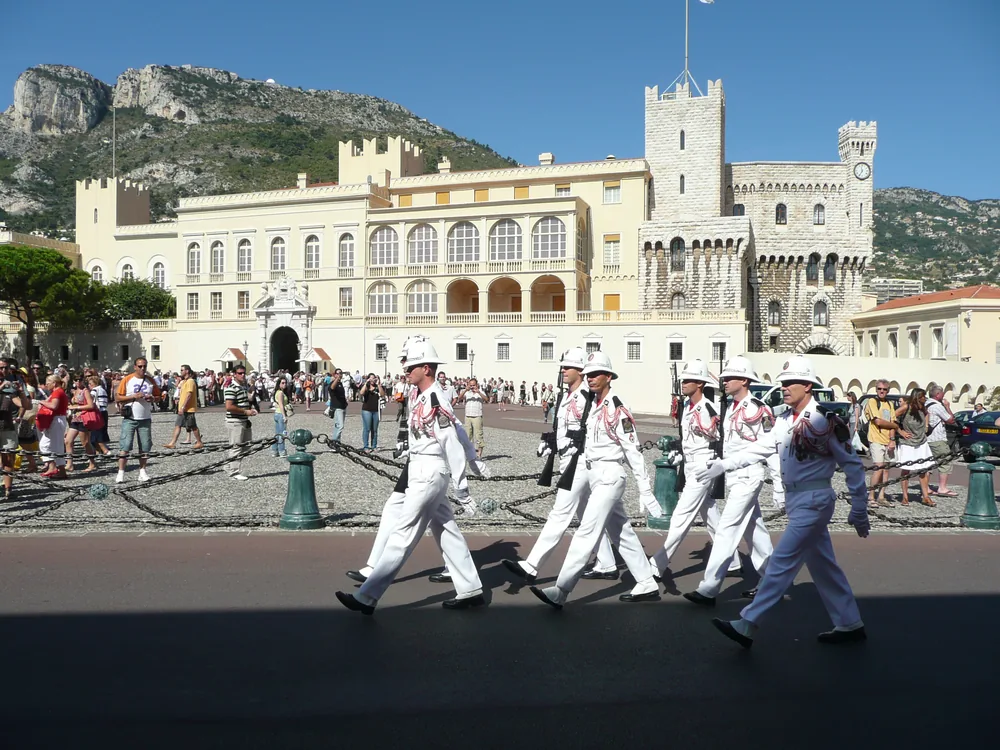
© Castles & Palaces
Quick Facts
- Hours
- Daily 10:00–18:00
- Guided tour from
- €1090
- Duration
- 1–1.5 hours (State Apartments self-guided audio tour)
- Best time
- March 30 to October 15
- Nearest city
- Monaco
Featured Tour
Monaco, Monte-Carlo, the Prince's Car Collection and Palace
Cancellation available · Instant confirmation
Highlights
- ✦François Grimaldi's 1297 disguise — on the night of January 8, 1297, François 'la Malizia' (the Cunning) Grimaldi dressed as a Franciscan monk and asked for shelter at the fortress gate; when admitted, he let his armed men in behind him and seized the rock; the act of trickery that founded seven centuries of Grimaldi rule is commemorated by a statue of the armored-monk outside the palace and by the two monks that still appear in the Grimaldi coat of arms
- ✦Europe's oldest ruling dynasty — the Grimaldis have governed Monaco continuously (with brief interruptions during the French Revolutionary period) for over 700 years across 24 sovereign princes, making them the longest-reigning royal house in Europe still in power; the current sovereign, Prince Albert II, is the 32nd Lord of Monaco in direct line from François Grimaldi
- ✦The most continuously inhabited royal residence in the world — the palace has served as the active seat of a sovereign state for over 700 years without interruption; uniquely among European royal residences, it functions simultaneously as a working government building, a royal family home, and a public museum open in season
- ✦The State Apartments — the self-guided audio tour covers the Throne Room, the Louis XV Salon (with gilded boiseries and original Flemish tapestries), the Blue Salon, the York Room (where the Duke of York died in 1767 — a historical curiosity that required diplomatic navigation with Britain), and the Palatine Chapel; entry is by timed self-guided audio tour in multiple languages
- ✦The Changing of the Guard (11:55 daily, free, visible from Place du Palais) — the Carabiniers du Prince, Monaco's palace guard in white summer dress uniform or winter blues, perform the ceremony every day regardless of whether the palace interior is open; it is the most photogenic 5 minutes in Monaco and requires no ticket
- ✦GetYourGuide private day trip from Nice covering the palace interior + Prince's Car Collection + Monte-Carlo + Èze (from €1090 for the full private 9-hour tour; independent State Apartments entry is €13)
Skip the queue with a guided tour
Skip-the-line tickets & expert guides
The Prince's Palace of Monaco occupies the highest point of Le Rocher — the limestone rock that juts into the Mediterranean at the western end of Monaco — and has done so as a functioning seat of government without interruption for more than seven hundred years. It is the oldest continuously active royal residence in the world and the seat of the oldest ruling family in Europe. Both of those distinctions trace back to a single act of improvised cunning on a January night in 1297.
The rock had been fortified since 1215, when a Genoese garrison built the original fortress: four towers connected by an 8-metre curtain wall on the highest defensible point of the coastline between Genoa and Nice. The position was strategic — whoever controlled Le Rocher controlled a stretch of Mediterranean coastline that every trader, fleet, and army needed to pass. The Genoese built it as a military installation, not as a residence, and it passed through several Ligurian hands before the night that changed its ownership permanently.
On January 8, 1297, François Grimaldi — a member of a Genoese Guelph family temporarily expelled from Genoa in a factional political dispute — arrived at the fortress gate in the habit of a Franciscan monk, accompanied by a small party of armed men hidden nearby. He asked for shelter, was admitted, and promptly let his men in through the gate he now controlled. The garrison was overwhelmed and the rock was in Grimaldi hands by morning. François's nickname was 'la Malizia' — the Cunning. The armored-monk statue outside the palace entrance commemorates him; the two monks still visible in the Grimaldi coat of arms are a permanent heraldic acknowledgment of the dynasty's founding ruse.
What François took by deception, his descendants held by politics, marriage, and intermittent military force across seven centuries. The Grimaldis governed Monaco as feudal lords under Genoese, then French, then Spanish suzerainty, acquiring increasing degrees of autonomy through negotiation with each successive protecting power. Full sovereignty came in stages across the 17th and 18th centuries. The Treaty of Peronne (1641) established French protection while recognizing Grimaldi sovereignty. Napoleon's annexation of Monaco (1793–1814) was the dynasty's most serious interruption — two decades of French control — but the Grimaldis returned at the Restoration and have governed continuously since. Today Monaco is a constitutional monarchy with a population of approximately 40,000, the world's most densely populated sovereign state, ruled by the 32nd Lord in direct line from François: Prince Albert II, who succeeded his father Rainier III in 2005.
The fortress itself only became a palace gradually. The original military structure — useful for repelling attackers, entirely unsuitable for court life — began its transformation under Honoré I (1522–1581), who added the first residential elements and began the conversion from garrison to residence. The decisive architectural transformation came in the 16th century with the construction of the Cour d'Honneur: an arcaded courtyard in the Genoese-Italian Renaissance style, with double-loggias on two sides and a grand ceremonial staircase in Carrara marble, painted with trompe-l'œil architectural perspectives in the manner of the Ligurian Renaissance. The combination of medieval crenelated towers on the seaward exterior with a Renaissance Italian palazzo courtyard within is the architectural signature of the palace — a duality that honestly represents the building's history.
The State Apartments, open to visitors from late March through mid-October via a self-guided audio tour, cover the formal ceremonial rooms accumulated across four centuries of Grimaldi furnishing. The Throne Room, used for state ceremonies and still equipped with the throne, is decorated with Flemish tapestries commissioned in the 18th century and portraits of successive Grimaldis. The Louis XV Salon preserves gilded boiseries and period furniture from the reign of the prince who brought Monaco definitively under French cultural influence. The York Room carries a historical curiosity: the Duke of York, brother of King George III of Britain, died here in 1767 during a visit to Monaco — a death that required considerable diplomatic finesse to manage without diplomatic incident between Monaco and Britain. The Palatine Chapel, built in the 17th century, contains the tomb of Honoré II and functions as the palace's active place of worship.
The Changing of the Guard takes place at 11:55 every morning in the Place du Palais, regardless of whether the palace interior is open or the season. The Carabiniers du Prince — Monaco's palace guard, founded in 1817, dressed in white summer uniforms with a prominent hat and red-trimmed jackets — perform the ceremony in five minutes of precise choreography in front of the main gate. No ticket is required; the square fills with visitors in high season and empties quickly afterward.
The GetYourGuide private day trip from Nice is the only GetYourGuide product currently verified as including palace interior entry — it covers the State Apartments, the Prince's Car Collection (a separate museum housing Prince Rainier III's personal vehicle collection including a 1929 Bugatti Type 35, a 1963 Rolls-Royce Silver Cloud, and race cars from the Monte Carlo Rally), a stop in Monte-Carlo at the casino and gardens, and a visit to Èze with its perfume factory. The €1090 price is for the entire private 9-hour tour from Nice, not for palace entry alone; independent adult admission to the State Apartments is €13.
History
A Genoese garrison built the original fortress on Le Rocher in 1215 — four towers connected by an 8-metre curtain wall designed to control the Ligurian coastline. The rock changed hands among Ligurian factions through the late 13th century. On 8 January 1297, François 'la Malizia' Grimaldi seized Le Rocher by disguising himself as a Franciscan monk and gaining entry under the appearance of a religious traveller seeking shelter — an act of deception that became the founding episode of Grimaldi dynastic rule and is commemorated in the family coat of arms to this day. The Grimaldis governed under Genoese suzerainty through the 14th and 15th centuries, repeatedly challenged by rival Ligurian families but always recovering their position.
Honoré I began transforming the fortress into a residential palace from 1522, initiating the architectural sequence that continued through the 16th century with the construction of the Cour d'Honneur — its Renaissance arcaded loggias, Carrara marble staircase, and trompe-l'œil frescoes by Ligurian painters. Honoré II became the first Grimaldi to take the title Prince of Monaco in 1612; the Treaty of Peronne in 1641 established French protection and recognised Grimaldi sovereignty. The State Apartments were furnished and decorated with Flemish tapestries and Louis XV gilded boiseries through the 17th and 18th centuries. French Revolutionary and Napoleonic annexation incorporated Monaco into France from 1793 to 1814, temporarily removing the Grimaldis — who were restored at the Congress of Vienna in 1815. The Treaty of Turin in 1861 established Monaco's modern borders, ceding Menton and Roquebrune to France in exchange for full independence. A constitutional monarchy was established under Albert I in 1911.
Prince Albert II succeeded Rainier III in 2005. The palace serves as the active seat of government and is open to visitors from 30 March to 15 October.
How to Visit
Getting there: From Nice (35 km west) take the SNCF train — frequent services, 25 to 35 minutes, and by far the easiest approach; Monaco-Monte Carlo station is a 5-minute local bus ride or 20-minute walk uphill to Le Rocher. From the station, bus lines 1 and 2 from Casino Square reach Monaco-Ville in about 10 minutes. From the Italian Riviera, Ventimiglia is 20 minutes by train. By car, parking on Le Rocher is extremely limited — park in Monte-Carlo's Port Hercule car park and take the bus up the rock.
Tickets: Walk-up entry €13 adult, €8 child. The GetYourGuide tour — a 9-hour private day trip from Nice covering the State Apartments, the Prince's Car Collection, Monte-Carlo casino and gardens, and Èze village — is the only product verified to include palace interior access; book in advance as the small-group format limits availability.
Practical tips: The State Apartments are open only 30 March to 15 October — check dates before travelling, especially in October. Arrive by 11:40 to catch the Changing of the Guard at 11:55 in the Place du Palais, which is free, takes five minutes, and is visible any day of the year without a ticket. The self-guided audio tour is available in multiple languages; allow 1 to 1.5 hours for the State Apartments circuit.
Combine with: The Prince's Car Collection museum — housing Rainier III's personal vehicles, including a 1929 Bugatti Type 35 and Monte Carlo Rally race cars — is a 10-minute walk from the palace and pairs naturally for a full morning on Le Rocher. The private tour extends the day to Monte-Carlo, Èze, and the wider French Riviera.
Frequently Asked Questions
No — the State Apartments are open to visitors only from March 30 to October 15. The palace closes to the public for the rest of the year when Prince Albert II and the Grimaldi family are in full residence. The Changing of the Guard takes place at 11:55 every day of the year in the Place du Palais, free of charge, and is visible from outside the palace regardless of whether the interior is open.
Location
Place du Palais, 98000 Monaco
Nearby Castles
Tours & Tickets
Powered by GetYourGuide
From
€1090/ group