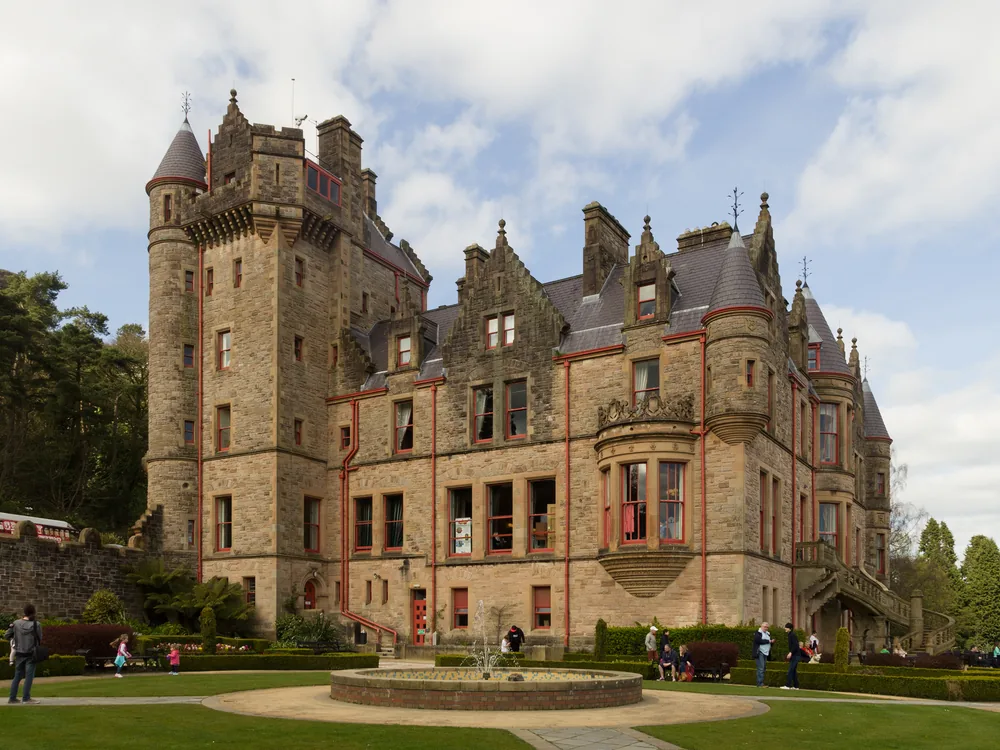
Belfast Castle
Belfast Castle
Northern ireland · Cave Hill, Belfast · Near Belfast
Built 1870 · Scottish Baronial — the current building was completed in 1870 to designs by the Belfast architectural firm W.H. Lynn (of Lanyon, Lynn & Lanyon) for the 3rd Marquess of Donegall; the style replicates the Scottish Baronial manner popularised by Queen Victoria's Balmoral Castle (1855), with crow-stepped gables, conical turrets, ashlar sandstone masonry, and a projecting spiral staircase tower; the building sits on the lower slope of Cave Hill, commanding views over the city and Belfast Lough; now owned by Belfast City Council and used as a public visitor amenity with restaurant, antique shop, and free public access
This page is part of an independent travel guide and is not affiliated with, endorsed by, or operated by Belfast Castle.
© Castles & Palaces
Quick Facts
- Hours
- Daily 09:00–17:30
- Guided tour from
- €116
- Duration
- 1–2 hours (castle interior and grounds); 2–3 hours if walking Cave Hill to the summit (McArt's Fort) and back
- Best time
- May to September
- Nearest city
- Belfast
Featured Tour
Belfast: Private City Tour visiting Belfast Castle, Peace Walls & Titanic Quarter
Cancellation available · Instant confirmation
Highlights
- ✦Free entry — Belfast Castle is a Belfast City Council public amenity: the building, its estate rooms, heritage exhibition, and grounds are all free to visit, with no entry fee and no advance booking required; the only costs are the restaurant and café
- ✦Cave Hill Country Park — the castle sits at the base of Cave Hill, a 368-metre basalt escarpment on the north edge of Belfast whose distinctive cliff face (known as 'Napoleon's Nose' for its profile resemblance to Bonaparte when viewed from the city below) has been a landmark since the early industrial period; the country park above the castle covers the full hillside, with paths to the summit McArt's Fort and panoramic views over the entire Greater Belfast area, Belfast Lough, and the Antrim plateau
- ✦The cat legend — embedded throughout the castle, inside and out, is one of Belfast's best-known architectural curiosities: a family legend holds that the castle will bring good fortune to its occupants only as long as a white cat lives on the estate; as a result, cats have been carved, painted, and embroidered into the fabric of the building by successive owners, and visitors can seek out more than thirty representations of cats in the castle's stonework, plasterwork, furniture, and stained glass
- ✦Wolfe Tone and the United Irishmen — in 1795, Wolfe Tone (the leader of the United Irishmen movement, who sought Irish independence with French support) met on Cave Hill with other leaders of the rebellion and took an oath 'never to desist from our efforts until we have subverted the authority of England over our country.' The spot — McArt's Fort, the Iron Age promontory fort at the summit — is reachable by the hill path from the castle and is one of the most historically significant sites of Irish republican history, physically within the same country park
- ✦Scottish Baronial architecture on the Antrim sandstone — the castle's design by W.H. Lynn (1870) is a faithful interpretation of the Scottish Baronial manner: crow-stepped gables, conical turrets, dressed sandstone, and a spiral staircase tower in the same tradition as Balmoral and the great Scottish country houses of the Victorian period; the style was fashionable among the Anglo-Irish aristocracy in the mid-19th century and survives in Northern Ireland in relatively few examples at this scale and quality
- ✦Belfast city context — Belfast Castle provides the best elevated overview of the city outside a paid attraction: the views from the grounds and the hillside above take in the Belfast Lough, the Titanic Quarter shipyards (where RMS Titanic was built), the city centre, Cave Hill plateau, and the Antrim and Down hills beyond; combine with the city's Peace Walls and murals (walking distance from the city centre) for a full Northern Ireland heritage day
Skip the queue with a guided tour
Skip-the-line tickets & expert guides
Belfast Castle stands on the lower slope of Cave Hill — the 368-metre basalt escarpment that rises above the northern edge of Belfast and whose distinctive cliff profile, known as 'Napoleon's Nose', has been one of the defining landmarks of the Belfast skyline since the city's industrial expansion in the 19th century. It is a Scottish Baronial castle, completed in 1870 in the manner that Queen Victoria's Balmoral had popularised across the British Isles fifteen years earlier: crow-stepped gables, conical corner turrets, ashlar sandstone, and a projecting spiral staircase tower. It is owned by Belfast City Council and is freely accessible as a public amenity — the building, the estate rooms, the grounds, and the walk into Cave Hill Country Park above all require no payment and no advance booking.
The site has a longer history than its Victorian building suggests. An earlier castle stood on Belfast's Cave Hill from the medieval period — the O'Neill clan, the most powerful Gaelic lords of Ulster, held the hill as a stronghold, and the ruins of a tower are documented from the 17th century. The current building was commissioned by the 3rd Marquess of Donegall, from the Belfast firm of Lanyon, Lynn and Lanyon, and completed in 1870. The Donegalls were the principal landlords of Belfast — the city's development in the 18th and early 19th centuries was shaped in part by their property holdings — and the castle was intended as a suitable aristocratic residence reflecting their status and the fashionable architectural vocabulary of the period. The family's financial difficulties led them to sell the castle in 1934; it passed through several owners before coming to Belfast City Council in 1978, which converted it to its current use as a public visitor facility with a restaurant, heritage rooms, and estate grounds.
The castle's interior reflects its history as a Victorian aristocratic residence. The principal rooms on the ground floor — the reception hall, the drawing room, and the dining room — retain their Victorian plasterwork ceilings, fireplaces, and joinery, and are displayed with period furniture. A heritage exhibition about the castle and the Cave Hill landscape provides historical context. The most distinctive feature of the interior is the cat: a family legend, which the Donegalls maintained, holds that the castle and its occupants will prosper only as long as a white cat lives on the estate. As a result, cats were incorporated into the building's fabric at every opportunity — carved in stone above doorways, embroidered into furnishings, depicted in paintings and stained glass, modelled in plasterwork on ceilings — and visitors who know to look for them will find more than thirty feline representations scattered throughout the castle. The cat-hunt has become a popular family activity that gives the castle a quirky identity unique in Northern Ireland's heritage.
The Cave Hill Country Park above the castle is the other major component of any Belfast Castle visit. The park covers the full extent of Cave Hill from the castle estate to the summit plateau, with paths that wind through the basalt crags, past the caves that give the hill its name (Neolithic in origin), and up to McArt's Fort — the Iron Age promontory fort at the summit's highest point, 368 metres above the city. From McArt's Fort the view takes in Belfast Lough, the Scottish coast on clear days, the Antrim plateau to the north, and the Ards Peninsula to the southeast. The walk from the castle to the summit takes approximately 45–60 minutes each way on the steeper paths.
McArt's Fort is also a site of republican historical significance. On 12 June 1795, Wolfe Tone — the Protestant Dublin barrister who led the Society of United Irishmen, a republican movement inspired by the French and American revolutions that sought to unite Catholics, Protestants, and Dissenters in an independent Irish republic — gathered with his principal associates on the summit and took an oath to continue the struggle for Irish independence regardless of personal cost. The 1798 rebellion that followed was crushed, and Tone was captured and died in captivity. The summit oath is commemorated with a memorial at McArt's Fort and the cave hill site remains a place of republican pilgrimage. Belfast Castle sits at the base of the same hill, unknowingly adjacent to one of the most charged sites in Irish political history.
The castle grounds provide the best panoramic view of Belfast available without paying for access. Looking south from the estate, the view encompasses the Titanic Quarter shipyards (where RMS Titanic and her sister ships were built between 1909 and 1914), the Victorian and Edwardian city centre, the Albert Memorial Clock (a Venetian Gothic tower built 1867–69 and famously not quite vertical), the two cranes of the Harland and Wolff shipyard (still standing, now heritage-listed), and the Holywood Hills across the Lough. The Titanic Belfast museum (opened 2012) is visible from the castle gardens.
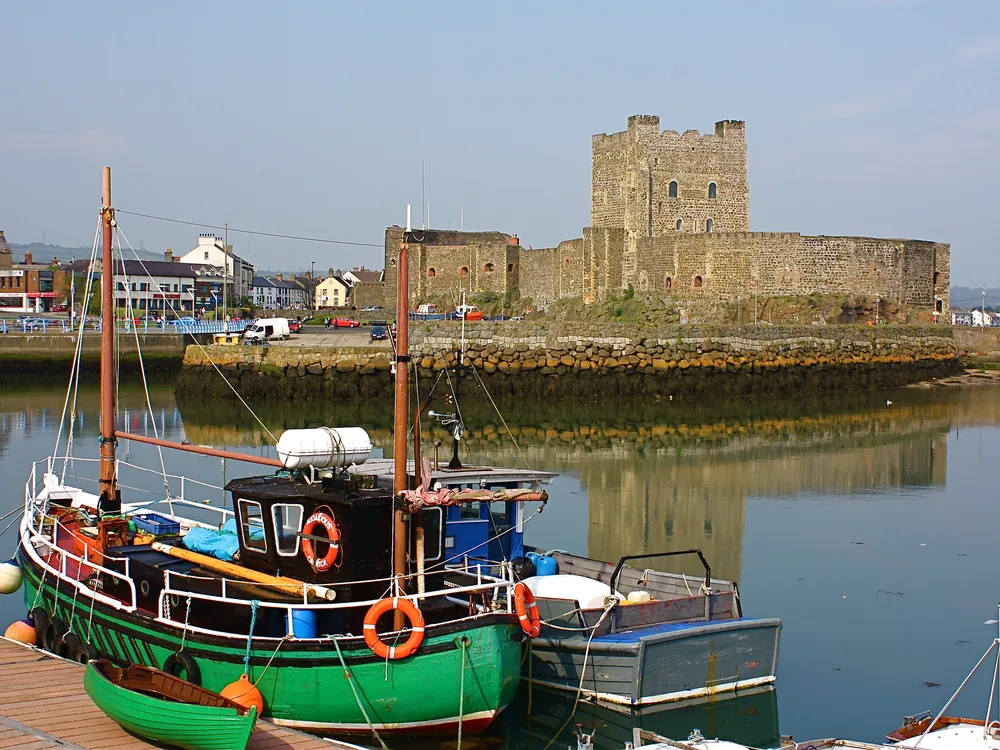
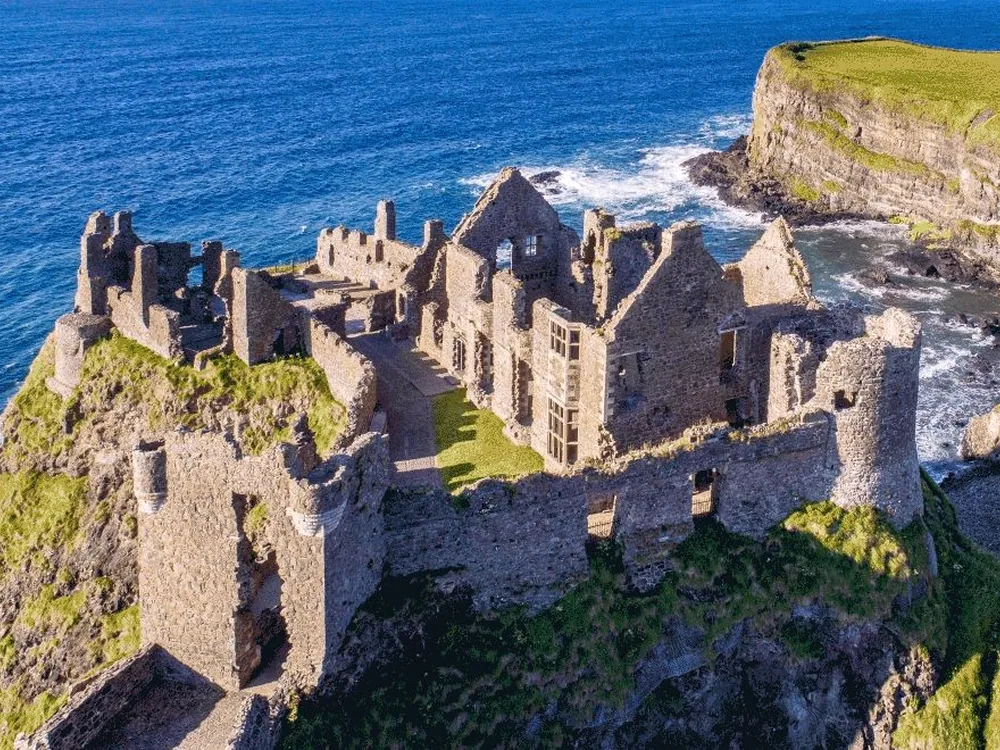
[Carrickfergus Castle](/castles/northern-ireland/carrickfergus-castle) is approximately 16 kilometres northeast along the Lough shore — a Norman castle dating from 1177, one of the best-preserved in Ireland, accessible in 25 minutes by car or by coastal bus. [Dunluce Castle](/castles/northern-ireland/dunluce-castle) is on the Antrim coast, approximately 90 kilometres north — a dramatically positioned medieval cliff-top ruin that is the iconic image of Northern Ireland's coastline. Together with Belfast Castle, these two provide a complete range of Northern Irish castle experience: Scottish Baronial Victorian free, Norman medieval paid, and cliff-top ruin dramatic.
History
O'Neill clan stronghold on Cave Hill in medieval period. Earlier castle ruins documented 17th century. Current Scottish Baronial castle built 1870 for 3rd Marquess of Donegall, designed by W.H. Lynn / Lanyon, Lynn & Lanyon. Wolfe Tone and United Irishmen oath at McArt's Fort, Cave Hill, 1795 (historically prior to the current building). Donegall family financial difficulties; castle sold 1934. Various private owners. Belfast City Council acquires 1978. Restoration and conversion to public visitor amenity. Current use: free public castle with restaurant, estate rooms, and Cave Hill Country Park access.
How to Visit
Getting there: Belfast Castle is on the Antrim Road on the lower slopes of Cave Hill, about 3 km north of the city centre. From Donegall Square take Metro Bus 1A or 1D — around 30 minutes. By car, follow the Antrim Road north; there is parking directly at the castle entrance. A taxi from the city centre costs around £10. Walking from the centre takes approximately 1 hour uphill.
Tickets: Free entry. The castle building, estate rooms, heritage exhibition, Cave Hill Country Park, and grounds are all free, maintained by Belfast City Council as a public amenity. Only the restaurant and café charge. The GetYourGuide tour — a private guided city tour by luxury vehicle covering Belfast Castle, the Titanic Quarter, Peace Walls, City Hall, and St George's Market — is the best option for a comprehensive private Belfast introduction; book in advance.
Practical tips: Check belfast-castle.co.uk before visiting — evening private functions occasionally restrict interior access to the main rooms. The Cave Hill walk to McArt's Fort at the summit (45 to 60 minutes each way) requires sturdy, non-slip footwear; conditions are wet underfoot after rain. Inside the castle, look for the 30+ cats hidden in stonework, plasterwork, stained glass, and furnishings — a family legend holds the castle prospers only while a white cat lives on the estate, and the hunt has become one of the best family activities in Northern Ireland.
Combine with: Carrickfergus Castle, a Norman castle from 1177 and one of the best-preserved in Ireland, is 16 km north-east along Belfast Lough — about 25 minutes by car. Dunluce Castle, the iconic cliff-top ruin on the Antrim coast, is 90 km north on the road to the Giant's Causeway.
Frequently Asked Questions
Yes — the castle building's ground floor rooms, heritage exhibition, and the estate grounds are all free of charge, maintained by Belfast City Council as a public amenity. There is no entry fee and no ticket required. Only the café and restaurant involve payment. Evening private functions occasionally restrict access to the interior rooms — check belfast-castle.co.uk if visiting for the interior rather than just the grounds.
Location
Antrim Road, Belfast BT15 5GR, Northern Ireland
Nearby Castles
Tours & Tickets
Powered by GetYourGuide
From
€116/ person