
Niedzica Castle
Zamek Niedzica
Poland · Lesser Poland (Pieniny Mountains) · Near Lapsze Nizne, near Zakopane
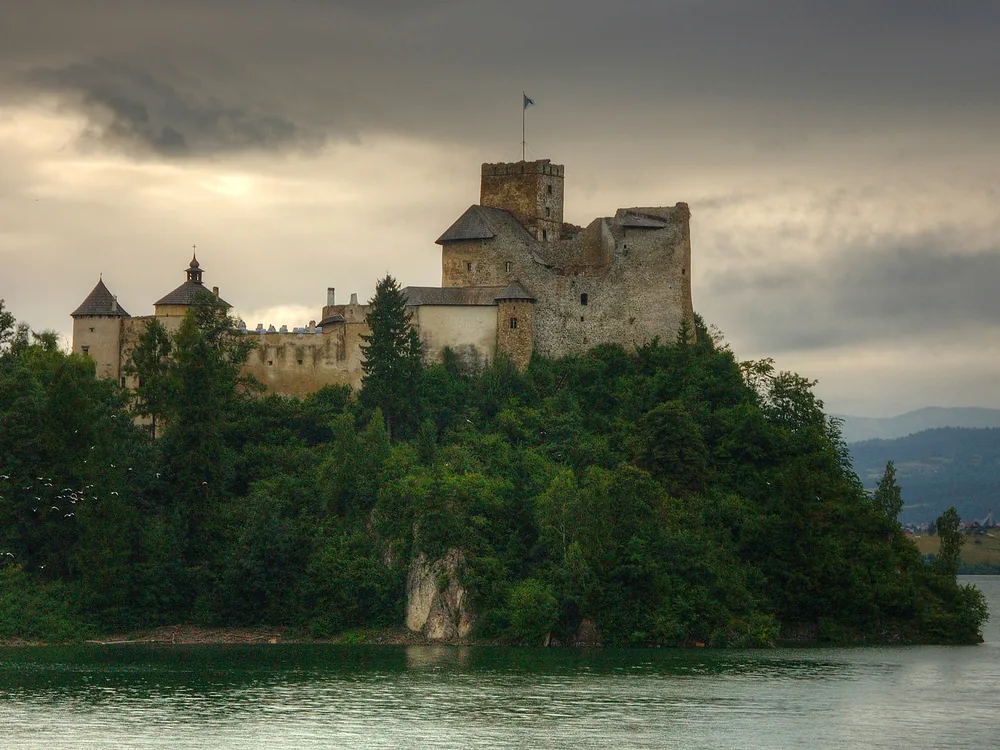
Built 1320 · 14th-century Gothic castle originally built by Hungarian nobility on the Dunajec River above the Polish-Hungarian border zone, on a rocky promontory that now overlooks the turquoise waters of Lake Czorsztyn (an artificial reservoir created in the 1990s); the castle changed hands between Polish and Hungarian noble families repeatedly across its medieval history as the border region shifted between kingdoms; the lower castle, upper castle, and gate complex survive in good condition; the GetYourGuide tour is primarily a Dunajec River rafting trip with a Niedzica stop included
This page is part of an independent travel guide and is not affiliated with, endorsed by, or operated by Niedzica Castle.
© Castles & Palaces
Quick Facts
- Hours
- Tue–Sun 09:00–17:00. Closed Mon
- Day trip from
- €97
- Duration
- 7-hour day trip (rafting + castle stop); 1.5–2 hours at the castle independently
- Best time
- May to September
- Booking
- Required — book 2+ days ahead
- Nearest city
- Lapsze Nizne, near Zakopane
Featured Tour
From Zakopane: Dunajec River Rafting & Niedzica Castle Day Trip
Cancellation available · Instant confirmation
Highlights
- ✦IMPORTANT: The GetYourGuide tour is primarily a Dunajec River rafting trip through the Pieniny gorge, with a Niedzica Castle stop included — this is an outdoor adventure day focusing on the gorge landscape and traditional raft experience, not a dedicated castle-touring ticket; state clearly in content what the day involves
- ✦The Inca treasure legend: a story attributed to the Salamoński family (who held the castle in the 18th century) involves a Peruvian descendant of the Inca royal line who married into the family and hid a treasure document — a quipu, the knotted-cord information system used by the Inca — in the castle walls before dying; searches have been conducted; no treasure has been found; the legend is folklore, not documented history, but it is one of the more distinctive backstories attached to any Central European castle
- ✦Lake Czorsztyn, the turquoise artificial reservoir visible from the castle, was created in the 1990s by damming the Dunajec River — the lake flooded the former castle town of Czorsztyn on the opposite bank (whose ruins are still visible), and the submerged village and the new shoreline created a landscape of surpassing visual drama that makes Niedzica's promontory position one of the most photogenic castle sites in Poland
- ✦The traditional Dunajec gorge raft trip is a Pieniny Mountains institution: wooden rafts (tratwy) poled by górale (highlander) raftsmen in traditional costume have operated on this stretch of river since at least the 18th century, and the gorge walls rising 300 metres above the river on either side create one of the most dramatic natural settings of any river journey in Central Europe
- ✦The castle occupies a complex border history — built originally by Hungarian nobility in the 14th century, it passed between Polish and Hungarian families repeatedly as the Dunajec valley's control shifted across the centuries, and the border itself between Poland and what is now Slovakia still runs through the immediate region
Skip the queue with a guided tour
Skip-the-line tickets & expert guides
Before booking the GetYourGuide tour at Niedzica: the day trip is structured as a Dunajec River rafting experience that includes a castle visit, not as a castle visit that happens to offer rafting. The itinerary centres on the traditional wood-raft journey through the Pieniny gorge — approximately 18 kilometres of river between high limestone canyon walls, poled by górale (Polish highland) raftsmen in traditional embroidered costume — and includes a stop at Niedzica Castle before or after the rafting section. Visitors expecting to spend most of a full day at the castle will be disappointed; visitors expecting an outdoor mountain-and-river day in one of Poland's most spectacular natural landscapes, with a medieval castle added to the programme, will be very satisfied.
The castle itself is one of the most pictorially striking in Central Europe, not primarily because of the architecture — though the 14th-century stonework is well-preserved — but because of the water. Lake Czorsztyn, the turquoise reservoir visible from the castle's promontory position, was created in the 1990s by damming the Dunajec River below Niedzica. The lake's colour comes from the glacial and limestone mineral content of the Tatra and Pieniny mountain water — the same geology that gives Alpine lakes their characteristic pale blue-green. Before the dam, the Dunajec ran through a shallower valley here; the lake flooded the former castle town of Czorsztyn on the opposite bank, whose ruins are still visible above the waterline. The result is a landscape of considerable drama: the medieval castle on its promontory, the turquoise lake below, the visible ruins of the flooded town on the far shore, and the Pieniny limestone peaks rising behind.
Niedzica Castle was built in the early 14th century by Hungarian nobility. The exact founder is debated but the castle dates to the 1310s–1320s, constructed on a rocky promontory above the Dunajec as a border stronghold in the zone between the Kingdom of Poland and the Hungarian territories to the south. The Dunajec here formed a natural frontier, and the castle's position — high enough to command the river valley, rocky enough to be difficult to attack — reflects a clear strategic intent. Control of the promontory meant control of the river crossing.
The castle's political history is a sequence of ownership transfers that reflects the border zone's contested character. It passed between Hungarian noble families — the Berzeviczy, Drugeth, and others — and Polish families across the 14th and 15th centuries as the valley's political affiliations shifted. The Ottoman expansion into Hungary in the 16th century sent refugees and administrative refugees northward into the region, further complicating the ownership patterns. By the 18th century, the castle had passed to the Salamoński family of Polish-Hungarian mixed heritage, and it is from this period that the Inca treasure legend originates.
The legend deserves honest handling. The story, in its most common form, runs as follows: a descendant of the Inca royal line (variously said to be a granddaughter of the last Inca emperor Atahualpa) travelled to Europe, eventually married into the Salamoński family, and came to Niedzica with a document — a quipu, the knotted-cord recording system used by the Inca — recording the location of a hidden Inca treasure in the Andes. She died at Niedzica, the quipu was hidden in the castle walls, and the treasure remains unfound. Searches were conducted in the 20th century, including after a supposed quipu was found in the castle cellars in 1946; this object has been analysed and found likely to be a 20th-century recreation rather than a genuine Inca artefact. The treasure story is folklore, embellished over generations. It is also a highly effective piece of heritage narrative — no other Central European castle has an Inca dimension — and the castle museum presents it with appropriate scepticism while acknowledging the story's persistence and local cultural significance.
The Dunajec raft trip deserves its own explanation for visitors unfamiliar with the tradition. The Dunajec gorge between Sromowce Niżne (on the Polish side) and Szczawnica, approximately 18 kilometres, has been commercially rafted on traditional wooden tratwy since at least the 18th century, when Polish and Slovak highlanders used the river for timber floating. The raftsmen — górale in Polish highland costume including embroidered vests, felt hats, and traditional trousers — pole the flat-bottomed wooden rafts through the gorge using long poles, narrating the landscape in Polish and often other languages. The limestone walls of the gorge rise up to 300 metres above the river in places, making the passage one of the most visually enclosed and dramatic natural-landscape experiences in Central Europe. The rafting trip typically takes 2–2.5 hours depending on water level.
The practical combination of castle and gorge makes the Pieniny region one of Poland's most rewarding single-day destinations. Zakopane, the principal mountain resort of the Polish Tatras, is approximately 40 kilometres west; the Morskie Oko lake in the Tatra National Park is 50 kilometres west and can be combined with a Pieniny day for ambitious visitors. The drive between Zakopane and Niedzica on the mountain roads through Czorsztyn and the Pieniny foothills is itself one of the most scenic in southern Poland. From Kraków, the journey to Niedzica is approximately 110 kilometres; the castle is commonly included in Kraków-based tour itineraries as a half-day or full-day excursion.
The gorale raftsmen who pole the Dunajec tratwy are members of a distinct Highland cultural community whose identity — language, costume, music, and traditional crafts — differentiates them sharply from lowland Poles. The tourist raft industry on the Dunajec, commercially operated since the late 19th century, has become one of the more unusual examples of traditional craft practice sustained by heritage tourism: the pole-and-drift technique is genuine, the costumes are worn daily rather than for show, and the raftsmen's commentary on the gorge reflects real local knowledge passed through families who have worked this river for generations.
History
Niedzica Castle was built by Hungarian nobility in the 1310s–1320s on a rocky promontory above the Dunajec River in the contested border zone between the Kingdom of Poland and Hungarian territories. The castle changed hands between Polish and Hungarian families repeatedly across the medieval period as the valley's control shifted. By the 18th century it was held by the Salamoński family, from whose tenure the Inca treasure legend originates (a quipu allegedly brought by a South American descendant of the Inca royal line; the legend is folklore). The Dunajec River was dammed in the 1990s to create Lake Czorsztyn, flooding the former castle town on the opposite bank and transforming the castle's visual setting. The castle is now a museum and a stop on the traditional Dunajec gorge raft tour.
How to Visit
Getting there: Niedzica Castle is approximately 110 km south of Kraków via Nowy Targ and the Pieniny mountain roads — about 2 hours by car. From Zakopane: 40 km east. Limited public transport — buses from Nowy Targ to Niedzica (check current timetables). The GetYourGuide tour picks up from Zakopane.
Tickets: Walk-up entry €97 adult. The GetYourGuide tour — a 7-hour day trip combining traditional Dunajec River gorge rafting through the Pieniny limestone canyon with a Niedzica Castle stop, departing from the Pieniny rafting start point — book in advance.
Practical tips: The GetYourGuide tour is structured as a rafting day with a castle stop — not a dedicated castle tour; allow 1.5–2 hours if visiting independently. Wear non-slip shoes for the castle's steep stone stairs. June and July offer the most vivid turquoise colour on Lake Czorsztyn.
Combine with: Czorsztyn Castle directly across the lake — the ruined Hungarian-era fortress whose flooded town is visible beneath the water. The Dunajec gorge can also be rafted independently from Sromowce Niżne on the Polish side.
Frequently Asked Questions
Primarily a rafting trip. The Dunajec River gorge raft experience through the Pieniny gorge is the centrepiece of the GetYourGuide day trip; the Niedzica Castle visit is an included stop. If your main interest is spending extended time in the castle, you are better served by visiting independently. If you want an outdoor Pieniny day combining traditional rafting with a castle stop, the GetYourGuide tour is well-suited.
Location
Zamek Niedzica, 34-441 Niedzica, Poland
Nearby Castles
Tours & Tickets
Powered by GetYourGuide
From
€97/ person