
Wawel Royal Castle
Zamek Królewski na Wawelu
Poland · Lesser Poland · Near Kraków
Built 1038 · Medieval origins, comprehensively rebuilt as Renaissance palace 1504–1548 under Sigismund I
This page is part of an independent travel guide and is not affiliated with, endorsed by, or operated by Wawel Royal Castle.
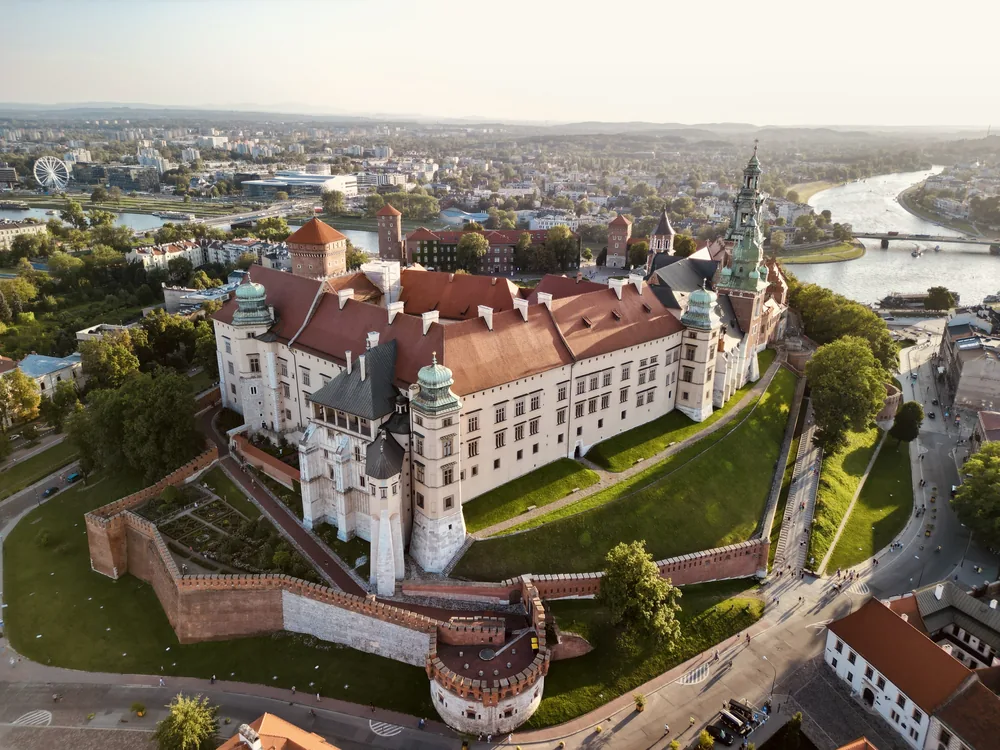
© Castles & Palaces
Quick Facts
- Hours
- Mon Grounds open all day. Museums: closed Monday.. Tue–Fri 09:30–17:00. Sat & Sun 10:00–17:00
- Skip-the-line from
- €34
- Duration
- 3–4 hours
- Best time
- April to June and September
- Booking
- Required — book 7+ days ahead
- Nearest city
- Kraków
Featured Tour
Krakow: Wawel Castle Guided Tour with Entry Tickets
Cancellation available · Instant confirmation
Highlights
- ✦The Renaissance courtyard — one of the finest Renaissance arcaded courtyards in central Europe, built by Italian masters for Sigismund I
- ✦The Royal Apartments — 71 rooms with Flemish tapestries commissioned by Sigismund Augustus, considered the finest tapestry cycle outside Brussels
- ✦Wawel Cathedral — the Gothic cathedral where Polish kings were crowned and where the tombs of 36 monarchs stand
- ✦The Wawel Dragon's Den — a limestone cave at the base of the hill, with a fire-breathing dragon sculpture at the entrance
- ✦The Crown Treasury and Armory — housing the Szczerbiec coronation sword (13th century) and Polish royal regalia
Skip the queue with a guided tour
Skip-the-line tickets & expert guides
Wawel Castle in Kraków is the symbolic heart of Poland — the hilltop complex of palace, cathedral and fortifications where Polish kings ruled for five centuries, where they were crowned in the cathedral, and where many of them are buried in its royal crypts. The hill itself, rising 228 metres above the Vistula River, has been occupied since at least the Neolithic period; the castle in its current Renaissance form was created between 1504 and 1548 by Sigismund I, who brought Italian masters from Florence and Padua to transform a Gothic fortress into a palace worthy of a European renaissance court.
The centrepiece of the castle is the arcaded Renaissance courtyard — three storeys of open arcades surrounding a rectangular courtyard, its proportions elegant and its stonework detailed. Around the courtyard are arranged the royal apartments, the cathedral and the fortifications. The royal apartments contain 71 rooms of which 24 are open to visitors, displaying the extraordinary cycle of Flemish tapestries commissioned by Sigismund Augustus — 136 survive of an original 365, depicting biblical and hunting scenes in vivid colour.
Wawel Cathedral, adjacent to the palace, is where Polish kings were crowned (from Władysław I in 1320) and where 36 monarchs are buried — including the great Jagiellonian dynasty kings and, controversially, President Lech Kaczyński, killed in the Smolensk air crash of 2010. The Bell of Sigismund, cast in 1520, is rung on national occasions and its sound — heard across Kraków — remains one of Poland's most powerful national symbols.
History
Wawel Hill has been an administrative centre since at least the 10th century, when Poland's first dynasty, the Piasts, established their seat here. Casimir III (the Great, r. 1333–1370) built the first significant stone castle. When the Jagiellonian dynasty came to power in 1386, Wawel became the seat of one of Europe's most powerful kingdoms — at its height in the late 15th and early 16th centuries, the Polish-Lithuanian Commonwealth stretched from the Baltic to the Black Sea.
The current Renaissance palace was built between 1504 and 1548 under Sigismund I and his son Sigismund Augustus, using Italian architects including Francesco Fiorentino and Bartolommeo Berecci. The move of the royal capital to Warsaw in 1596 began Wawel's decline as an active royal residence. Swedish invasions in the 17th century and Austrian occupation after the partitions of Poland (1772–1918) left the castle in poor condition. A major restoration campaign began after Polish independence in 1918 and continued through the 20th century.
How to Visit
Getting there: The castle is a 20-minute walk from Kraków's main railway station (Kraków Główny) along the Royal Way through the old town, or a 10-minute walk from the main market square (Rynek Główny). Trams stop near the castle entrance.
Tickets: The castle operates multiple separate exhibition circuits, each with a limited daily allocation of timed entry tickets. Book online well in advance — the Royal Apartments in particular sell out quickly. The cathedral and Dragon's Den are ticketed separately.
The Dragon's Den: The limestone cave at the base of Wawel Hill (separate ticket, small fee) is a short walk through atmospheric passages, ending at the river with the fire-breathing dragon sculpture — popular with children.
Practical tips: April to June and September–October — pleasant weather, the castle gardens and Vistula riverbank at their best. Book at least 7 days ahead.
Combine with: Kraków old town (UNESCO — the largest medieval market square in Europe), the Kazimierz Jewish quarter, and the Auschwitz-Birkenau Memorial (80km, 1.5 hours by bus) for a full Kraków itinerary.
Frequently Asked Questions
The Wawel Dragon (Smok Wawelski) is the most famous creature in Polish folklore — a fire-breathing dragon said to have lived in the cave at the base of Wawel Hill, devouring livestock and terrorising the city until a clever cobbler's apprentice named Skuba killed it by feeding it a sheep stuffed with sulphur. The dragon drank from the Vistula until it burst. A fire-breathing sculpture of the dragon by Bronisław Chromy stands at the cave entrance and breathes real fire (natural gas) every few minutes.
Location
Wawel 5, 31-001 Kraków, Poland
Nearby Castles
Tours & Tickets
Powered by GetYourGuide
From
€34/ person