Malbork Castle
Zamek w Malborku
Poland · Pomerania · Near Gdańsk
Built 1274 · Gothic brick
This page is part of an independent travel guide and is not affiliated with, endorsed by, or operated by Malbork Castle.
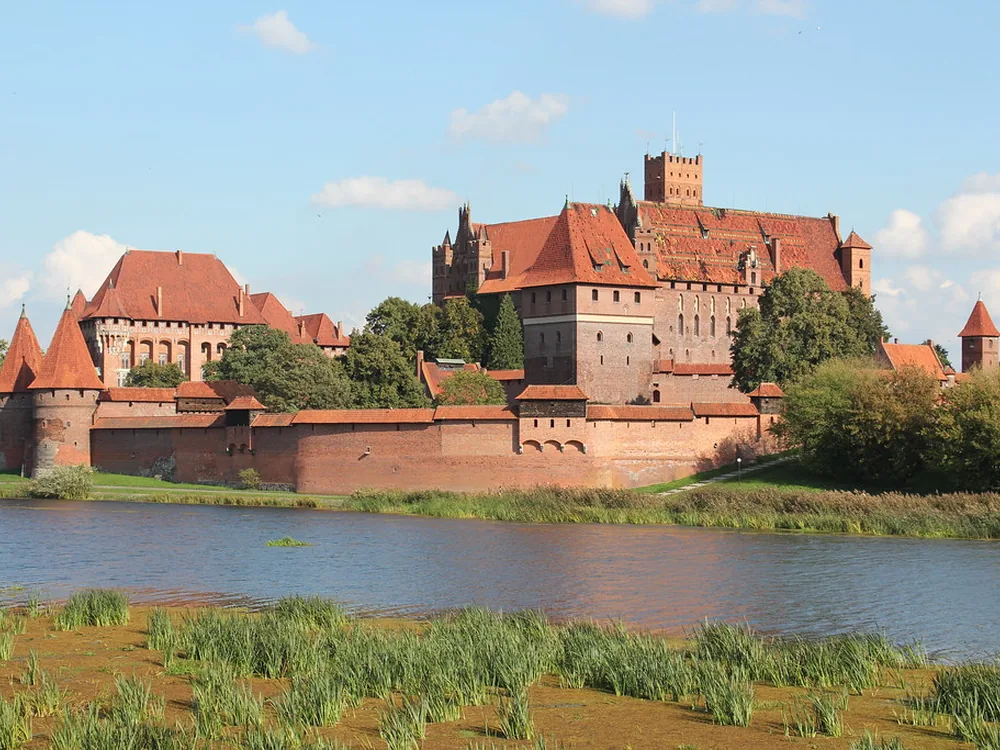
© Unsplash
Quick Facts
- Hours
- Mon Closed (Oct–Apr). Tue–Sun 10:00–17:00
- Day trip from
- €90
- Duration
- 3–4 hours
- Best time
- June to August
- Nearest city
- Gdańsk
Featured Tour
From Gdansk: Half-Day Malbork Castle Tour with Audioguide
Cancellation available · Instant confirmation
Highlights
- ✦The largest castle in the world by land area — 21 hectares of Gothic brick fortification
- ✦UNESCO World Heritage Site since 1997
- ✦The seat of the Teutonic Knights, who controlled Baltic trade for two centuries
- ✦The Great Refectory — a vaulted Gothic hall of extraordinary scale and elegance
- ✦The Light Festival each August projects illuminated narratives onto the castle walls at night
Tickets & tours
Book through GetYourGuide
Superlatives are inevitable at Malbork. It is the largest castle in the world by area — 21 hectares of Gothic brick fortification spread across three linked castles on a bend of the Nogat river. It is the largest brick building in the world. It was the headquarters of one of the most powerful military orders in medieval history. And it was almost entirely destroyed in 1945, then rebuilt brick by brick over sixty years in one of Poland's most determined acts of cultural reconstruction.
The castle was built by the Teutonic Knights — a German crusading military order founded during the Third Crusade — who established it as their Grand Master's residence and the capital of their Baltic state in 1309. From Malbork, the Knights controlled the Vistula delta, the amber trade, and a territory stretching from Prussia to Estonia. At its height in the early 15th century, the Teutonic Order was one of the most formidable political and military powers in Europe.
The High Castle, the oldest section, is also the most architecturally refined: its chapter house, church and Golden Gate represent Gothic brick architecture at its most ambitious. The Middle Castle, built for the Grand Masters, contains the Great Refectory — a palm-vaulted hall of extraordinary elegance whose thin granite columns spread into a canopy overhead, considered one of the masterpieces of Gothic secular architecture. The Outer Castle housed the garrison, craftsmen, hospital and stables — a self-contained medieval city.
Malbork's near-total destruction in 1945 and its subsequent reconstruction over decades gives the castle an additional resonance: a physical argument, in millions of carefully numbered and replaced bricks, about the meaning of cultural memory.
History
The Teutonic Knights began constructing Malbork (then called Marienburg — 'Mary's Fortress') in 1274 on the eastern bank of the Nogat river. The Order had been invited to Prussia in 1226 by the Polish Duke Konrad of Masovia to convert the pagan Baltic Prussians — a mission that expanded, over the following century, into the conquest of the entire southeastern Baltic coast.
In 1309, Grand Master Siegfried von Feuchtwangen moved the Order's headquarters from Venice to Marienburg, beginning a major expansion that transformed the original castle into the enormous complex that survives today. The following century was the Order's golden age: Malbork became the administrative capital of a Baltic state that controlled most of what is now northern Poland, Kaliningrad and Lithuania, and extracted enormous wealth from the amber trade, grain exports and river tolls.
The decline began at Grunwald (Tannenberg) on 15 July 1410, when a joint Polish-Lithuanian army under King Władysław II Jagiełło inflicted the most catastrophic defeat in the Order's history, killing over 200 knights including the Grand Master. Malbork withstood a subsequent siege — one of the most dramatic in medieval European history — but the Order never recovered its former power. In 1457, facing bankruptcy, the Grand Master sold the castle to King Casimir IV of Poland for the equivalent of an army's back pay.
For the next three centuries, Malbork served as a Polish royal residence, then fell into disrepair under Prussian ownership after the partitions of Poland in the 18th century. A major German restoration project between 1817 and 1942 reconstructed much of what the centuries had damaged — ironically making the work of 1945 destruction and subsequent Polish reconstruction even more extensive. Soviet and Polish forces fought through the castle district in early 1945; by the time the battle ended, approximately 50% of the structure had been destroyed. Polish conservators began the post-war reconstruction in 1962, completing the main phases in the early 2000s.
How to Visit
Getting there: Malbork is on the main railway line between Gdańsk and Warsaw. Direct trains from Gdańsk run approximately every hour (30–40 min, €5–8). From Warsaw, direct trains take about 3 hours. Malbork station is a 10-minute walk from the castle. A day trip from Gdańsk is entirely practical and strongly recommended.
Guided tours: The ticket price includes a guided tour, which is the best way to navigate the three-castle complex and understand the historical layers. Tours in English run at set times (check the website). A self-guided audio tour is also available. Without a guide, the sheer scale of the complex can be disorienting.
What to prioritise: If time is limited, focus on the High Castle (most architecturally refined, oldest section) and the Great Refectory in the Middle Castle (the single most impressive interior). The museum collections inside include extraordinary amber objects collected by the Teutonic Knights.
Light Festival: Each August (usually the second or third weekend), the Malbork Light Festival projects animated narratives from the castle's history onto its walls after dark. The combination of Gothic silhouette and projected light is one of the most spectacular events in Eastern Europe. Book accommodation in Malbork or Gdańsk weeks in advance for this weekend.
Tickets: Walk-up entry €12 adult, €7 child. The GetYourGuide tour — From Gdansk — offers a guided visit; book in advance.
Practical tips: June to August — warm and long days make exploring the vast grounds comfortable.
Combine with: Gdańsk's remarkable Old Town — almost entirely rebuilt after 1945 destruction, like Malbork — makes a natural 1–2 day base. The Hanseatic architecture of Długa Street, St. Mary's Church (one of the largest brick Gothic churches in the world) and the waterfront Motława district are all extraordinary.
Frequently Asked Questions
Yes — by land area, Malbork is the largest castle in the world at approximately 21 hectares. It surpasses Prague Castle (which claims the title of largest 'ancient castle' by a different measurement) and Mehrangarh in India. The complex comprises three linked castles — the High Castle, Middle Castle and Outer Castle — on the Nogat river in northern Poland.
Location
Starościńska 1, 82-200 Malbork, Poland
Nearby Castles
Tours & Tickets
Powered by GetYourGuide
From
€90/ person