
Pomeranian Dukes' Castle
Zamek Książąt Pomorskich w Szczecinie
Poland · West Pomerania · Near Szczecin
Built 1346 · Pomeranian Renaissance with Gothic foundations — a five-wing palace complex around two inner courtyards; distinctive blend of Flemish Renaissance, German late Gothic, and Scandinavian mannerist elements reflecting the Pomeranian dukes' Baltic connections
This page is part of an independent travel guide and is not affiliated with, endorsed by, or operated by Pomeranian Dukes' Castle.
© Castles & Palaces
Quick Facts
- Hours
- Tue–Sun 10:00–18:00. Closed Mon
- Guided tour from
- €89
- Duration
- 1–2 hours (exterior, courtyards, Bell Tower); the private walking tour adds Wały Chrobrego promenade and Royal Gate
- Best time
- April to October
- Nearest city
- Szczecin
Featured Tour
Szczecin: Pomeranian Dukes' Castle Exterior Private Walking Tour
Cancellation available · Instant confirmation
Highlights
- ✦The two inner courtyards — the castle's primary exterior experience, two interconnected Renaissance courtyards with arcaded galleries and the characteristic Pomeranian blend of Gothic structure and Renaissance ornament
- ✦The Bell Tower (Wieża Dzwonów) — the castle's freestanding bell tower, periodically open for panoramic views across the Oder river, the harbour, and the West Pomeranian landscape
- ✦The exterior architecture — a five-wing palace complex built in a distinctive Pomeranian Renaissance style that reflects the dukes' connections with Flemish, Scandinavian, and German courts; one of the most significant Renaissance palace complexes in the western Polish lands
- ✦Wały Chrobrego promenade (3-hour tour option) — the long embankment above the Oder, designed by a student of Karl Friedrich Schinkel in the 1900s and one of the most impressive urban waterfront promenades in Poland
- ✦Royal Gate at Solidarity Square — a Baroque triumphal arch in the old city centre, one of Szczecin's most photographed landmarks; included in the 3-hour private walking tour option
- ✦First northwestern Poland castle on this site — Szczecin is in a different Poland from Kraków/Warsaw/Wrocław; this is the site's first entry in northwestern Poland and the Pomeranian historical region
Skip the queue with a guided tour
Skip-the-line tickets & expert guides
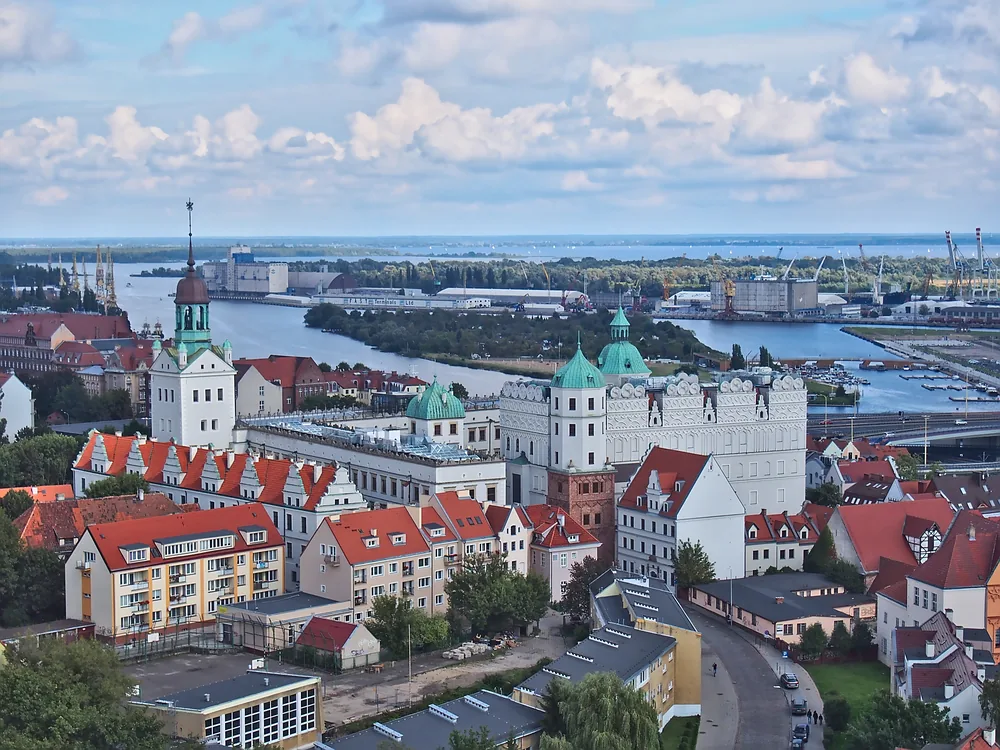
The Pomeranian Dukes' Castle in Szczecin is the largest historic castle complex in northwestern Poland and the principal monument of the House of Griffins — the Pomeranian Slavic dynasty that ruled the Duchy of Pomerania for over four centuries, from 1121 until the death of the last duke, Bogislaw XIV, in 1637. The castle stands on a gentle hill in the heart of Szczecin's old city, its five wings arranged around two inner courtyards in the Pomeranian Renaissance style that distinguished the Baltic dukes' architectural patronage from both Polish and German court buildings of the same period.
Pomerania — the Baltic coastal region stretching roughly from the Oder estuary eastward to the Vistula mouth — was one of medieval Europe's more distinctive political spaces: a Slavic duchy that remained independent of both Poland and the Holy Roman Empire for long periods, converted to Christianity under Polish influence in the 12th century but subsequently absorbed into the German cultural sphere through colonisation, trade, and dynastic marriages. The ruling House of Griffins (named for the heraldic griffin that dominates Pomeranian symbolism) maintained this dual Slavic/German identity for centuries, and the architecture of the Szczecin castle reflects it: the Gothic structural elements are from the earliest phases of the building; the Renaissance additions of the 16th century reflect the duchy's orientation toward the Flemish and Scandinavian courts; and the overall scale and ambition of the complex signals a dynasty that was economically prosperous from Baltic trade and politically sovereign within its territory.
The castle in its current form developed from a 14th-century Gothic original. The major Renaissance rebuilding occurred in the 1570s–1580s under Duke John Frederick, who brought craftsmen from Flanders and the German territories to transform the Gothic structure. The result was the five-wing palace complex with its distinctive arcaded courtyards — the architecture of a Renaissance court adapted to a northern European climate and a Baltic cultural context. The Bell Tower, built separately in the castle grounds, functioned as the carillon tower for the collection of bronze bells cast in the 17th century.
The castle's history as a Pomeranian ducal seat ended with the dynasty's extinction in 1637. The Thirty Years' War — raging across the Holy Roman Empire since 1618 — had already drawn Pomeranian territory into its orbit, and the duchy was partitioned between Swedish Pomerania (the western part) and Brandenburg-Prussia (the eastern part) after the Peace of Westphalia in 1648. The castle became a Swedish administrative building; later, a Prussian barracks and wine cellar; and after German reunification in 1945 (when Szczecin, as Stettin, transferred from Germany to Poland), a cultural institution. The castle's interior museums — which covered the history of the Pomeranian dynasty and the decorative arts of the Baltic region — are currently temporarily closed for renovation; the courtyard and exterior architecture remain accessible.
The private walking tour listed on GetYourGuide (€89, 2–3 hours, English/German/Polish guide) covers the castle exterior and the two inner courtyards, followed by a walk to additional Szczecin sites. The 2-hour option concentrates on the castle; the 3-hour option extends to the Wały Chrobrego promenade — the grand embankment terrace above the Oder river, designed in the early 20th century in an eclectic historicist style by a student of Karl Friedrich Schinkel, with sweeping views across the river and the harbour — and the Royal Gate in Solidarity Square (Plac Solidarności), a Baroque triumphal arch erected in the 18th century to commemorate a royal visit and now one of Szczecin's most recognisable landmarks. The GetYourGuide listing explicitly notes that the tour shows only the exterior and courtyards of the castle due to the temporary closure of the interior museums — an important clarification to set expectations correctly before booking.
Szczecin (Stettin in German) is a city whose identity spans Polish and German history. The city was German-majority and known as Stettin until 1945, when the Potsdam Agreement transferred the city to Poland along with the rest of Silesia and Pomerania east of the Oder-Neisse Line; the German population was expelled and replaced by Poles, many of them resettled from eastern territories that Poland lost to the Soviet Union. The Pomeranian Griffin Dynasty's castle thus now stands in a Polish city on the site of what was for centuries a German port — a layered history that the castle's architecture, positioned between Slavic foundations and Germanic Renaissance decoration, already encoded before the 20th-century population exchanges made the duality explicit.
For visitors to Poland who have seen the standard south/central circuit — Kraków, Wrocław, Warsaw, Malbork — Szczecin represents a genuinely different regional character: a Baltic port city with a Hanseatic and Pomeranian heritage, geographically closer to Hamburg than to Kraków, and architecturally distinct from the Brick Gothic of Malbork or the Renaissance Italianate of Kraków. The Pomeranian Dukes' Castle is the best single building in which to encounter that distinction.
History
Gothic castle foundation in the 14th century under the Pomeranian Griffin dynasty. Major Renaissance rebuilding in the 1570s–1580s under Duke John Frederick, using Flemish and German craftsmen. Dynasty extinct 1637 with the death of Duke Bogislaw XIV; castle passed to Swedish Pomerania, then to Brandenburg-Prussia. Used as barracks and wine cellar under Prussian/German rule. Transferred to Poland 1945 when Stettin became Szczecin; converted to cultural institution. Interior museums temporarily closed; courtyards and exterior accessible.
How to Visit
Getting there: The Pomeranian Dukes' Castle is a 10-minute walk from Szczecin Główny station through the historic centre. IC trains connect Szczecin to Berlin (2 hours) and Warsaw (4.5 hours); the castle makes an easy day trip from Berlin.
Tickets: Free entry. The castle exterior and both inner courtyards are accessible during daylight hours at no charge. The GetYourGuide tour — a 2–3-hour private walking tour in English, German, or Polish covering the castle exterior, courtyards, and optional extension to the Wały Chrobrego promenade and the Royal Gate at Solidarity Square — book in advance.
Practical tips: The interior museums are temporarily closed — verify current status at zamek.szczecin.pl before visiting. The Bell Tower (Wieża Dzwonów) has periodic opening hours for panoramic views over the Oder river; check the castle website for current times. Allow at least 1.5 hours to walk the two courtyards and the exterior before continuing into the old town.
Combine with: Malbork Castle — the Teutonic Knights' Gothic fortress on the Vistula, the largest castle in the world by surface area. Wisłoujście Fortress in Gdańsk — a star-shaped maritime fortress at the mouth of the Vistula guarding the Baltic trade route.
Frequently Asked Questions
No — the castle's interior museums are temporarily closed at the time of this listing (July 2026). The GetYourGuide tour explicitly describes an 'Exterior Private Tour' and notes that only the exterior architecture and inner courtyards can be visited. Check zamek.szczecin.pl for the latest status before booking, as the closure is described as temporary.
Location
ul. Korsarzy 34, 70-540 Szczecin, Poland
Nearby Castles
Tours & Tickets
Powered by GetYourGuide
From
€89/ person