
Poznań Imperial Castle
Zamek Cesarski w Poznaniu
Poland · Greater Poland Voivodeship — Poznań, Imperial Quarter (Dzielnica Cesarska) · Near Poznań
Built 1910 · Neo-Romanesque and Neo-Gothic Wilhelmine imperial palace, built 1905–1910 by Franz Schwechten (architect of Berlin's Kaiser Wilhelm Memorial Church) as the only purpose-built imperial residence of Kaiser Wilhelm II; interior extensively remodelled in stripped-classical style by Nazi architects in the early 1940s for Hitler's anticipated — but never realised — visits; underground circular bunker added during the Nazi occupation; now the CK ZAMEK multidisciplinary cultural centre
This page is part of an independent travel guide and is not affiliated with, endorsed by, or operated by Poznań Imperial Castle.
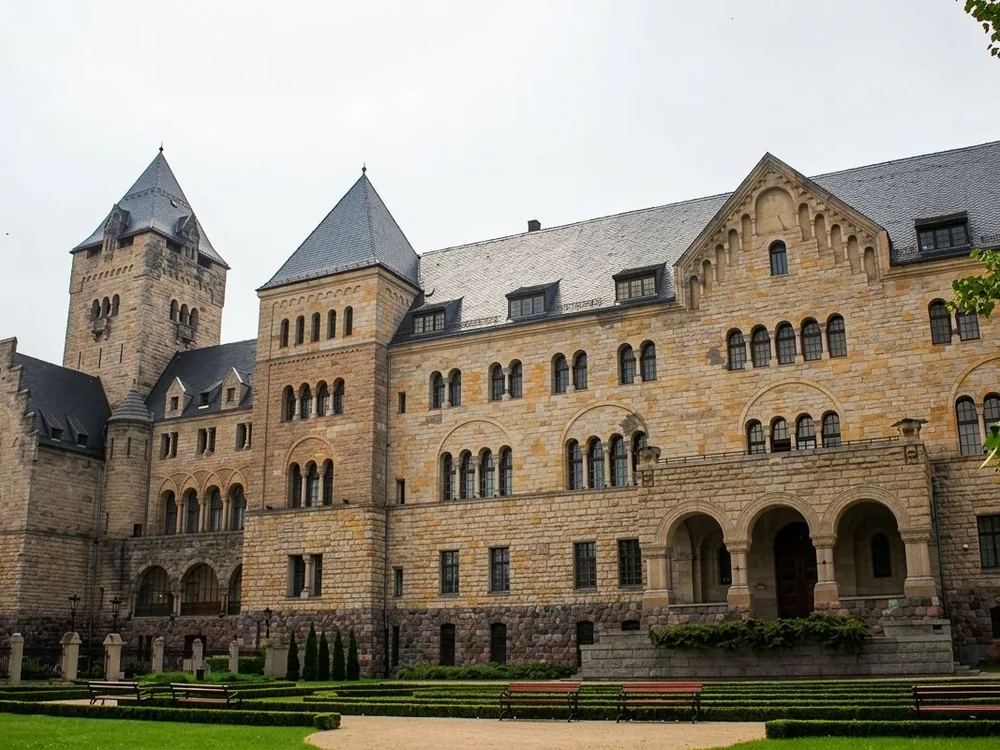
© Castles & Palaces
Quick Facts
- Hours
- Tue–Sun 10:00–19:00. Closed Mon
- Guided tour from
- €130
- Duration
- 2 hours (private guided walking tour)
- Best time
- Year-round
- Booking
- Required — book 1+ days ahead
- Nearest city
- Poznań
Featured Tour
Poznań Imperial Castle District: Private Walking Tour
Cancellation available · Instant confirmation
Highlights
- ✦The only purpose-built imperial castle commissioned by Kaiser Wilhelm II — built 1905–1910 in Posen (Poznań) as a deliberate architectural assertion of German imperial power at the centre of a predominantly Polish city during the era of systematic Germanisation
- ✦Designed by Franz Schwechten — architect of Berlin's Kaiser Wilhelm Memorial Church — in neo-Romanesque style, with a deliberately Germanic architectural language chosen to project imperial authority rather than reflect the Polish civic tradition of the surrounding city
- ✦The Nazi interior alterations — Hitler's architects remodelled the building in stripped-classical style for anticipated visits that never occurred, adding a circular concrete bunker beneath the castle; the Führer never came, leaving behind one of the stranger architectural ghost stories of the Second World War
- ✦The Imperial Quarter (Dzielnica Cesarska) surrounding the castle — a planned ensemble of Wilhelmine administrative buildings constructed in the 1900s as a unified German administrative landscape inserted into the historic Polish city, comparable to similar imperial urban interventions in Alsace-Lorraine
- ✦The private 2-hour guided walking tour provides the structured historical interpretation that the building's three-layer complexity demands: Wilhelmine imposition, brief Polish appropriation, and Nazi remodelling condensed into a single structure that outlived every regime that claimed it
Skip the queue with a guided tour
Skip-the-line tickets & expert guides
The Poznań Imperial Castle is the only purpose-built imperial castle to emerge from the reign of Kaiser Wilhelm II — a distinction that makes it unique in European architecture, and one that reflects the very specific circumstances of its creation. Built between 1905 and 1910 in what was then Posen, the Prussian province carved from Polish territory during the 18th-century partitions, the castle was designed by Franz Schwechten — the same architect responsible for Berlin's Kaiser Wilhelm Memorial Church — as a deliberate architectural statement of German imperial power in a city with a predominantly Polish population. The result is an imposing neo-Romanesque and neo-Gothic complex that has never quite belonged to the city it was built in, accumulating layers of contested historical meaning that make it one of the most architecturally complex and historically freighted buildings in Poland.
Kaiser Wilhelm II stayed here only a handful of times. The castle was completed in 1910, just four years before the First World War, and the outbreak of hostilities in 1914 transformed the context entirely: Posen became a garrison city rather than an imperial showpiece. The armistice of 1918 and the return of Poznań to the newly independent Polish Republic in 1919 ended whatever role the castle had been designed to play. Polish authorities adapted the building for civic and cultural use during the interwar period.
The most disturbing chapter came with the German occupation of World War II. Nazi architects undertook a systematic interior remodelling of the castle in preparation for Hitler's anticipated visits — which never occurred. The stripped-classical Nazi interior, the circular concrete bunker constructed beneath the building, and the architectural layering of three distinct imperial ideologies (Wilhelmine, Polish interwar, Nazi) within a single structure give Poznań's Imperial Castle an exceptional historical density. Visitors engage not with one imperial vision but with three successive attempts to make the same building mean different things.
The GetYourGuide private walking tour (2 hours) provides the structured historical interpretation that the building's complexity demands. A licensed local guide covers the castle's exterior architecture, accessible interior areas of the CK ZAMEK cultural centre, and the surrounding Imperial Quarter — the planned ensemble of Wilhelmine administrative buildings (including the former Royal Academy of Fine Arts and the provincial government offices) that was constructed around the castle in the 1900s as a unified German administrative landscape imposed on the historic Polish city.
For those who prefer independent exploration, the CK ZAMEK cultural centre has publicly accessible areas during opening hours and operates a regular programme of concerts, exhibitions, and film screenings — one of Poznań's most active arts venues in a building whose turbulent past gives every performance an added layer of context. The freely accessible exterior and the surrounding Imperial Quarter streets give a strong impression of the castle's imposing bulk and architectural ambition even without a guide; the tour adds the interior interpretation and the historical narrative that the stonework alone cannot provide.
History
The construction of the Poznań Imperial Castle was explicitly political in intent. The late 19th and early 20th centuries saw the German Empire pursuing a systematic Germanisation of its eastern provinces — imposing German administrative, cultural, and architectural imagery on the landscape of Posen (Poznań), a city with a predominantly Polish population that the Prussian state had absorbed during the 18th-century partitions. Building a new imperial residence here — the only new palace commissioned by Wilhelm II — placed a deliberate symbolic marker of German imperial authority at the centre of a Polish city.
Franz Schwechten designed the castle in neo-Romanesque style between 1902 and 1910, drawing on German Romanesque prototypes in an architectural language deliberately associated with German national identity rather than Polish tradition. The building was completed in 1910. Wilhelm II visited rarely; the symbolic function far exceeded the practical residential one.
Polish independence in 1919 transferred the building to Polish state use. The Nazi occupation beginning in 1939 brought the most disruptive physical alteration: interior remodelling in stripped-classical style, the construction of an underground circular bunker, and the reordering of the building for Hitler's planned — but never realised — visits. The Führer never came. Post-war, the castle was gradually converted into the CK ZAMEK cultural centre, which operates it today as one of Poland's leading multidisciplinary arts venues.
How to Visit
Getting there: The Imperial Castle is in central Poznań on ul. Święty Marcin, a 15-minute walk from Poznań Główny train station or a short tram ride (lines 6, 18, or 23 to the Teatr Polski stop). By rail, Poznań is 2.5 hours from Warsaw and 3 hours from Wrocław. The castle is at the edge of the Imperial Quarter, easily combined with the Old Town on foot.
Tickets: The CK ZAMEK cultural centre has publicly accessible areas during opening hours (free entry). The GetYourGuide private guided walking tour is a 2-hour private tour with a licensed local guide covering the Imperial Castle's exterior architecture, accessible interior areas, and the surrounding Imperial Quarter — the structured option for historical interpretation of the building's complex Prussian-Polish-Nazi history. The €130 is the price of a private guide, not castle admission. Book at least a day in advance through the GetYourGuide booking link.
Practical tips: The castle's exterior and the Imperial Quarter streets are accessible for free at any time and are worth a slow walk even without a guide — the sheer scale of the Wilhelmine ensemble and its incongruity with the surrounding Polish city is immediately legible. The full historical significance of the interior, the bunker, and the Nazi remodelling requires the guided tour. The nearby Poznań Old Town (Stare Miasto) is 10 minutes' walk east and makes a natural pairing with the castle visit.
Combine with: The Poznań Old Town (Stare Miasto) and the Renaissance Old Town Hall — just 10 minutes' walk from the castle — form a natural continuation from the Imperial Quarter, contrasting the Prussian architectural imposition of the 1900s with Poznań's own 16th-century civic identity.
Frequently Asked Questions
The CK ZAMEK cultural centre, which occupies the castle building, has publicly accessible areas during its opening hours with no admission charge — and it operates an active programme of concerts, exhibitions, theatre, and film screenings that are often open to the public. The castle exterior and the surrounding Imperial Quarter streets can be explored freely at any time. The GetYourGuide private guided walking tour adds a licensed local guide who covers the interior's accessible areas, the architectural history, and the Nazi-era alterations — a genuinely valuable addition given the complexity of the building's layered history.
Location
ul. Święty Marcin 80/82, 61-809 Poznań, Poland
Nearby Castles
Tours & Tickets
Powered by GetYourGuide
From
€130/ person