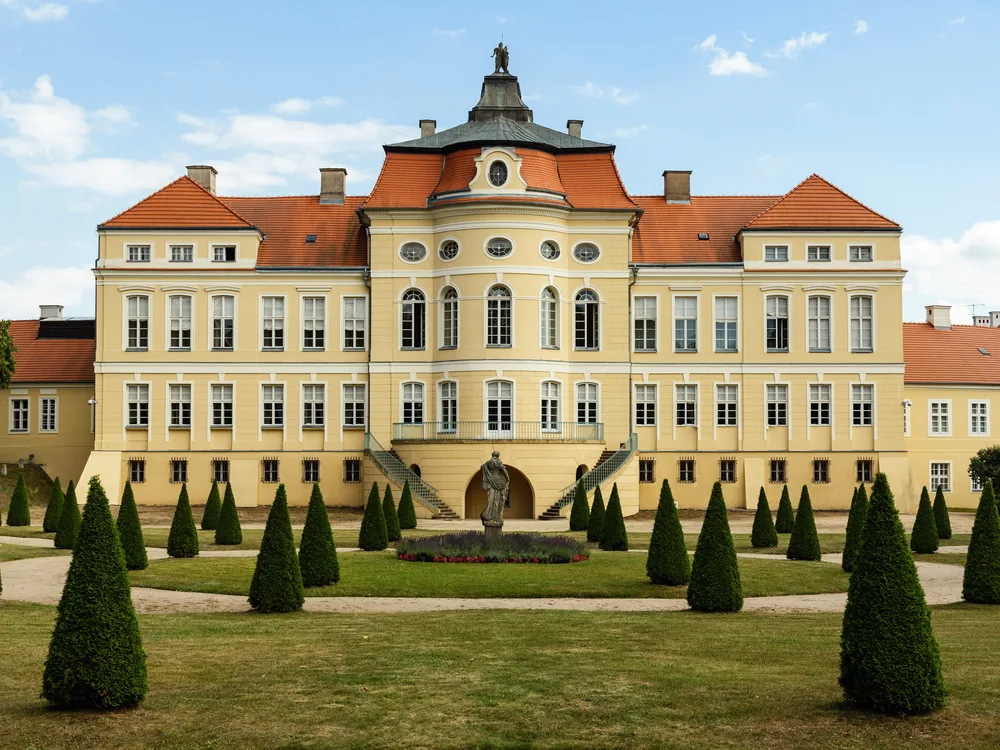
Rogalin Palace
Pałac w Rogalinie
Poland · Greater Poland Voivodeship (Wielkopolska) — Rogalin village, near Mosina, Poznań County · Near Poznań
Built 1770 · Baroque palace with neoclassical elements, late 18th century, with English landscape park — built for Kazimierz Raczyński, Voivode of Greater Poland, in the late 18th century; the main palace building is a Baroque composition in the tradition of Central European aristocratic residences; the flanking wings and service buildings were added in the early 19th century; the palace grounds include a formal French garden adjacent to the building and an extensive English landscape park with the famous ancient oak grove; the coach house adjacent to the palace was converted into an art gallery in the early 20th century by Edward Raczyński (Count, politician, and later President of Poland in exile), who installed a collection of Polish and European painting; the oaks of Rogalin — including the three ancient named specimens Lech, Czech, and Rus — are the most famous living feature of the estate
This page is part of an independent travel guide and is not affiliated with, endorsed by, or operated by Rogalin Palace.
© Castles & Palaces
Quick Facts
- Hours
- Tue–Sun 10:00–17:00. Closed Mon
- Guided tour from
- €67
- Duration
- 1.5–2 hours (palace interior, art gallery, formal garden, and walk to the oak grove)
- Best time
- May to September
- Nearest city
- Poznań
Featured Tour
Kornik Castle and Rogalin Palace Half-Day Private Tour
Cancellation available · Instant confirmation
Highlights
- ✦Three ancient named oaks: Lech, Czech, and Rus — the oak grove at Rogalin contains over 1,000 ancient trees, including three specimens named after the legendary brothers who founded the Polish, Czech, and Rus' nations according to medieval myth; these three trees, several centuries old with trunks several metres in circumference, became national symbols of Slavic cultural continuity during the Polish romantic period; they are living monuments in every sense — protected, individually identified, and visited by Poles who regard them as the arboreal equivalent of historical landmarks
- ✦The Raczyński art collection — Polish painting and European masters — the coach house of the Rogalin estate was converted in the early 20th century by Edward Raczyński into an art gallery housing the family's collection; the gallery includes significant works of Polish painting — Jan Matejko (the canonical painter of Polish historical subjects in the romantic era), Jacek Malczewski, Józef Brandt, and others — alongside European paintings of the 17th and 18th centuries; the collection, administered by the National Museum in Poznań, gives Rogalin an art gallery dimension unusual among estate museum visits
- ✦Baroque palace of a major Polish aristocratic family — the Raczyński family were one of the most prominent noble clans in Greater Poland across the 18th and 19th centuries; Kazimierz Raczyński, who built the palace in the 1770s–80s, was Voivode of Greater Poland; Edward Raczyński (1786–1845) was a collector, bibliophile, and supporter of Polish culture; Count Edward Raczyński (1891–1993), who donated the estate to Poland, was President of the Republic of Poland in exile from 1979 to 1986
- ✦English landscape park — the estate grounds include a formal French garden adjacent to the palace and an extensive English landscape park of several dozen hectares, with mature specimen trees, natural meadows, and the famous ancient oak grove; the park is accessible year-round and is one of the most pleasant walking landscapes of any Polish estate
- ✦Natural pairing with Kórnik Castle — Rogalin and Kórnik Castle are approximately 10km apart and routinely combined in a half-day excursion from Poznań; the GYG private tour (t26512) covers both with hotel pickup, transport, guide, and entrance tickets in a four-hour programme
Skip the queue with a guided tour
Skip-the-line tickets & expert guides
The three oaks named Lech, Czech, and Rus are the most immediately graspable thing about Rogalin for a visitor unfamiliar with the estate. They stand in the English landscape park that extends beyond the palace's formal French garden — three trees of several centuries' growth, their trunks several metres in circumference, their canopies occupying a substantial section of the park. The names were given during the Polish romantic period of the 19th century, when the triple brotherhood of the legendary Slavic founders (Lech, ancestor of the Poles; Czech, ancestor of the Czechs; Rus, ancestor of the Eastern Slavs) became a patriotic symbol for a culture under foreign administration. The oaks at Rogalin, already old by the 19th century, were given the names as a way of anchoring national myth to living, physical reality — a particularly Polish way of asserting continuity at a time when Poland's political existence was suspended.
The park that contains the three oaks holds over a thousand ancient trees in total, including many other oak specimens of significant age. The management of this grove — protecting trees that are simultaneously natural monuments and living organisms subject to disease and collapse — is a continuous conservation effort that has been ongoing since the Raczyński family donated the estate to the Polish state in the mid-20th century. Walking among the ancient oaks, which stand in an irregular formation across open parkland that allows their canopies full room to develop, gives a physical sense of the scale of time that no interior museum exhibit can replicate.
The palace itself was built in the 1770s and 1780s for Kazimierz Raczyński, Voivode of Greater Poland — one of the senior administrative positions in the Polish-Lithuanian Commonwealth of the pre-partition era. The architecture is Baroque in the Central European aristocratic tradition, with flanking wings and service buildings added in the early 19th century that extended the estate composition without disturbing the coherence of the main building. The formal French garden adjacent to the palace provides the geometric counterpoint to the naturalistic English park beyond — the canonical dual composition of 18th-century aristocratic estate design in Central Europe.
The art collection installed in the former coach house of the estate is one of the most significant aspects of Rogalin that visitors routinely underestimate. Edward Raczyński (1886–1945), who converted the coach house into a gallery in the early 20th century, was building on a family tradition of collecting that went back several generations. The gallery includes works by the canonical painters of Polish romantic nationalism — Jan Matejko, whose large-format historical canvases defined how 19th-century Poles visualised their medieval past; Jacek Malczewski, the symbolist painter of Polish historical consciousness; Józef Brandt, the painter of Polish cavalry and steppe landscapes — alongside European paintings and decorative arts. The collection is administered by the National Museum in Poznań, which also manages the palace and grounds.
The Raczyński family's connection to Polish public life continued beyond the estate. Count Edward Raczyński (1891–1993) — the grandson of the gallery's founder — had a remarkable biographical trajectory: Polish ambassador to Britain in 1939, a figure of the Polish government in exile during the Second World War, and President of the Republic of Poland in exile from 1979 to 1986, at the age of 88. He died in London in 1993, two years after the Polish republic was restored. He had earlier donated the Rogalin estate, along with its collection and grounds, to the Polish state — a gesture that preserved what the private family could no longer maintain and ensured the estate's public accessibility.
Rogalin Palace and Kórnik Castle are approximately 10 kilometres apart and are covered together by the GYG half-day private tour from Poznań (t26512). The two sites present complementary aspects of Greater Poland's aristocratic heritage: Rogalin with its Baroque palace, art gallery, and ancient oak grove; Kórnik with its neo-Gothic transformation, Moorish Hall, and historic library.
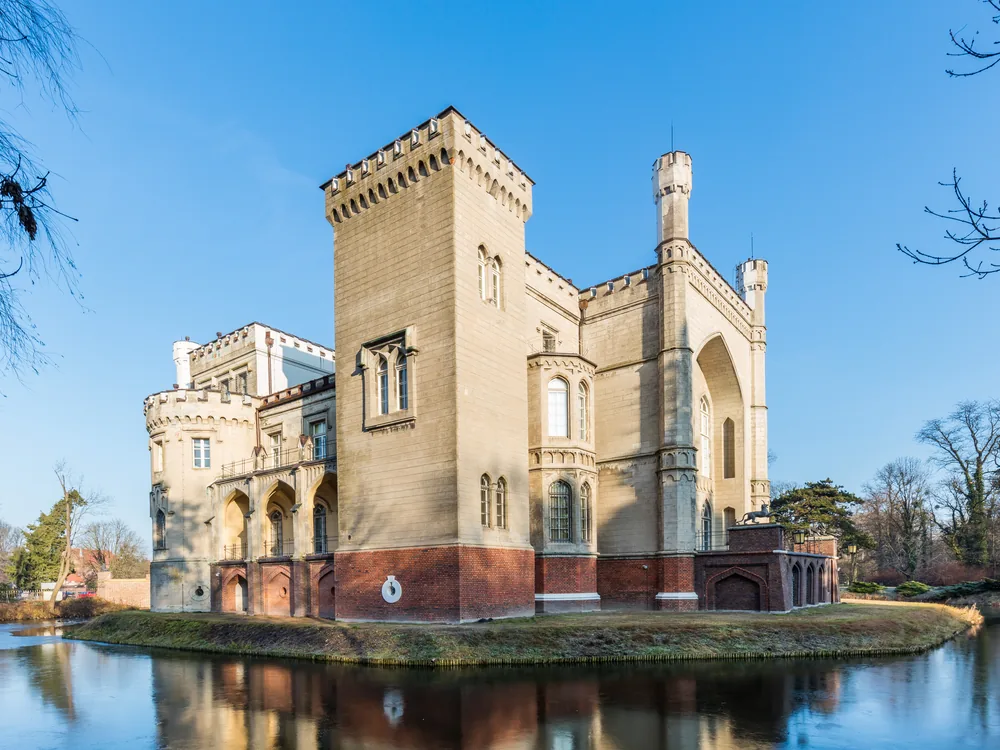
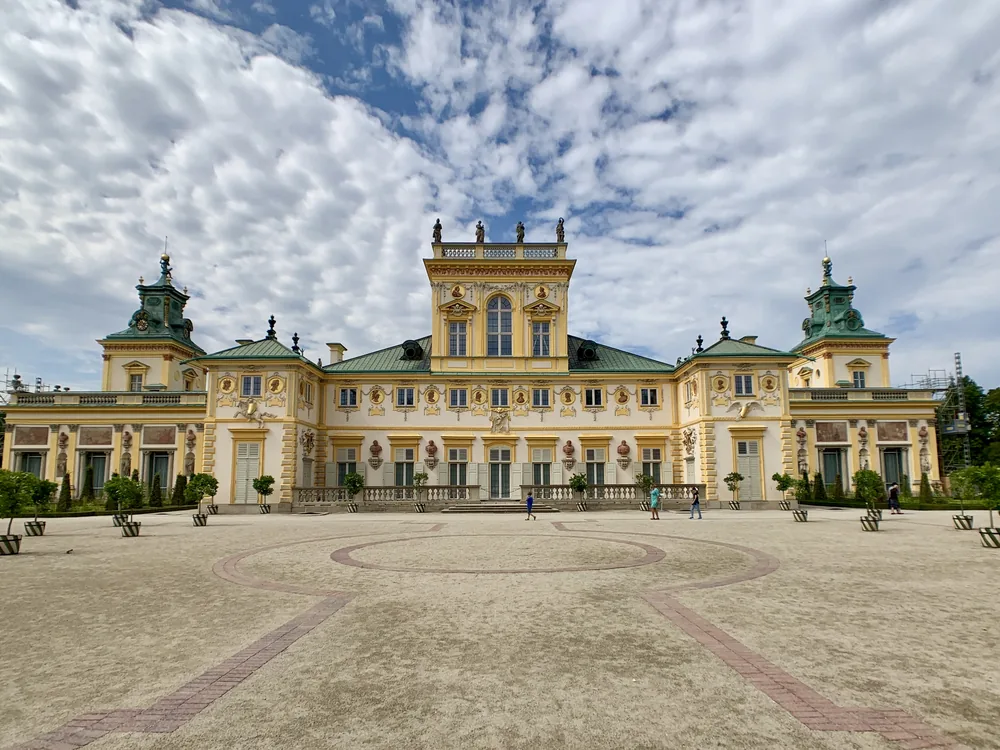
[Kórnik Castle](/castles/poland/kornik-castle) — Karl Friedrich Schinkel's neo-Gothic masterpiece 10km east, the Działyński family's castle of Polish cultural resistance with an Alhambra-inspired Moorish Hall and Poland's oldest arboretum — is the natural companion visit. [Wilanów Palace](/castles/poland/wilanow-palace) — the Baroque royal residence near Warsaw built for King Jan III Sobieski, one of Poland's grandest palace-and-garden compositions — is the major reference point for readers exploring Poland's aristocratic palace circuit more broadly.
History
Late 18th century (c. 1770–90): Kazimierz Raczyński, Voivode of Greater Poland, builds the Baroque palace at Rogalin; formal French garden and initial park established. Early 19th century: flanking wings and service buildings added; English landscape park extended; ancient oak grove incorporated into the estate's designed landscape. 19th century: Raczyński family develops the estate and its collections across successive generations; the ancient oaks acquire their legendary names (Lech, Czech, Rus) as symbols of Slavic national identity. Early 20th century: Edward Raczyński converts the coach house into an art gallery; major Polish and European paintings installed. 1939–1945: Second World War; estate survives; some collections evacuated or at risk. Mid-20th century: Count Edward Raczyński (later President of Poland in exile) donates the estate to the Polish state; National Museum in Poznań established as administrator. Present day: palace, art gallery, and park open Tuesday–Sunday; oak grove accessible year-round.
How to Visit
Getting there: Rogalin Palace is approximately 25 km south of Poznań. By car: about 35 minutes from Poznań city centre. Limited public transport — bus to Mosina (5 km away) then taxi or a short walk. The GYG tour includes hotel pickup and transport from Poznań.
Tickets: Walk-up entry €10 adult, €5 child. Open Tuesday–Sunday April–October (winter hours limited). The GYG tour (t26512, from €67, 5.0★/2 reviews) — a 4-hour private half-day from Poznań covering Rogalin Palace and Kórnik Castle, with hotel pickup, guide, and entrance to both sites included — book in advance.
Practical tips: Allow 1.5–2 hours to cover the palace interior, art gallery, and walk to the ancient oak grove where the legendary trees Lech, Czech, and Rus stand. The English landscape park and oak grove are accessible year-round during daylight hours, even outside museum hours. Arrive by opening time if combining with Kórnik Castle the same day.
Combine with: [Kórnik Castle](/castles/poland/kornik-castle) 10 km east — the Działyński family's neo-Gothic castle with an Alhambra-inspired Moorish Hall and Poland's oldest arboretum, easily done in the same half-day from Poznań. [Wilanów Palace](/castles/poland/wilanow-palace) near Warsaw — the Baroque royal residence built for King Jan III Sobieski, the major reference point for Poland's aristocratic palace circuit.
Frequently Asked Questions
Lech, Czech, and Rus are the legendary brothers of medieval Slavic mythology — the eponymous founders of the Poles (Lech), Czechs (Czech), and East Slavs/Rus' (Rus). The myth of the three brothers appears in medieval chronicles and became a significant motif in 19th-century Polish romantic nationalism, when Polish intellectuals and artists were working to preserve a sense of national identity under Russian, Prussian, and Austrian partition. The three most impressive ancient oaks at Rogalin were given these names in the romantic period as a way of connecting living natural monuments to national mythological identity. The oaks are genuinely ancient — several centuries old — and their size and age made them natural candidates for this kind of symbolic naming. Today they are among the most famous trees in Poland.
Location
Pałac w Rogalinie, Rogalin 4, 62-022 Rogalin, Poland
Nearby Castles
Tours & Tickets
Powered by GetYourGuide
From
€67/ person