Pszczyna Castle
Zamek w Pszczynie
Poland · Silesia — Upper Silesia, Pszczyna municipality, Silesian Upland, near Katowice · Near Katowice
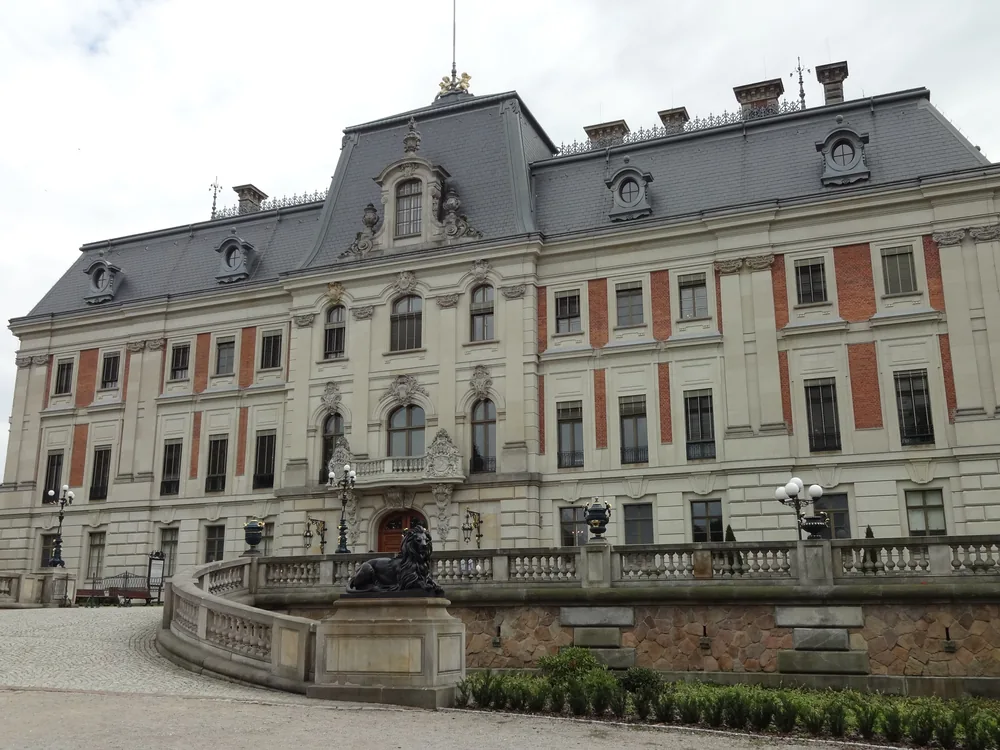
Built 1743 · French Baroque palace; built 1743–1765 by the Hochberg family (later Princes of Pless), who transformed an earlier Gothic castle from the 14th century into one of the grandest aristocratic residences in Central Europe; the exterior presents a restrained French classical three-wing facade arranged around a courtyard; the interior is remarkable for the exceptional preservation of 18th and 19th-century aristocratic furnishings — French furniture, Brussels tapestries, European paintings, and decorative arts; the Hall of Mirrors (Sala Lustrzana) is a long mirrored gallery with crystal chandeliers and gilded mouldings frequently compared to the Galerie des Glaces at Versailles on a more intimate scale; the castle park is laid out in the English landscape style and contains the hunting lodge that served as Kaiser Wilhelm II's wartime field headquarters in 1914 and access to the European bison reserve
This page is part of an independent travel guide and is not affiliated with, endorsed by, or operated by Pszczyna Castle.
© Castles & Palaces
Quick Facts
- Hours
- Tue–Sun 10:00–17:00. Closed Mon
- Guided tour from
- €229
- Duration
- 1.5 hours (guided castle tour); full day for the Kraków excursion including bison reserve
- Best time
- Year-round for the castle interior
- Nearest city
- Katowice
Featured Tour
From Kraków: Pszczyna Castle and Bison Reserve Day Trip
Cancellation available · Instant confirmation
Highlights
- ✦The Hall of Mirrors (Sala Lustrzana) — a long mirrored gallery lined with crystal chandeliers, gilded mouldings, and candelabra frequently compared to Versailles's Galerie des Glaces; one of the finest surviving aristocratic mirror galleries in Central Europe, created by the Hochberg family in the course of their 18th–19th century refurbishment
- ✦Original aristocratic furnishings largely in situ — the Hochberg apartments preserve French Empire and Biedermeier furniture, Brussels tapestries, Chinese export porcelain, and three centuries of family portraits; among the best-preserved furnished aristocratic interiors in Polish Silesia, with a collection density uncommon in regional castle museums
- ✦The Pszczyna European Bison Reserve — the captive herd maintained here helped save the European bison from extinction after all wild specimens were killed by the end of World War I; the Pszczyna reserve was one of the founding breeding sites of the recovery programme that has since re-established bison populations across Poland, Germany, and Belarus
- ✦Kaiser Wilhelm II's wartime field headquarters — the hunting lodge in the castle park served as the Kaiser's operational HQ in the autumn of 1914 during the Eastern Front campaigns of the early First World War, a detail that places the castle within one of the pivotal events of 20th-century European history
- ✦GetYourGuide full-day private excursion from Kraków — private transport with English-speaking driver, 80-minute guided castle tour with entry included, Pszczyna Bison Reserve visit, and free time in Pszczyna town centre; the €229 covers the full private day programme from Kraków, not castle admission alone
Skip the queue with a guided tour
Skip-the-line tickets & expert guides
Pszczyna is a small town in Upper Silesia, 40 kilometres south of Katowice, whose medieval market square and Gothic church would make it a pleasant enough stopping point on a drive through the Silesian upland. The reason to make a detour — or, from Kraków, a full day trip — is the castle at the edge of the town park: a French Baroque palace of exceptional interior quality, the product of two centuries of aristocratic investment by the Hochberg family, the Princes of Pless, who transformed a medieval Gothic fortification into one of the grandest residences in Central Europe.
The site has a long history. A Gothic castle stood at Pszczyna from the 14th century, when the town formed part of the Piast Duchy of Oświęcim. The castle passed through Bohemian, Hungarian, and Habsburg ownership across the following centuries before the Promnitz family acquired the estate in the early 17th century and began the transition from military stronghold to aristocratic residence. When the Hochbergs of Fürstenstein took possession in the early 18th century, they commissioned a comprehensive French Baroque reconstruction completed between 1743 and 1765, giving the castle its current appearance: a three-wing classical palace arranged around a courtyard, with a park in the English landscape style behind it. The Hochbergs, elevated to Princes of Pless in 1850, continued to invest in the interior through the 19th century, accumulating one of the finest private collections of French furniture, Brussels tapestries, European paintings, and decorative arts in the region.
The interior is the reason to visit. The Hall of Mirrors at Pszczyna — a long mirrored gallery lined with crystal chandeliers, gilded mouldings, and candelabra — is frequently compared to the Galerie des Glaces at Versailles, at a scale that feels more habitable and personal than the French original. The principal apartments preserve exceptional furnishings largely in their original positions: French Empire and Biedermeier pieces, Chinese export porcelain, and family portraits tracing the Hochberg line across three centuries. This is not a partially refurnished shell but a palace whose rooms read as they were lived in.
The castle park holds one additional feature with a different kind of significance: the Pszczyna European Bison Reserve. By the end of the First World War, all wild European bison had been killed; the last wild specimen was shot in the Białowieża Forest in 1919. The captive herds maintained at reserves including Pszczyna were the genetic foundation from which the species was rebuilt. European bison now number over 7,000 in the wild across Poland, Germany, and Belarus, and the Pszczyna reserve was one of the places that made that recovery possible.
[Książ Castle](/castles/poland/ksiaz-castle), 100 kilometres northwest in Lower Silesia, is the natural companion to Pszczyna — the vast three-wing Hochberg palace above the Pełcznica gorge, with its wartime Nazi underground installation (Project Riese) and one of the most dramatic natural settings of any castle in Poland.
History
A castle has stood at Pszczyna since at least the 14th century, when the town formed part of the Piast Duchy of Oświęcim in the Silesian upland south of Kraków. The medieval fortification passed through Bohemian, Hungarian, and Habsburg ownership over the following centuries before the Promnitz family acquired the estate in the early 17th century and began the transformation from military stronghold to aristocratic residence. When the Hochbergs of Fürstenstein took possession in the early 18th century, they commissioned the comprehensive French Baroque reconstruction — carried out between 1743 and 1765 — that gave the castle the three-wing classical facade and courtyard arrangement it retains today. The Hochbergs, elevated to Princes of Pless in 1850, continued to invest in the interior through the 19th century, furnishing the principal apartments with French furniture, Brussels tapestries, European paintings, and decorative arts that remain largely in place. A chapter of wider historical significance came in 1914, when Kaiser Wilhelm II established his wartime field headquarters in the park's hunting lodge during the early Eastern Front campaigns — a period documented in photographs and palace records. After the First World War the castle passed to the Polish state, and following the Second World War it was opened as a state museum. The adjacent European Bison Reserve, established in the castle park by the Hochberg family, maintained a captive herd through the 20th century that was central to the breeding programme that saved the species after all wild specimens were killed during the First World War.
How to Visit
Getting there: Pszczyna is 40 km south of Katowice and approximately 100 km from Kraków. From Katowice: regional train to Pszczyna station (approximately 45 minutes), then a 10-minute walk to the castle. By car from Katowice: approximately 35–40 minutes via the A1 and regional roads. From Kraków by car: approximately 1 hour 15 minutes; by train approximately 1.5–2 hours with a change at Tychy or Oświęcim.
Tickets: Walk-up entry to the castle museum: approximately PLN 35 adult (payable at the castle). The GetYourGuide full-day excursion from Kraków — a private day trip with English-speaking driver covering the 80-minute guided castle tour (entry included), the Pszczyna Bison Reserve, and free time in the Pszczyna town centre — is the structured option for visitors based in Kraków; the €229 covers the full private day programme, not castle admission alone. Book in advance; confirm current castle opening hours at zamek-pszczyna.pl before visiting.
Practical tips: The castle is typically closed Mondays; confirm hours at zamek-pszczyna.pl before travelling, as occasional special events can affect interior access on specific days. The bison reserve is within the castle park — allow extra time if you plan to visit both. The Pszczyna Rynek (market square) and the neogothic Evangelical church are worth 20–30 minutes of walking after the castle visit.
Combine with: Książ Castle (100 km northwest in Lower Silesia — one of the largest castle complexes in Poland, with a wartime Nazi underground installation (Project Riese) beneath the rock; together with Pszczyna they trace the great aristocratic palaces of Silesia across its Upper and Lower sub-regions).
Frequently Asked Questions
From Katowice (40 km): regional train to Pszczyna station takes approximately 45 minutes, then a 10-minute walk to the castle. By car from Katowice: approximately 35–40 minutes via the A1. From Kraków (approximately 100 km): by car approximately 1 hour 15 minutes; by train approximately 1.5–2 hours with a change at Tychy or Oświęcim. The GetYourGuide full-day excursion from Kraków provides private return transport and is the most straightforward option for visitors based in Kraków — the €229 covers the full private day programme, not castle admission alone.
Location
Brama Wybrańców 1, 43-200 Pszczyna, Poland
Nearby Castles
Tours & Tickets
Powered by GetYourGuide
From
€229/ person