
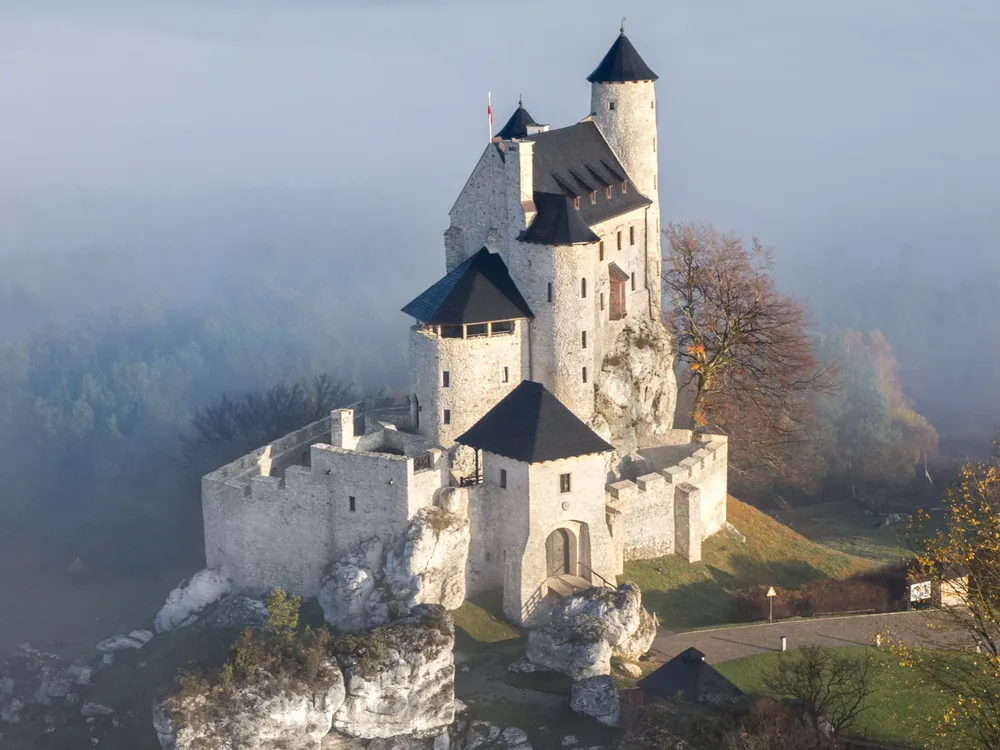
Rabsztyn Castle
Zamek Rabsztyn
Poland · Małopolskie, Polish Jurassic Highland · Near Kraków
Built 1250 · Royal medieval stronghold ruin on Rabsztyn Hill (Góra Rabsztyn) in the Olkusz area of the northern Jurassic Highland, approximately 45 km northwest of Kraków; the name derives from the German Rabenstein — Raven Rock — a toponym either from the corvids that nested on the exposed limestone or from early German settlers in the Olkusz mining region; the fortification grew over two centuries from a 13th-century simple stronghold into a large complex with three distinct structural sections: an upper castle on the hilltop summit (the core defensive position with tower and donjon), a middle castle on the intermediate slope (extended defensive circuit), and a lower castle at the base (outer ward and service buildings); a Renaissance palace with courtyard loggia was added around the turn of the 16th and 17th centuries, completing the castle's architectural evolution from medieval stronghold to Renaissance residence; the Renaissance palace was barely completed when Swedish forces during the Deluge of 1655 destroyed the complex; the castle was never substantially rebuilt and has been a ruin since the second half of the 17th century; conservation and stabilisation work completed 2012–2015, with tourist infrastructure installed and the site reopened in May 2015; an on-site café operates in the season; the three-part upper/middle/lower castle structure is architecturally unusual on the Eagles' Nests trail, where most fortifications are single-outcrop hilltop designs rather than tiered complexes
This page is part of an independent travel guide and is not affiliated with, endorsed by, or operated by Rabsztyn Castle.
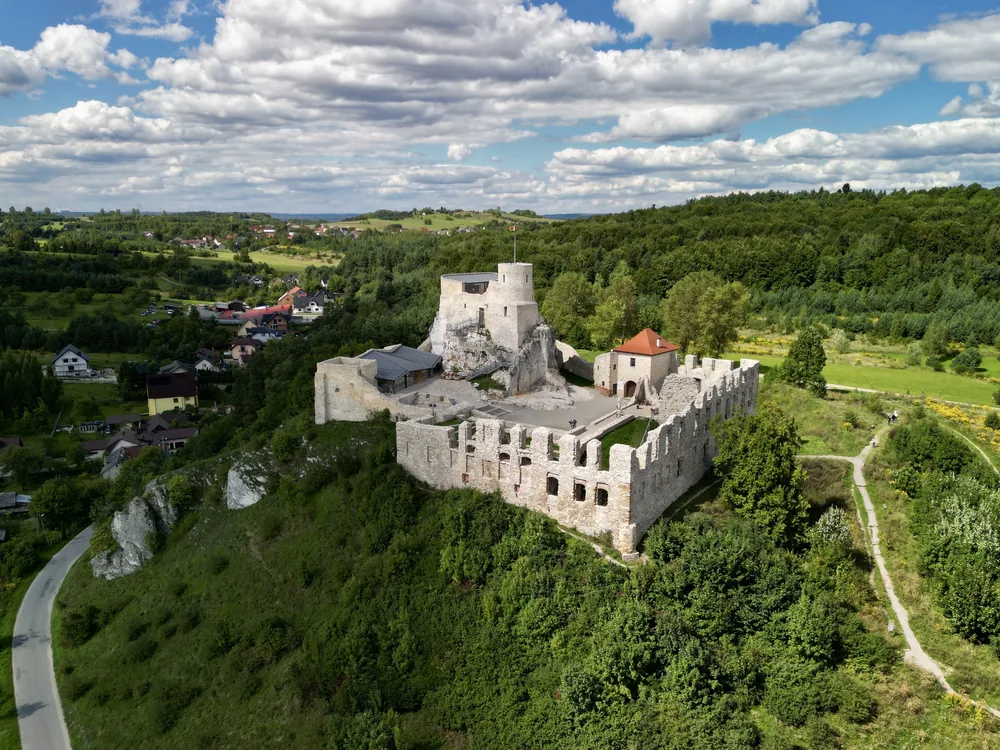
© Castles & Palaces
Quick Facts
- Hours
- Mon–Fri 10:00–18:00. Sat & Sun 09:00–18:00
- Day trip from
- €189
- Duration
- 1–1.5 hours
- Best time
- April to October
- Nearest city
- Kraków
Featured Tour
From Kraków: Trail of the Eagles' Nests — Medieval Castle Ruins
Cancellation available · Instant confirmation
Highlights
- ✦Rabsztyn is architecturally unusual within the Eagles' Nests chain for its three-tier structure: most Eagles' Nests castles are single-outcrop hilltop fortifications, but Rabsztyn grew over two centuries into a complex of upper castle (summit, core defensive tower and donjon), middle castle (slope, expanded defensive circuit), and lower castle (base, outer ward and service buildings); this tiered development — typical of larger royal strongholds but uncommon at the limestone-outcrop level of the Jurassic Highland — makes the ruin's spatial logic different from anything else on the trail, with three distinct height levels to walk through rather than a single perimeter
- ✦The Renaissance palace added to Rabsztyn at the turn of the 16th and 17th centuries represents the castle's final and most costly phase of development — a courtyard residence built just as the medieval stronghold was reaching its architectural completion; that the Swedish Deluge of 1655 destroyed the palace while it was still relatively new, before its full elaboration could be documented in surviving plans, makes the Rabsztyn ruins one of the more poignant lost-buildings on the Eagles' Nests trail: you are walking through the ruins of a late Renaissance residence that was never finished and was already ruined within a generation of completion
- ✦The name Rabsztyn derives from the German Rabenstein — Raven Rock — a toponym that appears in several forms across the German-settled regions of medieval Poland and Bohemia; in the Olkusz area, where the silver and lead mining industry attracted German settlers from the 13th century onward under Kraków's commercial jurisdiction, German toponyms are not unusual; the raven association with the exposed limestone rock summit at Rabsztyn Hill would have been immediately legible to any medieval traveller familiar with the craggy bird-populated outcrops of the Jurassic limestone landscape
- ✦The 2012–2015 conservation project that reopened Rabsztyn in May 2015 was one of the more substantial Jurassic Highland conservation investments of the decade — stabilising the surviving masonry across all three castle tiers, installing visitor paths and safety infrastructure, and adding the on-site café that makes Rabsztyn one of the few Eagles' Nests ruins with on-site food service; the reopening in 2015 marked Rabsztyn's return to the active heritage circuit after years as an inaccessible ruin, and the castle now operates as one of the named stops on guided tour itineraries including the Eagles' Nests Day Tour from Kraków
- ✦Rabsztyn's position on the Eagles' Nests trail places it between [Pieskowa Skała Castle](/castles/poland/pieskowa-skala-castle) to the south — the trail's only fully intact Renaissance castle and its most formal museum venue — and [Ogrodzieniec Castle](/castles/poland/ogrodzieniec-castle) to the north — the trail's most visited and most dramatically positioned ruin; this mid-trail position, with major landmarks on both sides, means that visitors who cover the Eagles' Nests trail in sequence typically encounter Rabsztyn at the midpoint of the day, after the major museum visit at Pieskowa Skała and before the afternoon cluster of Ogrodzieniec, [Mirów](/castles/poland/mirow-castle), and [Bobolice](/castles/poland/bobolice-castle)
Tickets & tours
Book through GetYourGuide
Rabsztyn Castle stands on Rabsztyn Hill (Góra Rabsztyn) near the village of Rabsztyn in Olkusz County, approximately 45 kilometres northwest of Kraków in the northern section of the Polish Jurassic Highland. The ruin is one of the named stops on the Eagles' Nests trail and one of the few Jurassic Highland castles with a documented three-tier structural history — upper, middle, and lower castle sections that grew over two centuries from a simple 13th-century stronghold into a complex royal fortress, completed in the early 17th century with a Renaissance palace, and destroyed by Swedish forces before that final architectural phase could be fully inhabited.
The name itself is the castle's oldest surviving historical document. Rabsztyn derives from the German Rabenstein — Raven Rock — a toponym that appears in various forms across the German-settled regions of medieval Silesia and Poland. The Olkusz area, where silver and lead mining brought German settlers under the commercial jurisdiction of Kraków from the 13th century onward, has several German-derived place names; Rabsztyn's is one of the more visually immediate — the exposed limestone summit of Rabsztyn Hill, rising from the Jurassic plateau with the characteristic vertical cliff faces of the upland geology, would have been recognisable as raven habitat to any German-speaking settler familiar with the high rocky outcrops of the broader Central European limestone landscape.
The castle's 13th-century origins placed it at the southern end of the period that produced the broad medieval fortification network across the Krakowsko-Częstochowska Upland. The initial stronghold was a simple royal installation on the hill summit; subsequent expansion across the 14th and 15th centuries added the middle and lower castle sections, creating the tiered complex that distinguishes Rabsztyn architecturally from most Eagles' Nests sites. The typical Eagles' Nests castle is a single-outcrop design: tower and curtain walls on a hilltop, exploiting the cliff faces on all sides. Rabsztyn's three-tier development — upper castle for the core defensive and residential functions, middle castle for extended circuit and garrison accommodation, lower castle for outer ward, stabling, and service buildings — produced a larger and more spatially complex fortress than the Jurassic Highland's geology usually accommodated.
The most consequential development came at the turn of the 16th and 17th centuries, when a Renaissance palace with courtyard loggia was added to the complex. This represented both the castle's architectural completion and its peak ambition: the Renaissance palace updated the medieval stronghold with the courtly residential style that Kraków's Wawel Castle had established as the standard for Polish royal and aristocratic architecture in the 16th century. The palace at Rabsztyn was barely complete when the Swedish Deluge (Potop) of 1655–1660 brought the destruction that ended the castle's functional life. Swedish forces, advancing through the Jurassic Highland as part of the broader invasion that devastated Poland across several years, destroyed the complex in the 1650s. The Renaissance palace — still relatively new, never fully elaborated — was destroyed within a generation of completion. The castle was never substantially rebuilt, and Rabsztyn has been a ruin since the second half of the 17th century.
The ruins remained inaccessible for much of the 20th century. Conservation work between 2012 and 2015 stabilised the masonry across all three castle tiers, installed visitor paths and safety infrastructure, and prepared the site for public access. The castle reopened to tourists in May 2015, with an on-site café making it one of the few Eagles' Nests ruins with food service on site. The reopening reintegrated Rabsztyn into the active Eagles' Nests heritage circuit and established it as a named stop on guided tour itineraries, including the Trail of the Eagles' Nests Day Tour from Kraków.
Visiting Rabsztyn today means walking through the three levels of a medieval-to-Renaissance fortress ruin — climbing from the lower ward through the middle castle to the upper summit, with the spatial relationships between the three tiers becoming legible in the field in a way that plans and descriptions cannot fully convey. The open ruined quality of the site, with masonry at various states of preservation across the hillside, gives it a character different from the more contained ruins of Mirów or the reconstructed completeness of Bobolice. The landscape context is also different from the southern Jurassic Highland sites: Rabsztyn's hill rises from a more open plateau, with wider views over the northern upland, compared to the more enclosed valley character of the sites nearer Kraków.
On the Eagles' Nests Day Tour from Kraków, Rabsztyn is the stop between [Pieskowa Skała Castle](/castles/poland/pieskowa-skala-castle) — the trail's fully intact Renaissance museum castle — and [Ogrodzieniec Castle](/castles/poland/ogrodzieniec-castle) — the trail's most visited and most dramatically sited ruin. The GetYourGuide booking link on this page is shared with the full Eagles' Nests Day Tour covering [Korzkiew](/castles/poland/korzkiew-castle), Pieskowa Skała, Rabsztyn, Ogrodzieniec, [Mirów](/castles/poland/mirow-castle), and [Bobolice](/castles/poland/bobolice-castle) — it is not a standalone Rabsztyn ticket.
History
A royal stronghold was built on Rabsztyn Hill in the 13th century — the name deriving from the German Rabenstein (Raven Rock), a toponym that preceded the Polish settlement and reflects the site's earlier identification with its German-speaking administrative context. Through the 14th and 15th centuries the castle expanded with middle and lower castle sections, growing into a tiered three-part complex that followed the natural terracing of the hill. A Renaissance palace added at the turn of the 16th and 17th centuries completed the castle's architectural evolution, adding a layer of sophisticated domestic comfort to what had been a purely military structure.
The Swedish Deluge of 1655 destroyed the complex within decades of the Renaissance palace's completion — the recently built upper section particularly devastated. Rabsztyn remained an unrestored ruin through the 17th to 20th centuries, a sequence of collapsed walls and overgrown stone on the Jurassic Highland hillside.
Conservation and stabilisation work across all three castle tiers between 2012 and 2015 installed visitor infrastructure without attempting reconstruction. Rabsztyn reopened to tourists in May 2015, with an on-site café. It is now managed as a conservation ruin and one of the named stops on the Eagles' Nests trail.
How to Visit
Getting there: Rabsztyn Castle is near the village of Rabsztyn, gmina Klucze, Olkusz County, approximately 45 km northwest of Kraków. By car: take the DK94 westward then local roads toward Klucze — about 50 minutes from Kraków. No direct public transport to the castle; local buses from Olkusz to Klucze are the nearest option, with a walk to the site.
Tickets: Walk-up entry PLN 12 adult, PLN 8 child. Open April to October; closed November to March. The GetYourGuide tour — an 8-hour day trip from Kraków covering Korzkiew, Pieskowa Skała, Rabsztyn, Ogrodzieniec, Mirów, and Bobolice — book in advance.
Practical tips: Wear sturdy footwear — the upper castle section involves steep paths and uneven limestone terrain across three tiers. An on-site café operates during the April–October season. If combining with other Eagles' Nests stops, plan 1–1.5 hours at Rabsztyn and arrive no later than mid-afternoon.
Combine with: Pieskowa Skała Castle 20 km south — the Eagles' Nests trail's only fully intact castle, now a Renaissance art museum. Korzkiew Castle 30 km south near Kraków — the trail's southernmost stop and its only castle-hotel.
Frequently Asked Questions
Rabsztyn derives from the German Rabenstein — Raven Rock. The Olkusz area attracted German settlers during the medieval silver and lead mining expansion of the 13th century onward, and several place names in the region have German origins. The raven association likely reflects the exposed limestone summit's character as bird habitat — a high, rocky outcrop of the kind that would have supported raven nesting in the medieval period.
Location
Rabsztyn 7, 32-310 Klucze, Poland
Nearby Castles
Tours & Tickets
Powered by GetYourGuide
From
€189/ person