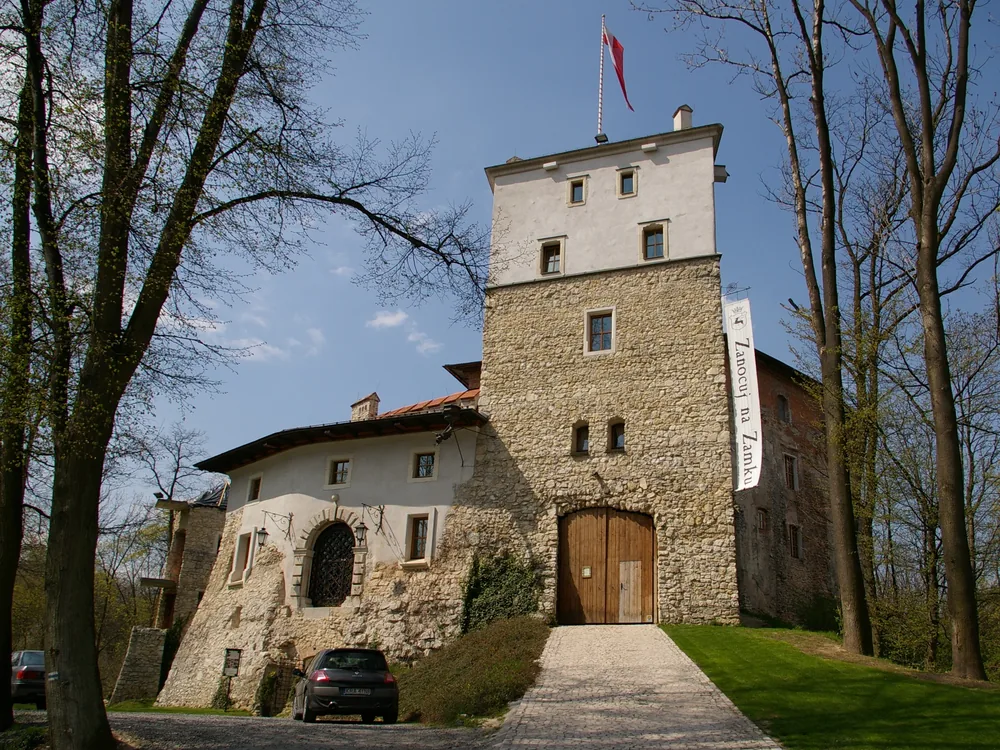
Korzkiew Castle
Zamek Korzkiew
Poland · Małopolskie, Polish Jurassic Highland · Near Kraków
Built 1352 · Gothic-Renaissance defensive tower and residential complex on a limestone hilltop at the southern entry to the Polish Jurassic Highland; founded 1352 by Jan z Syrokomli as a rectangular stone defensive tower; rebuilt in the late 15th century with a gate tower and expanded residential range in the hybrid Gothic-Renaissance style typical of the Kraków region in the Jagiellonian period; rebuilt again in 1720 under the Jordan family, who added baroque residential elements and hosted King Augustus II of Poland; fell into ruin in the late 19th century; purchased in 1997 by architect Jerzy Donimirski and restored as a functioning boutique hotel — the 15th-century gate tower converted to four guest rooms, the oldest Gothic-Renaissance residential building serving as banquet halls; as a hotel-castle distinguished from the open-ruin Eagles' Nests sites by being a continuously inhabited, privately managed building in a restored state; the southernmost castle on the Eagles' Nests chain and the first stop on the Eagles' Nests Day Tour from Kraków
This page is part of an independent travel guide and is not affiliated with, endorsed by, or operated by Korzkiew Castle.
© Castles & Palaces
Quick Facts
- Hours
- Mon–Sun Open
- Day trip from
- €189
- Duration
- 30–45 minutes (exterior/grounds/café)
- Best time
- April to October
- Nearest city
- Kraków
Featured Tour
From Kraków: Trail of the Eagles' Nests — Medieval Castle Ruins
Cancellation available · Instant confirmation
Highlights
- ✦Korzkiew is the southernmost castle on the Eagles' Nests chain — the first limestone hilltop fortification that appears on the Jurassic Highland when leaving Kraków northward through the Prądnik valley; its position defines its historical function: as the chain's Kraków-facing entry point, it was the first line of the signalling network that could relay observations from the city northward to Pieskowa Skała, Rabsztyn, Ogrodzieniec, and eventually Częstochowa; on the Eagles' Nests Day Tour from Kraków, Korzkiew is the first stop precisely because of this geographic logic
- ✦The Jordan family's 1720 reconstruction produced the castle's most socially prominent phase: they hosted King Augustus II — Augustus the Strong, Elector of Saxony and King of Poland from 1697 to 1733, one of the most powerful Central European monarchs of his era — at Korzkiew; Augustus the Strong was known for his physical strength, his absolutist Saxon court culture, his vast collection of Meissen porcelain, and the Saxon baroque influence he brought to Polish courtly life; a royal visit to a Jurassic Highland castle places the Jordan family in the first tier of 18th-century Polish aristocratic society
- ✦The 1997 restoration by architect Jerzy Donimirski is Korzkiew's most distinctive modern chapter: unlike the Eagles' Nests sites that were restored as museums or left as managed open ruins, Donimirski chose to restore the castle as a functioning boutique hotel — four rooms in the 15th-century gate tower, banquet halls in the oldest Gothic-Renaissance residential building; guests sleep inside medieval masonry that was ruinous less than 30 years ago; the Korzkiew model is the rarest form of castle stewardship in the Jurassic Highland: preservation through continuous habitation rather than museum curation
- ✦The long-term vision for Korzkiew extends beyond the castle building itself to what the owners call the Korzkiew Cultural Park: plans include rebuilding a second corner tower and completing the full perimeter wall, and surrounding the castle with a reconstructed wooden manor, an inn, and a brewery — an attempt to recreate not just the medieval fortification but the complete pre-ruin landscape of the estate; this is one of the most ambitious private heritage programmes in the Polish Jurassic Highland
- ✦For non-hotel visitors, the experience at Korzkiew is exterior and atmospheric rather than interior and educational — the hilltop setting, the restored gate tower silhouette, the limestone terrain of the southern Prądnik valley; the castle's café is accessible to non-guests, and the grounds can be walked; this is explicitly different from the museum interiors of [Pieskowa Skała Castle](/castles/poland/pieskowa-skala-castle) or the open ruins of [Ogrodzieniec](/castles/poland/ogrodzieniec-castle), [Mirów](/castles/poland/mirow-castle), and [Bobolice](/castles/poland/bobolice-castle) — Korzkiew is a hotel first, a heritage site second, and the visitor experience is calibrated accordingly
Tickets & tours
Book through GetYourGuide
Korzkiew Castle stands on a limestone hill in the southern margin of the Kraków-Częstochowa Upland, approximately 12 kilometres north of Kraków's city centre, in the village of Korzkiew in the gmina of Wielka Wieś. The hill is the southernmost of the Eagle's Nests defensive positions — the entry point to the Jurassic Highland limestone plateau that stretches northward through Ojców National Park toward Pieskowa Skała, Rabsztyn, Ogrodzieniec, and the paired ruins of Mirów and Bobolice. The castle's geographic position is also its historical purpose: the chain's Kraków-facing anchor, the first fortification visible when leaving the royal capital northward along the Prądnik valley route.
The castle was founded in 1352 by Jan z Syrokomli, a Polish knight who purchased the hill and raised a rectangular stone defensive tower on its summit. The founding year falls within the last decade of Casimir III the Great's reign (1333–1370), the period of intensive fortification across the Jurassic Highland that produced the Eagles' Nests chain. Casimir's programme placed approximately 25 castles on the limestone outcrops between Kraków and Częstochowa, exploiting the naturally defensible high ground to create a coordinated signalling and mutual-support network along the Kraków–Wrocław trade corridor. Korzkiew's tower was the chain's southernmost link — the position watching the approach from Kraków.
Ownership changed hands repeatedly over the following centuries. The Ługowski family held the castle after Jan z Syrokomli; the Zborowski family succeeded them. A late 15th-century rebuilding expanded the original tower with a gate building and residential range, producing the Gothic-Renaissance hybrid that became the architectural baseline for the subsequent Jordan period. The Jordan family acquired the castle and undertook a second major reconstruction in 1720, adding baroque residential elements consistent with the tastes of the Saxon-Polish court then dominant in Poland. The most historically documented event of the Jordan period was the hosting of King Augustus II — Augustus the Strong, Elector of Saxony and King of Poland from 1697 to 1733 — at the castle. Augustus the Strong was among the most powerful Central European monarchs of his era: known for his physical strength, his absolutist court culture, his massive collection of Meissen porcelain, and the Saxon baroque aesthetic he brought to Poland alongside his election as king. That the Jordan family could accommodate a royal visit placed them in the first tier of Polish aristocratic society and Korzkiew in the circuit of the Saxon-Polish court's movements across the kingdom.
The Wodzicki family acquired the property in the late 18th century, but the castle's strategic military value had long since passed. The 19th century brought progressive neglect, and by the late 1800s the building was a ruin. It remained in that state for approximately a century — a limestone shell on its hilltop, visible from the valley below but no longer habitable.
In 1997, architect Jerzy Donimirski purchased the ruin and undertook a restoration that distinguishes Korzkiew from every other Eagles' Nests site: the goal was not a museum but a living building. The 15th-century gate tower, the oldest surviving element above the original 1352 foundation, was converted into four boutique hotel rooms — guests sleep within the medieval masonry, inside what was once a military gateway. The oldest Gothic-Renaissance residential building became banquet halls for events and private gatherings. The restoration is explicitly ongoing: the castle's stated plans include the rebuilding of a second corner tower and the completion of the full perimeter wall, and the broader Korzkiew Cultural Park vision envisages surrounding the castle with a reconstructed wooden manor, an inn, and a brewery — a comprehensive attempt to recreate the pre-ruin estate's complete built landscape, not merely the castle itself.
For visitors who are not hotel guests, Korzkiew is primarily an exterior and grounds experience. The hilltop approach, the restored gate tower silhouette against the Jurassic Highland sky, and the limestone terrain of the southern Prądnik valley visible below are the primary qualities of the visit. The café is accessible to non-guests, and the grounds can be walked in the approach to the main building. This is explicitly different from the full museum interiors of [Pieskowa Skała Castle](/castles/poland/pieskowa-skala-castle) or the extensively walkable ruins of [Ogrodzieniec](/castles/poland/ogrodzieniec-castle), [Mirów](/castles/poland/mirow-castle), and [Bobolice](/castles/poland/bobolice-castle): Korzkiew is a functioning hotel that has preserved and restored a medieval building, and the visitor experience reflects that — scenic and atmospheric rather than institutionally educational. It occupies the category of castle-hotel rather than castle-museum, and the Eagles' Nests Day Tour treats it accordingly — as a scenic first stop for orientation and landscape context before the more extensive interior visits that follow at Pieskowa Skała and the afternoon ruins.
The GetYourGuide booking link on this page is shared with the Trail of the Eagles' Nests Day Tour from Kraków, which covers Korzkiew, Pieskowa Skała, [Rabsztyn](/castles/poland/rabsztyn-castle), Ogrodzieniec, Mirów, and Bobolice in a single day. It is not a standalone Korzkiew ticket. Independent visitors can reach the castle by car from Kraków in 20–25 minutes, following the Prądnik valley north through Wielka Wieś.
History
Jan z Syrokomli founded Korzkiew Castle in 1352 on a limestone hilltop 12 kilometres north of Kraków — the southernmost fortification in the Eagles' Nests chain, positioned to guard the approaches to the royal capital from the Polish Jurassic Highland. The 15th century brought a rebuilding that added the gate tower and residential range in a Gothic-Renaissance hybrid style that reflects the cultural transition of the period. Ownership passed through the Ługowski and Zborowski families across the following centuries.
The Jordan family undertook a second major reconstruction in 1720 and hosted King Augustus II (Augustus the Strong) at the castle during his reign — a royal visit that represents the high point of Korzkiew's social significance. The castle passed to the Wodzicki family in the late 18th century and fell into ruin in the 19th century as its strategic function disappeared along with the feudal system that had justified it.
The architect Jerzy Donimirski purchased the ruin in 1997 and began a careful restoration focused on converting the medieval fabric to hotel use without destroying its archaeological character. From the 2000s onward, the 15th-century gate tower was converted to hotel rooms and the Gothic-Renaissance residential building to banquet halls, with restoration continuing. The castle hotel is accessible to non-guests via its café and exterior grounds, and serves as the first stop on the Eagles' Nests Day Tour from Kraków.
How to Visit
Getting there: Korzkiew Castle is 12 km north of Kraków in the village of Korzkiew, gmina Wielka Wieś. By car: 20–25 minutes north from Kraków following the Prądnik valley on local roads. No direct public transport to the castle gate — self-drive or join a guided Eagles' Nests day tour from Kraków.
Tickets: Free entry. The castle operates as a boutique hotel; non-guests are welcome at the café and exterior grounds without charge. For the full Eagles' Nests circuit, the GetYourGuide tour — an 8-hour day trip from Kraków covering Korzkiew, Pieskowa Skała, Rabsztyn, Ogrodzieniec, Mirów, and Bobolice — book in advance.
Practical tips: Wear sturdy footwear — the hilltop approach follows uneven limestone terrain. The café is open to non-guests and makes a good stop after the grounds walk. Visit on a weekday to avoid weekend crowds from Kraków.
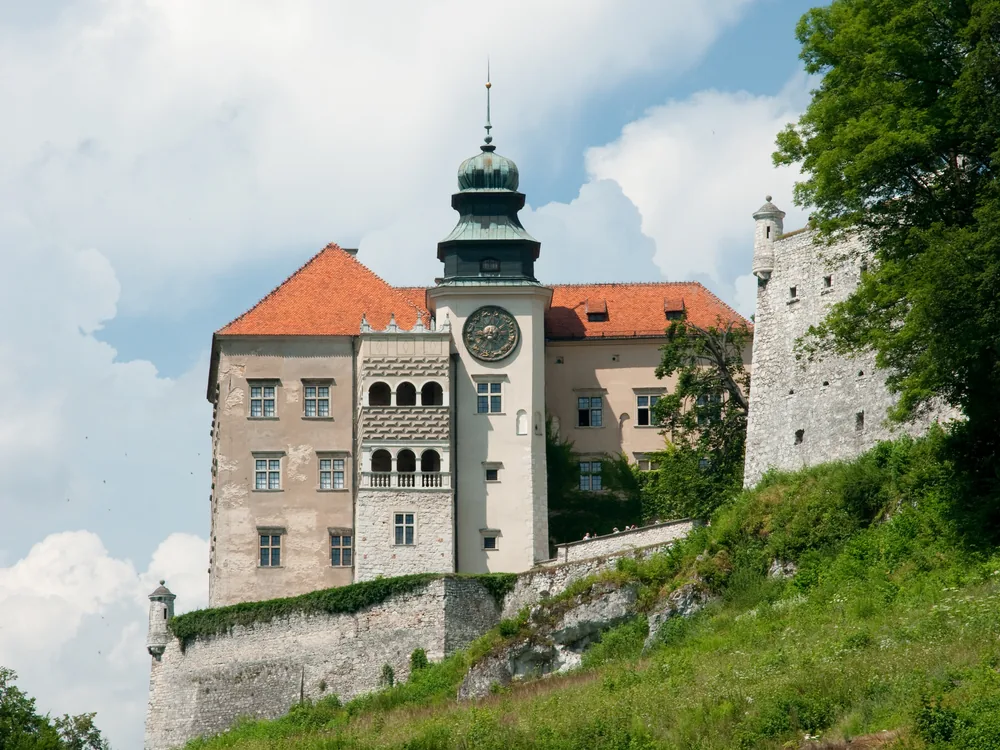
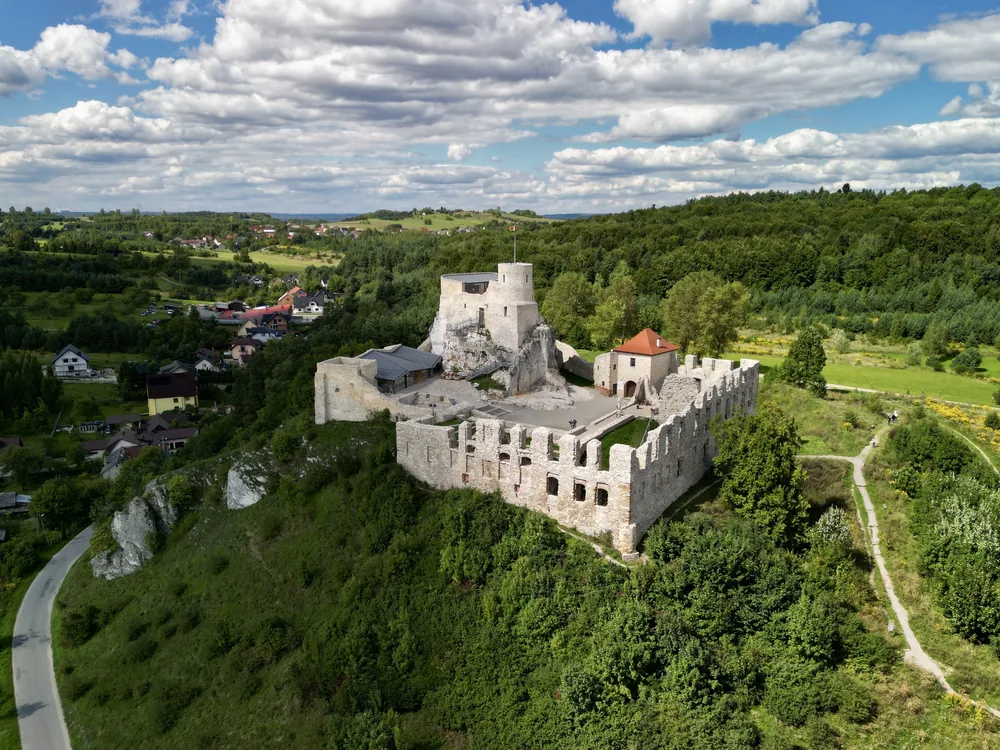
Combine with: Pieskowa Skała Castle 15 km north — the Eagles' Nests trail's only fully intact castle, now a museum. Rabsztyn Castle 20 km north — an atmospheric Eagles' Nests ruin reopened for visits in 2015.
Frequently Asked Questions
Yes, but the experience is an exterior one. Non-hotel guests can walk the approach to the castle, visit the café, and experience the hilltop grounds and the restored gate tower from outside. The interior rooms and banquet halls are for hotel guests and event attendees. This is different from museum-style Eagles' Nests sites like Pieskowa Skała or the open-access ruins like Ogrodzieniec — Korzkiew is a working hotel, not a heritage attraction with guided interior tours.
Location
Korzkiew 25, 32-089 Korzkiew, Poland
Nearby Castles
Tours & Tickets
Powered by GetYourGuide
From
€189/ person