Tykocin Castle
Zamek w Tykocinie
Poland · Podlaskie Voivodeship — on an island in the Narew river · Near Białystok
A 21st-century reconstruction, built from the foundations using archaeological data and historical sources, of the 16th-century brick royal castle of King Sigismund II Augustus — itself built on the site of an earlier wooden stronghold of the Lithuanian Gasztołd family
This page is part of an independent travel guide and is not affiliated with, endorsed by, or operated by Tykocin Castle.
© Castles & Palaces
Stay Here
Zamek w Tykocinie
Rooms are within the historic castle building itself
Booked via Booking.com · Free cancellation on most rates
The castle's museum, with an underground exhibition, a Glass Hall and the prison tower, is open to day visitors — check current opening hours.
Highlights
- ✦A wooden stronghold built by the Lithuanian Gasztołd family on an island in the Narew was replaced in the 16th century by a brick royal castle of King Sigismund II Augustus
- ✦Held one of the Commonwealth's largest arsenals at the end of the 16th century
- ✦In November 1705, Augustus II the Strong received Tsar Peter the Great here, and it was here that the Order of the White Eagle was first awarded
- ✦Destroyed in later wars, the castle fell into ruin from 1734 and was dismantled in the 18th century
- ✦Rebuilt from the foundations at the turn of the 21st century, using archaeological data and historical sources; it now houses a museum, a restaurant and guest rooms
Stay in the castle itself
Book a room via Booking.com
Tykocin Castle stands on an island in the Narew river, in the small Podlaskie town of Tykocin. Its history begins with a wooden stronghold built by the Lithuanian Gasztołd family, replaced in the 16th century by a brick royal castle commissioned under King Sigismund II Augustus — a fortress substantial enough to hold one of the Polish–Lithuanian Commonwealth's largest arsenals by the century's end.
The castle's most celebrated moment came in November 1705, when Augustus II the Strong received Tsar Peter the Great here during the Great Northern War; it was on this same occasion that the Order of the White Eagle, one of Poland's most prestigious honours, was first awarded. The castle's fortunes declined after this high point — it was destroyed in later wars, fell into ruin from 1734, and was ultimately dismantled during the 18th century, leaving only foundations behind.
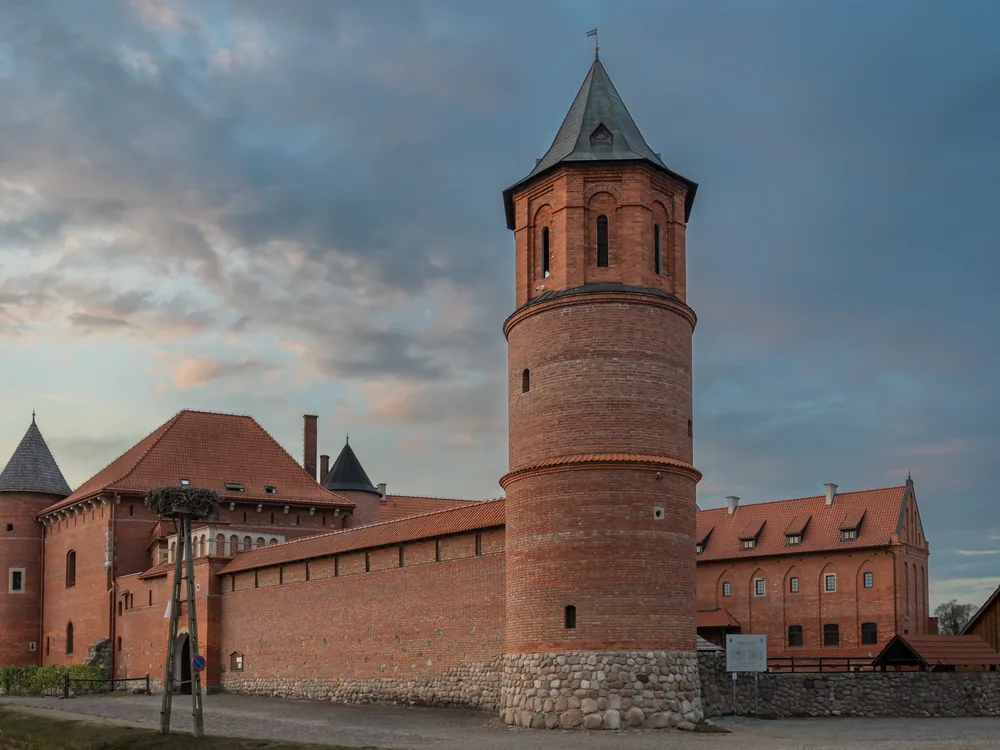
What stands today is an important distinction to make clear: the current castle is a 21st-century reconstruction, built from the foundations using archaeological data and historical sources, rather than a surviving or restored original building. It now combines a museum — with an underground exhibition, a Glass Hall with a reconstructed tiled stove, and the prison tower — with a restaurant and a small number of guest rooms set under the castle roof.
Tykocin also has a separate historic hotel in the former Alumnat building, once a military hospital; visitors booking a stay should confirm they are reserving the castle itself rather than this other property in the same town.
History
A wooden stronghold built by the Lithuanian Gasztołd family on an island in the Narew was replaced in the 16th century by a brick royal castle of King Sigismund II Augustus; at the end of the 16th century it held one of the Commonwealth's largest arsenals. In November 1705 Augustus II the Strong was received here by Tsar Peter the Great, and it was here that the Order of the White Eagle was first awarded. The castle was destroyed in the wars and from 1734 fell into ruin, and was dismantled in the 18th century; it was rebuilt from the foundations at the turn of the 21st century, using archaeological data and historical sources. It now houses a museum, a restaurant and guest rooms.
How to Stay
Getting there: In the small town of Tykocin in Podlaskie, on an island in the Narew river, reached by road; the castle stands at the edge of the old town.
Rooms & rates: From approx. €97/night for an 18 m² double with a private bathroom and a garden view, breakfast included and free cancellation on the rate seen; the rooms are under the castle roof.
On-site: Restaurant serving regional Podlasie and Jewish-influenced dishes, a terrace over the courtyard, and a museum with an underground exhibition, a Glass Hall with a reconstructed tiled stove and the prison tower; buffet breakfast is served overlooking the courtyard.
Good to know: This is a modern reconstruction built on the foundations of the 16th-century royal castle, not an original building. Tykocin also has a separate hotel in the former Alumnat building, so check you are booking the castle itself.
Combine with: The castle museum and the historic old town of Tykocin.
Frequently Asked Questions
No — the original royal castle was dismantled in the 18th century after falling into ruin. The building standing today is a 21st-century reconstruction, built from the foundations using archaeological data and historical sources.
Location
ul. Puchalskiego 3, Tykocin, Podlaskie Voivodeship, Poland
Nearby Castles
Rooms from
€97/ night