
Bacalhôa Palace
Quinta da Bacalhôa
Portugal · Setúbal District — Arrábida Peninsula, Vila Fresca de Azeitão, between Lisbon and Setúbal · Near Setúbal
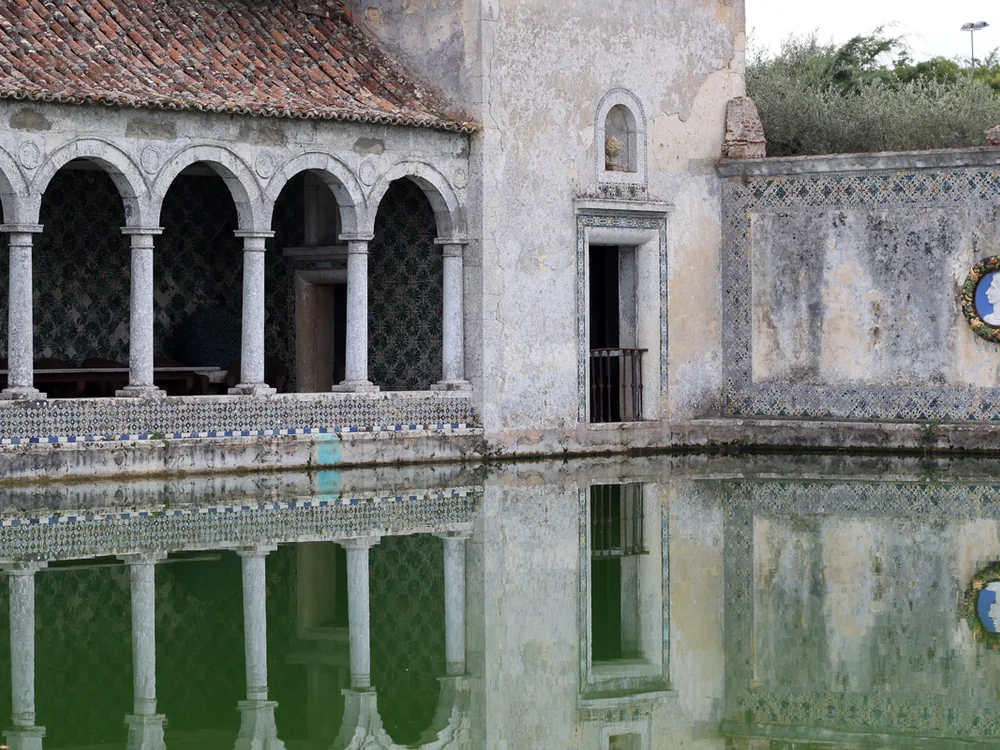
Built 1480 · Portuguese Renaissance manor house (quinta), 15th–16th century, with formal garden and lakeside pavilion — the Quinta da Bacalhôa is one of the oldest surviving examples of Renaissance domestic architecture in Portugal; the main house was originally constructed c. 1480 for the Infante Dom João (son of King Afonso V), with the characteristic Gothic-to-Renaissance transition visible in the corner towers, loggia, and garden layout; the estate was substantially developed by Brás de Albuquerque (natural son of Afonso de Albuquerque, Viceroy of Portuguese India) from approximately 1528, when he added the formal garden, ornamental tanks, and the Casa do Lago — a three-arched lakeside pavilion whose interior wall carries the famous 1565 azulejo panel depicting the Story of Susannah and the Elders; this panel, dated c. 1565 in blue-and-white tin-glazed tiles, is one of the oldest secularly-themed narrative azulejo panels surviving in Portugal; the estate functions as a working winery (Bacalhôa Vinhos) producing wines under the Setúbal Peninsula DOC designation
This page is part of an independent travel guide and is not affiliated with, endorsed by, or operated by Bacalhôa Palace.
© Castles & Palaces
Quick Facts
- Hours
- Mon–Sat 10:00–17:00. Closed Sun
- Guided tour from
- €130
- Duration
- 1.5–2 hours (guided manor house tour, formal gardens including the Casa do Lago pavilion and 1565 azulejo panel, and wine tasting at the estate cellar)
- Best time
- April to October
- Nearest city
- Setúbal
Featured Tour
Winery Visit & Fish Market Tour with Tasting from Lisbon
Cancellation available · Instant confirmation
Highlights
- ✦The 1565 azulejo panel of Susannah and the Elders — one of Portugal's oldest secular tiles — inside the Casa do Lago pavilion, set against the garden's ornamental lake, the rear wall carries a large-format azulejo panel dated c. 1565 depicting the biblical story of Susannah and the Elders in blue-and-white tin-glazed tiles; this panel is one of the earliest examples of secular narrative azulejo work surviving in Portugal — before the mid-16th century, azulejo programmes were almost exclusively religious; a secular biblical narrative on a garden pavilion reflects the Renaissance humanist culture of the estate's patron, Brás de Albuquerque, and the expanded repertoire of subjects that Portuguese tile-making was beginning to explore in the mid-16th century
- ✦Brás de Albuquerque — the son of India's Viceroy — the estate's most important patron was Brás de Albuquerque, the natural (legitimised) son of Afonso de Albuquerque, the Portuguese Viceroy of India who conquered Goa, Malacca, and Hormuz and established Portugal's maritime empire in the Indian Ocean in the early 16th century; Brás inherited his father's cultural ambitions if not his military career — he published a biography of his father and developed the Quinta da Bacalhôa into one of the most architecturally refined country estates in 16th-century Portugal; the corner towers, loggia, formal gardens with ornamental water tanks, and the Casa do Lago pavilion all reflect his investment in the estate from approximately 1528
- ✦Gothic to Renaissance — the architecture of transition — the main manor house at Bacalhôa represents one of the earliest examples of Renaissance taste in Portuguese domestic architecture; the original 1480s structure still shows the influence of late Gothic in its proportions, but the corner towers, the garden loggia, and the formal garden layout reflect the Italian Renaissance programme that was beginning to reach Portugal in the late 15th and early 16th century through the court of Manuel I; the estate's architecture captures precisely the moment of stylistic transition, before the fully-formed Manueline style and the later Baroque had absorbed Portuguese taste into their respective programmes
- ✦A working Setúbal Peninsula winery — the estate continues as a working winery producing Bacalhôa wines under the Setúbal Peninsula DOC, one of Portugal's most distinctive wine-producing regions, known for its Moscatel de Setúbal dessert wines and its structured red and white table wines from the Arrábida Peninsula's microclimate; the GYG day tour (t761722) includes four wine tastings from the estate and access to the 16th-century cellar; the combination of Renaissance architecture, historic azulejo tiles, and current winemaking on the same visit is genuinely unusual in Portugal
Skip the queue with a guided tour
Skip-the-line tickets & expert guides
The Quinta da Bacalhôa sits in the agricultural land of the Azeitão valley, between the Arrábida hills and the Setúbal plain, in a landscape that has been producing wine for several centuries. From the road, the estate reads as a manor house with corner towers behind a garden wall — not immediately spectacular, but distinctive in the precision of its proportions and the clarity of its Renaissance intent. Inside, the formal garden and the Casa do Lago pavilion reveal what the estate is: one of the most important survivals of Renaissance domestic architecture in Portugal.
The site was first developed c. 1480 for the Infante Dom João, son of King Afonso V, who built the main manor house with its characteristic late Gothic corner towers. The estate subsequently passed through several hands before being acquired around 1528 by Brás de Albuquerque — the natural son of Afonso de Albuquerque, the Portuguese Viceroy of India whose conquest of Goa in 1510, Malacca in 1511, and Hormuz in 1515 established Portugal's maritime empire in the Indian Ocean. Brás was legitimised after his father's death and spent much of his life in Portugal rather than Asia, channelling his inheritance into cultural patronage. He published a biography of his father and transformed the Quinta da Bacalhôa from a modest country house into one of the most refined Renaissance estates in 16th-century Portugal.
Brás's additions are the defining elements of the estate as it survives today. The formal garden — laid out with box hedges, citrus trees, pergolas, and ornamental water tanks in the Italian Renaissance manner — was one of the earliest examples of humanist garden design in Portugal. The Casa do Lago, a three-arched pavilion set against the garden's ornamental lake, carries the estate's most significant object: an azulejo panel dated c. 1565 depicting the biblical story of Susannah and the Elders. This panel, in blue-and-white tin-glazed tiles of the mid-16th century, is one of the oldest secular narrative azulejo programmes surviving in Portugal. Before the mid-16th century, Portuguese azulejo work was almost exclusively religious in subject; a secular biblical narrative on a garden pavilion signals the arrival of the Renaissance repertoire — its humanist engagement with classical and scriptural subjects outside explicitly ecclesiastical settings — into Portuguese tile-making.
The manor house itself represents the moment of Gothic-to-Renaissance transition in Portuguese domestic architecture. The original 1480s structure retains the corner tower form characteristic of late medieval Portuguese country houses; the Renaissance additions — loggia, garden layout, proportional clarity — overlay this medieval armature with Italian-influenced refinement. The result is a building that captures precisely the stylistic transition of the late 15th and early 16th century, before the Manueline style absorbed Portuguese architectural ambition into its own distinctive programme and before the Baroque of the 17th and 18th centuries imposed a different decorative order.
The estate functions today as a working winery. Bacalhôa Vinhos produces wines under the Setúbal Peninsula DOC, a designation that covers the Arrábida Peninsula south of Lisbon — a microclimate of chalk soils, Atlantic winds, and Mediterranean sun that produces some of Portugal's most characterful wines, including the famous Moscatel de Setúbal dessert wines and structured reds from Castelão and Syrah. The estate cellar dates to the 16th century. The GYG day tour from Lisbon (t761722) includes a guided tour of the palace and gardens, access to the cellar, and four wine tastings, alongside a visit to the Livramento fish market in Setúbal and a guided stop at Fortress São Filipe above the city. The two sites — Bacalhôa Palace and Fortress São Filipe — are the confirmed Visit stops on the same tour.
For independent visitors, the estate's guided tours operate at scheduled times with advance booking recommended. The manor house interior, the formal garden, the Casa do Lago pavilion, and the 1565 azulejo panel are all included in the standard estate visit. The Azeitão valley surrounding the estate is also the heart of Setúbal Peninsula wine country, and a visit can be easily extended to include other Azeitão wine estates and the town's azulejo-decorated fountain.
[Sesimbra Castle](/castles/portugal/sesimbra-castle) — the free Moorish-Portuguese hilltop fortress on the Arrábida coast, approximately 20km south — is the nearest comparable heritage site for visitors combining the Setúbal Peninsula wine country with medieval castles. [Queluz Palace](/castles/portugal/queluz-palace) — the 18th-century rococo royal palace on the outskirts of Lisbon — and [Castelo de São Jorge](/castles/portugal/castelo-sao-jorge) extend the Lisbon-Setúbal heritage circuit northward for visitors based in the capital.
History
Infante Dom João, son of King Afonso V of Portugal, built the original manor house with corner towers on the Azeitão estate around 1480, establishing the building that subsequent owners would transform into one of the most refined Renaissance garden compositions in Portugal. The estate passed through several hands in the late 15th and early 16th centuries before Brás de Albuquerque acquired it around 1528 and began the development that defines the property today: the formal garden layout, ornamental water tanks, garden loggia, and the Casa do Lago pavilion — all elements that transformed a Gothic manor house into a Portuguese Renaissance estate with direct Italian and Flemish influences.
Around 1565 an azulejo panel depicting Susannah and the Elders was installed in the Casa do Lago, making it one of the earliest surviving secular narrative azulejo panels in Portugal — a work of exceptional historical and artistic significance within the history of Portuguese tile art. The estate continued as an agricultural and wine-producing property through the 16th to 19th centuries, with the architectural fabric preserved largely intact through a period when many Portuguese quintas were neglected or altered.
American heiress Katherine Scoville acquired and restored the estate in the 1930s following a period of decline. The 20th century brought conversion to wine production under the Bacalhôa Vinhos brand, producing Setúbal Peninsula DOC wines including Moscatel de Setúbal from the estate's vineyards. The estate is open to guided visits.
How to Visit
Getting there: Vila Fresca de Azeitão is approximately 35 km south of Lisbon via the A2 and IC21 (around 40 minutes by car). No direct public transport from Lisbon — the estate is most practical by rental car or taxi from Setúbal, 20 km east.
Tickets: Walk-up entry €15 adult, €8 child. The GYG tour (t761722, from €130, 4.5★/3 reviews) — a 5-hour day trip from Lisbon including a guided tour of Bacalhôa Palace with four wine tastings, a visit to Setúbal's Livramento fish market, and a guided stop at Fortress São Filipe — book in advance.
Practical tips: The manor house interior is on guided tours only at scheduled times — not open for independent access, so plan arrival around published tour slots. Spring (April–June) shows the formal Renaissance garden at its best; September–October adds the grape harvest. The estate is closed on Sundays — confirm hours before travelling.
Combine with: [Fortress São Filipe](/castles/portugal/fortress-sao-filipe) in Setúbal (20 km east), included on the same GYG day tour, and [Sesimbra Castle](/castles/portugal/sesimbra-castle) on the Arrábida coast (20 km south) for a full Setúbal Peninsula heritage circuit.
Frequently Asked Questions
The 1565 azulejo panel in the Casa do Lago pavilion depicts the biblical story of Susannah and the Elders in large-format blue-and-white tin-glazed tiles. It is significant because it is one of the earliest surviving examples of secular narrative azulejo work in Portugal — before the mid-16th century, azulejo programmes in Portugal were almost exclusively religious in subject matter (church interiors, cloisters, devotional panels). A secular biblical narrative on a garden pavilion reflects the Renaissance humanist culture of the estate's patron, Brás de Albuquerque, and the expanded repertoire that Portuguese tile-making was beginning to explore in the mid-16th century. The panel's date, 1565, places it at the very beginning of Portugal's great azulejo tradition.
Location
Quinta da Bacalhôa, EN10, 2925-491 Vila Fresca de Azeitão, Portugal
Nearby Castles
Tours & Tickets
Powered by GetYourGuide
From
€130/ person