
Palácio da Bolsa
Palácio da Bolsa
Portugal · Norte Region — Porto, Historic Centre (UNESCO World Heritage Site) · Near Porto
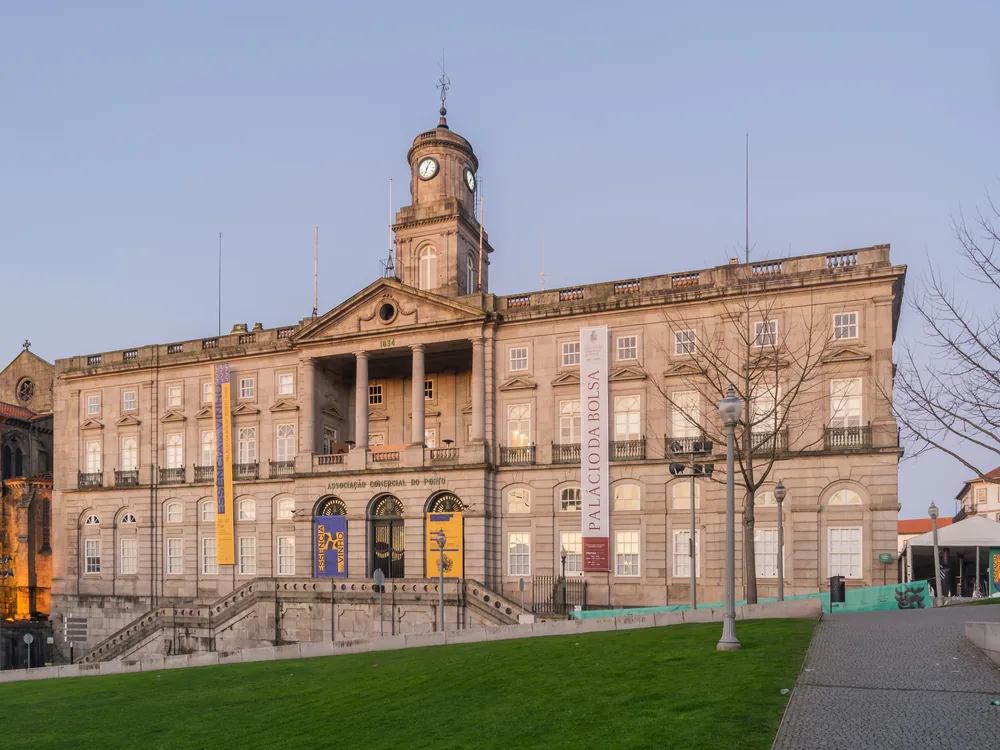
Built 1842 · 19th-century Portuguese Neoclassical palace with eclectic interior state rooms, 1842–1910, Porto Commercial Association — the Palácio da Bolsa was built by the Associação Comercial do Porto (Porto Commercial Association) on the site of the former Franciscan Convent of São Francisco, which was destroyed by fire in 1832; the exterior facade is a restrained Neoclassical composition in Porto's characteristic grey granite, with a projecting central block, flanking wings, and a formal street elevation that reflects the civic confidence of Porto's merchant class at the height of its 19th-century prosperity; the interior is far more varied and ambitious — a sequence of state rooms of ascending decorative elaboration leading to the Salão Árabe (Arab Room), designed by Gonçalves e Sousa and completed in 1880; the Arab Room is a Moorish Revival interior of extraordinary ornamental intensity, inspired by the Alhambra's Sala de los Embajadores and covered in polychrome stucco carved in Islamic geometric and arabesque patterns with a domed ceiling in gilded relief; other rooms include the Pátio das Nações (glazed courtyard), Sala dos Retratos (Portrait Gallery), Sala das Assembleias (Assembly Hall), Sala Dourada (Golden Room), and the Tribunal de Comércio (Commercial Court); the building is classified as a Portuguese National Monument
This page is part of an independent travel guide and is not affiliated with, endorsed by, or operated by Palácio da Bolsa.
© Castles & Palaces
Quick Facts
- Hours
- Daily 09:00–18:30
- Guided tour from
- €40
- Duration
- 1–1.5 hours (guided tour of state rooms including Pátio das Nações, Sala dos Retratos, Sala Dourada, and the Arab Room/Salão Árabe)
- Best time
- Year-round
- Nearest city
- Porto
Featured Tour
Monumental and historic Porto with the Palácio da Bolsa
Cancellation available · Instant confirmation
Highlights
- ✦The Arab Room (Salão Árabe) — Porto's most spectacular interior — designed by the Porto architect Gonçalves e Sousa and completed in 1880 after eighteen years of work, the Salão Árabe is one of the most ornamentally ambitious interiors in 19th-century European architecture; its walls and ceiling are entirely covered in polychrome stucco carved in Islamic geometric and arabesque patterns — a Moorish Revival composition directly inspired by the Alhambra's Sala de los Embajadores in Granada; the dome is finished in gilded relief; the room was designed to receive visiting heads of state and foreign dignitaries and was calibrated to impress: Porto's Commercial Association wanted an interior that could stand comparison with royal palaces, and the Arab Room achieves exactly that on its own eccentric terms
- ✦Built on the ruins of a burned Franciscan convent — the Palácio da Bolsa was constructed on the ruins of the Franciscan Convent of São Francisco, which stood on this site from the 13th century until a fire destroyed it in 1832; only the adjacent Igreja de São Francisco survived the fire; the Porto Commercial Association acquired the burned convent site and commissioned the new palace to serve as the city's commercial exchange — a function that required both practical trading spaces and ceremonial rooms capable of hosting state visitors; the building's origin on convent ruins is part of what gives it its unusual interior sequence: secular functions in a place with a monastic past, state rooms of increasing elaboration culminating in the Moorish fantasy of the Arab Room
- ✦The sequence of state rooms — a lesson in 19th-century Porto wealth — the standard guided tour moves through a sequence of rooms that traces the decorative ambition of Porto's merchant class: the Pátio das Nações (a glazed central courtyard with coats of arms of the nations that traded with Porto), the Sala dos Retratos (Portrait Gallery of kings and commercial presidents), the Sala das Assembleias (Assembly Hall), the Sala Dourada (a gilt-finished reception room), and the Tribunal de Comércio (Commercial Court, still used for ceremonies); each room escalates the ornamental programme until the Arab Room arrives as its culmination — the most extreme expression of what Porto's wealth could build
- ✦Adjacent to the Igreja de São Francisco — Porto's most gilded Gothic interior — the Palácio da Bolsa sits immediately beside the Igreja de São Francisco, the surviving Gothic church from the Franciscan complex that burned in 1832; São Francisco's interior is lined with approximately 200–250kg of applied gold leaf on carved Baroque woodwork — one of the most extravagant Baroque interiors in Portugal; visitors who combine both buildings in a single morning get the full range of Porto's ornamental ambition from the 14th-century Gothic through the 19th-century Neoclassical and Moorish Revival
- ✦IMPORTANT — palace entry is separate from the GYG walking tour price — the GYG Porto walking tour (t765879, $46) covers the city's main landmarks, historical context, and the palace's exterior setting; it explicitly does NOT include palace entry, which is marked as an 'Extra fee' (+€10) in GYG's own itinerary; the Arab Room and all interior state rooms are visible only with a palace ticket, purchased separately at the palace entrance; both are worth doing: the walking tour for the city context, the palace ticket for the interior
Skip the queue with a guided tour
Skip-the-line tickets & expert guides
Porto's Palácio da Bolsa stands at the western edge of the Ribeira district, in a position that announces the building's double function as both commercial institution and civic monument. It sits on ground that was once a Franciscan convent. The Convent of São Francisco had occupied the site from the 13th century — one of the oldest and largest Franciscan establishments in northern Portugal, with a Gothic church that still survives immediately to the building's right. In 1832, during the Liberal Wars that reshaped Portugal's political order, fire destroyed the convent. The adjacent Gothic church survived; the rest of the complex did not. The Porto Commercial Association acquired the burned site and began construction of a new building in 1842.
The building that resulted is genuinely difficult to categorise by any single architectural label. The exterior is restrained Neoclassical — grey Porto granite, a central projecting block, formal windows, civic in tone rather than princely. The interior is something else entirely. The Porto Commercial Association was the institutional expression of a merchant class that had grown wealthy on port wine, textile manufacturing, and Atlantic trade, and the palace's interior was designed to make that wealth visible in the most direct possible way. The sequence of state rooms moves through ascending levels of decorative intensity: the glazed central courtyard (Pátio das Nações) whose walls carry the coats of arms of the nations that traded with Porto; the Portrait Gallery lined with kings and presidents of the Commercial Association; the Assembly Hall where the city's merchants met; the Golden Room for formal receptions; the Commercial Court where disputes were adjudicated.
All of this is prologue to the Arab Room (Salão Árabe). Completed in 1880 after eighteen years of continuous work by the Porto architect Gonçalves e Sousa, the Arab Room is one of the most ornamentally extreme interiors of 19th-century Europe. Its walls and ceiling are entirely covered in polychrome stucco carved in Islamic geometric and arabesque patterns — a Moorish Revival composition directly inspired by the Alhambra's Sala de los Embajadores in Granada. The dome is finished in gilded relief. The room was designed specifically to receive visiting heads of state and foreign dignitaries: Porto's Commercial Association was determined to create an interior capable of impressing royalty, and the Arab Room's design logic is precisely that — to build something that could stand comparison with the sultan's palaces of Granada, translated into the commercial confidence of 19th-century Porto.
The choice of Moorish Revival for Porto's grandest interior is worth unpacking. By 1860, when work on the Arab Room began, Moorish Revival had become the architectural language of ambition and exoticism in 19th-century Europe — a style associated with wealth, orientalist fantasy, and the claim to cultural sophistication. It was also, in the Iberian context, a deliberate reference to the peninsula's pre-Reconquista past: building in the style of the Alhambra was a way of claiming inheritance from the most admired buildings in Spain, regardless of the religious history those buildings represented. Porto's merchants were making a statement about the city's cultural reach, not its religious identity.
The palace functions today as it was built to function: as the institutional home of Porto's Commercial Association, with the state rooms open to the public on guided tours and the building still used for civic ceremonies and official receptions. The tour takes approximately one hour and moves through all the major rooms in sequence.
A critical point for visitors arriving via the GYG walking tour of Porto (t765879): the tour's €40 price explicitly does not include entry to the palace interior — entry to the Arab Room and all state rooms is a separate ticket, approximately €10–12, paid directly at the palace. The GYG tour covers the palace's exterior, historical context, and the surrounding Ribeira district; the interior visit requires a separate palace ticket, purchased at the entrance. Both are worth doing, but the distinction matters for planning and budget.
The Igreja de São Francisco — immediately to the palace's right, the surviving Gothic church of the Franciscan complex — is worth combining with the palace visit. São Francisco's interior is lined with approximately 200–250kg of applied gold leaf on carved Baroque woodwork, one of the most extravagant Baroque church interiors in Portugal and a counterpoint to the palace's secular ornamental ambition next door.
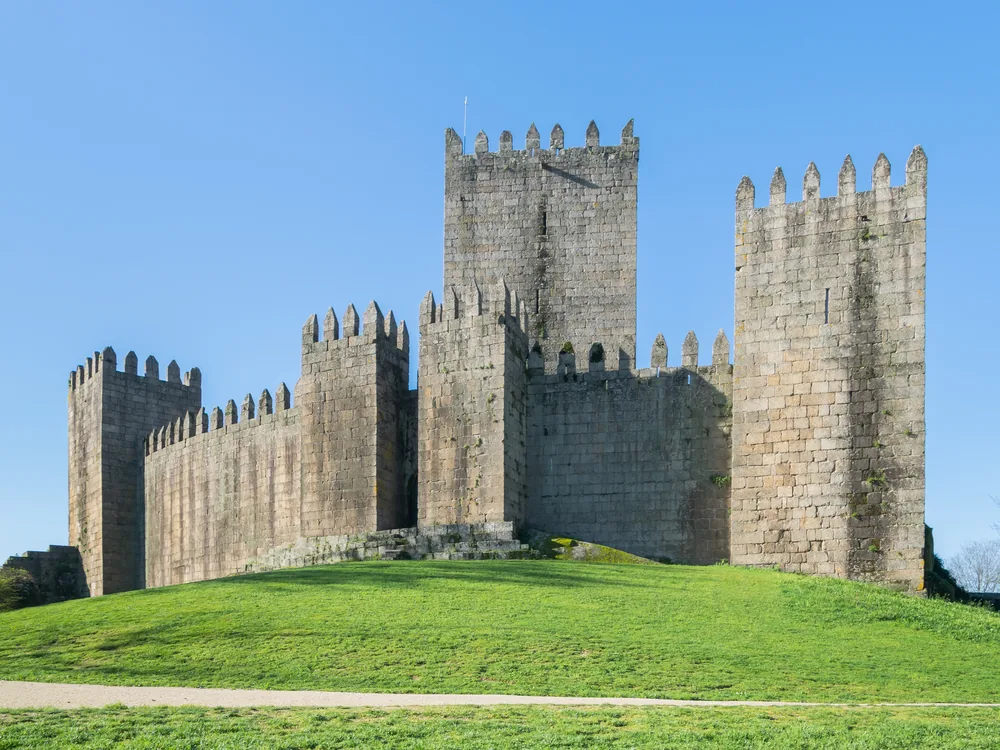
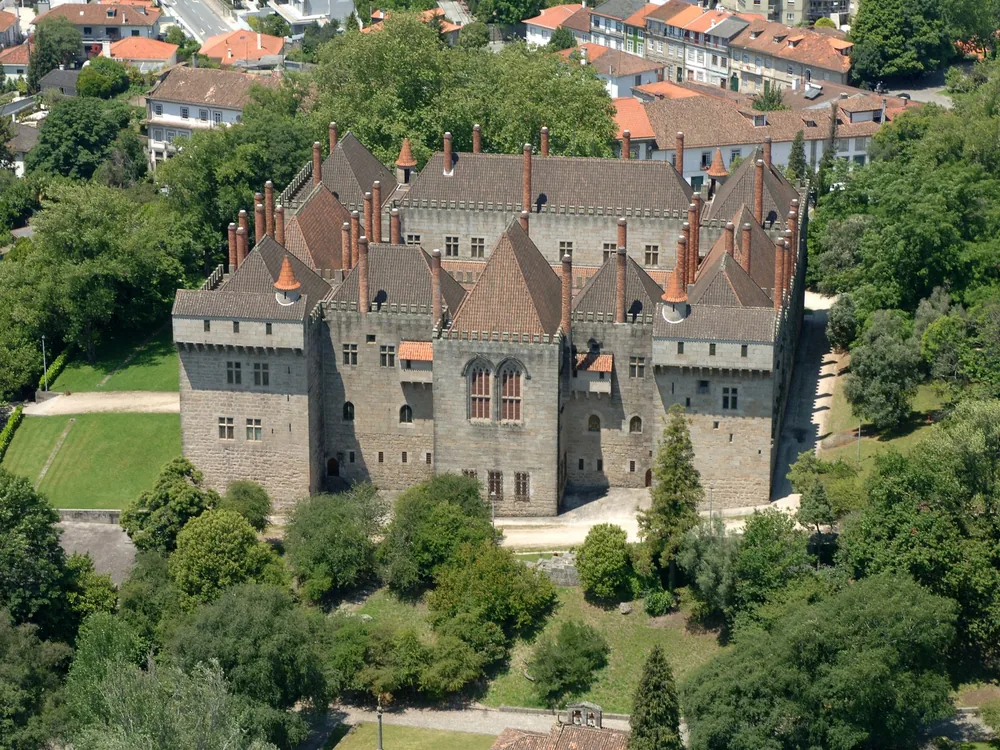
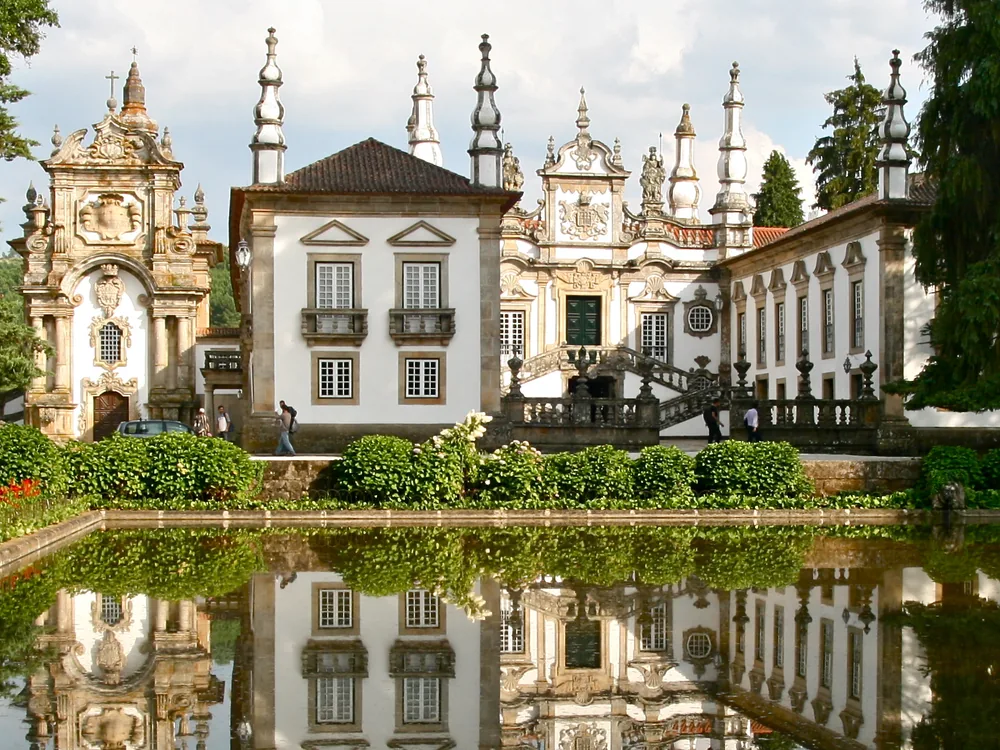
[Guimarães Castle](/castles/portugal/guimaraes-castle) — the medieval birthplace of the Portuguese kingdom, 50km to the north — and the [Palace of the Dukes of Braganza](/castles/portugal/palace-of-the-dukes-of-braganza) in the same town are the major Norte region heritage destinations for visitors extending from Porto. [Solar de Mateus](/castles/portugal/mateus-palace) — Nicolau Nasoni's baroque manor palace, 100km east near Vila Real — extends the baroque and decorative heritage of the Norte region further into the Douro hinterland.
History
The Franciscan Convent of São Francisco was established on the site in the 13th century and grew into one of the largest Franciscan complexes in northern Portugal. The Igreja de São Francisco — the surviving Gothic church that now stands immediately adjacent to the Palácio da Bolsa — was largely completed under King João I in 1383. The Liberal Wars of 1832 ended the monastic phase: fire destroyed the convent buildings while the Gothic church survived. The suppression of religious orders in Portugal in 1834 freed the site for civil acquisition, and the Porto Commercial Association (Associação Comercial do Porto) took possession.
Construction of the Palácio da Bolsa as Porto's new commercial exchange began in 1842. The building's most celebrated interior, the Arab Room (Salão Árabe), was begun in 1862 by the artist Gonçalves e Sousa and took eighteen years to complete — a Moorish Revival interior of stucco arabesques, gilt ornament, and inscriptions from the Quran executed with the same labour-intensive precision as the Alhambra rooms it referenced. The palace was substantially finished when the Arab Room was completed in 1880, with final decorative works continuing to 1910.
The Palácio da Bolsa was classified as a Portuguese National Monument in 1910. It is open daily to guided tours and is still used by the Porto Commercial Association for institutional functions and state events.
How to Visit
Getting there: The Palácio da Bolsa is in Porto's Ribeira district, a 20-minute walk from São Bento station or about 30 minutes from Porto Campanhã. Bus lines 500 and 900 stop nearby on Rua Mouzinho da Silveira. The Igreja de São Francisco is immediately to the right of the entrance.
Tickets: Walk-up entry €12 adult, €7 child — guided tours of all state rooms including the Arab Room run continuously throughout opening hours; no advance booking is required but queues build in spring and summer. The GYG tour (t765879, from €40, 4.9★/9 reviews) — a 4-hour guided walking tour of Porto's historic centre including São Bento Station, the Sé Cathedral, and the Palácio da Bolsa exterior — covers the palace grounds only; interior entry (the Arab Room and all state rooms) is a separate €10–12 charge paid at the palace, explicitly marked as an extra fee in the tour itinerary — book the GYG tour in advance.
Practical tips: The Arab Room is the tour's culmination — do not rush the earlier rooms, but pace yourself so you have time to read the inscription panels in the Arab Room itself. Combine the palace with the adjacent Igreja de São Francisco (separate ticket), whose Baroque interior covered in 200–250 kg of gilded woodwork is a striking contrast to the palace next door. Arrive at opening (09:00) in summer to avoid the longest tour queues.
Combine with: [Guimarães Castle](/castles/portugal/guimaraes-castle) and [Palace of the Dukes of Braganza](/castles/portugal/palace-of-the-dukes-of-braganza) for a full Northern Portugal heritage day trip from Porto.
Frequently Asked Questions
No. The GYG Porto walking tour (t765879, €40) explicitly does not include palace entry — GYG's own itinerary marks the Palácio da Bolsa interior as an 'Extra fee (+€10)' stop, paid separately at the palace. The walking tour covers the palace exterior, its historical and commercial context, and the surrounding Ribeira district. To visit the Arab Room (Salão Árabe) and the state rooms, you need a separate palace ticket, approximately €10–12 for adults, purchased directly at the palace entrance. Budget for both if you want the full experience.
Location
Palácio da Bolsa, Rua de Ferreira Borges, 4050-253 Porto, Portugal
Nearby Castles
Tours & Tickets
Powered by GetYourGuide
From
€40/ person