
Citadel of Suceava
Cetatea de Scaun a Sucevei
Romania · Bukovina / Suceava County · Near Suceava
Built 1375 · Moldavian medieval fortress — the Citadel of Suceava was built and expanded as the principal defensive fortification and occasional residence of the Moldavian rulers; the quadrilateral structure with corner towers was built in stages from the late 14th century through the reign of Stephen the Great (1457–1504), who significantly strengthened the walls and added the outer defensive ring; the fortress is notable for the use of Moldavian stone construction techniques and the integration of the natural terrain into the defensive plan; substantial restoration works have been underway since the early 2000s
This page is part of an independent travel guide and is not affiliated with, endorsed by, or operated by Citadel of Suceava.
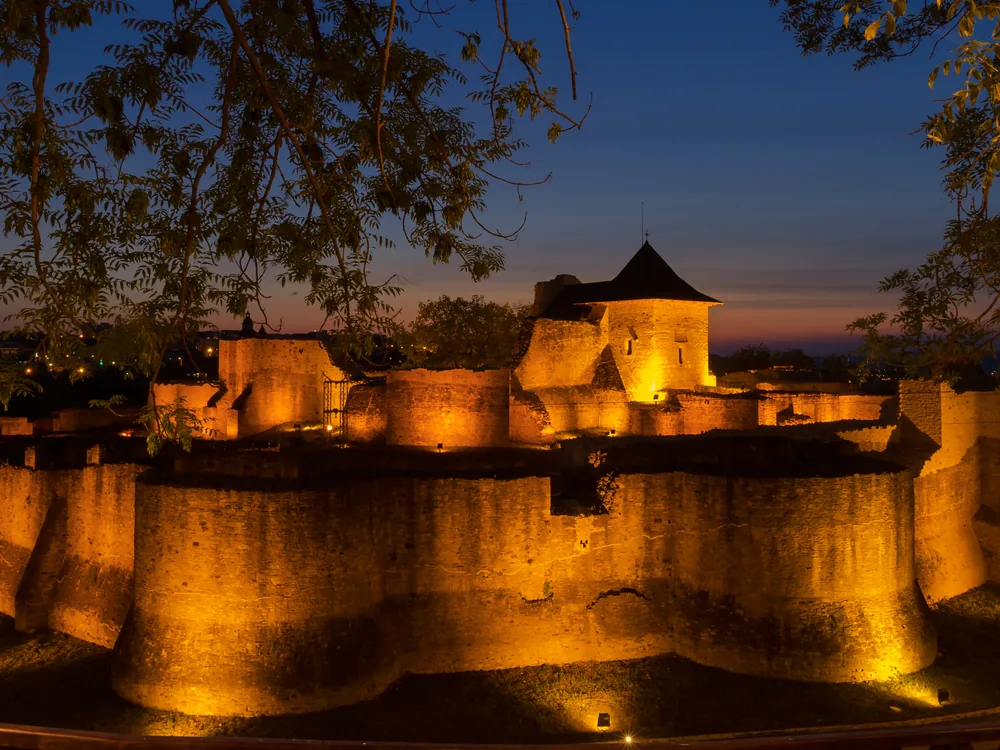
© Castles & Palaces
Quick Facts
- Hours
- Daily 08:00–20:00
- Guided tour from
- €49
- Duration
- 1 hour at the fortress itself; 4 hours for the full GetYourGuide walking tour covering fortress + historic landmarks
- Best time
- May to September
- Nearest city
- Suceava
Featured Tour
Discover Suceava: Walking Tour of Fortress & Historic Landmarks
Cancellation available · Instant confirmation
Highlights
- ✦Stephen the Great's fortress — the Citadel of Suceava was the primary military base of Stephen III of Moldavia (r. 1457–1504), whose 47-year reign was one of the most remarkable in medieval European history: he won 34 of 36 recorded battles, maintained Moldavian independence against the Ottoman Empire, Hungary, and Poland simultaneously, and was described by Pope Sixtus IV as the 'Athlete of Christ' for his repeated successes against Ottoman encroachment
- ✦Seat of the Moldavian throne — Suceava was the capital of the Principality of Moldavia from 1388 to 1565, and the Citadel of Suceava ('Cetatea de Scaun' — literally the 'Throne Citadel') was the seat of princely power during that period; it is one of the most historically significant medieval fortifications in Romania, corresponding in Moldavian history to what the Transylvanian castles are for Transylvanian history
- ✦The ongoing restoration (20+ years) — the citadel has been under active restoration and consolidation since the early 2000s, funded by Romanian and European heritage authorities; the work is restoring the original medieval stonework, the corner towers, and the outer ring of defences — but some areas of the site may be closed or scaffolded at any given time; the overall trajectory is toward a more complete presentation of the medieval fabric, expected to be substantially advanced over the coming years
- ✦The GetYourGuide walking tour (4 hours) — a 4-hour walking tour of Suceava that covers the Citadel of Suceava as its principal stop alongside several other historic landmarks of the city, including the Church of St George (Sfântul Gheorghe), the Historical Museum of Bucovina, and the old city centre; the tour is conducted in English
- ✦Gateway to the Bukovina painted monasteries — Suceava is the practical base for visiting the UNESCO-listed painted monasteries of Bukovina (Voroneț, Humor, Sucevița, Moldovița, Arbore), which are the primary cultural heritage draw of northern Romania; the citadel visit naturally combines with a painted monastery circuit based from Suceava
- ✦First Bukovina / northern Moldavia entry on this site — the site previously had no entries for Romania's northeastern region; Cetatea de Scaun opens the Suceava and Bukovina coverage
Skip the queue with a guided tour
Skip-the-line tickets & expert guides
The Citadel of Suceava — Cetatea de Scaun a Sucevei, meaning literally the 'Throne Citadel of Suceava' — stands on a promontory above the city of Suceava in the Bukovina region of northeastern Romania. It was the principal military fortress of the Principality of Moldavia during the period when Suceava was the Moldavian capital (1388–1565), and it is associated above all with the reign of Stephen III of Moldavia — Stephen the Great — whose 47-year rule from 1457 to 1504 made Moldavia one of the most consistently successful military powers in late medieval Europe.
The principality of Moldavia, founded in the mid-14th century, occupied a difficult geopolitical position: a medium-sized Orthodox Christian state sandwiched between the Ottoman Empire to the south and southeast, the Kingdom of Hungary to the west, and the Kingdom of Poland to the north. It held no secure overriding alliance and faced military pressure from all three major neighbours at various points in the 15th century. The standard medieval trajectory for such a state was absorption, partition, or vassal status within a generation or two. Moldavia's exceptional survival, during the period of maximum Ottoman expansion and the concurrent Hungarian and Polish competition for influence in eastern Europe, is largely the accomplishment of Stephen the Great's personal strategic skill and military organisation.
Stephen inherited a destabilised Moldavia in 1457 after defeating his cousin Petru Aron (who had murdered his father). Over the next 47 years, he is recorded as winning 34 of the 36 battles he fought — against Ottoman, Hungarian, Wallachian, Tatar, and Polish forces at various points. His defeat of the Ottoman advance at the Battle of Vaslui in 1475 was described by Pope Sixtus IV (who sent envoys to Suceava) as one of the most significant Christian victories over the Ottomans of the age; Sixtus called Stephen 'the Athlete of Christ,' an epithet more commonly applied to crusade-era commanders. Stephen's victory did not prevent eventual Ottoman suzerainty — Moldavia became an Ottoman tributary state after 1501 — but he maintained genuine political independence until his death in 1504 and negotiated terms far more favourable than most neighbouring rulers achieved.
The Citadel of Suceava was Stephen's principal military base throughout this period. The fortress had been built in stages from the late 14th century, but Stephen significantly strengthened it: adding an outer ring of defences, deepening the moat, reinforcing the corner towers, and improving the artillery positions as military technology evolved. The quadrilateral plan with corner towers, set on a natural promontory above the Suceava River plain, used the terrain as part of the defensive system — the promontory's steep slopes on several sides reduced the length of walls that needed active defence.
After Moldavia's capital moved from Suceava to Iași in 1565, the citadel's role as a throne fortress ended, and it was used primarily as a military garrison position. The Ottoman and later Cossack raids of the 17th century damaged the structure significantly; by the 18th century it was substantially ruined. The 19th and 20th centuries saw archaeological work on the site, and from the early 2000s, a comprehensive restoration and consolidation programme has been underway with Romanian and European Union heritage funding. The programme — now more than 20 years old — has been restoring the medieval stonework, the corner towers, and the outer defensive ring, and continues at the time of writing; some areas of the site may be closed or under active work during a given visit.
The GetYourGuide-listed walking tour (4 hours, English guide) covers the Citadel of Suceava as its main stop on a 4-hour circuit of the city's historic sites, including the Church of St George (where Stephen the Great is buried), the Historical Museum of Bucovina, and the old city centre. The tour provides the historical context for the citadel that makes the ruined walls coherent as an expression of medieval Moldavian power.
Suceava is the practical base city for visiting the painted monasteries of Bukovina — the UNESCO World Heritage cluster of Orthodox monasteries (Voroneț, Humor, Sucevița, Moldovița, Arbore) whose exterior walls carry Byzantine-tradition frescoes painted in the 15th and 16th centuries that are among the most extraordinary survivals of medieval religious art in Europe. A visit to the Citadel of Suceava and the painted monasteries can be combined in a two- or three-day Bukovina itinerary.
History
Principality of Moldavia founded mid-14th century; Suceava became capital in 1388. Citadel built and expanded from the late 14th century. Reign of Stephen the Great (1457–1504): major expansion and strengthening of the citadel; 34 of 36 recorded battles won; papal recognition as 'Athlete of Christ'. Capital of Moldavia moved from Suceava to Iași in 1565; citadel became garrison fortress. Damaged by Ottoman and Cossack raids in the 17th century; substantially ruined by the 18th century. Modern restoration programme underway since the early 2000s with EU and Romanian heritage funding. Currently managed by the Bucovina Museum complex.
How to Visit
Getting there: Suceava is in northeastern Romania. By car from Bucharest: approximately 4.5 hours via E85/A7; from Cluj-Napoca approximately 4 hours. By train: 6–7 hours from Bucharest (overnight trains available). Suceava Ștefan cel Mare Airport (SCV) has daily connections to Bucharest. The citadel is 1.5 km from the city centre — walkable or a 5-minute taxi.
Tickets: Walk-up entry 15 RON adult, 5 RON child. The GetYourGuide tour is a 4-hour English-language walking tour of Suceava that covers the fortress as its main stop alongside the Church of St George — where Stephen the Great is buried — and other historic city landmarks — book in advance.
Practical tips: Parts of the citadel may be closed during active restoration work ongoing since the early 2000s — check locally on arrival before making the walk up. Plan Suceava as a 2–3 night base: the UNESCO painted monasteries of Bukovina (Voroneț, Humor, Sucevița, Moldovița) are all within 60 km and require at least a full day to cover the main cluster. The citadel's promontory gives the best panoramic views over the Suceava valley in clear morning light.
Combine with: Peleș Castle and Bran Castle in the Prahova Valley and Transylvania — both are natural stops on the return route south from Suceava toward Bucharest through the Carpathians.
Frequently Asked Questions
Stephen III of Moldavia (r. 1457–1504), known as Stephen the Great (Ştefan cel Mare), is the central figure of Moldavian history and one of the most successful military commanders in late medieval European history. Over his 47-year reign — the longest of any Moldavian ruler — he won 34 of 36 recorded battles against Ottoman, Hungarian, Polish, Wallachian, and Tatar forces, maintaining the independence of Moldavia against the most powerful military forces of his age. His victory at the Battle of Vaslui (1475) against an Ottoman army led Pope Sixtus IV to hail him as 'Athlete of Christ.' He is buried at the Putna Monastery, approximately 70km from Suceava, and is venerated in the Romanian Orthodox Church as a saint. His portrait is on the Romanian 500 lei banknote.
Location
Str. Cetăţii, Suceava 720261, Romania
Nearby Castles
Tours & Tickets
Powered by GetYourGuide
From
€49/ person