
Poenari Castle
Cetatea Poenari
Romania · Arefu, Argeș County, Wallachia · Near Curtea de Argeș
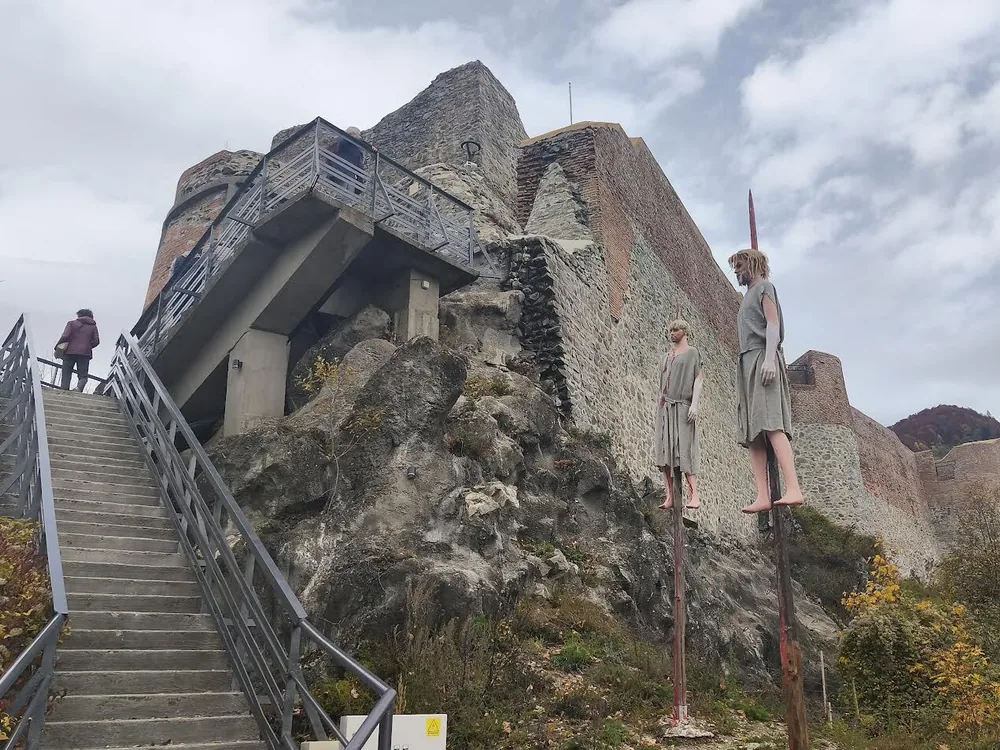
Built 1450 · Wallachian cliff-top fortress — an earlier Basarab dynasty fortification rebuilt and expanded by Vlad III of Wallachia (c. 1450s) on a limestone crag above the Argeș River gorge; the surviving structure consists of a large round tower, curtain wall fragments, and partial interior floor-plan ruins; approximately half the original perimeter was destroyed in an 1888 rockslide; reached by 1,480 concrete steps from the Transfăgărășan road below
This page is part of an independent travel guide and is not affiliated with, endorsed by, or operated by Poenari Castle.
© Castles & Palaces
Quick Facts
- Hours
- Tue–Sun 09:00–18:00. Closed Mon
- Day trip from
- €267
- Duration
- 2–3 hours (30–45 minutes up, 20–30 minutes at the ruins, 20–30 minutes down)
- Best time
- June to September
- Nearest city
- Curtea de Argeș
Featured Tour
From Bucharest: Vlad the Impaler's Royal Court & Poenari Fortress Private Day Tour
Cancellation available · Instant confirmation
Highlights
- ✦The most historically credible 'Dracula's castle' — unlike Bran Castle, which has no documented Vlad III connection, Poenari has strong historical evidence linking it to Vlad III's construction and the 1462 Ottoman siege from which he famously escaped
- ✦1,480 steps — a continuous concrete staircase climbing the gorge wall above the Argeș River, taking 30–45 minutes to ascend and providing an approach experience unlike any other castle in Europe; the steps were installed in the communist era, before which the castle was accessible only by footpath
- ✦The 1462 Ottoman siege — Sultan Mehmed II besieged this fortress during his invasion of Wallachia; Vlad escaped through the mountains to Transylvania, and his wife is said in some accounts to have thrown herself from the battlements rather than face capture; whether legend or history, the siege is documented
- ✦Views over the Transfăgărășan and Vidraru Dam — the summit ruins look down over one of Europe's most dramatic mountain roads and the artificial lake created by the Vidraru Dam (1966), making the panorama equal in drama to any castle view in Romania
- ✦1888 rockslide — approximately half the original castle perimeter was destroyed when a section of the crag gave way; the ruined state visible today is partly a result of this geological event rather than solely human abandonment or warfare
- ✦Paired with Târgoviște Royal Court on the same day tour — the GetYourGuide private tour visits the Royal Court of Târgoviște in the morning and Poenari in the afternoon, tracing Vlad's historical trajectory from his capital to his mountain fortress in a single long day
Skip the queue with a guided tour
Skip-the-line tickets & expert guides
Poenari Castle stands on a limestone crag above the Argeș River gorge in the Carpathian foothills of Argeș County, reached by 1,480 concrete steps from the Transfăgărășan mountain road below. It is the least-visited and most physically demanding of the sites associated with Vlad III of Wallachia, and it is the one with the strongest historical claim to the designation 'Dracula's Castle' — a title conventionally attached to Bran Castle in Transylvania, which has no documented connection to Vlad III at all.
The evidence for Vlad III's association with Poenari is as strong as 15th-century Wallachian sources permit. An earlier fortress existed on this crag, built by the Basarab dynasty in the 13th or 14th century. Vlad III rebuilt and massively expanded it in the 1450s, reportedly using as forced labour the Wallachian boyar families who had murdered his father, Vlad II Dracul, and buried his older brother Mircea alive. The labour detail — political enemies put to work building a fortress above their own lands — is entirely consistent with Vlad's recorded character and methods. Contemporary sources describe the work; later Wallachian chronicles elaborate it. What is certain is that the castle on this crag was substantially rebuilt during Vlad's reign and served as one of his principal fortresses during his conflict with the Ottomans.
The 1462 Ottoman siege is the central event in Poenari's history. In that year, Sultan Mehmed II invaded Wallachia with an army that outnumbered Vlad's forces enormously. Vlad conducted a famous night raid on the Ottoman camp — riding into the Turkish position in darkness to sow maximum confusion, in a tactical operation that became celebrated in both Wallachian and Ottoman accounts — but could not prevent the sultan's advance. He retreated to Poenari and was besieged. According to a story told in later Wallachian sources, a Wallachian archer who had been turned by the Ottomans shot an arrow into the castle with a message warning Vlad of his imminent capture. Vlad's wife — in the most dramatic version of the account — threw herself from the battlements into the Argeș River below rather than face Ottoman captivity. Whether this episode is history or elaboration, Vlad himself unquestionably escaped: he made his way through the mountains into Transylvania, where he was subsequently imprisoned by the Hungarian king Matthias Corvinus, who preferred Vlad neutralised to Vlad fighting (and possibly succeeding) against the Ottomans on Hungary's border.
The 1,480 steps are not metaphorical. They climb directly up the gorge wall from the road below — a concrete staircase installed in the communist era, under the Ceaușescu government's Transfăgărășan highway project of the early 1970s, to make the castle accessible for the first time. Before this, the castle was reachable only via a footpath cut into the cliff, a track that could be defended by a handful of archers against many times their number, which is precisely why the site was chosen. The climb takes approximately 30–45 minutes at a steady pace; it is steep and continuous, with no flat sections. Visitors should carry water. The descent takes approximately 20–30 minutes. The combination of physical effort and increasing height creates an arrival experience at the summit ruins unlike anything a visitor bus can deliver.
Approximately half the original castle perimeter was destroyed not by warfare or deliberate demolition but by geology: in 1888, a rockslide carried away the northeastern wall and one of the towers. The ruins visible today — a large round tower, curtain wall fragments, and remnants of the interior floor plan — represent what survived after that collapse and have been partially stabilised for visitor safety. The scale of the foundations shows that Vlad's construction was substantial, not merely a watchtower: the original castle was a significant military installation capable of housing a garrison and withstanding a siege, as indeed it did.
The Transfăgărășan road (DN7C) beneath the castle is itself one of the most dramatically engineered mountain highways in Europe: a two-lane asphalt road that climbs from the Wallachian plain at Curtea de Argeș to the high Carpathian ridge via a series of hairpin bends, a long tunnel near the summit, and a spectacular descent into Transylvania on the northern side. The road passes the Vidraru Dam and the artificial lake it created in 1966 — the largest arch dam in Romania at 166 metres — directly at the base of the Poenari steps. In summer, the combination of the blue reservoir, the dam face, the gorge, and the castle crag above creates a panorama that is as good from the road as it is from the ruins.
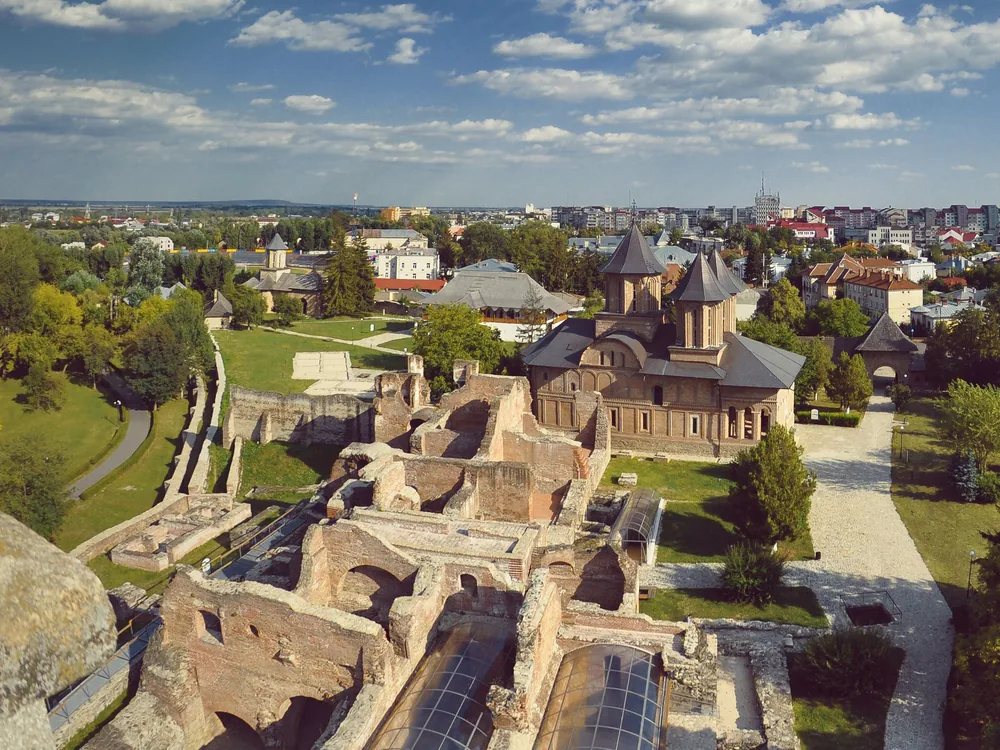
The GetYourGuide private day tour from Bucharest (11 hours) covers both the Royal Court of Târgoviște in the morning and Poenari Castle in the afternoon. Târgoviște (see the dedicated [Royal Court of Târgoviște page](/castles/romania/targoviste-royal-court)) was the capital from which Vlad ruled; Poenari was the fortress to which he retreated. Following this route in a single day traces the historical trajectory of Vlad III's reign from its administrative centre to its military culmination. Independent access to Poenari costs approximately €6 (30 RON), payable at the base of the steps; no booking required.
Visit the castle for the ruins, for the views, and for the genuine historical drama of a site that earned its associations with one of the most formidable military minds of 15th-century eastern Europe. Visit the Royal Court of Târgoviște for the deeper context of who Vlad was and how he governed. Visit Bran for the gift shops.
History
Earlier Basarab dynasty fortress on the Poenari crag, 13th–14th century. Vlad III rebuilds and expands the fortress c. 1450s using reported forced labour of political enemies. Ottoman siege of 1462: Vlad escapes to Transylvania; wife reportedly dies at the castle. Vlad killed 1476; castle falls out of military use. Transfăgărășan road (DN7C) constructed in the early 1970s under Ceaușescu, passing the base of the crag. 1,480-step concrete staircase installed in the same period. 1888 rockslide destroys northeastern wall and one tower. Castle now managed as national monument by the Argeș County Directorate for Culture.
How to Visit
Basic entry (~€6): Pay at the base of the 1,480 steps. No booking required, no advance purchase needed. The site is managed by the Argeș County Directorate for Culture. There are no facilities at the summit — carry water and snacks.
Private day tour from Bucharest (11 hours): The GetYourGuide private tour is a full-day private experience pairing this site with the Royal Court of Târgoviște (morning stop). The tour includes transport, a private guide, the Vidraru Dam, and the Transfăgărășan road. Suitable for two people sharing the cost; the per-person cost at two is approximately €134, comparable to guided tours at major European heritage sites.
Getting there: A car is essential — there is no public transport to Poenari. From Bucharest: A1 west to Pitești, then DN7C south via Curtea de Argeș into the Argeș Valley — approximately 160km, 2.5 hours. From Sibiu or Brașov (Transylvania): the Transfăgărășan road south from Bâlea Lac — only open in summer, spectacular approach. The Transfăgărășan road (DN7C) is officially closed November–June; check road conditions at drumuri-nationale.ro before travelling.
Practical notes: Start the climb before 10:00 in summer to avoid midday heat. Wear appropriate footwear — the steps become treacherous when wet. The site closes at 18:00; last ascent should begin no later than 16:30.
Tickets: Walk-up entry €6 adult, €2 child. The GetYourGuide tour — From Bucharest — offers a guided visit; book in advance.
Practical tips: June to September — the Transfăgărășan road is reliably open and the mountain weather is stable.
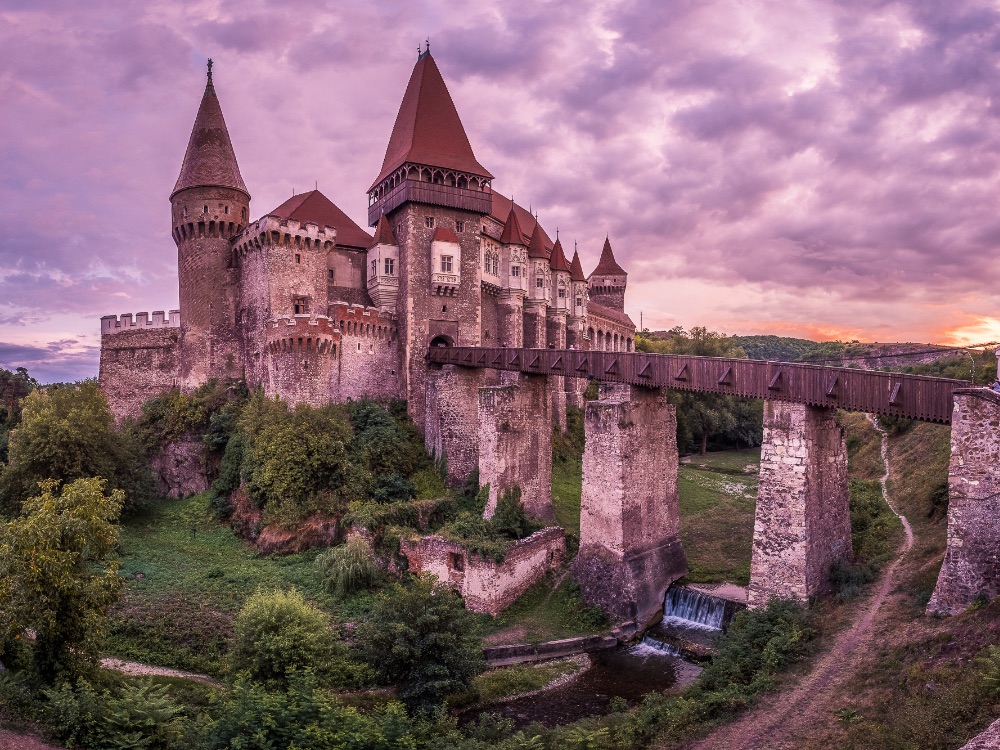
Combine with: Targoviste Royal Court, Corvin Castle.
Frequently Asked Questions
Poenari has documented historical connections to Vlad III: he rebuilt the fortress in the 1450s, was besieged here by the Ottomans in 1462, and escaped from here to Transylvania. Bran Castle, marketed as 'Dracula's Castle,' has no documented historical connection to Vlad III — the association is a 20th-century tourism construct. Poenari is remote, ruined, and requires 1,480 steps to reach; Bran is accessible, well-maintained, and receives hundreds of thousands of visitors annually. The two sites offer entirely different experiences: Bran is polished heritage tourism; Poenari is a genuinely demanding encounter with a dramatic historical site.
Location
DN7C, Arefu 117015, Argeș County, Romania
Nearby Castles
Tours & Tickets
Powered by GetYourGuide
From
€267/ person