
Blackness Castle
Blackness Castle
Scotland · West Lothian · Near Blackness, West Lothian
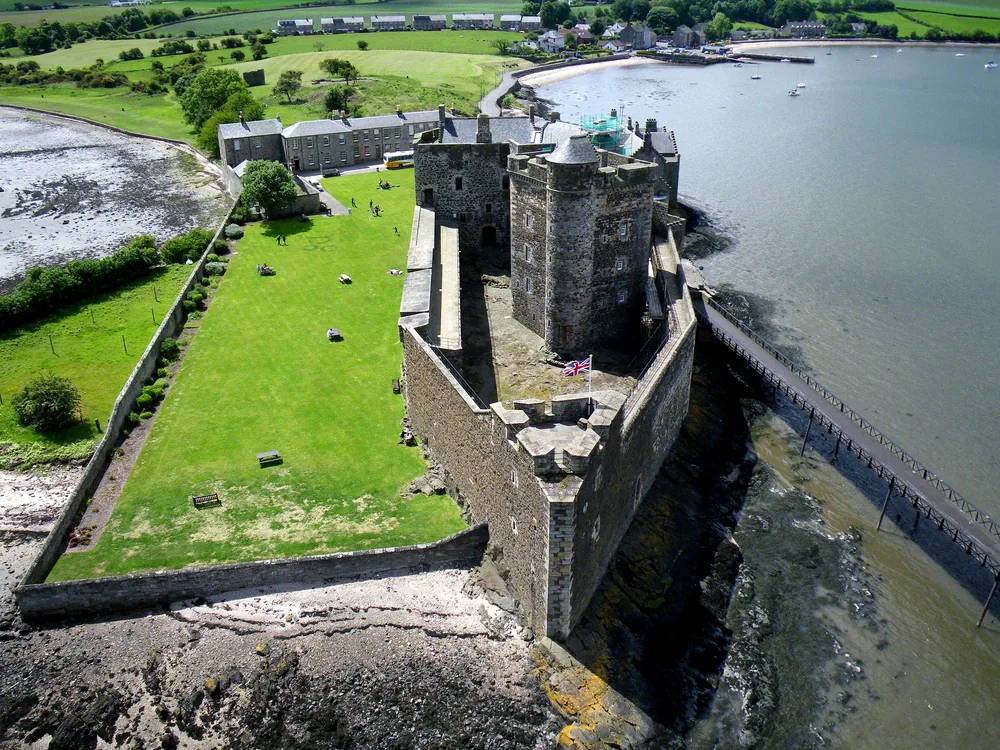
Built 1440 · Medieval stone fortress on a promontory jutting into the Firth of Forth, with a distinctive ship-shaped plan — the outer walls following the narrow point of the headland so closely that the castle resembles a stone vessel from the water, with a 'bow' at the north end, a 'stern' at the south, and the central tower reading like a mast; one of the most important state prisons in Scottish history, used from the 15th century through the 17th century and latterly as a garrison fortress and ammunition depot, remaining in military use into the 20th century; Historic Environment Scotland property
This page is part of an independent travel guide and is not affiliated with, endorsed by, or operated by Blackness Castle.
© Castles & Palaces
Quick Facts
- Hours
- Daily 10:00–17:00
- Boat tour from
- €23
- Duration
- 1 hour (cruise, castle viewed from water)
- Best time
- May to September
- Nearest city
- Blackness, West Lothian
Featured Tour
Queensferry: Firth of Forth Blackness Castle Cruise
Cancellation available · Instant confirmation
Highlights
- ✦The distinctive ship-shaped plan: the castle's outer walls follow the narrow Blackness headland so precisely that from the water it resembles a stone ship, with a north 'bow,' a south 'stern,' and the central tower like a mast — earning the nickname 'the ship that never sailed' among castle historians
- ✦One of the most important state prisons in Scottish history, used across three centuries from the 15th through the 17th: Covenanter prisoners were held here in significant numbers in the 1660s and 1680s during the periods of government repression known as 'the Killing Time,' making it a site of genuine religious and political significance in Scottish national memory
- ✦A working military installation for longer than most Scottish castles: its service as a garrison fortress, powder magazine, and ammunition depot extended into the early 20th century, making it one of the longest continuously functional castle sites in Scotland
- ✦Filming location for the Outlander television series, where it portrayed the fictional 'Fort William' in the show's early seasons — a draw for a substantial segment of visitors who should know the castle's genuine history is far richer than any fictional framing
- ✦Two ways to experience Blackness: the GetYourGuide boat cruise (from €23) sees the castle from the Firth of Forth with commentary on the Three Bridges and the Forth coastline; the Historic Environment Scotland ticket (separate purchase) provides on-site entry to walk through the castle itself
Skip the queue with a guided tour
Skip-the-line tickets & expert guides
From the water, Blackness Castle does something few medieval fortresses manage: it looks exactly like what it was built on. The narrow Blackness headland juts into the Firth of Forth with the castle riding its tip, the outer walls following the point so closely that the whole structure reads as a stone ship — bow at the north, stern at the south, the central tower rising like a mast from amidships. This is not an accident of fortification geometry; the castle's builders used the headland's natural form as a structural asset, making a fortification whose shape was determined by its site. It is the most immediately striking thing about Blackness, and it reads best from the water.
The castle was built primarily in the 15th century, associated in its early phase with the Crichton family, one of the most powerful noble dynasties in 15th-century Scotland. The Crichtons' influence ended abruptly when James II seized their lands and titles in 1455; Blackness passed to the Crown and began its long career as a royal stronghold and, most significantly, a state prison. For three centuries — roughly 1440 to 1680 — Blackness Castle held political prisoners of a variety that reflects the turbulent nature of Scottish political life during that period: nobles caught on the wrong side of dynastic struggles, Protestant reformers imprisoned during the Catholic reign of Mary of Guise, and most numerously the Covenanters — Scottish Presbyterians who refused to accept Charles II's episcopal church settlement and were imprisoned, often in brutal conditions, during the crackdowns of the 1660s and 1680s known in Scottish history as 'the Killing Time.' The castle's vaulted chambers and dungeon spaces, designed for storage and defence rather than habitation, became holding spaces for substantial numbers of prisoners under conditions that were not intended to be comfortable.
After the religious conflicts of the 17th century, Blackness transitioned from prison to garrison, serving as an ammunition depot and military installation that remained in active use well into the 20th century — longer than almost any other castle site in Scotland. This extended military function is part of why the structure survives in such relatively intact condition: a castle maintained as a working military facility is a castle that doesn't fall into disrepair in the way that purely residential or ceremonial buildings do. Historic Environment Scotland now cares for the site, which is open for walk-in visits with entry tickets purchased directly.
For Outlander viewers, Blackness Castle is the location used to portray the fictional 'Fort William' in the series' early seasons — a specific, verifiable connection that brings a significant number of visitors who may not have otherwise made the journey to West Lothian. The castle's on-screen appearance is accurate enough to the exterior that the setting is recognisable; the connection is worth knowing and worth mentioning, without treating it as the building's primary historical identity, which runs considerably deeper.
**The boat cruise vs. the castle visit — a critical distinction:** The GetYourGuide featured tour is a Firth of Forth sightseeing cruise departing from Queensferry that passes Blackness Castle as part of a scenic route that also takes in the three Forth Bridges — the Victorian rail bridge (UNESCO), the Edwardian road bridge, and the modern Queensferry Crossing. The cruise lasts approximately one hour and includes commentary on the landmarks along the Forth. It does not dock at or enter Blackness Castle — visitors see the castle from the water. This is a meaningfully different product from an on-site entry ticket, and the distinction matters for planning: if you want to walk through the castle's interior and its prison chambers, purchase a separate ticket through Historic Environment Scotland's website (link above). If you want the Firth of Forth view that shows the ship-shaped plan to best advantage, the cruise provides exactly that. Both are worth doing; neither substitutes for the other.
History
Blackness Castle was built in the 15th century, associated with the Crichton family before passing to the Scottish Crown in 1455 when James II seized Crichton lands. Under royal ownership it became one of Scotland's most important state prisons, used from the 15th through the 17th century to hold political prisoners including Covenanter dissenters imprisoned during the religious persecutions of the 1660s and 1680s.
The castle subsequently served as a garrison fortress, powder magazine, and ammunition depot, remaining in active military use into the 20th century — an unusually long operational lifespan that accounts for its relatively intact condition. Historic Environment Scotland now manages the site as a heritage attraction open to the public.
How to Visit
Getting there: Blackness Castle sits on its Firth of Forth headland about 4 miles east of Linlithgow and 18 miles west of Edinburgh. By car via the A904, the drive from Edinburgh takes roughly 30 minutes; a small car park is on site. By public transport, take a train to Linlithgow on the Edinburgh–Stirling line (about 20 minutes from Edinburgh Waverley); from Linlithgow station the castle is 4 miles with no direct bus, so a taxi or car is the practical option. For the Firth of Forth cruise, depart from South Queensferry Harbour — 9 miles west of Edinburgh, reachable by First Edinburgh bus from Haymarket or by car in about 20 minutes.
Tickets: Walk-up entry £27 adult, free child. The Firth of Forth cruise — a 1.5-hour boat trip from South Queensferry passing Blackness Castle and all three Forth Bridges, showing the castle's distinctive ship-shaped plan from the water — is a separate experience that does not include on-site castle entry; book in advance.
Practical tips: May to September offers the best visiting conditions — longest daylight hours suit the exposed ramparts and views across the Forth. No advance booking is needed for on-site HES entry; arriving at opening (10:00) lets you explore before coach groups arrive later in the morning. The interior features uneven historic surfaces, steps, and narrow passages — sturdy footwear is recommended.
Combine with: Linlithgow Palace, Mary Queen of Scots' birthplace 4 miles to the west, is also managed by Historic Environment Scotland and makes a natural West Lothian pairing.
Frequently Asked Questions
No — the GetYourGuide featured tour is a scenic boat cruise on the Firth of Forth that passes Blackness Castle as part of a route that also takes in the three Forth Bridges. The cruise does not dock at or enter the castle. For a walk-through visit to the castle's interior, purchase a separate on-site entry ticket through Historic Environment Scotland at historicenvironment.scot.
Location
Blackness, Linlithgow EH49 7NH, Scotland, UK
Nearby Castles
Tours & Tickets
Powered by GetYourGuide
From
€23/ person