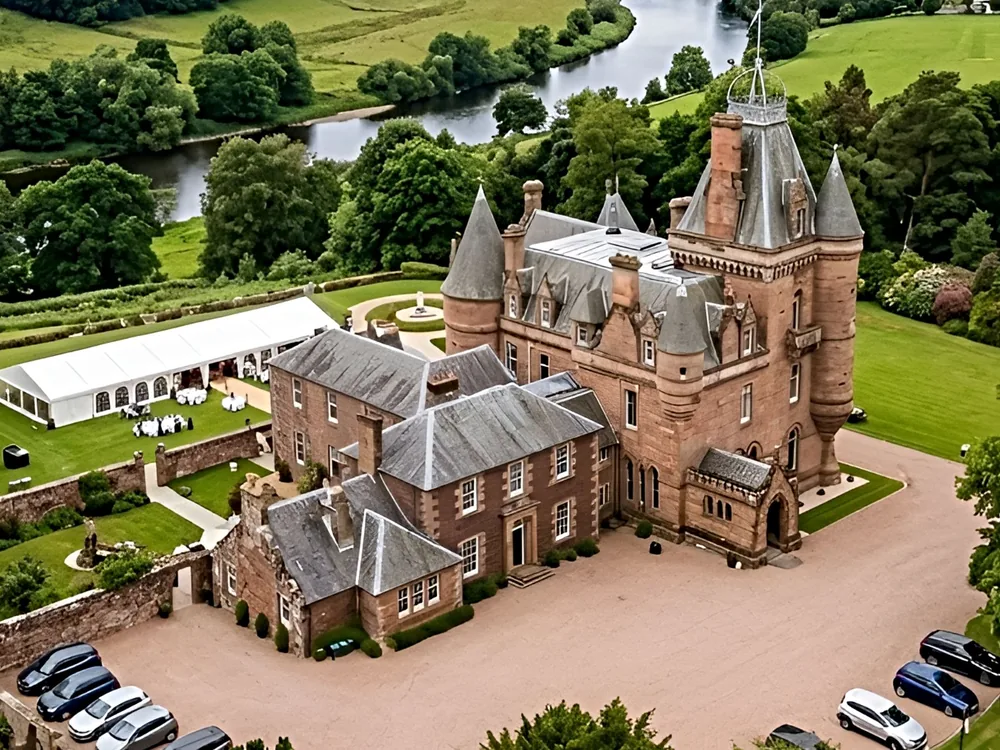
Cornhill Castle
Scotland · South Lanarkshire — Coulter, near Biggar · Near Biggar
Built 1851 · French Renaissance-style château designed by architect William Leiper, replacing an earlier farmhouse-scale mansion built in 1851 by the Bruce Campbell family
This page is part of an independent travel guide and is not affiliated with, endorsed by, or operated by Cornhill Castle.
© Castles & Palaces
Quick Facts
- Rooms from
- £115 / night
- Hotel rating
- ★★★★ 4-Star Hotel
- Duration
- The Ghillie restaurant and bar: 1–2 hours; overnight stay separately bookable
- Best time
- Year-round
- Nearest city
- Biggar
Stay Here
Cornhill Castle
★★★★ 4-Star HotelRooms are split between the historic building and a newer wing
Booked via Booking.com · Cancellation terms vary by rate
Restaurant/bar open to non-guests Wed-Sun — see Highlights above
Highlights
- ✦A castle has stood on this site above the River Clyde since 1851, when a first mansion — barely larger than a farmhouse — was built by the Bruce Campbell family
- ✦The estate passed around 1851 to William Handyside of Midlothian, then in the 1860s to Alexander Kay, a Glasgow merchant with business interests in India
- ✦The current French Renaissance-style château was designed by the architect William Leiper — among the most distinctive and elegant mansion designs in Scotland
- ✦Sensitively restored and converted into a quality country hotel, now including 7 separate lodges with hot tubs alongside the rooms in the main château
- ✦'The Ghillie' restaurant and bar is open to non-residents Wednesday to Sunday, with coffee from 10am, lunch 12–5pm and dinner 5–9pm
Stay overnight
Book a room via Booking.com
Cornhill Castle stands above the River Clyde at Coulter, a small village near Biggar in South Lanarkshire, and its present form represents one of the more architecturally distinctive transformations among Scotland's castle-hotels. A castle has occupied this site since 1851, though the first building here was considerably more modest than the château that stands today — described as barely larger than a farmhouse, it was built by the Bruce Campbell family as a comparatively unassuming country residence rather than any grand statement of wealth or status.
Ownership changed hands twice in quick succession in the years that followed. Around 1851 the property passed to William Handyside of Midlothian, and by the 1860s it had been sold again, this time to Alexander Kay, a Glasgow merchant whose business interests extended to India — one of the numerous Scottish commercial fortunes of the Victorian era built through trade connections across the British Empire. It was Kay's wealth and ambition that transformed Cornhill from its original modest farmhouse-scale building into something altogether more remarkable: a French Renaissance-style château, designed by the architect William Leiper, one of Glasgow's most accomplished Victorian architects. The result is widely regarded as one of the most singular and elegant mansions in Scotland, its turrets, steep rooflines and decorative stonework drawing directly on French château architecture rather than the more common Scots Baronial idiom favoured by so many comparable Scottish country houses of the period.
Cornhill's conversion into a hotel was handled with evident care for the château's architectural character, resulting in a country hotel that reads as a genuine restoration rather than a wholesale reinvention. The property today extends beyond the main château building itself: seven separate lodges, each equipped with its own hot tub, sit within the grounds alongside the château's own bedrooms, giving Cornhill a broader and more varied range of accommodation than a conventional single-building hotel — appealing equally to couples seeking the château's period grandeur and to groups or families wanting a more private, self-contained lodge experience on the same estate.
Dining at Cornhill centres on 'The Ghillie,' the estate's restaurant and bar, which follows a clearly defined non-resident access schedule: open Wednesday through Sunday, with coffee service starting at 10am, lunch served from midday to 5pm, and dinner from 5pm to 9pm. Guests staying in the château or the estate's lodges have access seven days a week, but the Wednesday-to-Sunday window for non-residents makes Cornhill one of the more precisely scheduled castle-hotel dining options in this collection — worth checking against travel dates for anyone planning a visit purely for a meal rather than a stay.
Set in the rolling countryside of the upper Clyde valley, within easy reach of both Biggar and the wider South Lanarkshire and Borders landscape, Cornhill offers a genuinely distinctive architectural experience for visitors more accustomed to Scotland's Baronial castle-hotel norm — a reminder that not every grand 19th-century Scottish country house drew its inspiration from home-grown medieval fortification.
William Leiper's career extended well beyond this single Lanarkshire commission — he was one of the architects most closely associated with Glasgow's flourishing commercial and residential building boom of the 1870s and 1880s, working across styles from Scots Baronial to the French-influenced idiom seen at Cornhill, and his work on prominent Glasgow buildings gave him a reputation that made him a natural choice for a client like Alexander Kay seeking something distinctly different from the standard turreted country house. That deliberate stylistic departure is part of what makes Cornhill worth visiting even for guests who have already stayed at several more conventionally Baronial Scottish castle-hotels.
History
A castle has stood at Cornhill since 1851, when a first, comparatively modest mansion was built by the Bruce Campbell family. The property passed around 1851 to William Handyside of Midlothian, and was sold again in the 1860s to Alexander Kay, a Glasgow merchant with business interests in India. Kay commissioned the architect William Leiper to design the current French Renaissance-style château, replacing the earlier, smaller building and creating one of Scotland's most architecturally distinctive country houses. Cornhill was later sensitively restored and converted into a country hotel, which today includes seven separate lodges with hot tubs in the grounds alongside the main château's own rooms.
How to Stay
Getting there: near Biggar, South Lanarkshire.
Rooms & rates: Bedrooms and suites — including a honeymoon suite spanning three levels of one of the original castle turrets — are within the historic castle building; 7 separate lodges with hot tubs are also available elsewhere on the grounds.
On-site: Restaurant/bar, gardens.
Good to know: Specify a castle room if sleeping inside the historic turreted building is the priority — the lodges are comfortable but distinct, more contemporary structures.
Combine with: Biggar town and the Tinto Hill walk, both nearby.
Frequently Asked Questions
Yes. 'The Ghillie,' the estate's restaurant and bar, is open to non-residents Wednesday to Sunday, with coffee service from 10am, lunch served 12–5pm and dinner 5–9pm. Guests staying at the château or in one of the estate's seven hot-tub lodges have access seven days a week, so it's worth checking the Wednesday-to-Sunday non-resident window against your travel dates.
Location
Coulter, Biggar, South Lanarkshire ML12 6QE, Scotland
Nearby Castles
Rooms from
£115/ night