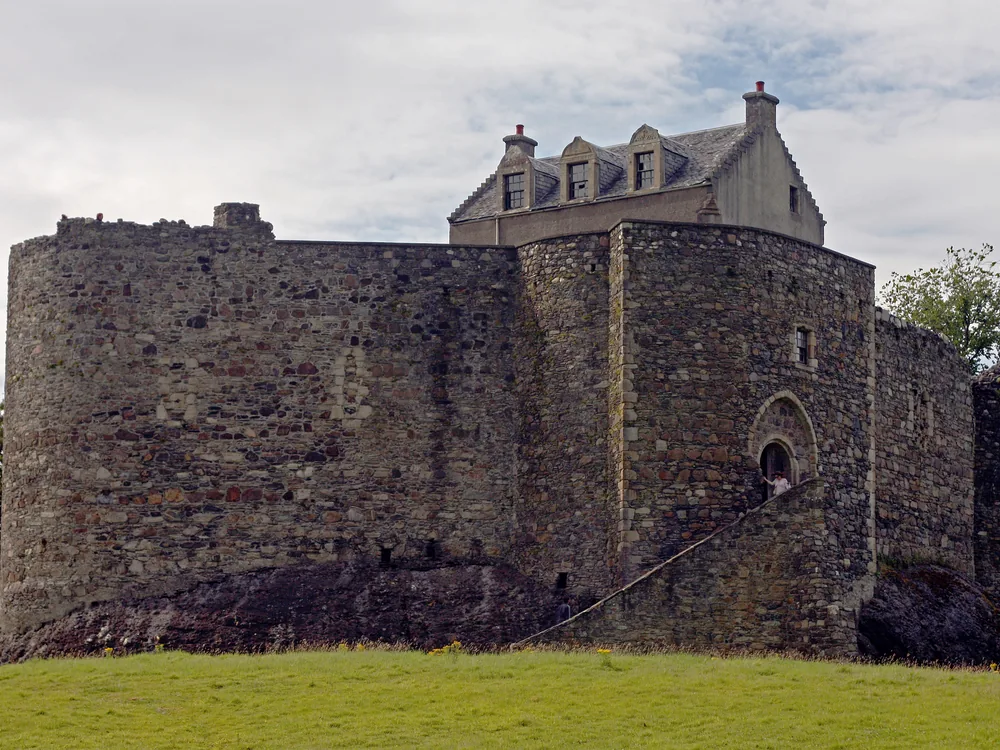
Dunstaffnage Castle
Caisteal Dhùn Stad Fhinneis
Scotland · Argyll · Near Oban
Built 1220 · MacDougall clan curtain-wall castle on a promontory of conglomerate rock above Loch Etive, 3 km north of Oban; built c.1220–1250 by the MacDougall Lords of Lorn, probably on the site of an earlier fort and likely near the location of the ancient Dál Riata capital; one of the largest and earliest curtain-wall castles in Scotland, with walls up to 3 metres thick and rising to 18 metres; the original castle had round corner towers and a great hall against the inner wall; the MacDougalls lost the castle to Robert the Bruce in 1309 after the defeat of the MacDougall-English alliance at the Pass of Brander; castle passed to the Stewart family, then to the Campbells of Argyll; a chapel dating from the 13th century stands within the outer enclosure — one of the earliest ecclesiastical buildings in Argyll still partially standing; Flora MacDonald, who helped Bonnie Prince Charlie escape after Culloden in 1746, was briefly imprisoned at Dunstaffnage before transfer to London; Robert Stevenson, the lighthouse engineer and grandfather of Robert Louis Stevenson, used Dunstaffnage as a base while building lighthouses in the Firth of Lorn; managed by Historic Environment Scotland (HES)
This page is part of an independent travel guide and is not affiliated with, endorsed by, or operated by Dunstaffnage Castle.
© Castles & Palaces
Quick Facts
- Hours
- Daily 09:30–17:30
- Entry from
- €6
- Duration
- 1–1.5 hours
- Best time
- April to September
- Nearest city
- Oban
Highlights
- ✦Dunstaffnage was built c.1220–1250 by the MacDougall Lords of Lorn on a conglomerate rock promontory commanding the entrance to Loch Etive and the approaches to the Firth of Lorn — a position that controlled the sea lanes between the Inner Hebrides and the mainland; the walls, up to 3 metres thick and 18 metres high, make it one of the most substantial curtain-wall castles built in 13th-century Scotland and one of the earliest surviving examples of the type north of the Clyde
- ✦The castle's most consequential medieval episode was its capture by Robert the Bruce in 1309 — part of Bruce's systematic reduction of the MacDougall power base after defeating the MacDougall-English alliance at the Pass of Brander in the same year; the MacDougalls had opposed Bruce's claim to the throne and allied with the English crown in a decision that cost them their principal Argyll strongholds; after the castle's capture, it was granted to the Campbells of Argyll, with whom it has remained associated ever since
- ✦Flora MacDonald, the 24-year-old Highland woman who helped Bonnie Prince Charlie escape from South Uist to Skye 'over the sea' after the Jacobite defeat at Culloden in 1746, was captured by government forces and briefly imprisoned at Dunstaffnage before being transferred to London for questioning; she was later released and became one of the celebrated heroines of Scottish Jacobite memory; her imprisonment at Dunstaffnage — a Campbell castle, in Campbell-held territory — reflects the political complexity of Jacobite Scotland's clan geography
- ✦The castle chapel, standing within the outer enclosure, is one of the earliest ecclesiastical buildings in Argyll still partially standing — built in the 13th century with pointed arches and corbelled detailing that show French Gothic influence reaching the Scottish west coast via the MacDougall family's connections to the Anglo-Norman world; the graveyard surrounding the chapel contains the graves of several generations of the Campbell custodian family
- ✦The Ell Maid of Dunstaffnage — the castle's resident supernatural guardian — is said to appear before a death or major event in the Campbell family; she reportedly appeared to warn before the castle fire of 1810, though whether she appeared before or after varies depending on which version of the story the guide is telling; the ghost tradition makes Dunstaffnage one of the more atmospheric castle visits in Argyll, particularly in the early morning mist that rolls off Loch Etive in spring and autumn
Tickets & tours
Book through GetYourGuide
Dunstaffnage Castle stands on a promontory of conglomerate rock above the entrance to Loch Etive, 3 kilometres north of Oban in Argyll. The rock rises directly from the water on three sides, with the castle walls completing the enclosure on the fourth. From the battlements, the view extends down the Firth of Lorn toward the Sound of Jura and north toward Ben Cruachan — a panorama of water, islands, and Highland landscape that was strategically legible to the MacDougall lords who built the castle c.1220 and remains visually striking to visitors eight centuries later.
The MacDougall Lords of Lorn chose this site for the same reasons that the Dál Riata Scots who preceded them in this landscape had fortified the general area: the promontory controls the seaward approaches to Loch Etive and the mainland approaches from the north, making it one of the dominant positions in the complex geography of the Argyll coast. The castle they built — with curtain walls up to 3 metres thick and 18 metres high, original round corner towers, and a great hall against the inner wall — is one of the largest and earliest examples of the curtain-wall castle type built in Scotland, contemporary with the great Welsh fortresses being built by Henry III and later Edward I and representing a different but parallel architectural tradition on the Scottish west coast.
The MacDougalls occupied Dunstaffnage as the primary stronghold of their Lordship of Lorn until the beginning of the 14th century, when their political miscalculation brought them into conflict with Robert the Bruce. The MacDougalls had chosen to align with the English crown in the Wars of Scottish Independence — an alliance that brought them into direct opposition to Bruce after his seizure of the Scottish kingship. In 1308, Bruce defeated the MacDougall-English alliance at the Pass of Brander, a narrow gorge below Ben Cruachan where the MacDougalls had set an ambush that the Bruce forces outmanoeuvred by sending men to the heights above the pass. Dunstaffnage fell in 1309, and the MacDougall Lord of Lorn was required to surrender it. Bruce installed the Campbell family as hereditary keepers of the castle — an arrangement that has persisted, with various interruptions, to the present day.
The castle's 14th to 18th-century history is one of Argyll politics and Campbell family power — a story of the same clan that grew to dominate the western Highlands from this base and others, eventually producing the Earls and Dukes of Argyll who became among the most powerful magnates in Scotland. The castle itself was used primarily as an administrative seat and occasional military garrison, and the physical fabric was extended and modified over the centuries with additions to the towers and domestic ranges.
Dunstaffnage's most famous prisoner arrived in 1746. Flora MacDonald — the 24-year-old South Uist woman who had helped Bonnie Prince Charlie escape from the Outer Hebrides to Skye disguised as her Irish maidservant 'Betty Burke' after the Jacobite defeat at Culloden — was captured by government forces and brought to Dunstaffnage. Her brief imprisonment here before transfer to London for questioning placed her at a Campbell castle in territory loyal to the Hanoverian government; the irony of a woman celebrated for helping the Stuart prince being held in a Campbell stronghold was not lost on contemporaries. She was later released without trial and became one of the most celebrated women in Scottish popular memory — Dr Johnson met her on his Hebridean journey in 1773 and described her as 'a woman of middle stature, soft features, gentle manners, and elegant presence.'
Robert Stevenson — the Scottish engineer who built many of Scotland's earliest lighthouses, including the Bell Rock (1811), and who was grandfather of Robert Louis Stevenson — used Dunstaffnage as a working base while constructing and maintaining lighthouses in the Firth of Lorn, giving the castle an unexpected connection to the engineering history of maritime Scotland.
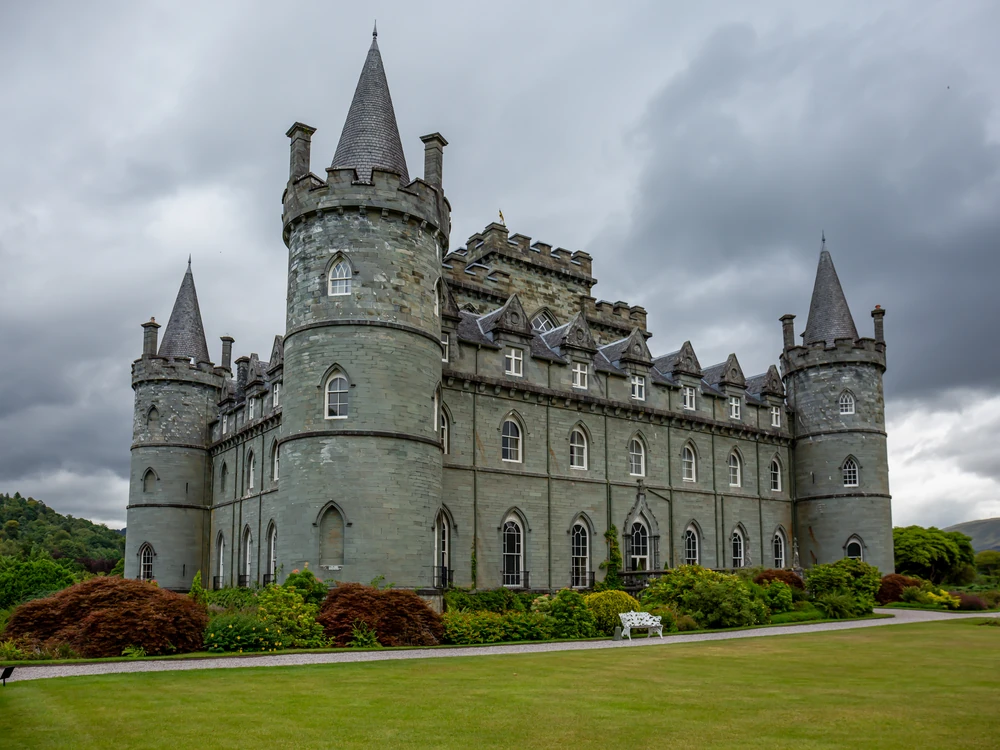
The castle chapel, in the outer enclosure, is a 13th-century ecclesiastical building with pointed arches that show French Gothic influence reaching the Argyll coast through the MacDougall family's Continental connections. It is one of the earliest partially-standing ecclesiastical buildings in Argyll and the surrounding Campbell family graveyard is still in use. The castle is managed by Historic Environment Scotland and typically open April to September. The GetYourGuide day tour from Glasgow combines Dunstaffnage with [Inveraray Castle](/castles/scotland/inveraray-castle) in a full Argyll day — the two most historically significant castle sites in the region, representing the MacDougall Argyll (Dunstaffnage) and the Campbell Argyll (Inveraray) of different centuries.
History
The MacDougall Lords of Lorn built Dunstaffnage Castle around 1220 to 1250 — a high curtain wall of local conglomerate stone on the rock promontory above Loch Etive, one of the most formidable fortifications in 13th-century Argyll. The MacDougalls' alliance with the English crown during the Wars of Scottish Independence put them on the wrong side of Robert the Bruce: Bruce defeated the MacDougall-English alliance at the Pass of Brander in 1308, and Dunstaffnage fell to him in 1309. The Campbell family was installed as hereditary keepers of the castle, beginning an association with the site that would last several centuries.
Dunstaffnage served as the Campbell administrative seat in Argyll through the 14th to 17th centuries. Its most celebrated later episode came in 1746, when Flora MacDonald was briefly imprisoned at the castle following the Battle of Culloden and the failure of the Jacobite rising — held here before being transferred to London. A fire damaged the tower house in 1810. Robert Stevenson, the lighthouse engineer, used Dunstaffnage as an engineering base during the 19th century.
Historic Environment Scotland manages the castle, which is open April to September.
How to Visit
Getting there: Dunstaffnage Castle is 3 km north of Oban on the A85 Connel road. By car from Oban, follow signs for Connel/Benderloch — the castle is signed from the main road with a car park on site; the drive from Glasgow takes roughly 3 hours via the A82 and A85. By public transport, Oban is served by ScotRail from Glasgow Queen Street (about 3 hours); from Oban station, local buses to Dunstaffnage run infrequently, so a taxi (about 10 minutes) is the most reliable option.
Tickets: Walk-up entry £6 adult, £4 child. The Glasgow–Oban–Argyll day tour — a 12-hour coach trip from Glasgow covering Dunstaffnage Castle, Inveraray Castle, and the Argyll coastline, with castle entry included — is the most convenient option for visitors based in Glasgow; book in advance.
Practical tips: Open daily April to September; October hours reduce to Thursday–Monday only — verify at historicenvironment.scot before travelling, especially in shoulder season. Allow 1–1.5 hours for the castle and chapel, and note that the 13th-century chapel and graveyard in the outer enclosure remain accessible year-round even when the main castle interior is closed. Mist rolling off Loch Etive in spring and autumn gives the site a particularly atmospheric quality in early morning.
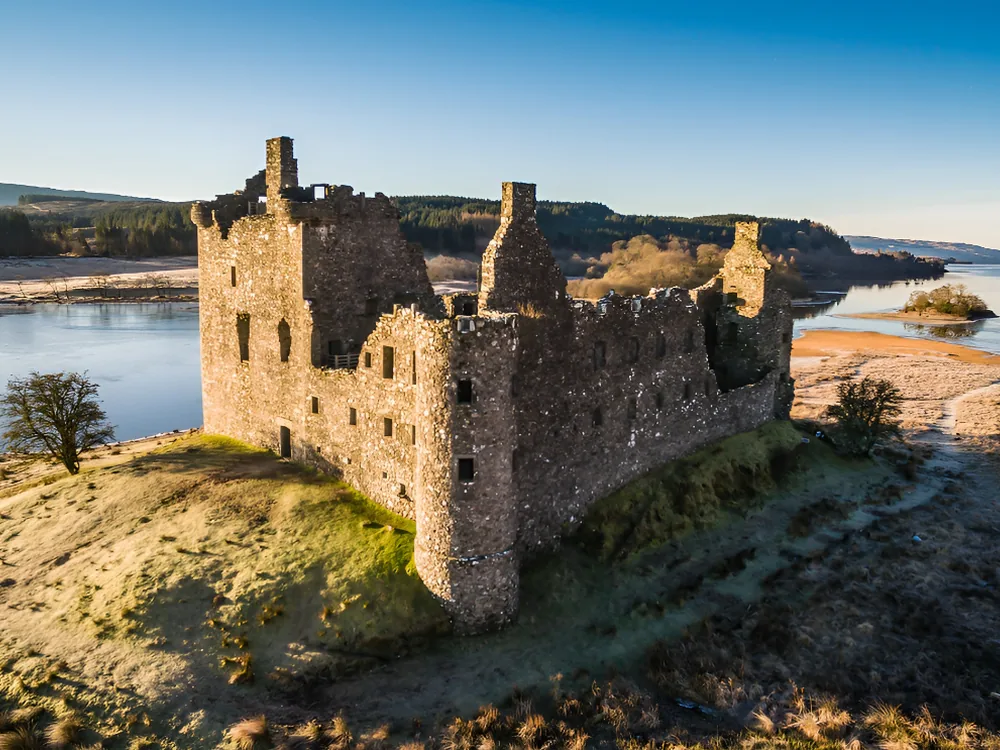
Combine with: Kilchurn Castle, the atmospheric loch-side ruin 30 km east on Loch Awe, and Inveraray Castle, the Duke of Argyll's seat 40 km south, are the natural Argyll pairings — the GetYourGuide day tour covers both Dunstaffnage and Inveraray on a single trip.
Frequently Asked Questions
The Ell Maid (or Green Lady) of Dunstaffnage is the castle's supernatural guardian — a ghost figure from Scottish folklore who supposedly appears at the castle before a significant event in the Campbell family, either as a warning of disaster or as a sign of good fortune depending on the version of the story. She reportedly appeared before the castle fire of 1810. Like most Scottish castle ghost traditions, the Ell Maid is well-documented in 19th-century folklore collections and regularly features in castle guide narratives.
Location
Dunstaffnage, Oban, Argyll, PA37 1PZ, Scotland
Nearby Castles
Tours & Tickets
Powered by GetYourGuide
Entry from
€6/ adult