
Devín Castle
Hrad Devín
Slovakia · Bratislava · Near Bratislava
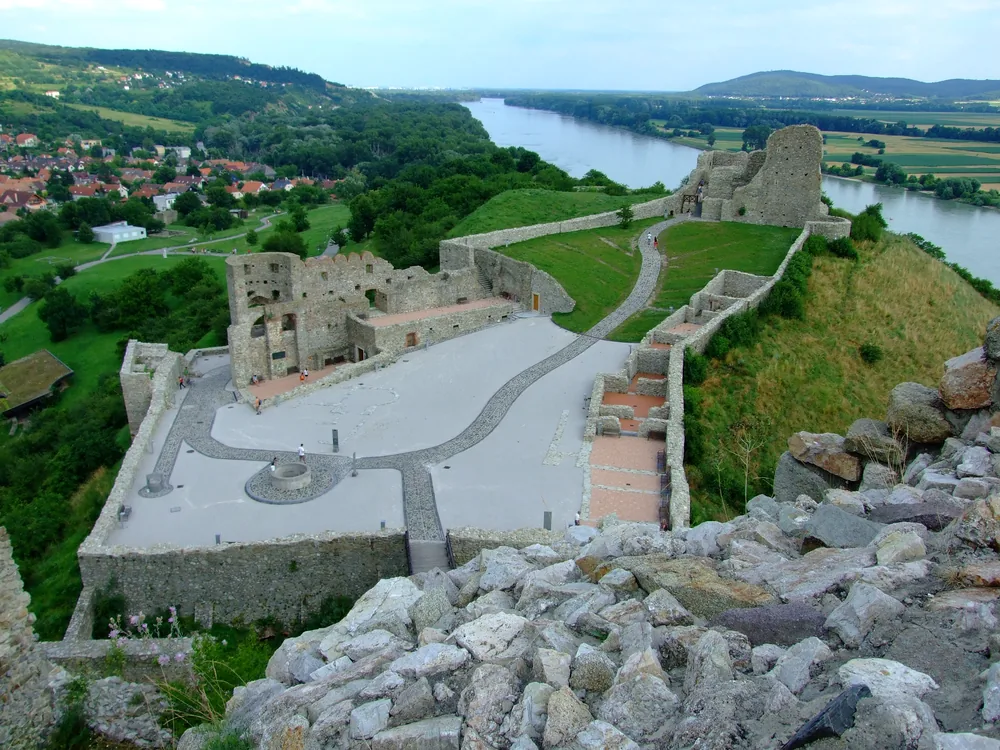
Built 864 · Castle ruins on a dramatic rock outcrop at the confluence of the Danube and Morava rivers, approximately 10 km west of central Bratislava; the site has been continuously fortified since Celtic times, with Great Moravian-era strongholds documented from the 9th century, later medieval construction under the Hungarian kingdom, and continued use through the Habsburg period before destruction by Napoleon's forces in 1809; the ruins include the remains of the main keep (a vertical tower fragment perched on the highest point of the rock is among the most photographed castle images in Slovakia), curtain walls, a Roman watchtower foundation, and the lower palace buildings; accessed by boat tour from Bratislava as well as by bus and car
This page is part of an independent travel guide and is not affiliated with, endorsed by, or operated by Devín Castle.
© Castles & Palaces
Quick Facts
- Hours
- Tue–Sun 09:30–17:00. Closed Mon
- Boat tour from
- €30
- Duration
- 1–2 hours
- Best time
- April to October
- Nearest city
- Bratislava
Featured Tour
Cruise - Devín Castle Round Trip
Cancellation available · Instant confirmation
Highlights
- ✦Devín Castle sits exactly at the confluence of the Danube and Morava rivers, the point where Austria, Slovakia, and the former Czechoslovakia meet — during the Cold War this river confluence was the Iron Curtain itself, the castle ruins standing in a heavily militarised border zone closed to casual visitors for decades, giving Devín a layer of recent political history that few medieval ruins can match
- ✦The site carries deep Slovak national symbolism: Great Moravia, the 9th-century Slavic state that constituted the first major political organisation of the Slovak and Moravian peoples, had a documented fortification at Devín, and the castle's position at the western frontier of that territory made it a touchstone of Slovak national consciousness during the 19th-century national revival and in subsequent decades
- ✦Napoleon's forces destroyed the castle in 1809 during the French army's advance along the Danube — the same campaign that saw Vienna briefly occupied for the second time — leaving the ruins that visitors see today; the vertical tower fragment balanced on the tip of the rock outcrop, now the most reproduced image of Devín, survived this destruction by the accident of the cliff on which it stands
- ✦The GetYourGuide boat tour from Bratislava takes the approach that makes the most visual sense: arriving by Danube river cruise, the castle rock appears ahead as you round a river bend, the confluence of the Danube and Morava visible from the water in the way that explains the site's strategic position across many centuries of Central European history
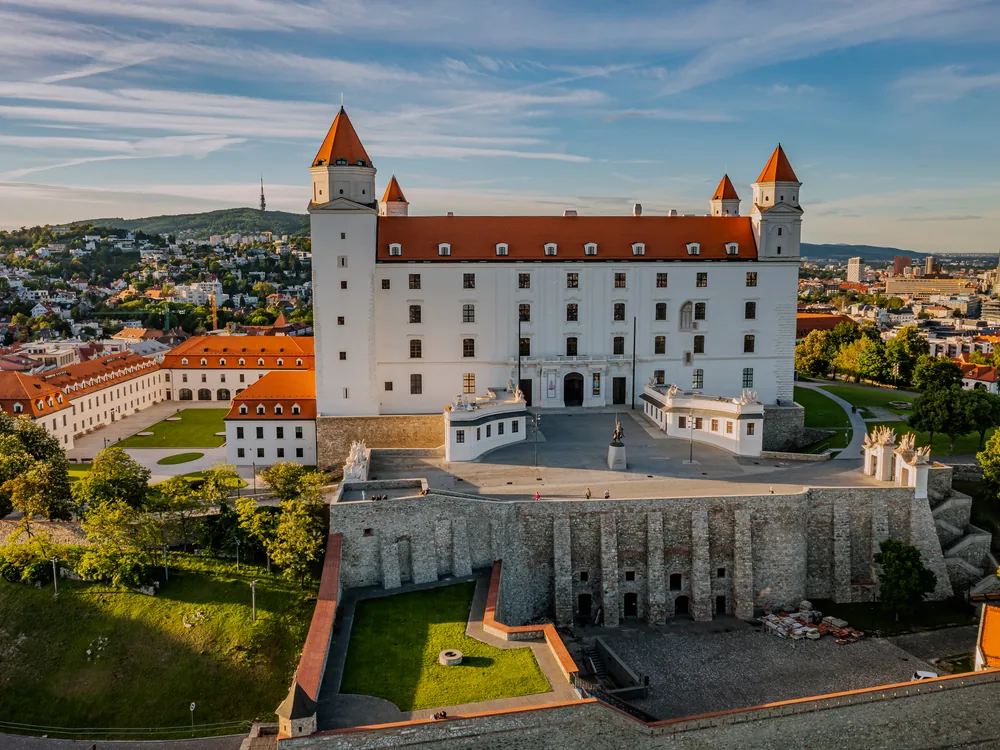
- ✦Bratislava Castle, already on this site and approximately 10 km downstream, is the essential companion visit — the two castles are within the same city boundary, both above the Danube, but representing the urban administrative seat (Bratislava) versus the frontier defensive position (Devín); together they cover Bratislava's complete medieval castle geography
Skip the queue with a guided tour
Skip-the-line tickets & expert guides
There is a specific and verifiable fact about Devín Castle's geographical position that matters before anything else is said about its history. The castle stands on a rock at the confluence of the Danube and Morava rivers. The Morava is the river that has served as the frontier between what is now Austria and what is now Slovakia for most of historical memory, and the Danube flows west to east along what was, for much of the medieval period, the northern boundary of the Hungarian kingdom. The castle rock at their meeting point is therefore a position of triple-border significance: whoever held it held the view of both rivers, both approaches, both frontiers. This geographical fact explains why the rock has been fortified since Celtic times and why it has remained significant through every change of political control across two and a half millennia.
The Iron Curtain-era significance of this position is the most recent and in some ways the most striking expression of the same logic. When the communist regimes of the Cold War divided Europe, the Morava river became the western border of the Czechoslovak Socialist Republic and the Iron Curtain ran directly past Devín Castle. The ruins — which had been a popular excursion site from Bratislava in the interwar period — were incorporated into a heavily militarised border zone, accessible only to authorised personnel. The river confluence that the castle was built to control became, for approximately 40 years, one of the most fortified and dangerous borders in the world, the place where Soviet-bloc territory met the West. The castle had been a frontier position in the 9th century, in the medieval period, in the Habsburg era, and it was a frontier position again in the 20th century, in a way that gave its ancient military function a contemporary political meaning.
The site's importance in Slovak national consciousness begins much earlier, with the Great Moravian period. Great Moravia was the 9th-century Slavic state centred on the Morava river basin and its surrounding territories, the first major political organisation of the Slavic peoples in Central Europe, and the culture in which Saints Cyril and Methodius introduced the Glagolitic alphabet and Christian liturgy in the Slavic vernacular — a cultural and religious foundation that shaped the subsequent development of Slavic Christianity, literacy, and national identity across Eastern Europe. The documented fortification at Devín from this period placed the site at the western frontier of this founding state, facing the East Frankish kingdom across the Morava. In the 19th-century Slovak national revival, Devín was seized upon as a symbol of pre-Hungarian Slovak statehood — Ľudovít Štúr, the linguist and political leader who codified modern literary Slovak in the 1840s, made a famous pilgrimage to Devín in 1836 with his students and wrote about it as a monument to the Slovak past. The castle ruin became, in this interpretation, an argument: Slovaks had been here, had been organised, had had their own state, before the Hungarian kingdom absorbed the territory.
Napoleon's forces destroyed the castle in 1809. The French army had occupied Vienna the previous year and again in 1809 after the Battle of Aspern-Essling and Wagram; Devín lay on the route of military operations along the Danube, and the castle was blown up to prevent it from being used as a defensive position by Austrian forces. The destruction was systematic — powder charges placed in the walls and towers — and thorough. What survives today is the partial lower structure, the curtain walls in varying states of preservation, and the single most famous element: a fragment of the main keep tower, standing on the highest point of the rock in a vertical stub that somehow survived the demolition and remains as the most reproduced image of Devín, visible from the river far below and from across the confluence.
The GetYourGuide boat tour is the recommended way to approach Devín if the schedule permits. A Danube river cruise from Bratislava's waterfront takes approximately 2 hours to reach the castle, passing under the Apollo Bridge and along the Slovak Danube shoreline before the river bends and the castle rock appears ahead as the Morava joins from the right. The confluence is visible from the boat approach in the same way it would have been visible to any medieval river traveller: as a widening of the navigable water and a change in the current, with the castle position on the rock marking the junction clearly. The 4-hour round trip includes time ashore at the castle. The alternative approach by bus (route 29 from Nový Most bridge in Bratislava) or by car gives faster access at the cost of the river approach.
Bratislava Castle, approximately 10 kilometres downstream and already on this site, is the natural companion. Both castles are within the current city boundary of Bratislava, both are above the Danube, both have roots in the Great Moravian period. But they represent completely different aspects of the city's medieval geography: Bratislava Castle was the urban administrative seat, the place from which the Hungarian kingdom governed its Bratislava county and the Habsburgs managed their coronation city; Devín was the frontier defensive position, the watching-eye on the river confluence, the place that needed to be held to control the western approach. The two ruins together tell the complete story of how medieval Bratislava worked as a defended place.
The archaeological evidence at Devín includes Roman watchtower foundations from the Danube limes — the frontier fortification the Roman Empire maintained along the northern bank of the Danube — alongside the Great Moravian-period structures, medieval Hungarian construction, and the Habsburg-era modifications before Napoleon's destruction. This chronological layering from Roman through 19th-century is one of the most complete sequences of any site in Slovakia and gives the castle visit an archaeological depth that supplements the later historical and political narratives.
History
The Devín rock has been fortified since Celtic times, with Roman watchtower remains from the Danube limes also present. The site was a major Great Moravian fortification in the 9th century, when Devín stood at the western frontier of the first major Slavic state. Later medieval construction under the Hungarian kingdom used the site as a border castle. The Habsburg period saw continued military use. In 1809 Napoleon's forces systematically destroyed the castle to deny it to Austrian defenders. The ruins became a symbol of Slovak national identity in the 19th century during the Slovak national revival. During the Cold War the site was in the Iron Curtain border zone and was inaccessible to civilian visitors for approximately 40 years. After 1989 the site opened to visitors and is now managed by the Bratislava City Museum.
How to Visit
Getting there: By boat: GetYourGuide Danube river cruise from Bratislava waterfront, 4-hour round trip. By bus: route 29 from Nový Most bridge in Bratislava (30–40 minutes). By car: approximately 15 minutes from Bratislava centre via the Devínska cesta road; parking available at the base.
Tickets: The boat tour covers the river cruise and castle entry. Walk-up entry to the castle is available separately (approximately €8). The boat tour is the most scenic approach.
Visit length: 1–2 hours at the castle; the boat tour is a 4-hour round trip including travel time.
Practical tips: April to October.
Combine with: Bratislava Castle (10 km downstream, in the city centre) is the essential pairing — the two castles together cover Bratislava's complete medieval and Habsburg castle geography. Bratislava Old Town is walkable from the castle hill.
Frequently Asked Questions
Devín was a major fortification of Great Moravia, the 9th-century Slavic state that constituted the first major political organisation of the Slovak and Moravian peoples and the culture in which Cyril and Methodius introduced Slavic-language Christianity and literacy. In the 19th-century Slovak national revival, Devín was adopted as a symbol of pre-Hungarian Slovak statehood by figures including Ľudovít Štúr, who led a student pilgrimage to the site in 1836. The castle thus carries a significance in Slovak national consciousness that goes well beyond its architectural or military history.
Location
Muránska ulica, 841 10 Devín, Bratislava, Slovakia
Nearby Castles
Tours & Tickets
Powered by GetYourGuide
From
€30/ person