
Alcázar of Jerez
Alcázar de Jerez
Spain · Andalusia, Cádiz Province — Jerez de la Frontera, historic centre · Near Jerez de la Frontera
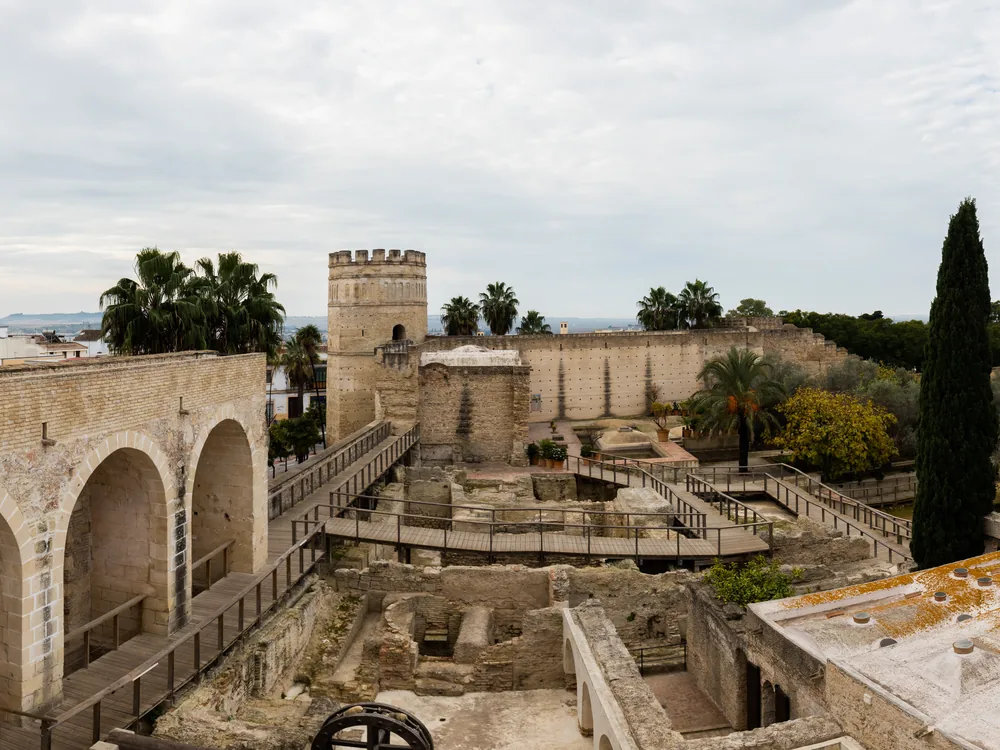
Built 1048 · Almohad military-palace complex of the 11th–12th centuries — built and expanded by successive Almohad emirs on the southern edge of the medina of Sharish (medieval Arabic name for Jerez) as both a defensive fortress and a palatial residence; the complex follows the Almohad model of combining military walls and towers with a palace precinct, gardens, and a mosque within a single enclosure; the mosque (now the Chapel of Santa María la Real) is the best-preserved Almohad mosque interior in the province of Cádiz and one of the most complete examples of Almohad religious architecture in southern Spain; the Arab baths (hammam) within the complex are also among the most intact surviving Almohad bath installations in Andalusia; the 18th-century Palace of Villavicencio was built within the Alcázar precinct after the Reconquista by the noble family of the same name, incorporating the camera obscura on the upper tower that now provides panoramic views of Jerez
This page is part of an independent travel guide and is not affiliated with, endorsed by, or operated by Alcázar of Jerez.
© Castles & Palaces
Quick Facts
- Hours
- Mon 09:30–15:00. Tue–Sat 09:30–18:00. Sun 09:30–15:00
- Guided tour from
- €22.5
- Duration
- 1.5–2 hours (Alcázar alone: mosque, palace, Arab baths, gardens, camera obscura); 3 hours including the GetYourGuide guided city walking tour extensions
- Best time
- March to June and September to November
- Nearest city
- Jerez de la Frontera
Featured Tour
Jerez de la Frontera: Alcázar City Guided Tour (Mosque, Arab Baths, Gardens + Historic Centre Walk)
Cancellation available · Instant confirmation
Highlights
- ✦The Almohad mosque — the mosque within the Alcázar complex is one of the best-preserved Almohad religious interiors in Cádiz province; converted to a chapel after the Reconquista (1264) but retaining the mihrab (prayer niche indicating the direction of Mecca), the horseshoe arches, and the geometric ceiling decoration of the original Almohad construction; it is a physically small space of exceptional architectural quality
- ✦Arab baths (hammam) — the Almohad-period bath complex inside the Alcázar is one of the most complete surviving hammam installations in Andalusia; the bath follows the Roman and Islamic tradition of successive cold, warm, and hot rooms with the characteristic star-vaulted ceilings that filter indirect light through pierced stone; the baths date from the 11th–12th century and remain intact in their architectural structure
- ✦Palace of Villavicencio and the camera obscura — an 18th-century aristocratic palace built within the former Alcázar precinct by the noble Villavicencio family; the upper tower houses a camera obscura — a lens-and-mirror system that projects a live 360-degree image of Jerez onto a curved white screen in the tower room, including the cathedral towers, the sherry bodegas, the bullring, and the wider Jerez landscape
- ✦Islamic gardens — the Almohad garden design within the Alcázar precinct follows the traditional Persian/Islamic garden model (the char-bagh, or 'four gardens' pattern) with formal water channels, geometrically planted beds, orange trees, and fountain basins; the gardens were reconstructed in the 20th century on the Almohad plan and provide the most intact simulation of the original Almohad garden environment in Jerez
- ✦Sherry country context — Jerez de la Frontera is the production centre and name-origin of sherry (jerez → xérès → sherry); the city's historic centre contains the bodegas of González Byass (the Tío Pepe operation, immediately adjacent to the Alcázar), Williams & Humbert, Pedro Domecq, and several other major sherry producers; the Alcázar visit pairs naturally with a bodega tour and [Palacio Domecq](/castles/spain/palacio-domecq) — the 18th-century noble palace of the Domecq family, a 10-minute walk from the Alcázar
- ✦GetYourGuide guided city tour extension — the GetYourGuide product (2 hours) covers the Alcázar interior and then continues on a walking tour to the Cathedral Redoubt, Plaza del Arroyo, Plaza de la Asunción (the church of San Dionisio and the Cabildo Viejo municipal building), and the Consistorio de Jerez; the tour provides an efficient introduction to the principal monuments of Jerez's historic centre beyond the Alcázar itself
Skip the queue with a guided tour
Skip-the-line tickets & expert guides
The Alcázar of Jerez stands at the southern edge of the historic centre of Jerez de la Frontera, adjacent to the walled garden of the González Byass bodega — the producer of Tío Pepe sherry, whose white-painted walls and black-stencilled brand are the first things a visitor arriving from the south sees on the approach to the fortress. The juxtaposition is not accidental: the sherry industry, the Alcázar, and the historic centre of Jerez have occupied the same urban quarter for nearly a thousand years, each shaped by the other's presence.
The Alcázar was built by the Almohad dynasty — the Moroccan Islamic empire that controlled most of al-Andalus from the mid-12th century, after the collapse of the earlier Almoravid state — on a site that may have had earlier fortification from the caliphal period. The Almohad construction of the 11th and 12th centuries combined military walls and towers with a palace precinct, a mosque, a hammam (Arab baths), and formal gardens in a single enclosure — the standard Almohad model of the alcázar as a self-contained administrative and residential complex, separated from but positioned to command the city's medina. The Alcázar of Jerez is a smaller version of the same model that produced the Alcázar of Seville and the Alcazaba of Málaga.
The mosque within the Alcázar is the site's most architecturally significant interior. After the Christian Reconquista of Jerez in 1264 by Alfonso X of Castile, the mosque was converted to a chapel — the Chapel of Santa María la Real — but the conversion left the fundamental architectural elements intact: the horseshoe arches of the prayer hall, the geometric stucco decoration, and the mihrab (the prayer niche in the qibla wall, oriented toward Mecca) are all readable in the current interior. The mihrab of the Jerez Alcázar is small, delicately worked, and entirely preserved — one of the more complete surviving examples of Almohad religious interior craftsmanship in Cádiz province.
The hammam — Arab bath complex — occupies a suite of rooms adjacent to the palace precinct. The Almohad bath followed the Roman-Islamic bathing tradition of successive thermal rooms (cold, warm, hot) with the vaulted ceiling structure that admitted light through star-shaped or circular perforations in the stone, creating the filtered, diffuse illumination characteristic of the great baths of al-Andalus. The Jerez hammam is one of the most complete surviving Almohad bath installations in southern Spain, with the vault geometry and the room sequence both intact.
The Palace of Villavicencio, an 18th-century addition within the Alcázar precinct, was built by the Villavicencio noble family on the site of the former Almohad palace after the Reconquista. Its upper tower contains one of the more unusual installations in any Andalusian monument: a camera obscura — a lens-and-mirror optical system that projects a live, inverted image of the surrounding city onto a curved white screen in the tower room. In the Villavicencio tower, the camera obscura rotates to show the cathedral towers, the bodega rooftops, the bullring, the Plaza del Arenal, and the Jerez countryside in a continuous 360-degree live projection. The effect — a real-time, silent image of the living city seen from above — is genuinely arresting in the age of the smartphone.
The GetYourGuide tour (2 hours) covers the Alcázar interior with a live guide (English and Spanish) and then continues into the historic centre: the Cathedral Redoubt (the fortified approach to the Catedral de San Salvador), the Plaza del Arroyo, the Plaza de la Asunción with the church of San Dionisio (patron saint of Jerez) and the Renaissance Cabildo Viejo municipal building, and the Consistorio de Jerez. Hotel pickup and Alcázar entrance are included.
Jerez de la Frontera's identity is built on three things that have been present here for centuries: sherry, horses, and flamenco. The sherry bodegas — González Byass (immediately adjacent to the Alcázar), Pedro Domecq (the Palacio Domecq family), Williams & Humbert — are open for tours throughout the historic centre. The Real Escuela Andaluza de Arte Ecuestre (Royal Andalusian School of Equestrian Art), a 15-minute walk north, puts on the famous 'How the Andalusian Horses Dance' show on scheduled performance days. The flamenco scene is concentrated in the Santiago neighbourhood, the barrio that produced several of the form's defining dynasties. [Palacio Domecq](/castles/spain/palacio-domecq) — the 18th-century palace of the founding Domecq sherry dynasty — is a 10-minute walk from the Alcázar and is the site's first same-city companion for the Jerez entry.
History
1048–1090s: Almohad-period construction of the Alcázar complex on the southern edge of the medina of Sharish (Jerez). Mosque, hammam, gardens, and palace precinct established in this period. 12th century: expansion and fortification under successive Almohad rulers. 1264: Christian Reconquista of Jerez by Alfonso X of Castile; the mosque converted to the Chapel of Santa María la Real. Post-Reconquista: Alcázar maintained as a royal residence and administrative centre; the Almohad palace structures gradually modified. 18th century: Palace of Villavicencio constructed within the Alcázar precinct by the Villavicencio noble family; camera obscura installed in the upper tower. 19th–20th century: restoration work on the Almohad sections; Islamic gardens reconstructed on the original plan. Current period: open as a public monument managed by the Jerez municipality.
How to Visit
Getting there: The Alcázar sits at the southern edge of Jerez's historic centre, immediately adjacent to the González Byass bodega. From Jerez train station, it is a 15-minute walk through the city centre. From Seville, take the AVE train or bus (approx. 1 hour), then walk or take a taxi. From Jerez-Aeropuerto, a taxi takes around 10 minutes. Street parking and city-centre car parks are available nearby.
Tickets: Walk-up entry €7 adult, €3 child; no advance booking required, though confirming hours at turismo.jerez.es is recommended. The GetYourGuide tour — a 2-hour guided tour of the Alcázar (mosque, Arab baths, Islamic gardens) followed by a walking tour of the historic centre, with Alcázar entrance included — book at least a day in advance.
Practical tips: Visit March–June or September–November to avoid the brutal July–August heat (up to 42°C). Allow 1.5–2 hours for the Alcázar alone. Combine with the González Byass bodega tour directly next door, or time a visit for a Royal Andalusian School of Equestrian Art performance day (15 minutes north).
Combine with: Palacio Domecq — 10 minutes east on foot, the 18th-century Baroque palace of the founding Domecq sherry dynasty, with a richly decorated staircase hall and heritage wine cellars.
Frequently Asked Questions
A camera obscura is an optical device — a lens focused through a pinhole or aperture into a darkened room — that projects a live image of the outside world onto a curved surface inside. The one in the Villavicencio tower uses a rotating mirror and lens system to project a 360-degree panoramic live image of Jerez onto a white concave screen. You can see the cathedral, the bodega rooftops, the bullring, and the surrounding landscape in real-time projection. It was installed in the 18th century and is one of the oldest working camera obscura installations in Spain.
Location
Alameda Vieja s/n, 11403 Jerez de la Frontera, Cádiz, Spain
Nearby Castles
Tours & Tickets
Powered by GetYourGuide
From
€22.5/ person