
Castell de Tossa de Mar
Vila Vella de Tossa de Mar
Spain · Girona Province — Costa Brava, Tossa de Mar, Catalonia · Near Girona
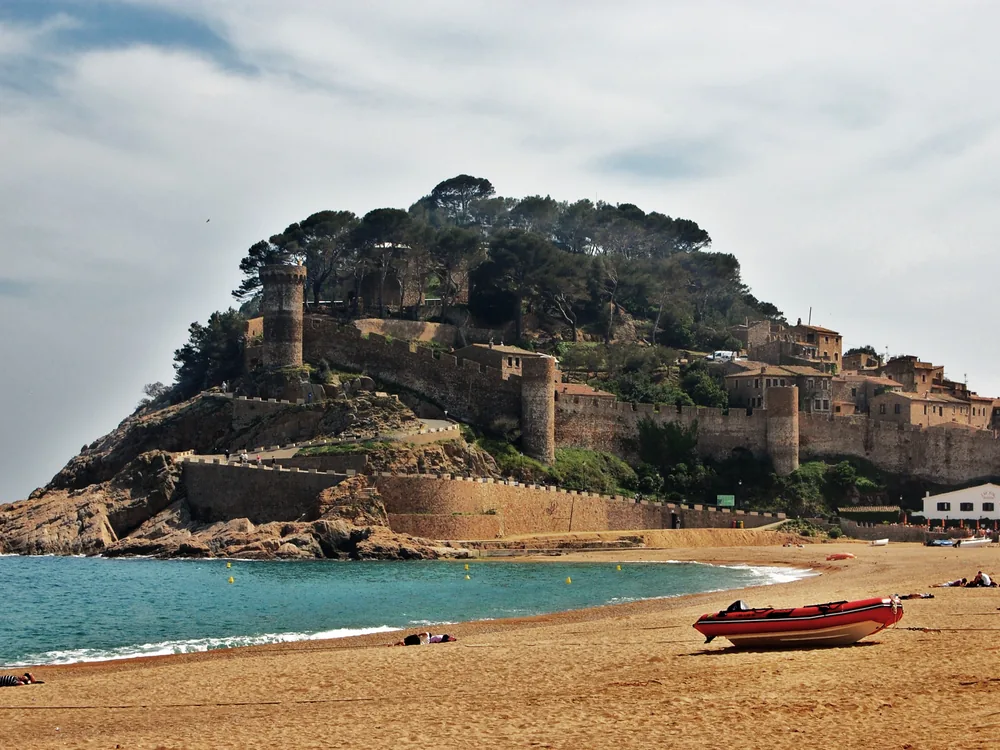
Built 1290 · Medieval Catalan fortified town (Vila Vella), 13th–14th century — the fortified settlement of Vila Vella ('old town') at Tossa de Mar is the sole remaining intact medieval walled town on the entire Catalan coast; the defensive circuit was constructed principally during the 13th and 14th centuries under the patronage of the Abbey of Sant Pere de Rodes and later the Monastery of Santa Maria de Ripoll, which held lordship over Tossa de Mar during the medieval period; the walls follow the perimeter of a rocky headland between two beaches — Platja Gran to the north and Platja de la Mar Menuda to the south — enclosing the former residential settlement on the clifftop with a circuit of round wall towers; the principal surviving towers are the Torre de Ses Hores (the main tower/keep, the tallest surviving element, housing a clock), the Torre dels Codesos, and the Torre de Can Garriga; within the enclosure, the Museu Municipal de Tossa de Mar occupies a former Gothic palace and houses archaeological finds and a painting by Marc Chagall; the site is freely accessible; the headland's position between the two beaches gives the fortified walls and towers their characteristic photogenic quality — medieval stone rising from the rocky Mediterranean headland above the turquoise water of the Costa Brava
This page is part of an independent travel guide and is not affiliated with, endorsed by, or operated by Castell de Tossa de Mar.
© Castles & Palaces
Quick Facts
- Hours
- Daily 10:00–18:00
- Guided tour from
- €85
- Duration
- 45 minutes–1 hour (Vila Vella walls, towers, and headland viewpoints; add 30 minutes for the Museu Municipal)
- Best time
- May to October for beach season
- Nearest city
- Girona
Featured Tour
Costa Brava Tour: Tossa de Mar Hike & Snorkel from Barcelona
Cancellation available · Instant confirmation
Highlights
- ✦The sole surviving fortified medieval town on the Catalan coast — the Vila Vella of Tossa de Mar is unique: no other fortified medieval settlement remains standing along the entire Catalan coastline; the walled towns and castle settlements that once defended other Costa Brava and Costa Daurada communities were dismantled, absorbed by later urban development, or allowed to collapse; Tossa's fortified enclosure survived because the town's relative isolation and modest economic development did not generate the pressure to demolish the medieval walls for building material or urban expansion; what remains at Tossa is consequently not just a well-preserved medieval castle but the only complete example of its type on the Catalan coast — a status that places it in a different category from comparable sites that survive as ruins or partial circuits
- ✦Marc Chagall's 'blue paradise' — the artists' colony that made Tossa famous — in 1933–34, the Russian-French painter Marc Chagall visited Tossa de Mar and was sufficiently moved to call it 'le paradis bleu' — the blue paradise — a phrase that became attached to the town's identity and which reflects Tossa's effect on the European artistic community that began visiting the Costa Brava in the early 20th century; Chagall was not the only painter drawn to Tossa: the town attracted a significant colony of European modernists in the 1920s and 1930s, drawn by the quality of the Mediterranean light, the geometry of the Vila Vella's towers against the sea, and the relative accessibility of the Costa Brava from France and Barcelona; the Museu Municipal de Tossa de Mar, inside the former Gothic palace within the walls, retains one of Chagall's paintings — making it among the few municipal museums in Spain with an original Chagall in its collection
- ✦The towers of the Vila Vella — medieval defence above Mediterranean turquoise — the three principal surviving towers of the Vila Vella — the Torre de Ses Hores (main keep, with its clock), the Torre dels Codesos, and the Torre de Can Garriga — are the visual elements that make Tossa de Mar's skyline instantly recognisable along the Costa Brava; the towers rise from the rocky headland between the two beaches in a configuration that combines vertical medieval defensive architecture with Mediterranean coastal scenery in a way that is genuinely rare in Catalonia; the Torre de Ses Hores, the tallest, gives views over the coast in both directions and over the vila nova (new town) below
- ✦The Camí de Ronda and the Costa Brava coastal path — the GYG day tour (t731263) from Barcelona combines the guided Vila Vella visit with a walk along the Camí de Ronda, the coastal path that runs along the rocky shoreline between Tossa de Mar and the beaches to the south; the Camí de Ronda is one of the defining walks of the Costa Brava — a path that alternates between clifftop sections above the Mediterranean and descents to small coves (calas) accessible only on foot; the combination of a medieval castle visit and a coastal hike in a single day gives the tour an unusual range from heritage to landscape; the optional snorkeling stop (marked 'Optional' in GYG's itinerary, not the castle visit) adds a third dimension for those who want it
Skip the queue with a guided tour
Skip-the-line tickets & expert guides
The headland at Tossa de Mar is not large. A rocky promontory pushing into the Mediterranean between two beaches — Platja Gran to the north, Platja de la Mar Menuda to the south — it would be, in most European coastal towns, a viewpoint with a café and a car park. At Tossa, it carries a complete walled medieval settlement. The walls and towers of the Vila Vella (Old Town) have stood on the headland since the 13th and 14th centuries, and unlike every other fortified coastal settlement on the Catalan coast, they are still standing in their entirety. Tossa de Mar is the sole remaining intact medieval fortified town on the coast of Catalonia.
The lordship over Tossa during the medieval period belonged to the great Benedictine monasteries of northern Catalonia — first the Abbey of Sant Pere de Rodes, then the Monastery of Santa Maria de Ripoll. The abbots commissioned the defensive circuit to protect the town and its fishing harbour from the corsair raids that plagued the Catalan coast from the 12th century onward. The walls follow the natural perimeter of the rocky headland, enclosing the residential settlement on the clifftop in a circuit of round towers connected by curtain wall. The principal surviving towers — the Torre de Ses Hores, the Torre dels Codesos, and the Torre de Can Garriga — are the dominant elements of the skyline as seen from either beach below.
The Torre de Ses Hores (Clock Tower) is the largest of the three, a round drum tower at the highest point of the enclosure that serves as the visual anchor of the Vila Vella's profile against the sea. It owes its name to the clock mechanism added in a later century; its medieval function was the same as all watch towers on the Catalan coast — early warning of approaching sails. From its upper section, the coast extends in both directions along the Costa Brava.
Within the enclosure, the town that the walls protected has largely disappeared. What remains, besides the walls and towers themselves, is the Museu Municipal de Tossa de Mar, housed in a former Gothic palace within the enclosure. The museum's collection includes archaeological finds from the Roman villa at Els Ametllers (one of the best-preserved Roman villa sites on the Catalan coast, immediately below the headland) and, more unexpectedly, a painting by Marc Chagall — acquired from the painter's visit and making the Museu Municipal one of the very few provincial Spanish museums with an original Chagall in its permanent collection.
Chagall visited Tossa de Mar in 1933–34 and called it 'le paradis bleu' — the blue paradise. He was not alone in that response. From the early 20th century, the Costa Brava attracted a significant colony of European modernist artists who came for the Mediterranean light, the clarity of the sea colour, and the visual geometry of the Vila Vella's towers rising above the turquoise water. The combination of medieval architecture and Mediterranean coast that makes Tossa photogenic now was making it artistically compelling a century ago.
The GYG day tour from Barcelona (t731263, approximately 9.5 hours, small group of maximum 8 people) places the castle at the heart of the programme. The tour includes a guided walking tour of the Vila Vella (30 minutes, confirmed Visit stop, not Optional), free time in Tossa de Mar, and a coastal hike along the Camí de Ronda — the historic coastal path that runs along the rocky Costa Brava shoreline between Tossa and the beaches to the south, alternating between clifftop sections with open Mediterranean views and descents to small coves (calas) accessible only on foot. An optional snorkeling stop is available for those who want it. The Camí de Ronda hike is the tour's second major attraction after the castle: a walk along one of Spain's most visually dramatic coastal paths, combining physical immersion in the Costa Brava landscape with the earlier heritage visit. The tour carries a 5.0★ rating across 26 reviews and is Top Rated on GYG.
The Vila Vella is freely accessible at all times — the enclosure is a public area within the town, and the walls, towers, and headland can be visited without any ticket. The museum inside carries a small admission fee. The Costa Brava's peak tourist season (July–August) brings significant crowds to Tossa de Mar; the Vila Vella in spring or autumn, with the beaches quieter and the headland less congested, is a different experience from the summer peak.
[Cardona Castle](/castles/spain/cardona-castle) — the salt-rock hilltop fortress of the Cardona dukes inland in Catalonia — and [Siurana Castle](/castles/spain/siurana-castle) — the last Moorish stronghold in Catalonia, on a clifftop in the Priorat — are the other Catalan castle experiences best combined with a Costa Brava base.
History
Pre-13th century: Tossa de Mar a fishing settlement on the Costa Brava; lordship held by the Benedictine monasteries of northern Catalonia. 13th–14th century: Vila Vella defensive circuit constructed under the patronage of the Monastery of Santa Maria de Ripoll; walls, towers (Torre de Ses Hores, Torre dels Codesos, Torre de Can Garriga), and residential enclosure established. 14th–15th century: Vila Vella defended against corsair raids; the fortified enclosure provides the town's primary coastal defence. 15th–17th century: Tossa under Catalan-Aragonese then Spanish Crown; fortified town maintained but gradually declining in military significance as coastal defence patterns change. 18th–19th century: Vila Vella enclosure gradually depopulated as the new town (vila nova) develops below the walls; medieval fabric preserved by lack of development pressure. Early 20th century: European modernist artists begin visiting Tossa de Mar; Marc Chagall visits 1933–34 and calls the town 'le paradis bleu.' Mid-20th century: Museu Municipal established within the former Gothic palace inside the enclosure; Chagall painting acquired. Present day: Vila Vella freely accessible; museum open year-round; one of the most visited heritage sites on the Costa Brava.
How to Visit
Getting there: Tossa de Mar is approximately 90 km northeast of Barcelona via the C-32 coastal motorway (~1 hour by car). By bus, regular services (Sagalés/Moventis) run from Barcelona Nord bus station to Tossa de Mar (approximately 1.5 hours). From Girona, around 45 minutes by bus or taxi. The Vila Vella headland is a 10-minute walk from the town's bus stop.
Tickets: Free entry. The Vila Vella walls, towers, and headland are freely accessible at all times. The Museu Municipal inside the enclosure charges a small museum fee (confirm at the site). The GYG tour (t731263, from €85, 5.0★/26 reviews) — a 9.5-hour small-group day trip from Barcelona (max 8 people) covering a guided walk of the Vila Vella, the Camí de Ronda coastal hike, and optional snorkeling, with lunch included — book at least 2 days in advance.
Practical tips: Spring and autumn (April–June, September–October) are best — the Vila Vella is far less crowded than in July–August when Tossa's beaches fill. Allow 45 minutes–1 hour for the castle circuit plus the museum. Views of the walls from the beach below are available without climbing the headland — excellent in both directions from Platja Gran.
Combine with: [Cardona Castle](/castles/spain/cardona-castle) — the Carolingian salt-mountain fortress inland in the Catalan pre-Pyrenees, 100 km west. [Siurana Castle](/castles/spain/siurana-castle) — a dramatic clifftop Moorish castle in Tarragona's Priorat, around 100 km southwest.
Frequently Asked Questions
The coastal fortified settlements of medieval Catalonia were progressively dismantled, absorbed into later urban development, or allowed to collapse across the 18th–20th centuries, as their defensive function became obsolete and the building materials became attractive for re-use. Tossa de Mar's Vila Vella survived because the town's relative economic marginalisation and modest size did not generate the development pressure that demolished comparable sites elsewhere. The walls were not demolished because there was no compelling reason to do so: the town's tourism identity eventually became attached to the very medievalism that economic stagnation had preserved. The result is that Tossa's is not merely the best-preserved medieval fortified town on the Catalan coast — it is the only one.
Location
Vila Vella, Camí de Ronda, 17320 Tossa de Mar, Girona, Spain
Nearby Castles

Tours & Tickets
Powered by GetYourGuide
From
€85/ person