
Xàtiva Castle
Castell de Xàtiva
Spain · Valencia Community · Near Valencia
Built 1100 · Twin-castle complex (Castell Menor and Castell Major) on a limestone ridge above Xàtiva, 60 km south of Valencia; Iberian origins extended by Romans, Moors (Taifa period), and Christian reconquest; one of the largest medieval fortress complexes in the Valencia region; devastated and the town deliberately burned by Philip V in 1707 during the War of the Spanish Succession as punishment for supporting the Habsburg claimant; the castle museum still displays a portrait of Philip V hung upside down — a protest maintained for over 300 years
This page is part of an independent travel guide and is not affiliated with, endorsed by, or operated by Xàtiva Castle.
© Castles & Palaces
Quick Facts
- Hours
- Tue–Fri 10:00–18:00. Sat & Sun 10:00–20:00. Closed Mon
- Day trip from
- €81
- Duration
- 2 hours
- Best time
- March to June, September to November
- Nearest city
- Valencia
Featured Tour
Valencia: Xàtiva Castle and Bocairent Day Trip
Cancellation available · Instant confirmation
Highlights
- ✦A twin-castle complex — the Castell Menor and Castell Major — on a limestone ridge above the plain, one of the most extensive medieval fortress sites in the Valencia region
- ✦In the castle museum, a portrait of Philip V hangs deliberately upside down — a protest maintained by municipal decision for over 300 years after he burned the city in 1707 for supporting the Habsburg cause in the War of the Spanish Succession
- ✦Birthplace of two popes of the Borja (Borgia) family: Calixtus III (1455–1458) and his nephew Alexander VI (1492–1503), the most notorious pope of the Renaissance
- ✦Occupied continuously since the Iberian period: the Romans called the city Saetabis and it was a major textile-producing centre; the Moors called it Shatibi and made it a key stronghold of the taifa of Valencia
- ✦Panoramic views from the ridge over the fertile plain stretching toward the Mediterranean and the mountains of the Albaida valley to the south
Skip the queue with a guided tour
Skip-the-line tickets & expert guides
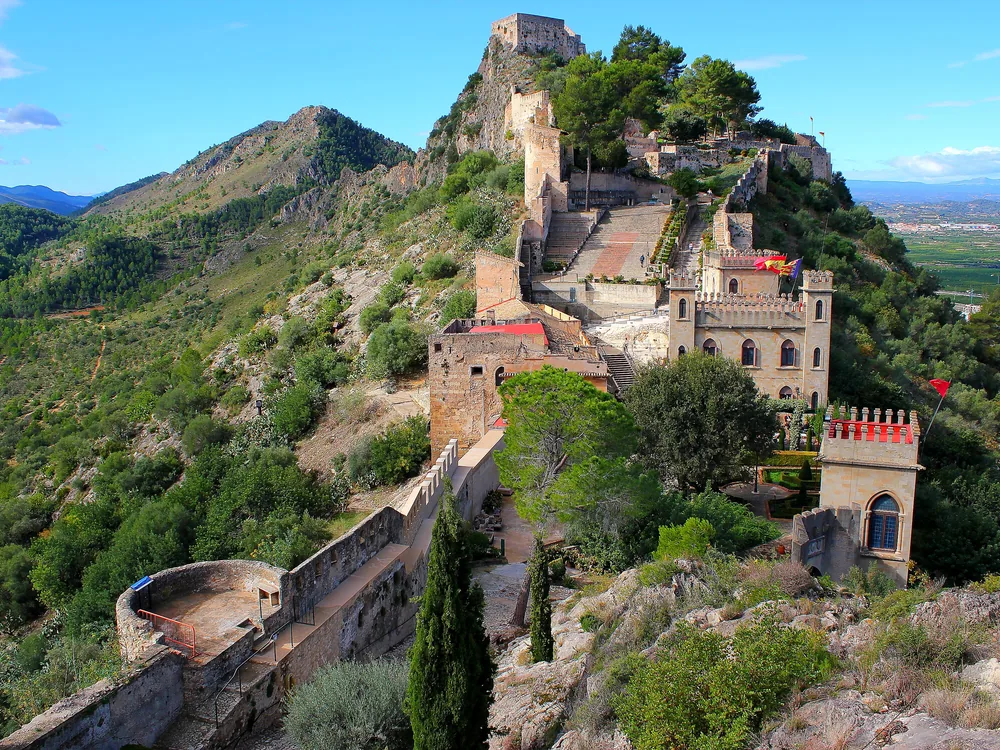
On a limestone ridge above the plain south of Valencia, a long double-crested silhouette marks the site of one of the most historically loaded fortresses in Spain. The Castell de Xàtiva — two connected castles on two separate summits, the Menor (older) and the Major (larger), linked by a walled passageway — commands a panoramic view over the town of Xàtiva and the fertile plain stretching to the Mediterranean. The site has been fortified continuously since at least the Iberian period; the Romans called the city Saetabis and it was one of the most important textile-producing centres in Hispania; the Moors called it Shatibi and used it as a key stronghold of the taifa of Valencia. The castle you see today is the result of 2,000 years of layered construction — and it holds one of the most pointed acts of political protest in European museum history.
In 1707, Xàtiva made the worst political calculation of its history. When the War of the Spanish Succession divided Europe between Philip V of Bourbon and Archduke Charles of Habsburg, Xàtiva supported the Habsburg claim. Philip V won the war. His response to the city that had opposed him was systematic: in 1707 his forces burned Xàtiva to the ground, killing much of the population and forcing survivors to flee. The town was renamed San Felipe — erasing even the name of the city — and remained so for a century, until the name Xàtiva was restored after Philip's dynasty had passed. In the castle museum, in the Sala de los Retratos (Portrait Hall), a portrait of Philip V of Spain hangs on the wall. Upside down. It has hung that way, by municipal decision, for over 300 years. No official agreement has ever restored it to the correct orientation. The inverted portrait is one of the more eloquent acts of institutional memory in European civic culture — and one of the more photographed objects in the Valencia region.
The twin castle complex divides clearly between the two periods of its major construction. The Castell Menor is the older section, with Moorish and early Christian-era construction dating from the 11th century; it includes some of the earliest surviving stonework on the ridge. The Castell Major is larger and was substantially built and expanded during the Christian kingdom of Valencia in the 13th through 15th centuries. Between them, the walled walkway offers an exceptional ridge-top experience, with views over the Albaida valley to the south and the Xàtiva plain to the north. The total fortification extends over several hundred metres along the ridge and includes towers, cisterns, a chapel (the ermita de Sant Josep), and the museum building where the upside-down portrait waits.
Xàtiva was also, remarkably, the birthplace of two popes. Alfons de Borja, born here in 1378, became Pope Calixtus III in 1455; his nephew Rodrigo de Borja, born in Xàtiva in 1431, became Pope Alexander VI in 1492 — the most controversial pope of the Renaissance, whose name in its Italian form became synonymous with nepotism, political machination, and spectacular personal excess. The Borja family's association with Xàtiva, Valencia, Gandia, and eventually Rome forms a specific cultural circuit for anyone following the dynasty that gave the world its most notorious papacy and its most celebrated family scandal.
The GetYourGuide day trip (8 hours from Valencia) combines Xàtiva with a visit to Bocairent — a medieval village in the mountains of the Vall d'Albaida, approximately 40 km south of Xàtiva. Bocairent is known for 'Les Covetes dels Moros' — a series of pre-Islamic cave galleries carved into a sandstone cliff face, whose precise origin and purpose remain debated — and for its remarkably preserved medieval street plan with whitewashed houses and a historic bullring embedded directly into the cliff. The combination covers two entirely distinct historical experiences in a single day from Valencia: the ridge-top castle with its centuries of military and political drama, and the intimate mountain village with its carved caves and pedestrianised medieval centre.
History
The ridge above Xàtiva has been occupied since the Iberian period, with the Romans establishing the important city of Saetabis here — one of the principal textile-producing centres of Roman Hispania, known for the quality of its linen. The Moors took the site in the early 8th century and made it a significant fortress city (Shatibi) within the taifa of Valencia, constructing the first major Islamic fortifications on the ridge. James I of Aragon took the city in 1244 during the Christian reconquest of Valencia, and subsequent Christian rulers built up the Castell Major to its current extent through the 13th to 15th centuries.
The defining event of Xàtiva's modern history came in 1707, during the War of the Spanish Succession, when Philip V of Bourbon — having won the war against the Habsburg claimant — ordered the city burned in punishment for its support of the Habsburg cause. Xàtiva was systematically destroyed, its population dispersed, and its name erased in favour of 'San Felipe.' The name was restored in the 19th century. In the castle museum, a portrait of Philip V has been displayed upside down ever since, a protest maintained by municipal decision for over three centuries.
Xàtiva was also the birthplace of two popes of the Borja family: Calixtus III (born Alfons de Borja, 1378) and Alexander VI (born Rodrigo de Borja, 1431), the latter among the most controversial figures of the Renaissance papacy.
How to Visit
Getting there: Xàtiva is 60 km south of Valencia, reachable by Cercanías commuter train (C-2 line) in approximately 55 minutes from Valencia Nord station; trains run frequently. The castle is a 20-minute uphill walk from Xàtiva station through the old town, or accessible by a small tourist lift-tram (funicular) from the town centre.
Tickets: Direct castle admission is approximately €3 (children free). No advance booking required. The GetYourGuide day trip departs from Valencia and includes return transport, guide commentary, and entry to Xàtiva Castle and Bocairent village. Free cancellation up to 24 hours in advance.
The upside-down portrait: Found in the Sala de los Retratos (Portrait Hall) inside the museum building. The portrait is well-signed and routinely cited as the highlight of the interior visit — an 18th-century oil painting of the Bourbon king, inverted by official municipal decision and never corrected.
Practical tips: March to June, September to November.
Combine with: The Borja-family trail: the Colegiata de Santa Maria in Xàtiva's old town has Borja family associations, and the Palau Ducal dels Borja in Gandia (40 km south) is a natural companion stop for a full Borja itinerary. For medieval heritage, the Bocairent day trip extends the visit into the Albaida valley.
Frequently Asked Questions
In 1707, Philip V of Bourbon — having won the War of the Spanish Succession — ordered Xàtiva burned to the ground as punishment for the city's support of the Habsburg claimant to the throne. The city was destroyed, its inhabitants dispersed, and its name changed to San Felipe. In response, the people of Xàtiva hung a portrait of Philip V upside down in the castle museum, where it has remained by municipal decision for over 300 years. The protest has never been formally resolved, and the inverted portrait is now one of the most recognised symbols of Valencian historical memory.
Location
Subida al Castillo, 46800 Xàtiva, Valencia, Spain
Nearby Castles
Tours & Tickets
Powered by GetYourGuide
From
€81/ person