
Thun Castle
Schloss Thun
Switzerland · Thun, Canton Bern, Switzerland · Near Thun
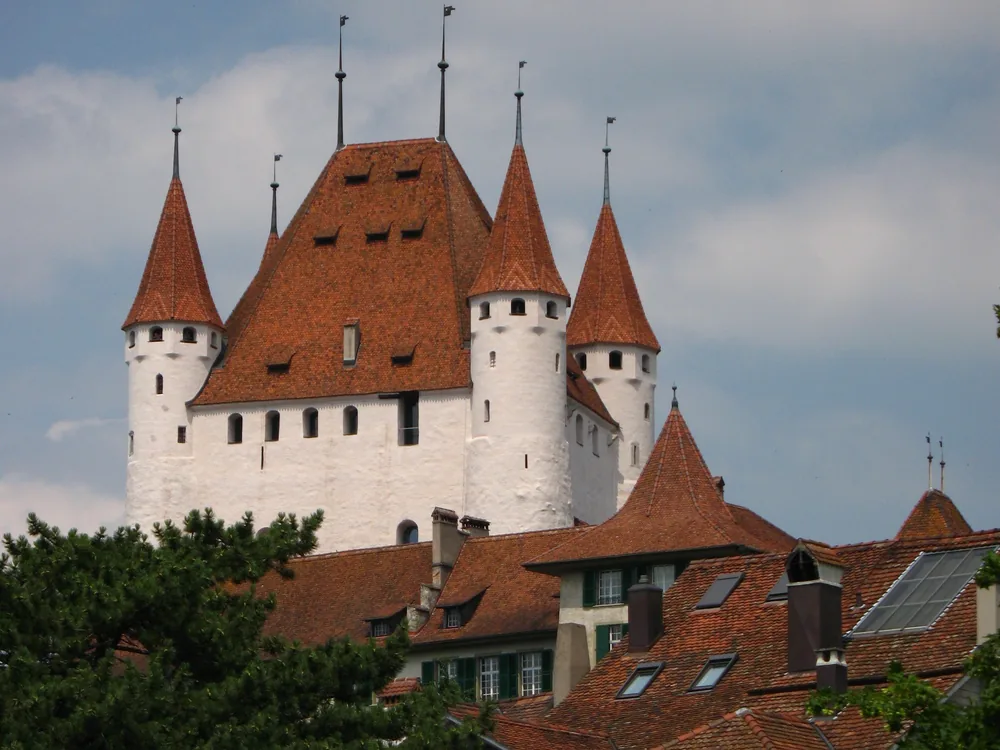
Built 1190 · 12th-century hilltop fortress above Thun's old town; the keep was built by Duke Berthold V of Zähringen around 1190 — part of the same Zähringen building programme that founded Bern; the square tower with its four corner turrets is the defining element of the Thun skyline and one of the best-preserved Zähringen-period keeps in Switzerland; the Knights' Hall inside the keep is one of the largest medieval secular interiors in the Bernese Oberland; the lower ward was added in the 13th century and expanded through the Bernese period after 1384
This page is part of an independent travel guide and is not affiliated with, endorsed by, or operated by Thun Castle.
© Castles & Palaces
Quick Facts
- Hours
- Daily 10:00–17:00
- Day trip from
- €224
- Duration
- 1–1.5 hours for the castle and museum; 3.5 hours on the GetYourGuide 3 Castles Tour
- Best time
- April to October
- Nearest city
- Thun
Featured Tour
Interlaken: Lake Thun — 3 Castles Tour with Entry Tickets
Cancellation available · Instant confirmation
Highlights
- ✦A Zähringen keep with 830 years of history — Thun Castle was built around 1190 by Duke Berthold V of Zähringen as part of the same building programme that founded the city of Bern; the Zähringen dynasty shaped the urban geography of what is now Switzerland more than any other medieval family, and Thun Castle's keep — with its square plan and four corner turrets — is one of the best-preserved examples of Zähringen military architecture surviving in the country
- ✦The Knights' Hall — the castle's most remarkable interior is the Knights' Hall on the keep's second floor, a large vaulted secular room that was the main ceremonial space of the medieval castle; it is one of the largest surviving medieval secular interiors in canton Bern, preserved with the original column arrangement and vault forms that give a clear sense of how 12th-century elite domestic space was conceived
- ✦The Thun old-town setting — the castle sits on a steep hill directly above Thun's remarkably preserved medieval old town, with its arcaded main street elevated above the Aare river; the castle's terraces give views over the old town's distinctive two-storey arcaded buildings, across the Aare, and south toward Lake Thun and the Bernese Alps; on clear days Eiger, Mönch, and Jungfrau are visible in the distance
- ✦The third of the Lake Thun castles trio — alongside the already-live [Oberhofen Castle](/castles/switzerland/oberhofen-castle) and [Spiez Castle](/castles/switzerland/spiez-castle), Thun Castle completes the circuit of three major castles around Lake Thun; each is distinct in character — Oberhofen is a romantic lakeside castle with a moat and garden, Spiez is a vineyard peninsula fortress with a Romanesque church, and Thun is a hilltop Zähringen keep above a medieval town — making the trio one of Switzerland's most coherent multi-castle itineraries
- ✦The GetYourGuide Lake Thun 3 Castles Tour is a 3.5-hour small-group tour from Interlaken (max 8 guests) covering all three Lake Thun castles with all entry tickets included, English guide, and hotel pickup from Interlaken — the most efficient way to visit all three with full context
Tickets & tours
Book through GetYourGuide
Thun Castle rises on a hill directly above the old town of Thun, where the Aare river leaves Lake Thun and begins its run north through the Bernese lowlands toward Bern. The castle's square keep with its four corner turrets has been the defining element of the Thun skyline since approximately 1190, when Duke Berthold V of Zähringen — the same duke who founded the city of Bern — built it as part of the Zähringen dynasty's systematic fortification and urbanisation of what is now the Swiss Mittelland and the approaches to the Alpine passes.
The Zähringen are one of the most consequential medieval dynasties in Swiss history, though they are not always recognised as such. Between the 11th and 13th centuries, they founded or refounded a series of strategically positioned towns — Bern, Fribourg, Burgdorf, Murten, Thun itself — that became the nuclei of Swiss urban life and eventually the core members of what would become the Swiss Confederation. Thun Castle was their fortified control point for Lake Thun and the Aare valley; Bern was founded within the same decade. When the Zähringen male line died out in 1218, their territories passed to the Counts of Kyburg and subsequently to the Habsburg family before Thun was purchased by the city of Bern in 1384, beginning a period of Bernese administration that shaped the castle's later development.
The castle's museum occupies the keep's four floors and covers Thun's history from prehistory through the 19th century. The centrepiece is the Knights' Hall on the second floor — one of the largest surviving medieval secular interiors in canton Bern, a vaulted room that served as the main ceremonial space of the medieval castle. The column arrangement and vault forms preserved here give a clear sense of how an important 12th-century fortified residence was designed: not as a purely military structure but as a functioning noble household with formal reception spaces appropriate to the Zähringen duke's social position.
The castle's terraces, reached by the same steep staircase that connects it to the old town below, give views south over Lake Thun and on clear days the entire arc of the Bernese Alps — Eiger, Mönch, Jungfrau visible as a distinct profile on the southern horizon. The old town of Thun below, with its distinctive two-storey arcaded main street elevated above the Aare, is one of the better-preserved small medieval towns in the Swiss Mittelland.
The GetYourGuide Lake Thun 3 Castles Tour covers Thun Castle alongside Oberhofen Castle and Spiez Castle in a 3.5-hour small-group programme from Interlaken, with all entry tickets included, English storytelling at each site, and hotel pickup. The three castles are collectively the most varied and complementary castle circuit in the Bernese Oberland.
History
A fortified position on the Thun hill is documented before the Zähringen period, but the current castle structure dates primarily from Duke Berthold V of Zähringen's construction around 1190. When the Zähringen male line died out in 1218, the castle passed through Kyburg and Habsburg hands before the city of Bern purchased Thun in 1384, beginning a long period of Bernese administration. Bern used the castle as a residence for the Bernese governor of the Oberland. After the French invasion of 1798 ended the Ancien Régime, the castle served various administrative functions before being opened as a museum in 1888 — making it one of Switzerland's earliest castle museums. The museum has been continuously maintained and updated since then, with significant restoration work in the 20th and 21st centuries.
How to Visit
Getting there: Thun is 30 minutes by InterRegio train from Bern and 20 minutes from Interlaken. The castle is reached by a steep staircase from the old town's main square (Rathausplatz) — the ascent takes approximately 10 minutes on foot. The GetYourGuide 3 Castles Tour includes hotel pickup from Interlaken.
Tickets: Walk-up entry CHF 12 adult, CHF 5 child — paid at the castle entrance; open daily April–October (reduced hours February–March, closed January). The tour (3.5 hours, max 8 guests) covers Thun Castle, Oberhofen Castle, and Spiez Castle with all entry tickets included — book well in advance as the small-group format fills quickly.
Practical tips: The terraces above the Knights' Hall give the best views of the Bernese Alps and Lake Thun — clear mornings before cloud buildup are the most reliable for the full Eiger-Mönch-Jungfrau view. The old town below the castle is worth time after your visit: Thun's elevated main street (Obere Hauptgasse) with its distinctive first-floor shops built above the street level is one of the most unusual streetscapes in Switzerland. The Aare riverbank walk connects the castle hill to the lake shoreline in about 15 minutes.
Combine with: Oberhofen Castle (10 km east on Lake Thun's southern shore — the romantic lakeside castle accessible by BLS lake steamer, with a Turkish smoking room and formal garden; also on the 3 Castles Tour) and Spiez Castle (20 km east on Lake Thun — the vineyard peninsula fortress with a 10th-century Romanesque church; BLS lake steamer connects Thun, Spiez, and the Interlaken end of the lake).
Frequently Asked Questions
The Knights' Hall (Rittersaal) is the main ceremonial room of Thun Castle's keep, located on the second floor of the square tower. It is a large vaulted secular space with columns supporting the ceiling above — one of the most completely preserved medieval secular interiors in canton Bern. The hall dates to the Zähringen period (late 12th century) and served as the primary reception and assembly space for the castle's noble residents. Most comparable medieval interiors in Switzerland were substantially modified or rebuilt in later centuries; the Thun Knights' Hall retains its original structural form with relatively little later intervention, making it unusually legible as a medieval space. The castle museum's displays in the hall cover armoury, historical artefacts from the Thun region, and archaeological finds from the castle hill spanning prehistory to the medieval period.
Location
Schlossberg 1, 3600 Thun, Switzerland
Nearby Castles
Tours & Tickets
Powered by GetYourGuide
From
€224/ person