Departing from Dresden
From Dresden: Albrechtsburg Meissen & Moritzburg Castle
The Gothic hilltop castle where European porcelain was born, and the Baroque hunting lodge on a lake where Augustus the Strong staged the most extravagant court in Saxony
From
€420/ person
Rating
★ 4.7(420)
Duration
Full day (8 hours)
Rating
4.7 ★ (420 reviews)
Languages
English, German
Group size
Max 16 people
About This Tour
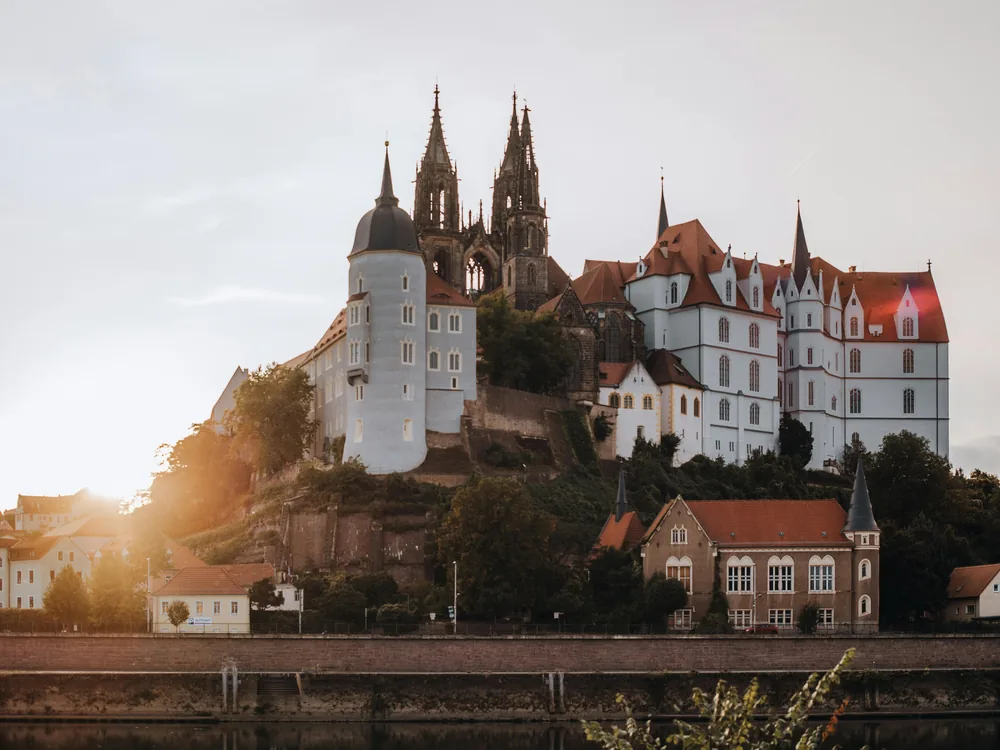
Saxony's two most extraordinary castles lie within 40 kilometres of Dresden and represent completely different visions of royal power. Albrechtsburg in Meissen is one of the first residential palaces in German history — a soaring Gothic structure on a hilltop above the Elbe built in the 1470s by the Wettin princes, which later became famous as the birthplace of European porcelain when Augustus the Strong locked his alchemists inside in 1710 and ordered them to replicate the Chinese secret. Moritzburg is the opposite: a pure fantasy of Baroque excess — a salmon-pink hunting lodge on an artificial island in a lake, built for Augustus the Strong in the 1720s, surrounded by water, filled with the world's largest collection of antlers, and upholstered in leather wallpaper that took 500 stags a year to produce. Two castles, one extraordinary ruler, a day through the most theatrical landscape in eastern Germany.
Highlights
- ✓Albrechtsburg, Meissen — one of Germany's first residential Gothic palaces (1471-1525), birthplace of European hard-paste porcelain in 1710
- ✓Meissen Cathedral (Dom) — the twin-spired Gothic cathedral beside the castle, one of the finest medieval cathedrals in eastern Germany
- ✓Meissen Porcelain Manufactory — still operating in Meissen since 1710, with crossed swords mark the most famous in the world
- ✓Moritzburg Castle — the Baroque hunting lodge on an artificial island (1723-1733), built for Augustus the Strong with 4 round towers reflected in the surrounding lake
- ✓Moritzburg's antler collection — the largest in the world, covering every wall of the hunting rooms, including a 66-point stag antler weighing 20kg
- ✓Augustus the Strong — Elector of Saxony and King of Poland, the most extravagant and culturally ambitious ruler of early 18th-century Germany
Ready to book this tour?
Free cancellation · Instant confirmation
Itinerary
Head northwest from Dresden along the Elbe valley toward Meissen. The guide introduces Augustus the Strong (1670-1733) — Friedrich August I, Elector of Saxony and (from 1697) King of Poland — the ruler who transformed Dresden into one of the most lavish courts in Europe, built the Zwinger and the Frauenkirche, patronised Handel and Telemann, and whose obsession with Chinese porcelain drove the most important technological discovery in European ceramic history.
Albrechtsburg Castle in Meissen is one of the most historically significant buildings in Germany. Built between 1471 and 1525 by Arnold of Westphalia for the Wettin princes Ernst and Albrecht, it was conceived as a purely residential palace rather than a military fortress — one of the first buildings in German history designed explicitly for court life rather than defence. The soaring Gothic interior spaces, the spiral staircases, and the elaborate carved stone vaulting represent a pivotal moment in German architectural history. In 1710, Augustus the Strong transformed the castle into a secret laboratory: he imprisoned the alchemist Johann Friedrich Böttger and the mathematician Ehrenfried Walther von Tschirnhaus inside and ordered them to discover the Chinese formula for hard-paste porcelain. They succeeded — the first European hard-paste porcelain was produced at Meissen in 1709-1710, and the Meissen Manufactory (still operating today) was established in the castle to protect the secret. Adjacent to the castle, the twin-spired Meissen Cathedral (Dom) is one of the finest Gothic cathedrals in eastern Germany, containing the earliest large-scale cast bronze figures in German art (1250-1260).
The Meissen Porcelain Manufactory has been in continuous operation since 1710, making it the oldest European porcelain manufacturer. The factory moved from Albrechtsburg to its current building in the 19th century. The manufactory tour includes the demonstration workshops where master painters and modellers work on pieces using exactly the same hand-painting techniques established in the 18th century. The museum displays the history of the factory's production from Augustus the Strong's dragon vases to the Art Nouveau period. The crossed-swords trademark — introduced in 1722 — remains the most recognised porcelain mark in the world.
Moritzburg Castle stands on an artificial island in the middle of an artificial lake — an environment of pure theatrical fantasy created by Augustus the Strong for the most extravagant hunting parties in Saxony. The original hunting lodge on this site was built for Duke Moritz of Saxony (hence the name) in the 1540s; Augustus completely rebuilt it in 1723-1733, enlarging the island, creating the lake system, and building the salmon-pink Baroque palace with four round corner towers that is one of the most photographed castle reflections in Germany. The interior is a monument to the hunt: every wall of the Great Hall and the hunting rooms is covered in antlers — the largest antler collection in the world — including an extraordinary 66-point stag rack weighing 20 kilograms. The wallpaper in the leather room is genuine leather from approximately 500 stags, tooled and painted in the 1730s and completely preserved.
What's Included
- ✓Return transport from Dresden
- ✓Professional English and German-speaking guide
- ✓Albrechtsburg Castle entry
- ✓Meissen Cathedral entry
- ✓Meissen Porcelain Manufactory demonstration tour
- ✓Moritzburg Castle entry
- ✓Small group (max 16)
Not Included
- ✗Lunch (free time in Meissen — the market square has several good restaurants)
- ✗Porcelain purchases at the Manufactory
- ✗Moritzburg hunting carriage museum (optional)
Insider Tips
The Meissen Porcelain Manufactory demonstration workshop is the highlight for many visitors — watching a master painter add the crossed swords to a piece with a single brushstroke is genuinely impressive
Moritzburg is most beautiful in autumn (October-November) when the lake trees turn and the reflection doubles the palace's colours — and in winter when the lake freezes and the castle appears to float on ice
Albrechtsburg's Gothic interior spaces are genuinely extraordinary — the net vaulting and the Wendelstein spiral staircase are among the finest late-Gothic architectural elements in Germany
Allow time to walk through Meissen's old town — the market square and the medieval lanes below the castle hill are charming and rarely crowded
Frequently Asked Questions
How was European porcelain discovered at Meissen?
Augustus the Strong was obsessed with Chinese and Japanese porcelain — he reportedly traded 600 Prussian soldiers for 151 Chinese vases with the King of Prussia. He imprisoned the alchemist Johann Friedrich Böttger (who had claimed he could make gold) and redirected his efforts toward porcelain. Working with the mathematician Tschirnhaus, Böttger discovered that firing kaolin clay from the Erzgebirge mountains at extremely high temperatures produced a hard, white, translucent ceramic identical to Chinese porcelain. The discovery was made in 1709; the factory opened in 1710 in Albrechtsburg, surrounded by secrecy. The formula leaked to Vienna by 1718 and to the rest of Europe by the 1740s.
How many children did Augustus the Strong really have?
The popular claim of 354 illegitimate children (plus one legitimate heir) is almost certainly exaggerated — a calculation from his contemporaries that was based on unreliable gossip. Historians have documented approximately 15 acknowledged illegitimate children with various mistresses, plus his legitimate son Frederick Augustus II. The legend of his sexual athleticism was partly cultivated by Augustus himself as a display of dynastic vitality.
Is Moritzburg Castle the one in the Cinderella story?
Yes — Moritzburg Castle was the filming location for the beloved East German Cinderella film (Drei Haselnüsse für Aschenbrödel, 1973), known in the West as Three Wishes for Cinderella. The film was a co-production between Czechoslovakia and East Germany, filmed partly at Moritzburg and partly at Švihov Castle in Bohemia. It remains one of the most-watched Christmas films in Germany, the Czech Republic, Norway, and several other European countries, and its association with Moritzburg is intensely strong.
More Tours from Dresden
Powered by GetYourGuide
From
€420
per person
Free cancellation available on most dates · Secure booking
Meeting point
Dresden city centre — exact location confirmed at booking
From
€420/ person