
Departing from Kraków
From Kraków: Trail of the Eagles' Nests — Medieval Castle Ruins
A chain of 14th-century fortresses on Jurassic limestone cliffs — Poland's most dramatic medieval landscape, built in a single reign to guard a kingdom's southern edge
From
€189/ person
Rating
★ 4.7(850)
Duration
Full day (8 hours)
Rating
4.7 ★ (850 reviews)
Languages
English
Group size
Max 15 people
About This Tour
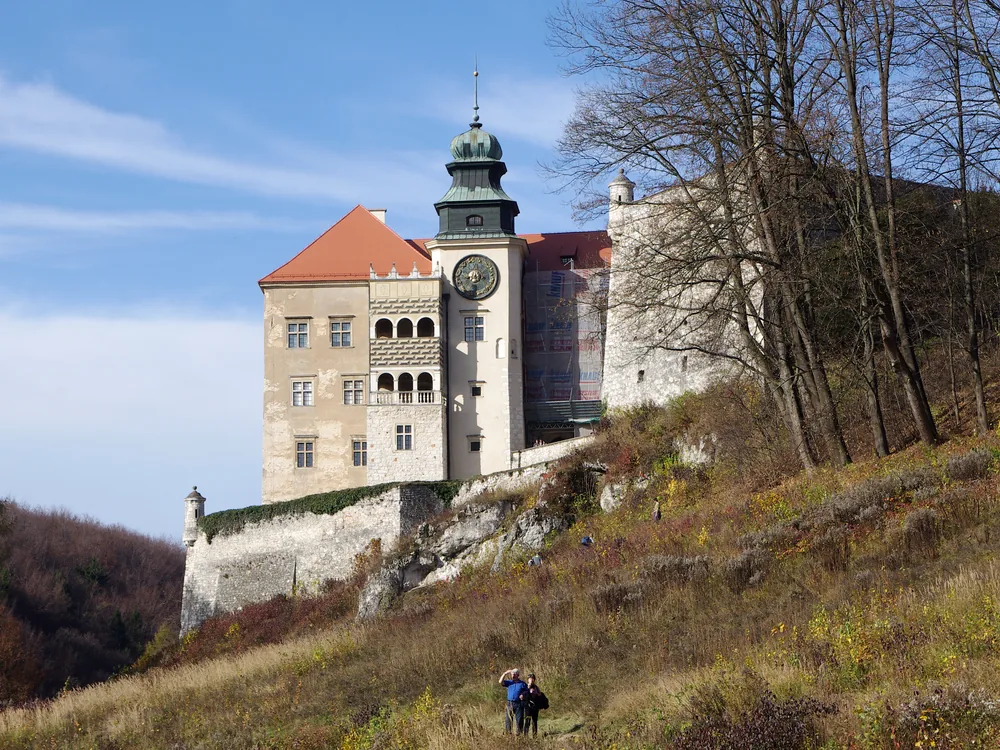
The Trail of the Eagles' Nests (Szlak Orlich Gniazd) follows a chain of 25 medieval castle sites along the limestone upland north of Kraków — a defensive line built by King Casimir III the Great in the 14th century to guard Poland's southern frontier against Silesian and Bohemian aggression. The Jurassic landscape is extraordinary: white limestone cliffs rising from pine forests, riddled with caves, topped with ruins that seem to grow from the rock itself. Pieskowa Skała is the jewel — a fully intact Renaissance castle perched on a cliff above the Prądnik River, its arcaded courtyard surviving from 1542. Ogrodzieniec is the most dramatic ruin: Gothic towers spreading across three limestone hilltops, one of the most photographed ruins in Poland. Ojców Castle, the smallest, sits above a river gorge of exceptional beauty. Together they trace how one medieval king transformed a kingdom from wood to stone.
Highlights
- ✓Pieskowa Skała Castle — Poland's finest Renaissance castle, intact on its limestone cliff since 1542, with arcaded courtyard
- ✓Ogrodzieniec ruins — Gothic towers across three hilltops, covering 3 hectares: the most dramatic castle ruin in Poland
- ✓Ojców National Park — Jurassic limestone gorges, river caves, and medieval ruins in an extraordinary natural setting
- ✓Hercules' Club — the 25m limestone rock column that has become the emblem of the Jurassic upland
- ✓King Casimir the Great's defensive chain — the story of 25 castles built to guard a kingdom in a single 37-year reign
- ✓Łokietek's Cave — the royal cave where King Władysław hid from the Bohemians in 1306 before reunifying Poland
Ready to book this tour?
Free cancellation · Instant confirmation
Itinerary
Head north from Kraków into the Kraków-Częstochowa Upland, where the flat Vistula plain abruptly gives way to a Jurassic landscape of limestone crags, cave entrances, and hilltop ruins. The guide introduces King Casimir III the Great (1310–1370) — the Polish monarch who built more than 50 stone castles in a single reign, earning his epithet by finding Poland built in wood and leaving it built in stone — and explains the strategic logic of the Eagles' Nests chain as a curtain wall against the Kingdom of Bohemia.
Enter Ojców National Park, one of the smallest and most spectacular national parks in Poland, where the Prądnik River has carved a gorge through the Jurassic limestone. The Ojców Castle ruins — a tower and gate on a cliff above the river, built by Casimir the Great around 1350 — guard the mountain pass. Below the castle, Łokietek's Cave (named for King Władysław I Łokietek, who sheltered here from the Bohemian forces of Wenceslaus II in 1306) is a 320m limestone cavern with two grand chambers. Łokietek went on to reunify Poland and crown himself king in 1320 — beginning the dynasty that led to Casimir the Great.
The finest castle on the entire Eagles' Nests trail, Pieskowa Skała (Dog's Rock) occupies a limestone cliff 515m above sea level above the Prądnik River gorge. Founded by Casimir the Great in the 14th century, it was comprehensively rebuilt in the Italian Renaissance style around 1542 by the Szafraniec family — the rebel lords who defied both king and church from this impregnable perch. The arcaded courtyard, with three tiers of loggia in pale limestone, is one of the finest examples of Renaissance architecture in Poland outside Kraków's Wawel. It is the only Eagles' Nest castle that survived fully intact into the modern era and now houses a museum of Polish decorative arts from the medieval to the Baroque period.
The most dramatic ruin on the entire trail, Ogrodzieniec spreads across three limestone hilltops at 516m — the highest point in the Kraków-Częstochowa Upland. Originally a Casimir the Great fortification, it was massively expanded in the early 16th century by the Boner family (Florentine bankers who became the wealthiest merchants in Poland) into a Gothic-Renaissance palace-fortress covering nearly three hectares. The Swedish invasions of the 1650s (the Deluge) left it a ruin. Walk the towers, cellars, the gate complex, and the approach path past Hercules' Club (Maczuga Herkulesa) — a 25m free-standing limestone column that has become the geological emblem of the Jurassic upland.
What's Included
- ✓Return transport from Kraków
- ✓Professional English-speaking guide
- ✓Pieskowa Skała Castle entry
- ✓Ogrodzieniec Castle entry
- ✓Ojców National Park entry
- ✓Small group (max 15)
Not Included
- ✗Pieskowa Skała Castle museum interior (optional extra, highly recommended)
- ✗Lunch (free time in Ogrodzieniec village)
- ✗Cave tours in Ojców National Park (optional)
Insider Tips
Comfortable walking shoes are essential — castle approaches involve uneven limestone terrain and steps cut from rock
Ogrodzieniec is particularly atmospheric in late afternoon light when the limestone towers glow gold — the tour timing usually catches this
The Prądnik Valley below Pieskowa Skała is genuinely beautiful; the view from the loggia across the gorge is one of the best in southern Poland
The full Eagles' Nests Trail (165km on foot) is one of Poland's classic long-distance hiking routes — this day trip hits the three unmissable sites
Frequently Asked Questions
Why is the trail called the Eagles' Nests?
The name comes from the dramatic cliff-top positions of the castles — perched on limestone crags high above the valleys, like eagle nests on rocky outcrops. The metaphor captures both the inaccessibility of these 14th-century fortifications and the commanding views they give across the Jurassic upland.
How many castles are on the full Eagles' Nests Trail?
The official trail includes 25 medieval castle sites along approximately 165 kilometres, from Kraków in the south to Częstochowa in the north. Most are ruins in varying states of preservation; Pieskowa Skała is the only one that survived fully intact as a habitable building.
Who was King Casimir the Great?
Casimir III (1310–1370) was the last Polish king of the Piast dynasty and the only Polish monarch called 'the Great' by his subjects. He found Poland built in wood and left it built in stone — constructing more than 50 stone castles in his 37-year reign, codifying Polish law, founding Kraków's Jagiellonian University, and granting formal protections to Jewish communities across the kingdom.
More Tours from Kraków
Powered by GetYourGuide
From
€189
per person
Free cancellation available on most dates · Secure booking
Meeting point
Kraków city centre — exact location confirmed at booking
From
€189/ person