
Departing from Madrid
From Madrid: Ávila's Medieval Walls & Salamanca – Castile's Two Crown Jewels
The most complete medieval city walls in Europe and the Golden City of Spain's Renaissance — two UNESCO masterpieces in one day
From
€69/ person
Rating
★ 4.5(1,240)
Duration
Full day (12 hours)
Rating
4.5 ★ (1,240 reviews)
Languages
English, Spanish
Group size
Max 50 people
About This Tour
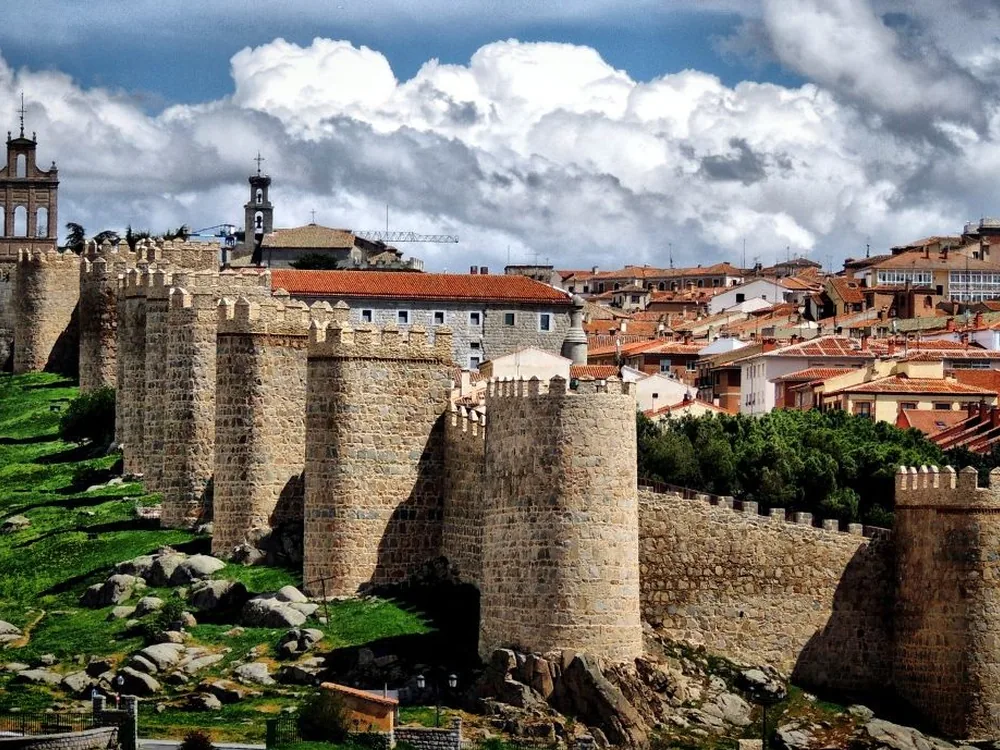
Ávila's medieval walls are the most complete surviving city fortifications in Europe — 2.5 kilometres of 11th-century ramparts with 88 towers and 9 gates, encircling the entire city exactly as they did when King Alfonso VI ordered their construction after the reconquest from the Moors in 1088. Unlike the fragmentary walls of most medieval cities, Ávila's circuit is entirely intact and walkable: a complete medieval defensive system that has enclosed the city for 900 years. The Cathedral of Ávila — the first Gothic cathedral in Spain, begun in the 12th century — is embedded directly into the eastern wall, its apse forming one of the defensive towers and its stones indistinguishable from the fortifications around it. Salamanca, an hour northwest, is Spain's answer to Oxford: a university city of golden sandstone that has been a centre of European learning since 1218. Its Plaza Mayor is the finest baroque square in Spain, and its cathedral complex — the Old Cathedral (Romanesque, 12th century) attached directly to the New Cathedral (Gothic/Baroque, 16th–18th century) — is one of the most remarkable double-cathedral ensembles in Europe.
Highlights
- ✓Ávila's medieval walls — 2.5 km of intact 11th-century ramparts with 88 towers, the most complete medieval city walls in Europe (UNESCO)
- ✓Cathedral of Ávila — the first Gothic cathedral in Spain, its apse embedded directly into the city wall as a defensive tower
- ✓The birthplace of Santa Teresa of Ávila — the 16th-century mystic and Doctor of the Church who reformed the Carmelite Order
- ✓Salamanca's Plaza Mayor — the finest Baroque public square in Spain, designed by Alberto Churriguera in 1729
- ✓Salamanca's twin cathedrals — the Romanesque Old Cathedral (1120) directly attached to the Gothic New Cathedral (1513–1733)
- ✓The University of Salamanca (1218) — the oldest university in the Iberian Peninsula and one of the oldest in the world
Ready to book this tour?
Free cancellation · Instant confirmation
Itinerary
Ávila's walls were built between 1090 and 1099 on the orders of Raymond of Burgundy, son-in-law of King Alfonso VI, following the Christian reconquest of the city from the Moors. The circuit — 2,516 metres, 88 semicircular towers, 9 gates — is the most complete medieval city wall in Europe: every tower and gate survives, the walkable ramparts extend the full circuit, and the silhouette against the Castilian meseta appears almost exactly as it did in the 11th century. The guide walks the most dramatic section of the walls including the Alcázar gate (the most fortified), the Puerta del Alcázar and the church of San Vicente, before visiting the Cathedral — the first Gothic cathedral in Spain, remarkable for having its apse incorporated directly into the defensive wall. The guide covers the city's most famous daughter: Santa Teresa of Ávila (1515–1582), the mystic and reformer whose Carmelite monasteries spread across Spain and whose writings — including the mystical masterpiece 'The Interior Castle' — made her a Doctor of the Church.
Salamanca is built entirely from the golden sandstone of its surrounding region — a warm amber stone that glows in the afternoon light and gives the city its UNESCO nickname 'the Golden City'. The University of Salamanca, founded in 1218 by King Alfonso IX of León, is the oldest in the Iberian Peninsula and the third oldest in Europe after Bologna and Oxford. Its famous Plateresque facade (1534) contains a hidden frog carved on the skull — finding it is said to bring good luck to students. The guide covers the university's extraordinary history: Christopher Columbus presented his case for the western route to Asia here in 1486. The double cathedral complex is unique in Spain: the 12th-century Old Cathedral (Romanesque) was never demolished when the New Cathedral (Gothic) was built against it in 1513 — both stand side by side, connected internally, their contrasting styles visible simultaneously. Plaza Mayor — designed by Alberto Churriguera in 1729 and completed in 1755 — is the most perfect Baroque public square in Spain, its arched facades decorated with 102 medallion portraits of Spanish kings and historical figures.
What's Included
- ✓Return transport from Madrid
- ✓Professional English-speaking guide
- ✓Ávila city walls entry
- ✓Small group section of tour
Not Included
- ✗Cathedral of Ávila interior entry (~€7 — optional)
- ✗Salamanca Old Cathedral entry (~€7 — optional)
- ✗University of Salamanca visit (exterior free; interior optional ~€10)
- ✗Lunch (free time in Salamanca)
- ✗Tips for guide and driver
Insider Tips
Walk the full circuit of Ávila's walls — the section along the eastern side (closest to the cathedral) and the northwest corner give the best views of the Castilian meseta
In Salamanca, find the carved frog on the University facade before your guide tells you where it is — it takes most people 3-5 minutes
Salamanca's Plaza Mayor is best in early morning or evening when the golden stone catches the slanted light — avoid midday
Ávila's yemas de Santa Teresa (egg yolk sweets shaped like the saint's veil) are the city's traditional confection, made since the 16th century
Frequently Asked Questions
Why is Ávila's cathedral embedded in the city wall?
When the cathedral was begun around 1160 — making it the first Gothic cathedral in Spain — the bishop and the city's military commander agreed to incorporate the apse (the rounded east end) directly into the defensive wall. This served two purposes: it saved the cost of building a separate wall section where the cathedral stood, and it gave the cathedral an imposing military presence on the most exposed eastern side of the city wall. The Cathedral of Ávila is therefore simultaneously a church and a castle tower — unique in European architecture.
What did Christopher Columbus do in Salamanca?
In 1486, Columbus presented his proposal for a western route to Asia to a commission of scholars and cartographers at the University of Salamanca. The commission rejected his plan — correctly, as it turned out, because Columbus had dramatically underestimated the circumference of the Earth. (The scholars knew the Earth was round; they correctly calculated it was too large to cross.) Columbus subsequently presented his plan to the Portuguese and then the Spanish crowns directly. The University of Salamanca's famous Hall of the Columbus Commission still exists.
How old is the University of Salamanca?
The University of Salamanca was founded in 1218 by King Alfonso IX of León — making it 800 years old and the third oldest university in Europe after Bologna (1088) and Oxford (c.1096–1167). At its peak in the 16th century it had 10,000 students and was one of the four great universities of western Europe alongside Bologna, Paris and Oxford. It was here that Francisco de Vitoria, teaching in the 1530s, laid the foundations of modern international law — largely in response to questions raised by the conquest of the Americas.
More Tours from Madrid
Powered by GetYourGuide
From
€69
per person
Free cancellation available on most dates · Secure booking
Meeting point
Madrid city centre — exact departure point confirmed at booking
From
€69/ person