Departing from Cardiff
From Cardiff: Wye Valley — Tintern Abbey, Chepstow Castle & Caerphilly Castle
The border route: Wordsworth's ruined abbey, Britain's oldest post-Roman stone castle, and the largest fortress in Wales — a Welsh-speaking historian guide taking the Wye Valley road rather than the South Wales valleys
From
€105/ person
Rating
★ 4.7(116)
Duration
Full day (8 hours)
Rating
4.7 ★ (116 reviews)
Languages
English, French
Group size
Max 8 people
About This Tour
Cardiff sits at the intersection of two distinct castle landscapes. The first is the South Wales valleys route: Caerphilly, Raglan, Tretower, Castell Coch — medieval fortresses in the mountain heartland, the subject of the two other Cardiff-based tours on this site. The second is the Wye Valley border route, heading east from Cardiff along the valley of the River Wye toward the English-Welsh border: a corridor of different historical character, shaped not just by castle-building but by the Cistercian monasteries that colonised the same river valleys, and by the Romantic poets who came after them.
This small-group day trip (maximum 8 people) follows the Wye Valley route. The three stops — Tintern Abbey, Chepstow Castle, and Caerphilly Castle — are connected by a single geographical and historical thread: the control of the River Wye crossing and the Welsh Marches, contested from the Norman conquest through to the Civil War and reflected in sites of radically different character. The guide — a Welsh-speaking former history teacher who has led this route consistently, with strong and consistent GetYourGuide reviews — is the distinguishing feature of the product: the positive review sentiment is almost entirely about the guide's knowledge and the way that knowledge is communicated.
Entry fees are not included in the base price (an optional pass covering all three sites is available — ask at booking); the €105 listed price covers transport, guiding, and the small-group experience.
This is the Wye Valley/border-history route, distinct from the other two Cardiff-based tours on this site: the Cardiff three-castles trip (Caerphilly, Raglan, Tretower) covers medieval South Wales castle architecture in the countryside; the Cardiff Castle & Castell Coch tour covers the Victorian Gothic Bute legacy in Cardiff city. This tour's primary differentiators — Tintern Abbey and Chepstow Castle — appear on neither of the other two. All three share Caerphilly Castle as a stop; if you have already visited Caerphilly, this tour's value is still primarily Tintern and Chepstow.
Highlights
- ✓Tintern Abbey — the roofless Cistercian ruin on the River Wye that inspired Wordsworth's 'Lines Written a Few Miles above Tintern Abbey' (1798); one of the finest ruined abbeys in Britain, founded in 1131, dissolved by Henry VIII in 1536; the roofless nave and intact window tracery are the defining image of Romantic-era ruin aesthetics in Wales
- ✓Chepstow Castle — the oldest surviving post-Roman stone fortification in Britain, begun by William FitzOsbern immediately after the Norman Conquest (c.1067); positioned on a limestone cliff above the River Wye at the first crossing point above the Severn estuary; the strategic logic of this site controlled movement between England and Wales for 600 years
- ✓Caerphilly Castle — the second largest castle complex in Britain (after Windsor), 30 acres of concentric water defences built by Gilbert de Clare in 1268-71; the most technically accomplished water fortress in medieval Wales; includes the famous leaning southeast tower, tilted more than the Leaning Tower of Pisa by Civil War undermining
- ✓The guide — a Welsh-speaking former history teacher who leads this specific route with deep expertise in Welsh Marches history, the Cistercian monastic network, and the Norman castle-building programme along the Wye; consistently strong GetYourGuide reviews reflect specific feedback about the guide's knowledge and communication
- ✓Small group (maximum 8) — the tour is capped at 8 people, not 16 or 20; the guide's narrative style is designed for small-group engagement rather than large-group lecturing; the size creates the space for questions and digression
- ✓The Wye Valley landscape itself — the river gorge between Chepstow and Tintern, one of the most beautiful river valleys in Britain, was the destination that launched British tourism in the 18th century when the Picturesque movement (Gilpin's 'Observations on the River Wye', 1782) established it as the first organised scenic tour in English travel literature
Ready to book this tour?
Free cancellation · Instant confirmation
Itinerary
Depart Cardiff heading east toward the River Wye and the Welsh-English border. The guide introduces the geographical and historical logic of the Wye Valley as a corridor: the river as a boundary (the English-Welsh border follows the Wye for much of its lower course), as a strategic chokepoint (whoever controlled the first crossing above the Severn estuary controlled movement between England and Wales), and as a monastic landscape (the Cistercians colonised the same river valleys the Normans had fortified, creating a dual landscape of castle and abbey). The Chepstow Castle stop comes first as it was built first — the starting point of the Norman conquest's Wye Valley phase.
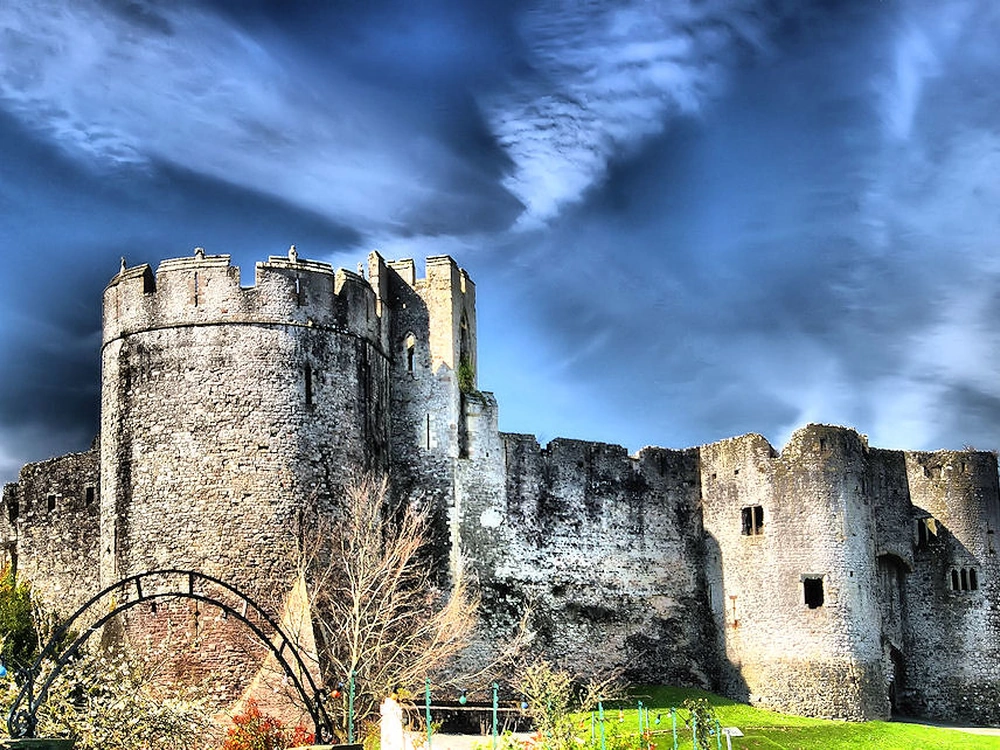
Chepstow Castle (Castell Cas-gwent) is the oldest surviving post-Roman stone fortification in Britain. William FitzOsbern, one of William the Conqueror's most trusted lieutenants, began construction immediately after the Conquest — within a year of Hastings, in 1067 — on a long thin promontory of limestone cliff above the River Wye at the first place where the river could be bridged above the Severn estuary. This was not incidental positioning: controlling this crossing controlled movement between England and Wales, and FitzOsbern understood this better than anyone else in the Norman military hierarchy. The castle's Great Tower (now referred to as the Great Keep) is one of the earliest stone castle buildings in post-Conquest Britain — preceding most of the Norman castle-building programme by several years. The castle was subsequently extended by the de Clare family (who also built Caerphilly), the Bigod earls of Norfolk, and the Crown. Its most famous prisoner was Henry Marten — one of the regicides who signed Charles I's death warrant — who was confined at Chepstow from 1660 until his death in 1680, a period of 20 years, in a tower that still bears his name. The castle was slighted after the Civil War and has been an open ruin since the late 17th century; its position on the cliff above the Wye makes it one of the most dramatically sited medieval fortifications in Britain.
Tintern Abbey (Abaty Tyndyrn) was founded in 1131 by Walter de Clare, Lord of Chepstow, for the Cistercian order — the white monks who specialised in colonising remote river valleys across medieval Europe as locations for monastic communities. The site on the River Wye, surrounded by steep forested hillsides, is typically Cistercian in its combination of beauty and isolation. The abbey grew to become one of the wealthiest Cistercian houses in Wales, with an extensive estate of agricultural granges across the Wye valley and the Forest of Dean. Henry VIII dissolved Tintern in 1536 during the Dissolution of the Monasteries, stripping the lead from the roofs and leaving the building to decay. The ruin that resulted — a complete roofless nave with its window tracery largely intact, the great west window still standing, the choir and transepts defining the full scale of the 13th-century church — became one of the defining sites of 18th-century Picturesque tourism. William Gilpin described the Wye tour (including Tintern) in his 1782 'Observations on the River Wye', effectively launching British landscape tourism as an organised practice. William Wordsworth visited in 1793 and again in 1798, composing 'Lines Written a Few Miles above Tintern Abbey' on the second visit — one of the defining poems of English Romanticism, which uses the landscape of the abbey and the river valley as the occasion for an extended meditation on memory, nature, and the passage of time. The poem does not describe the abbey in detail; it uses the approach to it, and the landscape visible from the valley, as its subject. The guide discusses the Romantic reception of Tintern alongside the medieval and monastic history, giving the site its full historical and literary range.
Caerphilly Castle (Castell Caerffili) is the third stop and returns the itinerary to pure military architecture after the monastic register of Tintern. Built between 1268 and 1271 by Gilbert de Clare — the same family that built Chepstow in the Norman period — Caerphilly is the most technically sophisticated water fortress in medieval Wales. At 30 acres it is the second largest castle complex in the UK after Windsor, its scale achieved through water rather than height: three artificial lakes and two moats surround the castle so that no approach is possible without crossing water. The concentric ring of walls — inner ward, outer ward, and two vast dam platforms — reflects the influence of crusader castle design that Gilbert de Clare or his military engineers may have encountered, and anticipates the concentric design of Edward I's Welsh castles by nearly two decades. The famous leaning southeast tower — tilted approximately 10 degrees from vertical, a greater angle than the Leaning Tower of Pisa — was deliberately undermined during the Civil War by Parliamentary forces attempting to make the castle indefensible. It was never restored or stabilised, and now leans in permanent arrested collapse. This is the third Cardiff-based tour on this site to include a Caerphilly stop. If you have already visited Caerphilly with the [Three Castles day trip](/tours/wales/cardiff-three-castles-caerphilly-raglan) or the [Cardiff Castle & Castell Coch tour](/tours/wales/cardiff-castle-caerphilly-castell-coch), the guide's Caerphilly segment here offers additional depth on the de Clare family's dual role in both the Chepstow and Caerphilly narratives, making the repeat visit contextually different from the first.
What's Included
- ✓Return transport from Cardiff in a small-group vehicle
- ✓Professional guide (English, French; Welsh-speaking)
- ✓Small group guaranteed (maximum 8 people)
Not Included
- ✗Site entry fees — an optional all-sites pass is available; ask at booking. Entry fees approximately: Tintern Abbey £7 adult (Cadw), Chepstow Castle £8 adult (Cadw), Caerphilly Castle £8 adult (Cadw). Cadw membership covers all three.
- ✗Lunch (free time at Tintern village or Chepstow town)
- ✗Gratuities
Insider Tips
The guide's knowledge is the product's defining quality — the GetYourGuide reviews consistently single this out. Ask questions; the guide is a Welsh-speaking former history teacher who finds genuine digressions more interesting than a scripted narrative.
Entry fees are not included in the €105 base price — budget approximately £23 for all three Cadw sites (adult rate), or use a Cadw membership if you have one. Confirm the pass option at booking.
Tintern's interior is best photographed at the east end, looking west through the nave toward the great west window: the full scale of the ruined church is visible from this angle, and the roofless nave frames the sky in a way that photographs effectively in most lighting conditions.
Chepstow Castle's cliff position above the Wye is best appreciated from the bridge below — if time allows before or after the castle visit, walking down to the Wye riverside reveals the full logic of the site's defensive position.
This tour follows the Wye Valley/border-history route. Two other Cardiff-based tours cover different territory: the Three Castles day trip (Caerphilly, Raglan, Tretower — medieval South Wales castles in the countryside) and the Cardiff Castle & Castell Coch tour (Victorian Gothic legacy of the Marquess of Bute, Cardiff city, Caerphilly). All three share Caerphilly; the two sites unique to this tour are Tintern and Chepstow.
Frequently Asked Questions
How is this different from the other Cardiff day trips that also visit Caerphilly?
This is the Wye Valley/border-history route. Its primary differentiators are Tintern Abbey (roofless Cistercian ruin, Wordsworth's subject) and Chepstow Castle (oldest post-Roman stone fortification in Britain, Norman cliff-top position above the Wye) — neither of which appears on either of the other two Cardiff-based tours. The Three Castles trip (Caerphilly, Raglan, Tretower) covers medieval castle architecture in the South Wales countryside with no Wye Valley component. The Cardiff Castle & Castell Coch tour covers the Victorian Gothic Bute legacy in Cardiff city and north of it. All three share Caerphilly. If you're choosing between them based on Caerphilly alone, note that the guide's approach to Caerphilly on this tour — connecting it to the de Clare family's Chepstow legacy — gives the repeat visitor contextually new material.
Did Wordsworth actually write about Tintern Abbey itself?
'Lines Written a Few Miles above Tintern Abbey' (1798) is one of English Romanticism's defining poems, but it is not a description of the abbey ruins. Wordsworth's title locates the poem geographically — he is a few miles upstream from the abbey, on the banks of the Wye — but the poem's subject is his own memory, the five years since his previous visit, and what the landscape (river, trees, mountain forms) means to a mind changed by those five years. The abbey appears in the title and nowhere else. The guide covers this distinction, and the broader Romantic reception of Tintern, as part of the site's literary history.
Why is Chepstow Castle called the oldest post-Roman stone castle in Britain?
The 'post-Roman' qualifier is important: there were late Roman stone fortifications in Britain (Saxon Shore forts, Hadrian's Wall). Chepstow's Great Tower was begun in 1067 — within a year of the Norman Conquest — making it the earliest dated stone castle building in Britain after the Roman period. Most Norman castles of this generation were timber-and-earthwork motte-and-bailey constructions; the decision to build in stone from the start at Chepstow reflects the strategic importance of the site and William FitzOsbern's resources.
Is the guide actually Welsh-speaking?
Yes — the guide is a Welsh-speaking former history teacher. The Welsh language and the Welsh-language names for the sites (Abaty Tyndyrn, Castell Cas-gwent, Castell Caerffili) are woven into the guide's narration alongside the English-language historical context. The tour operates in English (and French on request); Welsh is part of the guide's background knowledge rather than the tour's primary language.
More Tours from Cardiff
Powered by GetYourGuide
From
€105
per person
Free cancellation available on most dates · Secure booking
Meeting point
Cardiff — confirmed at booking by Tours of Wales
From
€105/ person