Caerphilly Castle
Castell Caerffili
Wales · South Wales · Near Cardiff
Built 1268 · Concentric medieval
This page is part of an independent travel guide and is not affiliated with, endorsed by, or operated by Caerphilly Castle.
© Unsplash
Quick Facts
- Hours
- Daily 10:00–17:00
- Day trip from
- €79.13
- Duration
- 2–3 hours
- Best time
- Spring and summer for open lake reflections
- Nearest city
- Cardiff
Featured Tour
From Bristol: Mountains & Castles of Wales Day Tour
Cancellation available · Instant confirmation
Highlights
- ✦The second largest castle in Britain (after Windsor) and the largest in Wales, covering over 12 hectares including its artificial lake system
- ✦A pioneering concentric castle design that influenced English military architecture from the 1270s onwards
- ✦The leaning south-east tower — out of plumb by more than the Leaning Tower of Pisa — damaged during the Civil War
- ✦The elaborate water defences — a system of lakes, dams, and islands that made the castle virtually impregnable
- ✦The great hall reconstruction — the finest surviving example of a Decorated Gothic great hall in Wales
Tickets & tours
Book through GetYourGuide
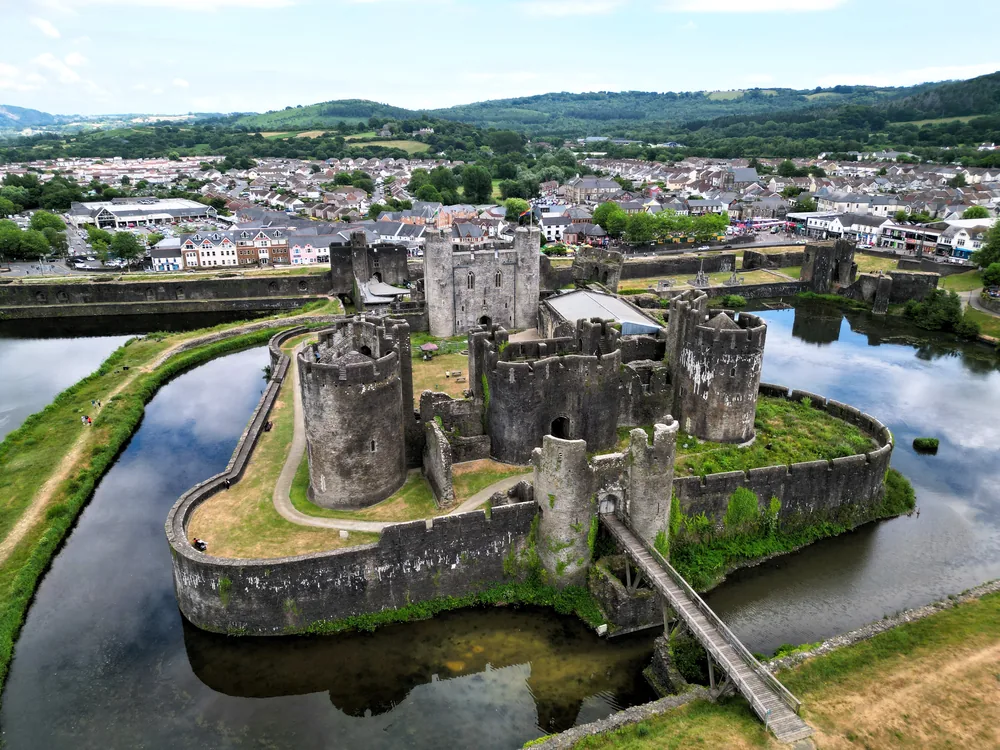
Caerphilly Castle is the largest castle in Wales and the second largest in Britain — a statement of military engineering ambition that remains astonishing 750 years after its construction. Built between 1268 and 1271 by Gilbert de Clare, the most powerful lord in medieval Wales, the castle covers over 12 hectares including its extraordinary system of artificial lakes, dams, and islands. To approach it is to understand immediately why the concentric castle design, with its rings of walls and water defences, was so formidable: the garrison within could observe and defend every approach while an attacker faced multiple obstacles of water, wall, and fire.
The castle's most famous feature is its leaning south-east tower, which tilts at an angle of approximately 10 degrees from vertical — considerably more than the Leaning Tower of Pisa. The lean was caused by deliberate undermining during the English Civil War, when Parliamentary forces attempted to destroy the castle. The wall cracked but did not fall, and the resulting lean has made it one of the most recognisable castle features in Britain.
Inside the castle walls, the great hall — partially reconstructed in the 20th century — gives the most vivid sense of the scale of life within a major medieval fortress. Lead statues of Gilbert de Clare and his successors stand in niches around the interior. The outer gatehouse, inner gatehouse, and the complex system of drawbridges, portcullises, and passages through which any attacker would have to penetrate, speak to the paranoid military logic of the 13th century — a period of near-constant conflict between Anglo-Norman lords and the native Welsh princes.
History
Caerphilly was built between 1268 and 1271 by Gilbert de Clare, 7th Earl of Gloucester and 6th Earl of Hertford — one of the wealthiest and most powerful barons in medieval England, who controlled most of Glamorgan. The castle was a direct response to the growing power of Llywelyn ap Gruffudd, Prince of Wales, who was pressing south into the lowlands of Glamorgan. De Clare needed a fortress that could both withstand siege and serve as the administrative centre of his Welsh lordship.
The construction of the water defences — damming two streams to create the extensive lake system — was as important as the castle buildings themselves. The lakes isolated the castle from direct assault and controlled the only approach routes. Llywelyn destroyed an early version of the castle in 1270, but de Clare rebuilt it more ambitiously, completing the main structure by 1271. Llywelyn captured it again briefly in 1272 but was repelled.
After the conquest of Wales by Edward I in 1282–83 removed the Welsh threat, Caerphilly lost its strategic importance. It passed through the Despenser and Lancaster families and was used primarily as an administrative centre before falling into disrepair during the Tudor period. The Civil War damage to the south-east tower was the castle's last significant military event. The Marquess of Bute (who also restored Cardiff Castle and Castell Coch) undertook the first systematic restoration in the 1870s, draining and re-flooding the lakes and clearing centuries of debris.
How to Visit
Getting there: Caerphilly town is 16 km north of Cardiff. Regular trains run from Cardiff Central to Caerphilly (about 20 minutes, frequent service). The castle is a 5-minute walk from the train station. By car, it is signposted from the A470 and A468. There is paid parking adjacent to the castle.
Cadw membership: If you plan to visit several Welsh castles (Conwy, Caernarfon, Harlech, Raglan), consider a Cadw membership or multi-site Explorer Pass — it quickly pays for itself.
The leaning tower: The famous lean is most clearly seen from the outer ward, looking south from the inner gatehouse. The tower leans at about 10 degrees — photograph it alongside a vertical reference for maximum effect.
Tickets: Walk-up entry €9 adult, €6 child. The GetYourGuide tour — From Bristol — offers a guided visit; book in advance.
Practical tips: Spring and summer for open lake reflections.
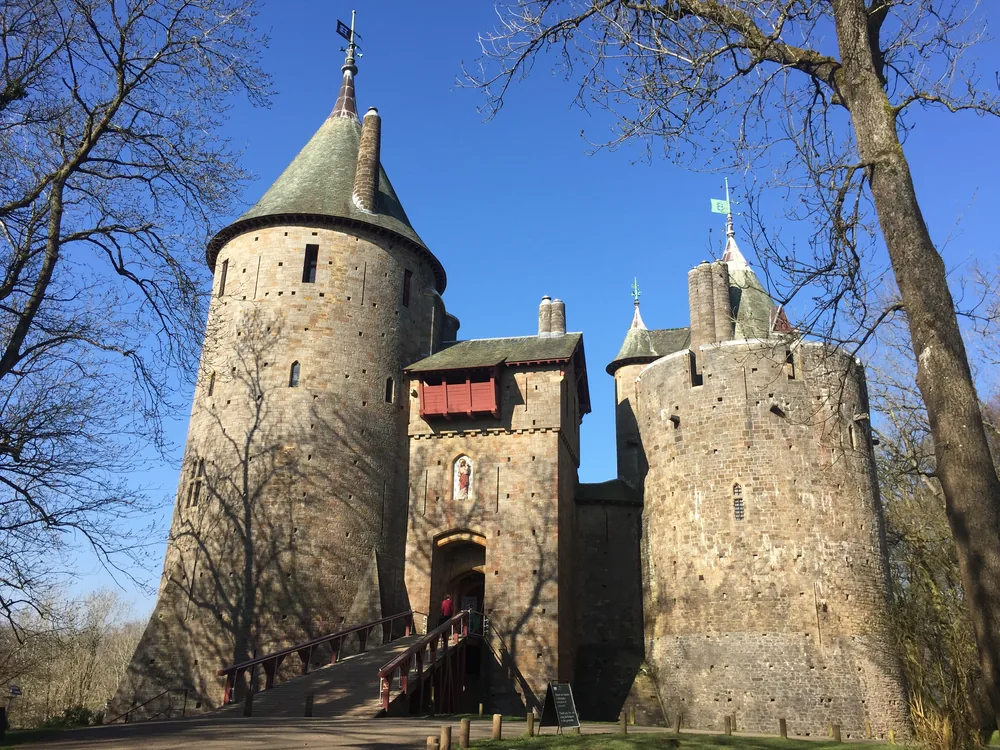
Combine with: Cardiff (16 km south) and Castell Coch (a Victorian Gothic revival castle in the woods north of Cardiff, 13 km away) make perfect additions for a Welsh castle day.
Frequently Asked Questions
The south-east tower was deliberately undermined during the English Civil War (1640s) by Parliamentary forces attempting to 'slight' (render militarily useless) the castle. The undermining caused the wall to crack and lean but not collapse — leaving the spectacular tilt of approximately 10 degrees that persists today. It leans further from vertical than the Leaning Tower of Pisa.
Location
Castle Street, Caerphilly CF83 1JD, Wales
Nearby Castles
Tours & Tickets
Powered by GetYourGuide
From
€79.13/ person