
Petrela Castle
Kalaja e Petrelës
Albania · Tirana County · Near Tirana
Built 540 · Byzantine-era hilltop fortress on a rocky outcrop above the Erzen river valley, 22 km southeast of Tirana; original fortifications built c.540 AD under Emperor Justinian I as part of the late Roman defensive system for the Via Egnatia route; the current castle fabric is predominantly from Ottoman-era restoration and reconstruction, with Byzantine foundations visible in the lower walls; the castle is associated with Gjergj Kastrioti Skanderbeg — Albania's national hero — who is said to have used it as a military base and whose sister Mamica is recorded to have lived here; the hilltop position at 380 metres above sea level commands the entire upper Erzen valley and the routes south toward Elbasan and east toward North Macedonia; the castle has undergone partial restoration since the 1990s; a small café operates within the courtyard during the visitor season; the access road is narrow and requires a vehicle — the road winds 4 km from the village of Petrelë to the castle gate
This page is part of an independent travel guide and is not affiliated with, endorsed by, or operated by Petrela Castle.
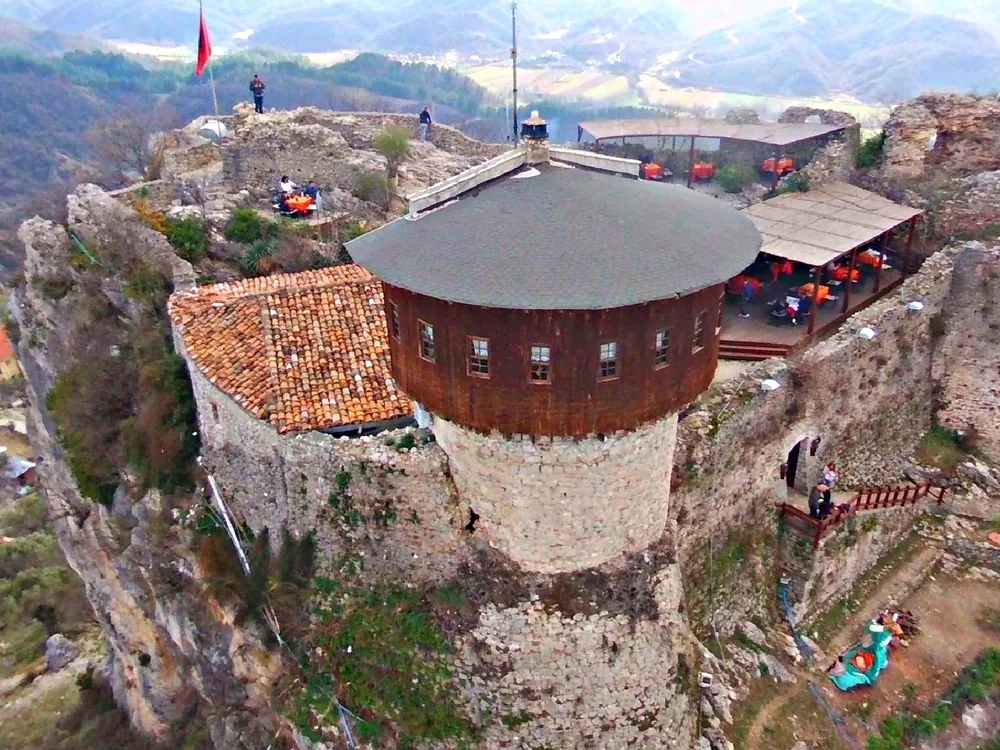
© Castles & Palaces
Quick Facts
- Hours
- Mon–Fri 09:00–17:00. Sat & Sun 09:00–18:00
- Day trip from
- €77
- Duration
- 1–1.5 hours
- Best time
- May to September
- Nearest city
- Tirana
Featured Tour
From Tirana: Petrela Castle and Biggest ZipLine in Balkan
Cancellation available · Instant confirmation
Highlights
- ✦Petrela Castle was originally built c.540 AD under Emperor Justinian I — the Byzantine emperor who also rebuilt Hagia Sophia, re-conquered Italy and North Africa, and codified Roman law — as part of the defensive network protecting the Via Egnatia, the ancient road connecting the Adriatic to Constantinople; the castle's Byzantine foundations represent one of the oldest standing fortification structures in Albania and one of the most significant examples of Justinianic defensive architecture in the western Balkans
- ✦The castle's Skanderbeg connection is its most celebrated historical association: Gjergj Kastrioti Skanderbeg (1405–1468), the Albanian national hero who held off Ottoman expansion for 25 years with a coalition of Albanian clans, used Petrela as a military base during the campaigns of the 1440s–1460s; his sister Mamica (Mamiza) is recorded in the historical sources as having lived at the castle; the association with Skanderbeg places Petrela in the same historical narrative as [Kruje Castle](/castles/albania/kruje-castle) and the network of fortifications from which he conducted the Albanian resistance
- ✦The view from the castle battlements over the upper Erzen valley — the river valley visible in both directions, the Tirana basin to the northwest and the route toward Elbasan to the southeast — explains immediately why the Byzantine engineers chose this specific outcrop; the castle controlled the most direct overland route between the Albanian coast (and Durrës, the Adriatic port) and the interior of the Balkans, and whoever held it held the traffic between east and west
- ✦The Erzen river valley below Petrela Castle is one of the most scenically undeveloped river landscapes within easy reach of an Albanian capital — the rural character of the valley, the small villages, and the absence of major infrastructure make the approach to the castle one of the more atmospheric of any near-Tirana heritage site, particularly in contrast to the rapid urbanisation visible from the Tirana basin
- ✦The castle's small courtyard café — operating in the summer season within the partially-restored castle walls — offers coffee and Albanian cold drinks at the battlement level, with the valley view as the primary attraction; it is one of the more satisfying café positions in the Albanian heritage circuit and functions as a quiet counter-point to the castle's otherwise historically saturated visit
Tickets & tours
Book through GetYourGuide
Petrela Castle stands on a rocky outcrop 22 kilometres southeast of Tirana, above the Erzen river valley at 380 metres altitude. The approach is part of the experience: a 4-kilometre road climbs from the village of Petrelë through cultivated hillsides and past farmhouses, arriving at the castle gate on a promontory that drops steeply on three sides. The view from the battlements — up the Erzen valley toward Elbasan and the interior of Albania, northwest toward Tirana — makes the purpose of the fortification immediately legible.
The castle's history spans fifteen centuries. The earliest fortifications at Petrela were built c.540 AD under the Byzantine Emperor Justinian I, as part of the defensive network protecting the Via Egnatia — the ancient road that connected Dyrrachium (Durrës) on the Adriatic to Constantinople, the most important overland route in the medieval Balkans. Justinian's building programme along the Via Egnatia was extensive: facing pressure from Gothic, Slavic, and eventually Avar and Bulgar raids, he commissioned or restored fortifications at regular intervals along the road, creating a chain of defensive positions that could slow or stop raiding parties advancing from either direction. Petrela's rocky outcrop above the Erzen valley was a natural choice for one of these positions — the valley narrows here, the outcrop dominates both the road and the river crossing, and the position is naturally defensible on three sides.
The Byzantine foundations of the original castle are visible in the lower courses of the walls, where the late Roman mortared stonework differs from the later Ottoman-era reconstruction above. The castle was rebuilt and maintained through the medieval Albanian period and the Ottoman conquest, with successive modifications reflecting the changing military technology and administrative requirements of each era.
The castle's Skanderbeg connection is the episode that has lodged most firmly in Albanian historical memory. Gjergj Kastrioti Skanderbeg (1405–1468) — Albania's national hero, the Christian military commander who abandoned Ottoman service in 1443 and led a coalition of Albanian clans in resistance to Ottoman expansion for the remaining 25 years of his life — used Petrela as one of his military bases during the campaigns of the 1440s and 1450s. His sister Mamica (Mamiza) is recorded in the historical sources as having lived at the castle during this period, suggesting that the family regarded Petrela as a secure position worth occupying even when Skanderbeg himself was campaigning elsewhere. The castle is therefore part of the same Skanderbeg geography as [Kruje Castle](/castles/albania/kruje-castle) 35 kilometres to the north — the primary Skanderbeg fortress that is now one of Albania's most visited heritage sites.
The Ottoman period brought the castle under imperial administration. It remained in use as a military position through the 16th and 17th centuries before declining in strategic importance as Ottoman consolidation of Albania reduced the need for a dense network of hilltop fortifications. The castle fell into partial disrepair and ruin through the 18th and 19th centuries, and the communist era (1944–1990) brought no particular attention to the site beyond general archaeological inventory.
The post-communist decades have seen partial restoration of the walls and towers, with the castle opened to visitors and a small café established in the courtyard. The restoration is not complete and much of the fabric remains in a picturesque intermediate state between ruin and functional heritage site. A dedicated GetYourGuide day tour from Tirana includes the castle entrance ticket and, for those who want it, access to the largest zip-line course in the Balkans nearby — making Petrela one of the more adventure-oriented castle visits in Albania.
History
Emperor Justinian I's great programme of frontier fortification in the 540s AD left its mark across the Balkans, and Petrela's rocky outcrop above the Erzen valley was an obvious candidate for one of its defensive positions. The castle's Byzantine foundations — visible in the lower courses of the walls, where late Roman mortared stonework predates the Ottoman-era reconstruction above — represent one of the oldest standing fortification structures in Albania. The site commanded the Via Egnatia, the ancient road linking the Adriatic at Durrës with Constantinople, and whoever held this promontory held the traffic passing through the Erzen valley narrows below.
The castle's medieval Albanian history is dominated by its association with Gjergj Kastrioti Skanderbeg, the 15th-century commander who led Albanian resistance to Ottoman expansion. In the 1440s and 1450s, Skanderbeg used Petrela as one of his military bases during the campaigns that made him the defining figure in Albanian historical memory. His sister Mamica is recorded in the sources as having lived at the castle during this period — suggesting it was considered secure enough for the Kastrioti family even when Skanderbeg himself was operating elsewhere.
The castle was rebuilt and adapted through successive Albanian and Ottoman administrations before falling into disrepair in the 18th and 19th centuries. The communist period brought no significant intervention, and post-communist restoration since 1990 has opened the site to visitors, with a small courtyard café operating in the summer season.
How to Visit
Getting there: Petrela Castle is 22 km southeast of Tirana. By car, take the SH3 road toward Elbasan, turn south at Petrelë village, then follow the 4-km narrow access road to the castle gate. There is no practical public transport to the gate; a hire car, taxi, or guided tour is required. Sturdy footwear essential.
Tickets: Walk-up entry is approximately €2 adults, €1 children. The GetYourGuide day tour from Tirana (5 hours) includes the Petrela Castle entrance ticket and transport from Tirana, with an optional add-on for the Balkans' largest zip-line course nearby.
Practical tips: The summer courtyard café is one of the more atmospheric stops in the Albanian castle circuit — coffee at battlement level with the Erzen valley below is a genuine highlight and worth building time in. The site is open daily May–September; verify locally before visiting in autumn or spring, as management hours can change without notice.
Combine with: Toptani Castle and Preze Castle — both free, self-guided Tirana-hinterland castle sites reachable independently; no single GetYourGuide tour currently covers all three together.
Frequently Asked Questions
Gjergj Kastrioti Skanderbeg, Albania's 15th-century national hero, used Petrela as one of his military bases during his resistance to Ottoman expansion (1443–1468). His sister Mamica (Mamiza) is recorded as having lived at the castle during this period, suggesting the family regarded it as a secure position. Skanderbeg's primary fortress was Kruje (35 km north of Tirana), but he maintained control of several castles throughout central Albania as part of his defensive strategy. Petrela's position controlling the Erzen valley route toward Elbasan made it strategically important.
Location
Petrelë, Tirana County, Albania
Nearby Castles
Tours & Tickets
Powered by GetYourGuide
From
€77/ person