
Preze Castle
Kalaja e Prezës
Albania · Durrës County · Near Tirana
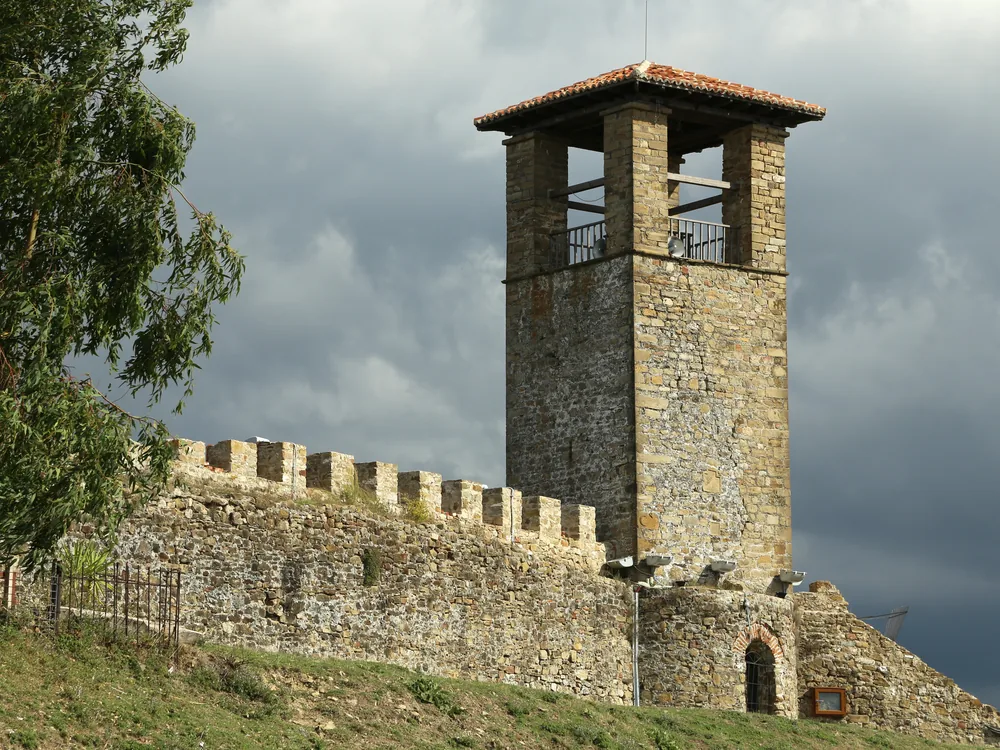
Built 1280 · Medieval Albanian hilltop fortress on a ridge above the Prezë village, 20 km north of Tirana and 18 km east of Durrës; originally built in the late 13th century, the castle controlled the overland route between the Albanian interior and the Adriatic coast at Durrës — the most important port in medieval Albania and one of the principal Adriatic entry points for east-west trade; the castle was used by successive Albanian lords and Ottoman governors; associated with the Thopia family, one of the most powerful medieval Albanian noble dynasties, who held territory in central Albania from the 13th century and who built and maintained several castles in the Tirana–Durrës corridor; partially restored since Albanian independence in 1991; a mosque built within the castle courtyard during the Ottoman period survives in a ruinous state; the hilltop position (approximately 450 metres above sea level) commands panoramic views over the Tirana plain to the south, the Durrës plain and Adriatic to the west, and the Mat river valley to the north
This page is part of an independent travel guide and is not affiliated with, endorsed by, or operated by Preze Castle.
© Castles & Palaces
Quick Facts
- Hours
- Mon–Fri 08:00–18:00. Sat & Sun 08:00–19:00
- Entry from
- Free
- Duration
- 1–1.5 hours
- Best time
- April to October
- Nearest city
- Tirana
Highlights
- ✦Preze Castle was built by the Thopia family — one of the most powerful Albanian noble dynasties of the 13th–15th centuries, whose territory extended across central Albania from the Adriatic coast toward the Shkumbin river; the Thopias were among the Albanian lords who alternately allied with and resisted the Angevin Kingdom of Naples, the Byzantine Empire, the Serbian empire of Stefan Dušan, and the Ottoman advance, navigating the political turbulence of late medieval Albania with the clan pragmatism that characterised Albanian noble politics of the period
- ✦The castle's position on the Prezë ridge commands arguably the widest panoramic view of any hilltop fortress within the Tirana day-trip zone: to the south, the Tirana basin and, on clear days, the silhouette of the capital's tower buildings; to the west, the flat Durrës plain extending to the Adriatic horizon; to the north, the Mat river valley and the more rugged terrain of northern Albania; to the east, the mountain chains that separate the coastal plains from the Albanian interior — a 360-degree view that makes the strategic rationale of the position immediately comprehensible
- ✦The ruined Ottoman mosque within the castle courtyard — built after the Ottoman conquest of Albania in the 15th century — is a direct material record of the castle's transition from medieval Albanian noble fortress to Ottoman garrison position; the mosque's survival (even in ruined form) at the highest point of the castle reflects the Ottoman administrative pattern of establishing Islamic religious buildings at politically significant sites as both a functional and symbolic act of territorial possession
- ✦The route between Durrës and the Albanian interior — which Preze Castle was built to control — has been one of the most strategically important corridors in Albania since antiquity; the Via Egnatia, the ancient road from the Adriatic to Constantinople, passes through the Durrës coastal zone before climbing into the interior, and medieval Albanian lords positioned at Preze could levy tolls, monitor traffic, and control military movement on the most significant overland route in the region
- ✦The village of Prezë below the castle is one of the more intact pre-communist rural settlements in the immediate Tirana hinterland — the communist regime's collectivisation policies and forced urbanisation affected many Albanian villages, and the relatively undeveloped state of Prezë today makes the approach to the castle through the village an authentic example of the Albanian hill-village landscape that has been significantly eroded by post-1990 development elsewhere in the Tirana zone
Tickets & tours
Book through GetYourGuide
Preze Castle stands on a ridge 20 kilometres north of Tirana and 18 kilometres east of Durrës, at approximately 450 metres above sea level. The ridge position between Albania's capital and its principal Adriatic port is not accidental: the castle was built to control exactly this corridor, the most significant overland route in medieval central Albania, connecting Durrës — the Adriatic entry point for east-west trade and military movements — with the Albanian interior.
The castle was built in the late 13th century by the Thopia family, one of the most consequential Albanian noble dynasties of the medieval period. The Thopias built their authority across central Albania in the 13th and 14th centuries, controlling territory from the Adriatic coastal zone inland toward the Shkumbin river, and constructing or controlling a network of hilltop fortifications that allowed them to tax and monitor movement through their territory. Preze was part of this network — a ridge position between the coast and the capital that could not be bypassed without being visible from the battlements.
The Thopia lords navigated the extraordinarily complex political environment of late medieval Albania with the pragmatic clan intelligence that the period required. Albania in the 14th century was contested between the Angevin Kingdom of Naples, the Byzantine Empire in its final contraction, the expanding Serbian empire of Stefan Dušan, various Italian commercial powers, and the approaching Ottoman state. Albanian lords mediated between these forces, allying and switching allegiances according to clan advantage, and the Thopias were among the more successful practitioners of this approach. Karl Thopia — who captured Durrës from the Angevins in 1368 and briefly made it an Albanian capital — was the dynasty's most historically significant figure and the lord most closely associated with the fortifications in this corridor.
The Ottoman conquest of Albania — completed progressively from the 1430s through the 1470s, with Skanderbeg's resistance representing the principal delay — brought Preze Castle under Ottoman administrative control. The mosque built in the castle courtyard during this period remains as a ruined structure, its walls and mihrab outline visible among the courtyard debris. It represents the standard Ottoman practice of establishing Islamic religious infrastructure at politically significant sites as part of the process of territorial consolidation.
The view from the castle battlements is one of the practical reasons to make the climb. On a clear day — which in Preze means a day without either Tirana's air quality haze or the coastal fog that can blanket the Durrës plain — the panorama encompasses the Tirana basin to the south (the capital's skyline visible), the flat Adriatic coastal plain to the west (the sea visible on the clearest days), the Mat river valley to the north, and the mountain chains to the east. The 360-degree quality of the view from the ridge top is exceptional for a site this close to a capital city.
The village of Prezë, through which the access path passes, is one of the more intact pre-communist rural settlements in the Tirana hinterland. The communist collectivisation and urbanisation policies that restructured much of Albanian village life left Prezë in a state of relative traditional continuity — the approach through the village to the castle involves a 20-minute walk on unpaved paths that are as historically legible as the castle above.
Preze Castle is free to enter and has no formal ticketing infrastructure. The management is by the local municipality and the visit is self-guided. [Toptani Castle](/castles/albania/toptani-castle) in Tirana's Skanderbeg Square and [Petrela Castle](/castles/albania/petrele-castle) southeast of the capital are the other two medieval castle sites in the immediate Tirana hinterland — Petrela now has its own dedicated bookable GetYourGuide day tour, while Preze and Toptani are best visited independently or with a private driver.
History
The Thopia family built Preze Castle in the late 13th century to control the most important corridor in central Albania — the overland route between Durrës, the principal Adriatic port, and the Albanian interior. The ridge position was not subtle in its strategic intent: the castle sat directly above the road, at a height from which both the coastal plain to the west and the Tirana basin to the south were visible on clear days, making large-scale movement through the corridor effectively impossible without the garrison's knowledge.
The Thopias were among the most consequential Albanian noble dynasties of the medieval period, navigating with clan pragmatism the competing pressures of the Angevin Kingdom of Naples, the Byzantine Empire, the expanding Serbian state of Stefan Dušan, and the advancing Ottomans. Karl Thopia, the dynasty's most historically significant figure, captured Durrës from the Angevins in 1368 and briefly made it an Albanian administrative centre. His successors held Preze through the decades of Ottoman consolidation that followed Skanderbeg's death in 1468.
Ottoman administration brought the castle under imperial control and introduced a mosque to the courtyard — its walls and mihrab outline surviving today in ruinous form among the courtyard debris — as part of the standard Ottoman practice of establishing Islamic infrastructure at politically significant sites. The castle declined as a military position through the 18th and 19th centuries and was not significantly altered during the communist period. It has been open as a free-access heritage site since Albanian independence in 1991.
How to Visit
Getting there: Prezë village is 20 km north of Tirana on the SH1 road toward Lezhë, approximately 30 minutes by car. Turn east from the SH1 at Prezë, then make the 20-minute uphill walk to the castle gate. A private driver or taxi from Tirana is the most practical way to reach the site without a rental car.
Tickets: Entry is free — there is no ticketing and no dedicated GetYourGuide tour for Preze specifically. Petrela Castle, 15 km south, has its own bookable GetYourGuide day tour with transport from Tirana if you'd rather not self-drive.
Practical tips: Visit in the morning on a clear day for the best panoramic views — the Adriatic is visible to the west, the Tirana skyline to the south, and the Mat valley to the north, all in one sweep from the battlements. Summer midday heat on the exposed ridge can be intense; bring water. The approach through Prezë village is itself worth slowing down for — one of the more intact pre-communist Albanian hill villages in the Tirana hinterland.
Combine with: Toptani Castle and Petrela Castle — both free, self-guided Tirana-hinterland castle sites; no single GetYourGuide tour currently covers all three together, though Petrela has its own dedicated bookable day tour.
Frequently Asked Questions
The Thopia were a medieval Albanian noble dynasty who controlled central Albania from the 13th through the 15th centuries. Their territory extended from the Adriatic coast (including the city of Durrës) inland toward the Shkumbin river, and they built or controlled a network of hilltop fortifications including Preze Castle. Karl Thopia (died 1388) was the dynasty's most historically significant member, who captured Durrës from the Angevins in 1368 and held it until his death. The Thopias navigated the complex politics of late medieval Albania — Angevin, Byzantine, Serbian, and Ottoman pressures — before their territory was absorbed by the Ottoman advance.
Location
Prezë, Durrës County, Albania
Nearby Castles
Tours & Tickets
Powered by GetYourGuide
Free Entry