
Fort Kniepass
Fort Kniepaß
Austria · Saalachtal, District of Zell am See, Salzburg State — Unken, near the German-Austrian border · Near Salzburg
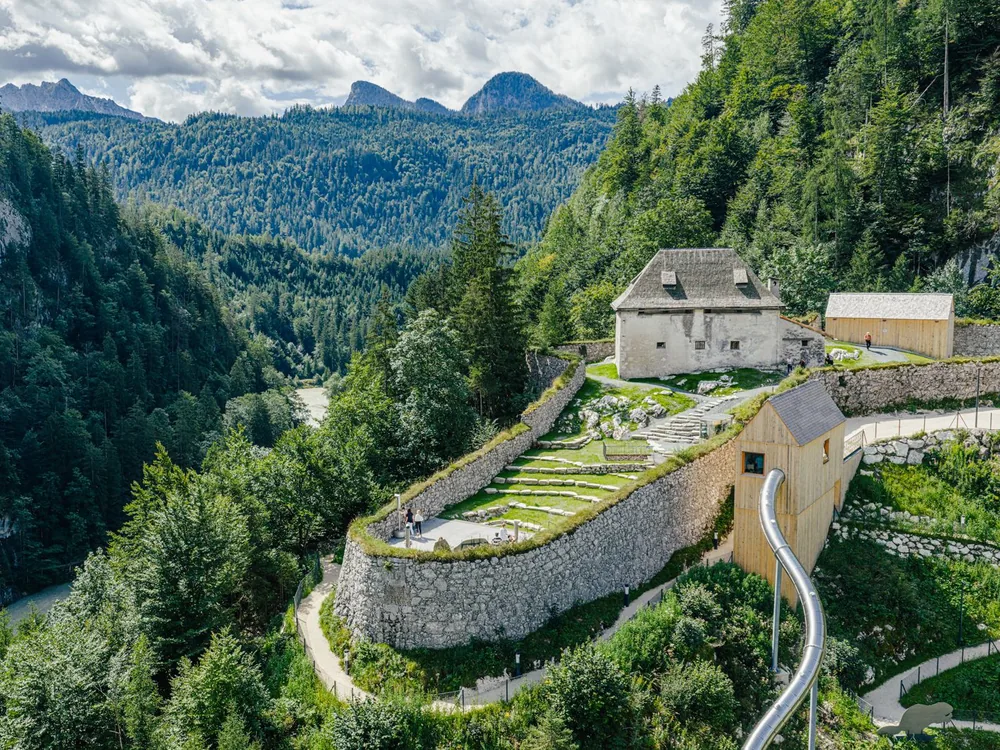
Built 1300 · 14th-century Alpine border fortification, adapted across subsequent centuries — the fort was built to command the narrow pass in the Saalachtal where the valley bends (the 'Knie', or knee) at a defensible constriction along the principal transit route between the Salzburg basin and Bavaria; the historic wall circuit, gate structures, and defensive positions date primarily from the medieval and early modern period; the site has been adapted for contemporary visitor use with an interpretive trail through the existing fabric, but the historic fortifications remain the primary architectural presence; the setting in the steep wooded Saalachtal is integral to understanding the fort's original defensive function
This page is part of an independent travel guide and is not affiliated with, endorsed by, or operated by Fort Kniepass.
© Castles & Palaces
Quick Facts
- Hours
- Mon–Fri 10:00–17:00. Sat & Sun 09:00–18:00
- Entry via GYG
- €12
- Duration
- 2–3 hours (KniePASS Adventure Trail, Viper Slide, and optional on-site restaurant lunch); allow a half-day from Salzburg
- Best time
- May to September
- Nearest city
- Salzburg
Featured Tour
Fort Kniepass Ticket
Cancellation available · Instant confirmation
Highlights
- ✦A 14th-century Alpine border fort in active use — Fort Kniepass has guarded the Saalachtal valley pass between Austria and Bavaria since the 14th century; the historic wall circuit, gate structures, and defensive positions are the physical backdrop for every element of the modern visit, grounding the adventure trail in a genuine medieval fortification
- ✦KniePASS Adventure Trail — 12 interpretive waypoint stations on the theme of borders — geographic, political, ecological, and personal — using the fort's specific history as a boundary-control installation as the grounding for a broader interpretive framework; the 55-metre climb from the valley floor to the upper fortifications passes through historic gate structures and curtain walls
- ✦Viper Slide — longest and highest dry tube slide in the Alps — a 150-metre tube slide descending 56 metres from the fort's upper level to the valley below; included in the standard GYG admission ticket (one ride); the slide is the most direct expression of Fort Kniepass's positioning as an active outdoor destination rather than a passive heritage museum
- ✦On-site restaurant and fermentation centre — the fort's historic buildings house a restaurant serving regional Salzburg food alongside a fermentation and food-culture centre engaging with the Austrian Alpine tradition of dairy and fermented-food production; a full visit naturally extends to include lunch
- ✦Honest combination of history and adventure — Fort Kniepass is the rare heritage site that accurately represents itself as both a genuine medieval fortification with serious interpretive content and a family adventure day out; the two elements are complementary, and the site rewards visitors who approach both with equal openness
Skip the queue with a guided tour
Skip-the-line tickets & expert guides
The pass at Kniepass has been worth defending since the medieval period. The Saalachtal — the valley of the Saalach river, a tributary of the Salzach — runs from the Salzburg basin southward along a corridor that has served as one of the primary routes between the Salzburg region and Bavaria since the trans-Alpine trade networks were established in the early medieval period. The valley's navigability made the narrow constrictions along its length natural points of control; whoever held those points held the movement of goods, travellers, and armies between two sides of an Alpine frontier.
Fort Kniepass was built to hold one such point. The fortification dates to the 14th century, when the Saalachtal's importance as a trans-border corridor was already well established — salt moving from the Salzkammergut mines northward, Alpine livestock passing between mountain pastures, trade goods between the markets of Salzburg and Bavaria all funnelled through this valley. The fort's name reflects its position: the 'Kniepass' describes a bend in the valley at the point where the fortification stands, the valley turning at an angle — the 'knee' — that creates the defensible constriction the original fort was designed to command. A sharply turning valley is naturally difficult to approach at speed and relatively easy to observe from the high ground above.
For several centuries the fort served as a border post and military control point on what was, at various moments, the actual political boundary between the Prince-Archbishopric of Salzburg and the Duchy of Bavaria. The frontier between Salzburg and Bavaria shifted across the medieval and early modern periods — settled, disputed, and renegotiated as the political configurations of the Holy Roman Empire evolved and the power of the Salzburg archbishops waxed and waned relative to their Bavarian neighbours. The fort's function changed with the frontier: sometimes a customs and toll station, sometimes a garrison post, sometimes a checkpoint for a boundary that had recently moved. The consistent thread was geographic: the valley bend at Kniepass remained a point of passage that warranted control regardless of who held the larger territorial claim on either side.
The modern visitor experience makes this history explicit rather than merely assumed. The KniePASS Adventure Trail — a waymarked interpretive path through and around the historic fortifications — uses the theme of borders as its organising concept across twelve stations. The stations address what a border is in multiple registers: geographic (the river as a natural boundary, the ridgeline as a political one), historical (the specific history of the Saalachtal frontier and the shifts in Austrian-Bavarian territorial claims), ecological (the treeline boundary between valley and high Alpine terrain, the transition from one plant and animal community to another), and personal (the experience of crossing a threshold, of belonging to one side or another). The fort's specific history as a boundary-control installation provides the grounding; the trail builds outward from it.
The climb from the valley floor to the upper fortifications covers approximately 55 metres in elevation along the trail, passing through the historic gate structures, curtain walls, and defensive positions of the original 14th-century fort. The pace is unhurried and the path suitable for visitors of moderate fitness; the historic fabric of the fortifications is present throughout rather than reconstructed for effect. The combination of a purposeful interpretive framework and a genuine medieval fortification gives the Adventure Trail a quality that many heritage adventure parks lack: the history being interpreted is physically present.
The Viper Slide — a 150-metre dry tube slide descending 56 metres from the fort's upper level to the valley below — is included in the standard GYG admission ticket as one included ride. The slide is currently claimed as the longest and highest dry tube slide in the Alps. This addition should be understood clearly: Fort Kniepass is a genuine 14th-century fortification with serious interpretive content, and it is also an outdoor adventure site with a large slide. The two elements coexist on the same site and attract the same audience — primarily families visiting the Salzburg region who want an outdoor day with both physical activity and historical substance. For visitors who find the standard castle-museum circuit either too passive or insufficiently physically engaging, Fort Kniepass proposes a different contract.
The on-site restaurant occupies part of the historic fort buildings and serves regional Alpine food. A fermentation and food-culture centre on the premises engages with the Salzburg State tradition of dairy, fermented foods, and Alpine agricultural production. The complete programme — Adventure Trail, Viper Slide, lunch at the restaurant — is a comfortable half day in the Saalachtal valley.
Unken is approximately 45km southeast of Salzburg city centre by the A10 motorway and then the B21 federal road through the Saalachtal. The valley is visually impressive: steep wooded hillsides, the Saalach river below, the Berchtesgaden Alps to the west. Berchtesgaden itself is approximately 30km to the northwest via Bad Reichenhall, across the German border. Public transport connections to Unken are limited; the site is most practically reached by car, with parking available at the fort.
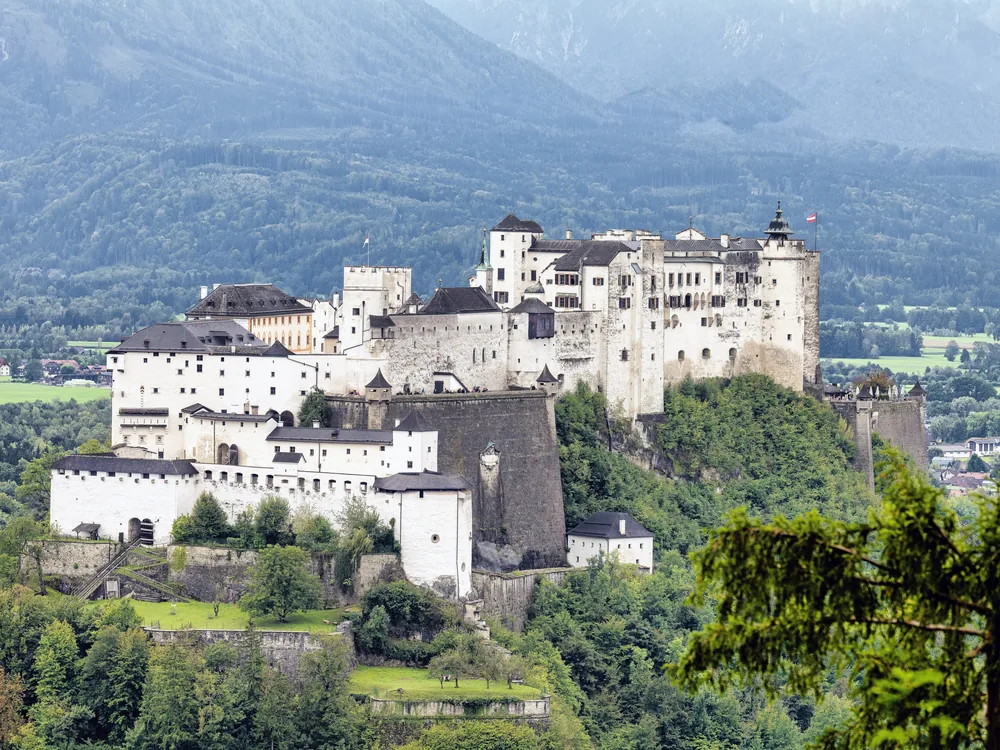
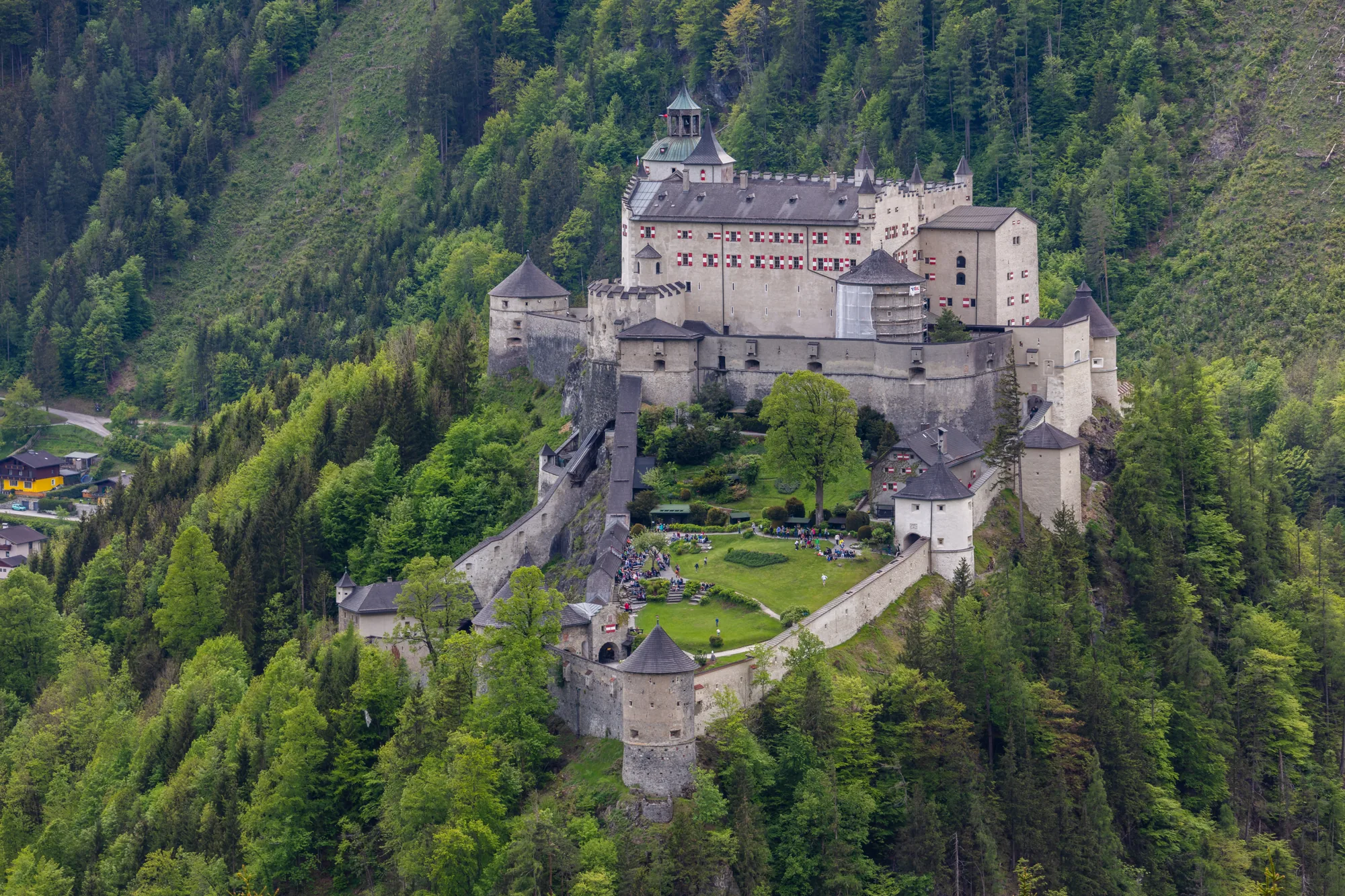
[Hohensalzburg Fortress](/castles/austria/hohensalzburg-fortress) — the medieval archbishop's fortress above Salzburg's old city, one of the largest and best-preserved castle complexes in Central Europe — is approximately 45km north along the Salzach valley. [Hohenwerfen Castle](/castles/austria/hohenwerfen-castle) — the 11th-century cliff-top fortress high above the Salzach river south of Salzburg, featured in films and as a falconry centre — is approximately 35km south. Both represent the full traditional castle-museum model with extensive interior circuits and commanding Alpine views; Fort Kniepass offers a different register, more active and less conventional, best understood as a complement to rather than a substitute for the more famous Salzburg-region fortifications.
History
14th century: Fort Kniepass constructed in the Saalachtal to control the Kniepass bend in the valley — a strategic transit point on the route between the Prince-Archbishopric of Salzburg and the Duchy of Bavaria. Medieval and early modern period: the fort functions variously as a border control post, customs station, and garrison depending on the current state of the Salzburg-Bavaria frontier, which shifts across several centuries. 17th–19th century: Habsburg rule of Salzburg (from 1816 after the Napoleonic reorganisation); the frontier with Bavaria stabilises in approximately its current form. 19th–early 20th century: fort declines from active military function as the political context shifts. Late 20th–early 21st century: fort conserved and developed as a heritage and adventure site; KniePASS Adventure Trail with 12 waypoint stations and Viper Slide added; restaurant and fermentation centre established. Present day: open to visitors; GYG ticket covers the Adventure Trail, one Viper Slide ride, and access to the fort complex.
How to Visit
Getting there: Unken is approximately 45 km southeast of Salzburg by car via the A10 motorway and the B21 federal road through the Saalachtal, about 45–55 minutes. Parking is available at the fort. Public transport to Unken is limited; driving is the practical option from Salzburg.
Tickets: Walk-up entry is €13 adults, €7 children. The GYG admission ticket (t1190629, from €12, no reviews yet) covers the KniePASS Adventure Trail (12 stations through the historic fortifications), one ride on the Viper Slide (150 m, 56 m drop — claimed as the longest dry tube slide in the Alps), and access to the full fort complex.
Practical tips: The Viper Slide closes in wet or icy conditions — confirm availability via fort-kniepass.at before visiting in unsettled weather. The site works best as part of a Saalachtal day rather than a standalone trip from Salzburg; pair with the Maria Kirchenthal pilgrimage site at Lofer or build it into a drive between Salzburg and Hohenwerfen.
Combine with: [Hohenwerfen Castle](/castles/austria/hohenwerfen-castle) — the 11th-century cliff-top fortress above the Salzach valley approximately 35 km south, and the natural companion for a Salzburg-region fortifications day.
Frequently Asked Questions
The standard GYG ticket (t1190629) includes the KniePASS Adventure Trail through the historic fortifications (12 waypoint stations), one ride on the Viper Slide (150m long, 56m descent), and full access to the fort complex. The on-site restaurant and fermentation centre are not included in the ticket price but are available separately on-site. Note that the Viper Slide closes in wet or icy conditions; if visiting in unsettled weather, confirm slide availability via the fort's website before booking.
Location
Kniepaß 1, 5091 Unken, Austria
Nearby Castles
Tours & Tickets
Powered by GetYourGuide
From
€12/ person