
Citadel of Dinant
Citadelle de Dinant
Belgium · Namur Province, Wallonia · Near Dinant
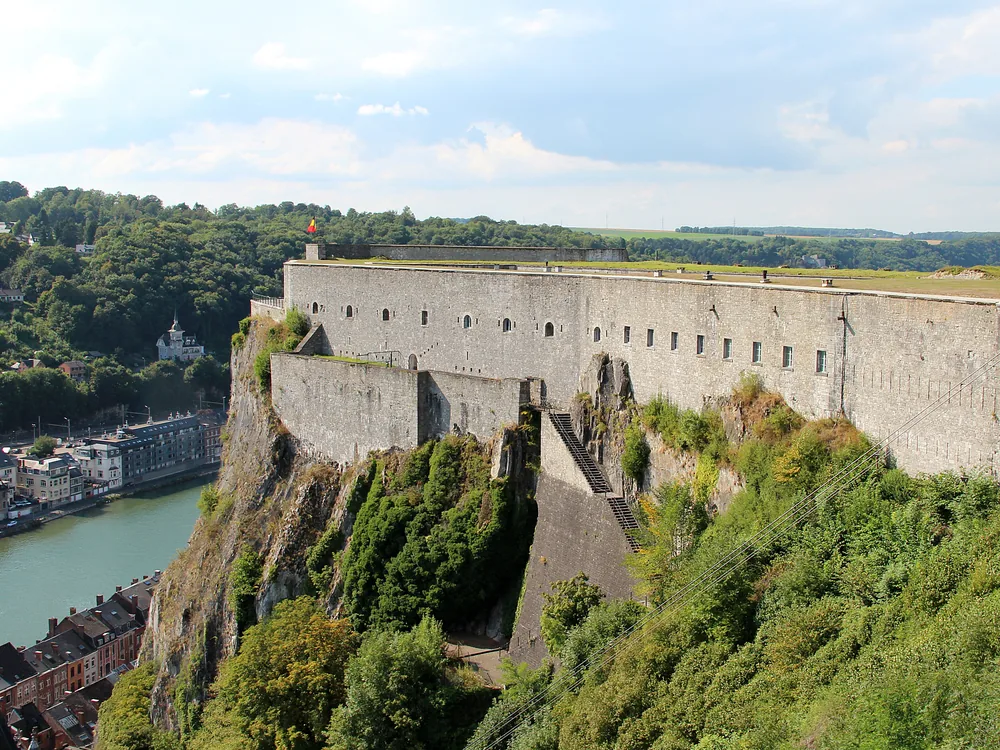
Built 1051 · Meuse river cliff fortress on a sheer 100-metre limestone wall directly above Dinant town; first fortified in 1051 under the Prince-Bishopric of Liège; destroyed by Charles the Bold, Duke of Burgundy, in 1466 following his brutal sacking of the town; rebuilt; refortified by Vauban himself in the 1690s under French administration as part of his celebrated network of border fortifications; the current fort dates primarily to 1821 (Dutch-era reconstruction parallel to Huy); accessible by cable car (téléphérique) from the town square beside the collegiate church of Notre-Dame; the combination of vertical cliff, cable car, collegiate church, and river at the base creates one of the most compositionally striking urban landscapes in Belgium; site of the August 1914 Dinant Massacre, when German forces shot 674 Belgian civilians in reprisal for alleged franc-tireur activity — a foundational atrocity of the First World War and the birthplace of Charles de Gaulle, who was wounded here in 1914; also the birthplace of Adolphe Sax, inventor of the saxophone (1814)
This page is part of an independent travel guide and is not affiliated with, endorsed by, or operated by Citadel of Dinant.
© Castles & Palaces
Quick Facts
- Hours
- Daily 10:00–18:00
- Day trip from
- €950
- Duration
- 1.5–2 hours
- Best time
- Year-round
- Nearest city
- Dinant
Featured Tour
From Brussels: Wallonia Fortress Cities — Namur, Bouillon, Huy & Dinant
Cancellation available · Instant confirmation
Highlights
- ✦The Citadel of Dinant rises directly from a 100-metre vertical limestone cliff above the town, the collegiate church of Notre-Dame pressed against the cliff base, the cable car ascending beside the church tower to the fortress above — a composition of vertical rock, Gothic architecture, and cable-car engineering that is unique in Belgium and one of the most visually arresting urban landscapes in northern Europe
- ✦In August 1914, during the first German advance into Belgium, troops of the German Third Army shot 674 civilians in Dinant in reprisal for alleged franc-tireur (civilian sniper) activity — one of the largest mass-killing atrocities of the First World War's opening weeks; Charles de Gaulle, a 23-year-old lieutenant, was wounded at Dinant during the same fighting and remained associated with the town throughout his life; the Dinant Massacre was a foundational event in establishing the narrative of German brutality in Belgium that shaped Allied propaganda for the duration of the war
- ✦Vauban — Sébastien Le Prestre de Vauban, Louis XIV's military engineer who designed or refortified over 150 fortresses from Dunkirk to Strasbourg — personally inspected and worked on the Dinant fortifications in the 1690s when France controlled the town under the terms of the Peace of Nijmegen; the fortress is one of the few Meuse sites with a direct Vauban connection, giving it a place in the network of fortification works that transformed European military architecture in the late 17th century
- ✦Dinant is the birthplace of Adolphe Sax, who invented the saxophone here in 1814 — a fact commemorated by painted saxophone installations along the town's Meuse embankment and the Maison de M. Sax museum; the combination of fortress history, WWI atrocity, and musical invention gives Dinant an unusually dense cultural identity for a small river town
- ✦The May 1940 fighting at Dinant — where Rommel's 7th Panzer Division crossed the Meuse under fire in a key operation of the Battle of France — added another military-historical layer to a town that had already experienced the 1914 massacre, Vauban's fortifications, and Charles the Bold's 1466 sack; the citadel's museum addresses all periods of the fortress's military history, making the visit one of the more historically comprehensive in Wallonia
Tickets & tours
Book through GetYourGuide
Dinant is one of the most visually arresting towns in Belgium: a narrow strip of buildings pressed between the Meuse river and a 100-metre vertical limestone cliff, with the spire of the collegiate church of Notre-Dame rising against the rock face and the cable car ascending beside it to the fortress at the top. The citadel's position is absolute — not a bluff with a slope but a sheer cliff, and the fortress that crowns it is therefore both visually dominant and practically disconnected from the town, reached only by the cable car, the 408-step staircase, or (historically) by being a besieging or defending military force.
The site has been fortified since 1051, when the Prince-Bishopric of Liège established a military installation on the cliff top above the town it controlled. Dinant was an important Meuse crossing point and a centre of brass-working (the French word 'dinanderie' — decorative metalwork — derives from the town's name), and the cliff fort was both a symbol of the Bishop's authority and a practical defensive installation controlling the river approach. Medieval control of Dinant was contested between the Prince-Bishops of Liège and various secular claimants, as with most of the Meuse valley's strategic points.
The most dramatic medieval episode was the 1466 siege by Charles the Bold, Duke of Burgundy. Charles laid siege to Dinant after the town supported his enemies in a political dispute, captured it, and subjected it to a punishment that contemporary sources describe in unusually detailed and appalling terms: the entire population was expelled or killed, the buildings were burned, and the town was deliberately destroyed as an example to others considering resistance. The collegiate church survived, the fortress survived, the town was eventually rebuilt, but the 1466 sack is the foundational historical trauma of Dinant's identity — the precedent against which later atrocities at the same location are measured.
France controlled Dinant under the terms of the Peace of Nijmegen (1678), and during this period Sébastien Le Prestre de Vauban — Louis XIV's military engineer, creator of the most influential body of fortification theory in European history — inspected and worked on the Dinant defences. Vauban's fortification principles were based on the geometry of overlapping fields of fire, the elimination of blind spots, and the management of sieges through careful defensive layering; his involvement at Dinant places the fortress in the network of approximately 150 sites where he left his mark across French territory from Dunkirk to Briançon.
The Congress of Vienna (1815) placed Dinant in the new United Kingdom of the Netherlands, and the Dutch government rebuilt the fortifications between 1818 and 1821 to create the star-plan fort that stands today — parallel to the Huy Citadel rebuilt on the same Dutch programme. Belgium separated from the Netherlands in 1830, and Dinant became Belgian.
August 1914 brought the first of Dinant's two 20th-century military catastrophes. German forces advancing through Belgium encountered resistance at Dinant — from Belgian regular army troops and, allegedly, from franc-tireur civilian snipers, a category the German military had been systematically prepared to punish brutally. On 23 August 1914, troops of the German Third Army shot 674 Belgian civilians in Dinant, the largest single atrocity of the German advance through Belgium. The victims included women, children, and elderly residents; the youngest was two weeks old. Among the French soldiers present during the same fighting was a 23-year-old infantry lieutenant named Charles de Gaulle, who was wounded in the battle and who would later identify his first encounter with war — at Dinant in August 1914 — as formative to his understanding of military and political leadership.
In May 1940, Dinant was a key crossing point during the Battle of France: Erwin Rommel's 7th Panzer Division crossed the Meuse at Dinant under fire as part of the Sichelschnitt breakthrough that would lead to Dunkirk and the fall of France in six weeks. The citadel museum addresses both 20th-century military episodes alongside the medieval and Vauban history.
The GetYourGuide Wallonia day tour from Brussels combines Dinant with [Huy Citadel](/castles/belgium/huy-castle), [Namur Citadel](/castles/belgium/namur-citadel), and [Château de Bouillon](/castles/belgium/chateau-de-bouillon) — the full circuit of Wallonia's principal Meuse fortifications in a single day.
History
The citadel above Dinant has been a military position since 1051, when the Prince-Bishopric of Liège established the first fortification on the sheer limestone cliff commanding the Meuse crossing. For four centuries the rock and its fortress were disputed between ecclesiastical and secular powers competing for control of the river approach.
The decisive medieval catastrophe came in 1466, when Charles the Bold of Burgundy sacked and largely destroyed both the town and its defences, a brutal punishment for a town that had supported his enemies. Dinant was rebuilt, and in the 1690s the great military engineer Sébastien Vauban worked on the fortifications after the Peace of Nijmegen transferred the town to French sovereignty in 1678. The current star-plan fortress was built by the Dutch between 1818 and 1821, after the Congress of Vienna assigned Dinant to the United Kingdom of the Netherlands. Belgian independence in 1830 transferred it to the new kingdom.
The citadel's worst chapter came on 23 August 1914, when German forces advancing through Belgium shot 674 civilians in the Dinant Massacre — one of the largest atrocities against civilians in Western Europe at the war's opening weeks. Charles de Gaulle, then a young lieutenant, was wounded in the fighting here. In May 1940, Rommel's 7th Panzer Division made its famous Meuse crossing at Dinant during the Battle of France breakthrough.
How to Visit
Getting there: Dinant is 30 km south of Namur on the N92 Meuse valley road. By train: Dinant station on the Namur–Dinant line (approximately 50 minutes from Namur); the cable car station is a 5-minute walk from the station. By car: 90 km from Brussels (1.5 hours via E411 motorway).
Tickets: Adult €8, child €5, including the cable car ride. Open daily year-round — tickets at the cable car station or online at citadellededinant.be. The GetYourGuide "From Brussels: Wallonia Fortress Cities — Namur, Bouillon, Huy & Dinant" day trip covers Dinant alongside three other Wallonia fortresses in a single private day from Brussels.
Practical tips: If you are physically fit, descend by the 408-step staircase rather than the cable car — it follows the cliff face and gives views that the cable car misses. Allow 1.5–2 hours to cover the star-plan fort, the views over the Meuse, and the museum addressing the 1466 sack by Charles the Bold, Vauban's fortifications, and the 1914 civilian massacre.
Combine with: Huy Castle is 30 km north along the Meuse and makes a natural pairing. Namur Citadel is another 20 km north for a full Meuse fortress day.
Frequently Asked Questions
On 23 August 1914, during the German advance through Belgium in the opening weeks of World War I, troops of the German Third Army shot 674 Belgian civilians in Dinant — men, women, children, and elderly residents — as a reprisal for alleged franc-tireur (civilian sniper) activity. The youngest victim was two weeks old. It remains one of the largest single atrocity events of the First World War's opening German advance through Belgium. Charles de Gaulle, then a 23-year-old French lieutenant, was wounded in the military fighting at Dinant during the same events.
Location
Rue Félicien Rops 37, 5500 Dinant, Belgium
Nearby Castles
Tours & Tickets
Powered by GetYourGuide
From
€950/ person