
Citadel of Huy
La Citadelle de Huy
Belgium · Liège Province, Wallonia · Near Huy
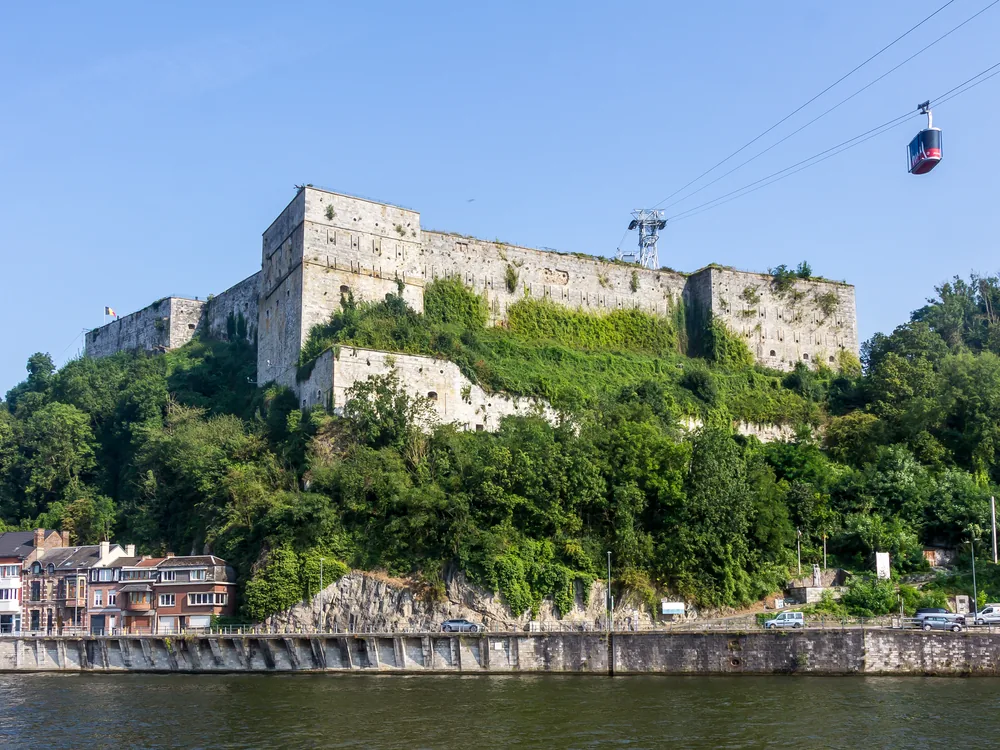
Built 1818 · Dutch-era hilltop fortress built 1818–1823 on a limestone bluff above the Meuse river at Huy; the site has been fortified since the 9th century — the original medieval castle was held alternately by the Prince-Bishops of Liège and the Counts of Namur through the Middle Ages, serving as one of the four strategic Meuse citadels (with Namur, Liège, and Dinant) that controlled the river route through the Ardennes; the medieval castle was dismantled by order of the Spanish Netherlands government in 1715 following the Treaty of Utrecht; the current star-plan fortress was built during Dutch rule of the Southern Netherlands (1815–1830) to designs broadly following Vauban's fortification principles, occupying the same commanding bluff position; the fortress subsequently served as a state prison through the 19th century; in WWII, the Germans used it as a detention and transit camp where over 7,000 Belgian and foreign prisoners were held between 1940 and 1944 — now a WWII memorial museum (Musée de la Résistance et des Camps); the cable car from Huy town centre provides the easiest ascent
This page is part of an independent travel guide and is not affiliated with, endorsed by, or operated by Citadel of Huy.
© Castles & Palaces
Quick Facts
- Hours
- Tue–Fri 09:00–17:00. Sat & Sun 10:00–18:00. Closed Mon
- Day trip from
- €950
- Duration
- 1.5–2 hours
- Best time
- April to October
- Nearest city
- Huy
Featured Tour
From Brussels: Wallonia Fortress Cities — Namur, Bouillon, Huy & Dinant
Cancellation available · Instant confirmation
Highlights
- ✦The Citadel of Huy carries a layered WWII history that distinguishes it from the region's other Meuse fortresses: between 1940 and 1944, the German occupation used the fortress as a detention camp where over 7,000 Belgian civilians and foreign nationals were held before transfer to concentration camps in the east; the fortress's position above the town — visible from every point in Huy — meant that residents could see the building where their neighbours were imprisoned while the occupation continued below
- ✦The four Meuse Citadels — Huy, [Namur](/castles/belgium/namur-citadel), Liège, and [Dinant](/castles/belgium/citadel-of-dinant) — form the most concentrated cluster of river-control fortifications in Belgium, all commanding the Meuse between the Ardennes and the North Sea plain; together they represent the military strategic logic of the Meuse valley from the medieval Prince-Bishopric of Liège through the Dutch fortification era to 20th-century military history
- ✦The original medieval castle at Huy was one of the most contested in the Meuse region — held alternately by the Prince-Bishops of Liège, the Counts of Namur, and various noble claimants through the medieval period in a pattern of contested sovereignty that reflects the Meuse valley's position at the intersection of the Bishop of Liège's ecclesiastical territory and the secular County of Namur; the current fort's 1818–1823 construction replaced a medieval predecessor dismantled in 1715 under Spanish Netherlands order
- ✦The cable car (téléphérique) from Huy town centre is one of the few urban cable-car installations in Belgium and provides the most practical and most scenic ascent to the citadel; the view from the fortress terrace over the Meuse valley, the town's historic collegiate church, and the river bends toward Namur and Liège makes the approach by cable car a recommended part of the visit rather than merely a convenience
- ✦The Musée de la Résistance et des Camps within the fortress is a dedicated WWII memorial museum covering the Belgian resistance movement, the Nazi occupation, and the use of Huy Citadel as a detention camp; it is one of the more important WWII memory sites in Wallonia and the primary focus for most visitors to the citadel today
Tickets & tours
Book through GetYourGuide
The Citadel of Huy stands on a limestone bluff above the Meuse at Huy, a town of modest size on the river between Liège to the east and Namur to the west. The bluff's position — a high natural promontory on the river's southern bank, controlling the Meuse approach from both directions — has attracted fortification since the 9th century. The current fortress was built between 1818 and 1823 under Dutch rule, but the history of the site runs back through at least a millennium of contested ownership and military significance.
The medieval castle that preceded the current fort was one of the most disputed fortifications in the Meuse region. The Prince-Bishops of Liège — who exercised both secular and ecclesiastical authority over a substantial territory centred on the city of Liège — and the Counts of Namur both claimed the Huy position as strategically essential to their control of the Meuse corridor, and the castle changed hands through the medieval period in a pattern of negotiation, purchase, war, and re-purchase that reflects the Meuse valley's position at the contested boundary between two major medieval powers. By the 17th century, the treaty arrangements that ended the Eighty Years' War and the ongoing reconfiguration of the Southern Netherlands had progressively changed the political context, and in 1715, following the Treaty of Utrecht, the Spanish Netherlands government ordered the medieval castle demolished — a common fate for fortifications deemed politically problematic by the new Bourbon administration of the Spanish Netherlands.
The current fortress was built under the United Kingdom of the Netherlands (1815–1830), the short-lived state created by the Congress of Vienna that united present-day Belgium and the Netherlands under the Dutch crown. The Dutch government commissioned fortification engineers to rebuild the Huy bluff as part of a broader programme of Meuse valley defence, using the star-plan principles associated with Vauban that remained the dominant fortification doctrine of the early 19th century. The fortress was completed in 1823 and used as a state prison through the 19th century — the Belgian equivalent of the Tower of London, where political prisoners, common criminals, and eventually social reformers were held in the cells below the military fortifications.
Belgium separated from the Netherlands in 1830 and the fortress remained in Belgian military and prison use through the 19th and early 20th centuries. The Second World War brought its most significant and most disturbing chapter. German forces occupied Belgium in May 1940 and quickly identified the Huy Citadel as a useful detention facility: its secure cells, its position above the town, and its existing prison infrastructure made it an efficient place to hold prisoners. Between 1940 and 1944, over 7,000 Belgian civilians and foreign nationals were detained at Huy Citadel before transfer to concentration camps in the east, primarily Buchenwald, Neuengamme, and Ravensbrück. The fortress's visibility from every point in Huy town — residents could not avoid seeing the building where their neighbours were imprisoned — gave the occupation a particularly visible and deliberate quality.
The Musée de la Résistance et des Camps, established within the fortress after the Liberation, is the primary focus of the modern visitor experience. The museum covers Belgian resistance to the German occupation, the use of the Huy Citadel as a detention and transit camp, and the experiences of prisoners who passed through it. It is one of the more important WWII memory sites in Wallonia and the reason most visitors come to Huy Citadel today rather than the medieval or 19th-century fortification history.
The ascent to the fortress is most practically made by the cable car (téléphérique) from Huy town centre, which operates daily in season and provides a view over the Meuse, the collegiate church of Notre-Dame de Huy, and the river valley that is worth the ride independently of the museum visit. The walking path from the town also exists for those who prefer the approach on foot.
The GetYourGuide Wallonia day tour from Brussels combines Huy with [Dinant](/castles/belgium/citadel-of-dinant), [Namur Citadel](/castles/belgium/namur-citadel), and [Château de Bouillon](/castles/belgium/chateau-de-bouillon) in a full day — covering the four principal Meuse fortress cities of Wallonia in a circuit that shows the river valley's military significance across different centuries and different wars.
History
The limestone bluff above the Meuse at Huy has been fortified since at least the 9th century, when it offered one of the most naturally defensible positions on the river between Liège and Namur. Through the medieval period the castle above it was a persistent point of contention between the Prince-Bishops of Liège and the Counts of Namur, changing hands repeatedly as the two powers competed for control of the Meuse corridor. The medieval fortress that stood here until 1715 was demolished by order of the Spanish Netherlands government following the Treaty of Utrecht — a common fate for old fortifications that had become more politically inconvenient than strategically useful.
The current fortress on the bluff is a different kind of structure entirely. Between 1818 and 1823, under the United Kingdom of the Netherlands, a new star-plan fortress was built in the modern military engineering tradition, completing a design conceived for an era of artillery warfare rather than medieval siege. Belgian independence in 1830 transferred ownership to the new Belgian state, which converted it to a prison — a function it served through the 19th and early 20th centuries.
The most sombre chapter in the fortress's history came during the German occupation of 1940 to 1944, when it was used as a detention and transit camp through which more than 7,000 prisoners passed — including political prisoners, members of the Belgian Resistance, and Jews awaiting deportation. The Musée de la Résistance et des Camps, established after liberation, now occupies the fortress and makes this period of incarceration the centre of its historical account.
How to Visit
Getting there: Huy is on the Liège–Namur railway line (approximately 25 minutes from Liège, 30 minutes from Namur). Huy station is a 10-minute walk from the cable car (téléphérique) that ascends to the citadel. By car: 40 km from Liège, 30 km from Namur on the E42 motorway.
Tickets: Adult €7, child €4, including the WWII museum. Open April to October, Tuesday to Sunday — verify current schedule at citadellehuy.be. The GetYourGuide "From Brussels: Wallonia Fortress Cities — Namur, Bouillon, Huy & Dinant" day trip covers Huy alongside Dinant, Namur, and Bouillon in a full private day from Brussels.
Practical tips: Take the cable car up rather than the walking path — the view over the Meuse valley and the collegiate church of Notre-Dame de Huy is spectacular on the ascent. The WWII memorial museum inside the fortress is the primary draw; allow 1.5 hours to do it justice, as the story of 7,000 prisoners detained here between 1940 and 1944 is told in considerable depth.
Combine with: Citadel of Dinant is 30 km southwest along the Meuse and makes a natural pairing. Namur Citadel is 30 km west for a full Meuse fortress day.
Frequently Asked Questions
Between 1940 and 1944, the German occupation used the Huy Citadel as a detention and transit camp where over 7,000 Belgian civilians and foreign nationals were held before transfer to concentration camps in Germany (primarily Buchenwald, Neuengamme, and Ravensbrück). The fortress's position above Huy town — visible from every street — meant that residents could see the building where their neighbours were imprisoned throughout the occupation. The Musée de la Résistance et des Camps within the fortress documents this history and the Belgian resistance movement.
Location
Citadelle de Huy, Chemin de la Citadelle, 4500 Huy, Belgium
Nearby Castles
Tours & Tickets
Powered by GetYourGuide
From
€950/ person