Jajce Fortress
Jajačka tvrđava
Bosnia · Central Bosnia Canton — Jajce, at the confluence of the Pliva and Vrbas rivers · Near Jajce
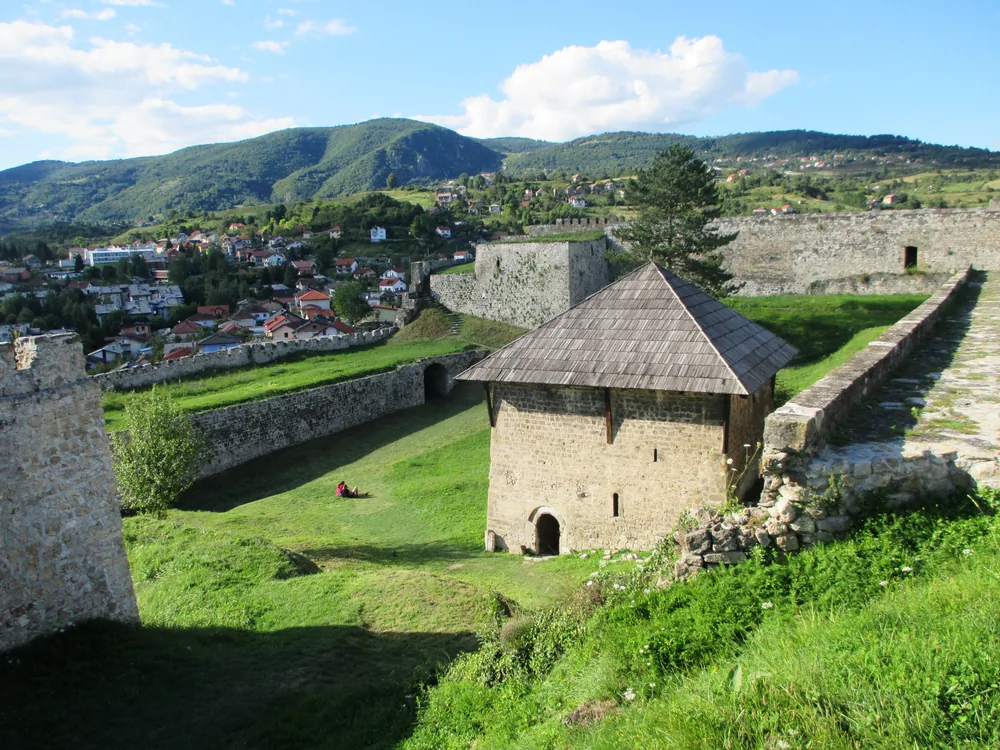
Built 1380 · Medieval Bosnian fortress complex, 14th–15th century — the fortress at Jajce was developed as the fortified capital of the medieval Kingdom of Bosnia in the late 14th century, occupying a commanding hilltop position at the confluence of the Pliva and Vrbas rivers; the complex includes the main fortress enclosure on the hilltop, the Medvjed Tower (Bear Tower) — the fortress's most prominent surviving element — the Šah-bet Tower, St. Luke's Tower, and sections of the original defensive curtain wall; beneath the fortress, the catacombs (a unique rock-hewn burial chamber) served as the royal necropolis of the last Bosnian kings; the town's topography — a limestone karst hilltop with the Pliva Waterfall at its foot — made Jajce naturally defensible from multiple directions
This page is part of an independent travel guide and is not affiliated with, endorsed by, or operated by Jajce Fortress.
© Castles & Palaces
Quick Facts
- Hours
- Daily 09:00–19:00
- Guided tour from
- €160
- Duration
- 2–3 hours (fortress complex and towers, catacombs, and the Pliva Waterfall in the town centre); allow more time for the full town circuit including St. Luke's Tower and the mosque
- Best time
- May to October
- Nearest city
- Jajce
Featured Tour
Jajce: Guided Tour with Fortress, Catacombs, and Waterfall
Cancellation available · Instant confirmation
Highlights
- ✦The last coronation of the Kingdom of Bosnia — Stjepan Tomašević, 1461 — in 1461, Stjepan Tomašević was crowned as the last king of the medieval Kingdom of Bosnia at Jajce, the kingdom's capital; only two years later, in 1463, Ottoman forces under Sultan Mehmed II swept through Bosnia; Tomašević was captured and executed; the Kingdom of Bosnia ceased to exist; Jajce's fortress holds the memory of the last act of a medieval state that had existed for centuries and ended in a matter of weeks
- ✦The catacombs — rock-hewn royal burial chambers beneath the fortress — beneath the fortress hill at Jajce, a system of carved underground chambers served as the necropolis of the last Bosnian kings; the catacombs are a rare surviving example of medieval Bosnian royal burial architecture — carved from the karst limestone, decorated with carved motifs, and associated with the Bogomil/Bosnian Church tradition that gave medieval Bosnia a distinctive religious identity; the catacomb visit, accessed via guided tour, is one of Jajce's most distinctive heritage experiences
- ✦The Pliva Waterfall — a 22-metre waterfall inside a European town — at the foot of the fortress hill, the Pliva River drops 22 metres into the Vrbas in a dramatic waterfall that sits in the middle of the town; urban waterfalls of this scale are extraordinarily rare in Europe, and the Pliva Waterfall is one of the geological features that makes Jajce's landscape visually unusual regardless of the historical and military content of the fortress above it
- ✦AVNOJ 1943 — Jajce and the founding of socialist Yugoslavia — on November 29–30, 1943, Jajce hosted the Second Session of AVNOJ (the Anti-Fascist Council of the National Liberation of Yugoslavia), the meeting at which Tito's Partisan movement established the political framework that would become the Socialist Federal Republic of Yugoslavia; the date — November 29 — became Yugoslav National Day; Jajce thus holds two decisive political moments separated by 482 years: the fall of the medieval Bosnian kingdom (1463) and the founding of socialist Yugoslavia (1943)
- ✦Medvjed Tower, Šah-bet Tower, St. Luke's Tower — the fortress's defensive system — the Jajce fortress complex includes multiple surviving towers of different periods; the Medvjed Tower (Bear Tower) is the most prominent, rising above the fortress enclosure; the Šah-bet Tower is associated with the Ottoman period of Jajce's history; St. Luke's Tower is a medieval defensive element named for the Franciscan connections of the last Bosnian kingdom; together they give the fortress a layered defensive character across Bosnian, Ottoman, and later periods
Skip the queue with a guided tour
Skip-the-line tickets & expert guides
The confluence of the Pliva and Vrbas rivers at Jajce is one of the more unusual topographies in the Balkans. The Pliva drops off a limestone shelf into the Vrbas in a 22-metre waterfall — a geological accident of karst landscape that placed a dramatic urban waterfall in the middle of what became the capital of a medieval kingdom. The fortress rises above the waterfall on a hilltop that commands both rivers. The combination of defensible height, water supply from two rivers, and the natural barrier of the confluence made Jajce an obvious site for a fortified capital, and the medieval Kingdom of Bosnia developed it accordingly from the late 14th century.
The Kingdom of Bosnia was a distinctive medieval state. Its religious life — organised around the Bosnian Church, an independent Christian institution of disputed theological character that is associated in some scholarship with the Bogomil movement and in others with an independent local Orthodox-Catholic synthesis — gave it an identity separate from both Catholic Croatia-Hungary and Orthodox Serbia. The stećci (medieval tombstones) found across Bosnia, the catacombs beneath Jajce, and the fortress-town topography of Jajce itself are the primary physical remains of this kingdom in the landscape.
In 1461, Stjepan Tomašević was crowned King of Bosnia at Jajce. He was 29 years old and the last of his line. Two years later, in 1463, Sultan Mehmed II — the same Ottoman ruler who had conquered Constantinople a decade earlier — turned his attention to Bosnia. The campaign was swift and overwhelming. Tomašević was captured at Ključ and executed; the Kingdom of Bosnia ceased to exist after approximately 150 years of independent statehood; the Ottoman flag flew over Jajce.
The catacombs beneath the fortress were the necropolis of the last Bosnian kings — a system of rock-hewn underground chambers carved from the karst limestone of the Jajce hilltop, decorated with carved motifs and serving as royal burial chambers. They are a unique surviving element of medieval Bosnian court architecture, accessible via guided tour through passages and chambers that give direct physical encounter with the underground world of the Bosnian royal court in its final decades.
The fortress towers that survive above ground — Medvjed Tower (the 'Bear Tower', the most prominent), Šah-bet Tower (Ottoman-period), and St. Luke's Tower — represent different episodes of Jajce's defensive history across the medieval and early Ottoman periods. The curtain wall sections, the main fortress enclosure, and the urban layout of the lower town together make Jajce the most complete medieval fortress town in Bosnia.
Five centuries after the fall of the medieval kingdom, Jajce witnessed another decisive political act. In November 1943, Josip Broz Tito's Partisan movement gathered in Jajce for the Second Session of AVNOJ — the Anti-Fascist Council of the National Liberation of Yugoslavia — where the political framework of the future Socialist Federal Republic of Yugoslavia was established. The session was held at a moment when the Second World War was still being fought on Bosnian soil, and the Partisans were choosing the political character of the post-war state under active wartime conditions. November 29 became Yugoslav National Day as a result. Jajce thus holds two of the most politically decisive events in Bosnian history, separated by 480 years.
The GYG day tour from Sarajevo (t1279524) covers the fortress complex, catacombs, towers, Pliva Waterfall, and the Jamia Esme Sultana Mosque in an eight-hour programme with round-trip transportation from Sarajevo. The small group format (maximum eight people) and the length of the journey from Sarajevo (approximately 2 hours each way) make the guided tour the most practical way to visit for visitors based in the Bosnian capital.
Visitors with a car and more time in Bosnia can extend the regional picture with [Vranduk Fortress](/castles/bosnia/vranduk-fortress) and [Tešanj Castle](/castles/bosnia/tesanj-castle) — medieval Bosnian fortifications in the Vrbas and Bosna river valleys — and [Srebrenik Fortress](/castles/bosnia/srebrenik-fortress) in northeastern Bosnia.
History
Jajce's role as the capital of the medieval Kingdom of Bosnia gave the fortress above the Pliva-Vrbas confluence a significance that extended well beyond its military function. Through the late 14th and 15th centuries, the hilltop complex served as the kingdom's administrative and ceremonial centre — the place where Bosnian royal authority was expressed in stone. The catacombs beneath the town, used as a royal necropolis, and the multiple towers and curtain walls of the fortress itself represent the concentrated investment of a dynasty determined to legitimise itself through architecture.
The kingdom's end came with brutal speed. In 1461, Stjepan Tomašević was crowned as the last King of Bosnia at Jajce — an act of political affirmation that lasted barely two years. Ottoman forces under Mehmed II conquered Bosnia in 1463; Tomašević was captured and executed, and Jajce passed to Ottoman administration. The fortress was subsequently adapted for Ottoman military use, with new towers and modifications reflecting changed tactical requirements, and the town was integrated into the Ottoman provincial system for the next four centuries.
The Austro-Hungarian occupation following the Congress of Berlin in 1878 brought a different kind of transition, as did the period of Yugoslav rule that followed the First World War. The most historically resonant moment of the modern period came in November 1943, when the Second Session of AVNOJ — the governing body of the Partisan resistance — met in Jajce and laid the framework for socialist Yugoslavia, making the medieval Bosnian capital briefly the birthplace of a new state. November 29 became Yugoslav National Day as a result. The Bosnian War of 1991–1995 affected the town without destroying the fortress; both the citadel and the catacombs are open to visitors today.
How to Visit
Getting there: Jajce is approximately 160 km northwest of Sarajevo by road (via M5 and M16, about 2.5–3 hours by car or bus from Sarajevo's Federal bus terminal). By car from Banja Luka: about 60 km south through the dramatic Vrbas gorge.
Tickets: Adult approximately €5 (around 10 BAM), child €3. Catacombs access may require a separate guided ticket — confirm at the Jajce tourist office on arrival. The GYG "Jajce: Guided Tour with Fortress, Catacombs, and Waterfall" (t1279524, from €160) is a round-trip guided tour from Sarajevo in a small group of maximum eight, covering the fortress, catacombs, towers, Jamia Esme Sultana Mosque, and the Pliva Waterfall — a new listing with no reviews yet.
Practical tips: Allow 2–3 hours for the full fortress and waterfall circuit. The Pliva Waterfall is at the foot of the fortress hill and walkable from the entrance — do both in the same visit. The fortress involves steep paths and uneven surfaces throughout; not suitable for wheelchair users.
Combine with: [Vranduk Fortress](/castles/bosnia/vranduk-fortress) is in the Bosna valley en route from Sarajevo and makes a natural stop. [Tešanj Castle](/castles/bosnia/tesanj-castle) is also in central Bosnia for those completing a Bosnian medieval fortifications circuit.
Frequently Asked Questions
Stjepan Tomašević, the last King of Bosnia, was crowned at Jajce in 1461. Two years later, in 1463, the Ottoman Sultan Mehmed II — the conqueror of Constantinople (1453) — launched a rapid campaign into Bosnia. The Ottoman advance was so swift that the Bosnian defensive system, including the fortress at Jajce, could not be coordinated in time. Tomašević fled from castle to castle and was eventually captured at the fortress of Ključ. He was executed by Ottoman forces — possibly by beheading — and with him the Kingdom of Bosnia effectively ended. The entire conquest took only a matter of weeks. Jajce itself fell to the Ottomans shortly after Tomašević's capture.
Location
Jajačka tvrđava, Jajce, Bosnia and Herzegovina
Nearby Castles
Tours & Tickets
Powered by GetYourGuide
From
€160/ person