
Tešanj Castle
Tešanjska tvrđava
Bosnia · Zenica-Doboj Canton, Tešanj · Near Tešanj
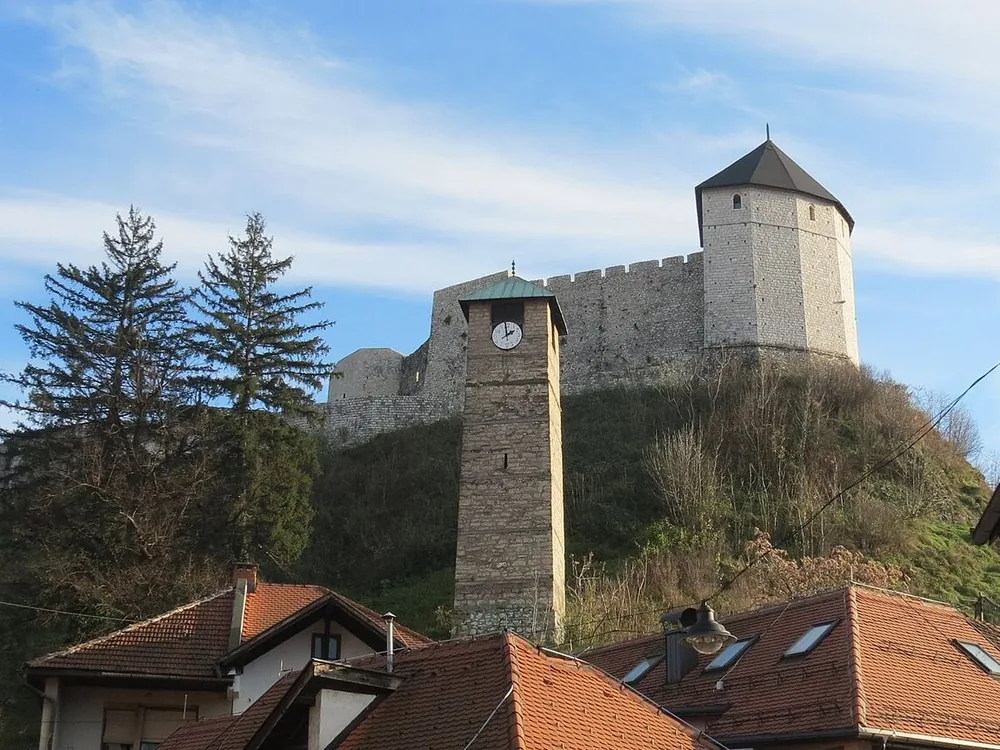
Built 1512 · Layered medieval-to-Ottoman fortress complex — the site's earliest fortification layers include Bronze Age and possible Roman-era earthworks, with 6th-century Byzantine-period defenses documented in the archaeological record; the major standing structure dates from the Ottoman period beginning in 1512 under the Bosnian Sandžak-bey Gazi Ferhad Pasha, who added round towers, reinforced curtain walls, and an inner bastion system specifically designed to withstand artillery assault; the surviving footprint covers approximately 5,600 m² including the upper citadel and lower defensive works; the Ferhadija Mosque (1563), still standing below the castle walls in the old bazaar, is architecturally related to the castle complex as a monument of the same Ottoman patronage period; the castle and čaršija (bazaar) together constitute one of the most complete surviving medieval-to-Ottoman urban stratifications in Bosnia
This page is part of an independent travel guide and is not affiliated with, endorsed by, or operated by Tešanj Castle.
© Castles & Palaces
Quick Facts
- Hours
- Daily 09:00–18:00
- Guided tour from
- €116
- Duration
- 1.5–2 hours (castle + čaršija); 12 hours (GetYourGuide full Bosnia castle circuit including Vranduk and Srebrenik)
- Best time
- April to October
- Nearest city
- Tešanj
Featured Tour
Sarajevo: Vranduk, Tešanj & Srebrenik — Bosnia's Medieval Fortresses (Full Day)
Cancellation available · Instant confirmation
Highlights
- ✦Repelled Prince Eugene of Savoy's army in 1697 — the same campaign that burned Sarajevo to the ground; Eugene's Austrian forces laid siege to Tešanj for three days and were forced to withdraw, making it the only fortress in the region to resist this assault; the episode was the Ottoman Empire's most significant military success in the campaign
- ✦One of Bosnia's three largest medieval fortress complexes — at approximately 5,600 m², the castle covers a substantial footprint combining the upper citadel with Ottoman-era defensive additions; the combination of medieval and artillery-era fortification engineering is visible in the surviving fabric
- ✦The living čaršija below the walls — the Ottoman-era old bazaar (čaršija) still operates below the castle walls, with traditional shops, the 1563 Ferhadija Mosque, and a medieval urban fabric that makes Tešanj one of Bosnia's most intact historic town centres; the castle and its town are a single monument, not an isolated ruin
- ✦The 1563 Ferhadija Mosque — built under Gazi Ferhad Pasha during the same Ottoman expansion phase that reinforced the castle; the mosque is one of the oldest surviving Ottoman buildings in central Bosnia and is still an active place of worship in the čaršija below the walls
- ✦Bronze Age to Ottoman layering — the site's fortification history spans from Bronze Age earthworks and 6th-century Byzantine-period defenses through Slavic, medieval Bosnian, and Ottoman periods; the geological position (high ground above a valley junction) was recognisable as defensible from the earliest settlement of the region
- ✦GetYourGuide 12-hour Bosnia castle circuit — the only tour covering all three central Bosnian medieval fortresses: Tešanj, [Vranduk Fortress](/castles/bosnia/vranduk-fortress), and [Srebrenik Fortress](/castles/bosnia/srebrenik-fortress), with drone video and all entrance fees included
Skip the queue with a guided tour
Skip-the-line tickets & expert guides
Tešanj Castle stands above one of the most continuously inhabited medieval town centres in Bosnia, its citadel walls visible from the čaršija below — the Ottoman-era old bazaar that still functions as the commercial and social heart of the town, with the 1563 Ferhadija Mosque in its centre and traditional market stalls along the streets that run up toward the castle gate. The relationship between the fortress above and the living town below is what makes Tešanj unusual among Bosnian medieval sites: this is not an isolated ruin on a hill outside a modern town, but a medieval citadel in continuous visual and physical dialogue with the Ottoman urban fabric that grew up beneath it.
The site's fortification history runs deeper than the standing Ottoman stonework suggests. Archaeological evidence places the earliest defensive structures here in the Bronze Age — the high ground above the Usora and Tešanjka rivers, commanding the valley junction at Tešanj, was recognizable as a defensible and strategically important position from the region's earliest settled periods. Roman-era presence is documented in the archaeological record. 6th-century Byzantine-period fortifications represent the next clearly documented layer of intentional defensive construction on the site, as the Byzantine Empire consolidated its Balkan territories and built or reinforced strategic hill-forts throughout the region.
The Ottoman period brought the most substantial transformation. After the fall of the medieval Bosnian kingdom in 1463, Tešanj passed into Ottoman administration, and beginning in 1512 — under the Bosnian Sandžak-bey Gazi Ferhad Pasha — the site received a systematic programme of military modernization. Ottoman military engineers added round towers to the curtain walls (round towers provided better deflection of cannon shot than square towers, which had right angles where impact could concentrate), reinforced the curtain walls themselves to greater thickness, and added an inner bastion system specifically designed to withstand gunpowder-era artillery. The result was a fortress that combined the existing medieval foundations with the most current military engineering thinking of the 16th century.
Ferhad Pasha's attention to Tešanj was not limited to its military function. In 1563, during the same phase of Ottoman expansion and consolidation, the Ferhadija Mosque was built in the čaršija below the castle — a permanent architectural statement of Ottoman authority and patronage, an act of urban formation that created the mosque-centred bazaar town typical of Ottoman provincial administration. The čaršija that visitors walk through today, with its mosque, its fountain, its traditional market streets, and its kafanas, is the 16th-century Ottoman urban grid established under Ferhad Pasha's patronage and maintained through subsequent centuries with remarkable continuity.
The fortress's most celebrated episode came in September 1697, under circumstances that had devastated much of northern Bosnia just days earlier. Prince Eugene of Savoy — the Habsburg military commander whose campaigns against the Ottoman Empire in the 1690s had brought Austrian forces deep into Balkan territory — led a raid into Bosnia in September 1697. The raid culminated in the burning of Sarajevo: Austrian forces entered the city on 24 September and set fire to much of it, destroying thousands of buildings and killing or displacing a significant proportion of the population. The burning of Sarajevo in 1697 was one of the most destructive single acts of the period's warfare in the Balkans.
From Sarajevo, Eugene's army moved northeast toward Tešanj. The castle's garrison and the Ottoman defenders of the town held the siege for three days before Eugene's forces withdrew — the logistics of supply in hostile territory, the approaching winter, and the effective resistance of the garrison all contributed to the decision not to press the assault further. Tešanj was the only major fortified position in the region to resist this Austrian campaign; Sarajevo had not had walls capable of mounting the same defence. The episode secured Tešanj's reputation in Bosnian historical memory as the fortress that held when others had fallen.
The castle today is one of Bosnia's better-preserved medieval fortress complexes — not fully intact, but with substantial surviving fabric in the curtain walls, towers, and interior structures, and with the Ottoman-era reinforcements visible in the construction technique alongside the earlier medieval masonry. The descent from the citadel into the čaršija — past the Ferhadija Mosque, along the market streets, through a town that has been trading and worshipping in approximately this arrangement for five centuries — gives the Tešanj visit a completeness that purely archaeological fortress sites lack.
For central Bosnia's other medieval fortifications: [Vranduk Fortress](/castles/bosnia/vranduk-fortress), approximately 30 kilometres south in the Bosna River gorge, is the gateway fortress and royal residence of King Stjepan Tomaš. [Srebrenik Fortress](/castles/bosnia/srebrenik-fortress), to the northeast in Tuzla Canton, is one of the most dramatically sited cliff-edge fortresses in the Balkans. The GetYourGuide 12-hour circuit covering all three (private group, drone video, all entrance fees included) is the most substantive medieval history day trip available from Sarajevo.
History
Tešanj's hilltop carries defensive earthworks dating to the Bronze Age — the kind of long-occupied site where each era of settlement builds on the logic of the one before it. Byzantine-period fortification was recorded in archaeological evidence from the 6th century, and the position within the medieval Bosnian kingdom's northern territories made it worth maintaining through the centuries that followed.
The Ottoman conquest of Bosnia in 1463 brought the castle under imperial administration, and the most significant phase of Ottoman investment came in 1512 under Gazi Ferhad Pasha, Bosnian Sandžak-bey, who commissioned round towers, reinforced curtain walls, and an inner bastion. Ferhad Pasha's patronage extended to the town below: the Ferhadija Mosque, built in the čaršija in 1563, gave the Ottoman urban fabric its defining monument, and the čaršija itself — the bazaar street rising toward the castle gate — took the form it largely retains today.
The fortress's most celebrated moment came in September 1697, when Prince Eugene of Savoy's Austrian forces, having burned Sarajevo on the same campaign, laid siege to Tešanj for three days. The garrison held. Austrian forces withdrew — making Tešanj the only fortress in the region to repel Eugene's otherwise devastating campaign. That resistance became the central event in Tešanj's historical self-understanding. The čaršija continued as a living commercial centre through the Austro-Hungarian and Yugoslav periods, and both castle and bazaar remain in use today.
How to Visit
Getting there: Tešanj is approximately 90 km north of Sarajevo by car (about 1 hour 20 minutes via the M17). Regional buses connect Sarajevo and Tešanj; the bus station is within walking distance of the castle and čaršija. The town is compact and easy to navigate on foot.
Tickets: Adult €2, child €1. Tickets at the castle gate — no advance booking needed. The GetYourGuide "Sarajevo: Vranduk, Tešanj & Srebrenik — Bosnia's Medieval Fortresses (Full Day)" covers Tešanj alongside Vranduk Fortress and Srebrenik Fortress in a private 12-hour circuit from Sarajevo, with all entrance fees, lunch, and drone video included.
Practical tips: Allow 1.5–2 hours total — 30–45 minutes climbing to the upper citadel and another 30–45 minutes in the čaršija below the walls. Visit the Ferhadija Mosque (1563) in the bazaar, an active place of worship; remove shoes and dress modestly. The castle climb involves steep, uneven stone paths.
Combine with: Vranduk Fortress is about 30 km south in the Bosna river gorge — a natural pairing. Srebrenik Fortress is to the northeast; all three are best covered together on the GetYourGuide Bosnia medieval circuit.
Frequently Asked Questions
The burning of Sarajevo in September 1697 was a raid, not a siege — Eugene's forces entered an undefended or lightly defended city and set fire to it. Tešanj was different: a garrisoned fortress specifically designed to withstand artillery, with Ottoman soldiers prepared to defend it. The three-day siege failed because Tešanj's 16th-century Ottoman reinforcements (round towers, thickened walls, inner bastion) had created a fortification that resisted the kind of rapid assault Eugene's mobile army could mount. Supply lines deep in Ottoman-held territory, approaching winter, and effective garrison resistance all contributed to the Austrian withdrawal.
Location
Stari grad, 74260 Tešanj, Bosnia and Herzegovina
Nearby Castles
Tours & Tickets
Powered by GetYourGuide
From
€116/ person