
Srebrenik Fortress
Srebreničko utvrđenje
Bosnia · Tuzla Canton, Srebrenik · Near Srebrenik
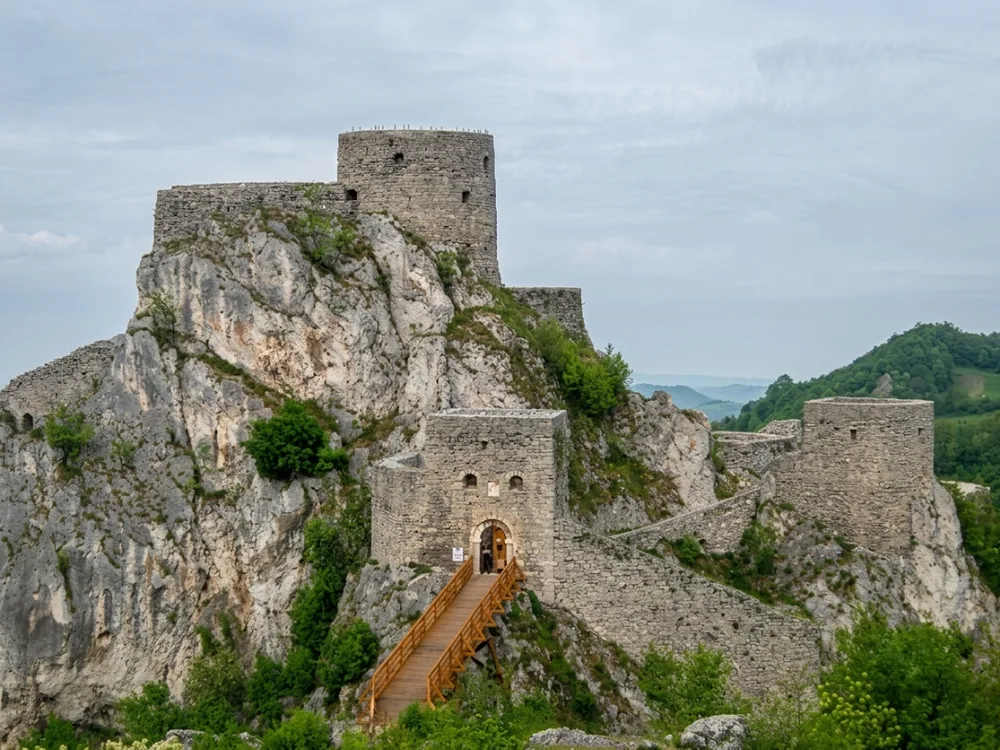
Built 1333 · Medieval clifftop citadel — the fortress occupies the summit of a near-vertical limestone rock rising up to 70 metres above the surrounding terrain; three sides of the rock face are sheer cliff with no practical approach; the only access point is the southern face, across an artificial trench cut through the rock to prevent natural approach from this side and spanned by a stone bridge; walls reach up to 2 metres in thickness; the interior includes the remains of a keep, a chapel, and residential structures; the combination of natural cliffs and artificial trench means the fortress's defensive capability derived almost entirely from its site rather than from the size of its walls or the sophistication of its engineering; archaeologically, the site shows evidence of earlier use before the medieval stone construction but the first documentary reference is 1333
This page is part of an independent travel guide and is not affiliated with, endorsed by, or operated by Srebrenik Fortress.
© Castles & Palaces
Quick Facts
- Hours
- Daily 09:00–17:00
- Guided tour from
- €116
- Duration
- 1–1.5 hours (fortress and bridge approach); 12 hours (GetYourGuide full Bosnia castle circuit including Vranduk and Tešanj)
- Best time
- April to October
- Nearest city
- Srebrenik
Featured Tour
Sarajevo: Vranduk, Tešanj & Srebrenik — Bosnia's Medieval Fortresses (Full Day)
Cancellation available · Instant confirmation
Highlights
- ✦One approach — a stone bridge over a deep trench — the only access to the fortress's summit; three sides of the rock are sheer cliffs with no practical approach; the fourth side was made equally impassable by cutting an artificial trench through the rock and bridging it with a single stone span, producing a defensive position where every attacker had to cross a bottleneck under fire from above
- ✦First documented 1333 in a charter of Stephen II Kotromanić to Ragusa — the document records Srebrenik as a significant fortified point in the northern Bosnian kingdom's territory; the charter to Ragusa (Dubrovnik) is a trade agreement, not a military document, but its mention of Srebrenik confirms the fortress's administrative importance at this date
- ✦Walls up to 2 metres thick — the surviving masonry reflects the medieval builders' understanding that the site's natural advantages were the primary defense; the walls did not need to be extremely thick to be effective, because no conventional siege machinery could be positioned on the surrounding cliffs
- ✦Control passed between Bosnian, Hungarian and Ottoman hands — in the complex three-way struggle of the 1460s between the Ottoman advance, the Hungarian defensive response under Matthias Corvinus, and the collapsing Bosnian kingdom, Srebrenik changed hands at least twice; the 'never taken' claim in some marketing materials oversimplifies this history (see opening_hours note)
- ✦GetYourGuide 12-hour Bosnia castle circuit — the only tour covering all three central Bosnian medieval fortresses: Srebrenik, [Vranduk Fortress](/castles/bosnia/vranduk-fortress), and [Tešanj Castle](/castles/bosnia/tesanj-castle), with drone video and all entrance fees included
Skip the queue with a guided tour
Skip-the-line tickets & expert guides
Srebrenik Fortress rises from the summit of a limestone rock that stands up to 70 metres above the surrounding terrain on three sheer cliff faces, with the sole access point — a stone bridge across an artificial trench cut through the rock — on the southern side. The effect, when you arrive at the foot of the rock and look up, is of a medieval fortification that is more natural phenomenon than construction: the cliffs do most of the defensive work; the walls on top merely close the perimeter the geology has already established. This is a site where the choice of location was the primary act of military engineering, and everything built upon it is almost supplementary.
The first written record of Srebrenik appears in 1333, in a charter granted by Stephen II Kotromanić, Ban (lord) of Bosnia, to the merchant republic of Ragusa (Dubrovnik). The document is a trade agreement rather than a military record, but its mention of Srebrenik confirms the fortress's significance in the administrative structure of the medieval Bosnian state at this date. By 1333, the fortress had clearly been established long enough to function as a recognized geographic and political reference point — which pushes the actual construction well before the documentary record begins.
Srebrenik's position made it one of the most important points in the northern Bosnian defense network. The Usora region, of which Srebrenik was the principal fortified anchor, controlled the valley routes from the Pannonian plain into the heart of Bosnia — the same strategic corridor that armies from the north repeatedly used. The medieval Bosnian kingdom maintained Srebrenik as a key position in the defense of this approach.
The fortress's later history illustrates the complexity of the Balkans in the 1460s — a decade in which the medieval Bosnian kingdom, the Ottoman Empire, the Hungarian Kingdom, and smaller local powers all competed for control of the same strategic territory. In 1462, Ottoman forces under Isa-beg Ishaković effectively controlled the Usora region as a whole, Srebrenik included, as part of a broader consolidation of Ottoman authority in northern Bosnia following the fall of Sarajevo (1451) and the destruction of the kingdom's political leadership. However, a combination of logistical difficulties and an epidemic forced the Ottoman forces to withdraw from the immediate region before they could consolidate control at the fortress level.
Hungarian king Matthias Corvinus, who had a consistent policy of defending his southern borders against Ottoman expansion, exploited this withdrawal to seize Srebrenik and hold it as part of a buffer zone against further Ottoman advance. This is the period in which some of the fortress's marketing materials make the claim that it was 'never taken by force' — a claim that requires significant qualification. The honest reading of the evidence is that Srebrenik was exceptionally difficult to take by direct assault (the site's natural defences made conventional siege operations essentially impossible), and that the Ottomans gained effective control of the wider region not by storming the fortress but by controlling the territory around it. The Ottomans eventually consolidated permanent control of Srebrenik sometime between 1510 and 1519 — not by breaching the walls but by the political mathematics of regional control.
Under Ottoman administration, the fortress continued to function as a military post for a period before the familiar pattern of declining strategic utility and eventual abandonment. The surviving fabric — the curtain walls up to 2 metres thick, the remains of the keep and a chapel in the interior, the stone bridge across the trench that is still the only approach — represents the medieval construction phase; the Ottomans added administrative and military buildings that have left less distinct archaeological traces.
The experience of visiting Srebrenik is defined by the approach. The path to the stone bridge brings you along the base of the cliffs, with the rock face rising above you and the trench visible ahead — the moment of crossing the bridge, in single file over the artificial gap, with the summit directly above, gives a visceral impression of what it would have meant to advance toward this fortress under hostile conditions. The walls from above give a panorama over the surrounding Tuzla Canton landscape: the valley below, the hills beyond, the farmland and woodland of northeastern Bosnia spreading out to the east toward the Serbian border.
For central Bosnia's other medieval fortifications: [Vranduk Fortress](/castles/bosnia/vranduk-fortress), in the Bosna River gorge to the southwest, is the gateway fortress and royal residence of King Stjepan Tomaš. [Tešanj Castle](/castles/bosnia/tesanj-castle), to the west in Zenica-Doboj Canton, is the fortress that repelled Prince Eugene of Savoy's 1697 army and still rises above a living Ottoman-era bazaar. The GetYourGuide 12-hour circuit covering all three (private group, drone video, all entrance fees included) is the only way to see all three in a single day.
History
Srebrenik's rock spur was being used defensively before anyone thought to write about it. The first written mention comes from a 1333 trade charter in which Stephen II Kotromanić of Bosnia granted commercial privileges to Ragusa — the inclusion of Srebrenik in the document establishing that the fortress existed and mattered by that date, even if its earlier history remains archaeologically rather than textually legible.
Through the 14th and 15th centuries, the fortress served as a key northern defensive position of the medieval Bosnian kingdom in the Usora region, guarding the approaches from the Hungarian kingdom to the north. Its sheer cliff faces on three sides and the stone bridge approach on the fourth made it among the most naturally defensible sites in Bosnia — a quality that kept it in play even as the Ottoman advance reshaped the region.
The Ottoman forces under Isa-beg Ishaković effectively controlled the surrounding Usora region by 1462, but Srebrenik's combination of natural defences and epidemic and logistical difficulties forced a withdrawal rather than a direct assault. Hungarian King Matthias Corvinus subsequently held the fortress as part of his southern buffer zone in the late 1460s. Permanent Ottoman consolidation came gradually through regional control rather than a single military action, completing in the years between 1510 and 1519. The fortress declined as a military installation in the post-Ottoman period and fell into partial abandonment, leaving the well-preserved medieval fabric that visitors approach today via the stone bridge.
How to Visit
Getting there: Srebrenik is approximately 110 km northeast of Sarajevo by car (about 1.5 hours via E761 and regional roads). Regional buses connect via Tuzla, but no direct public transport reaches the fortress base — a car is recommended for flexibility.
Tickets: Adult €2, child €1. Purchased at the fortress entrance — no advance booking needed. The GetYourGuide "Sarajevo: Vranduk, Tešanj & Srebrenik — Bosnia's Medieval Fortresses (Full Day)" covers all three central Bosnian medieval fortresses in a private 12-hour circuit from Sarajevo, with all entrance fees, lunch, and drone video included.
Practical tips: The stone bridge over the artificial trench is the only approach to the summit — narrow, no handrails, requiring confident footing on uneven stone. Not suitable for visitors with mobility limitations. Allow 1–1.5 hours on site; the panoramic view over the Tuzla Canton landscape from the summit is the payoff.
Combine with: Vranduk Fortress and Tešanj Castle are the natural companions — all three central Bosnian medieval fortresses are best covered in a single full day from Sarajevo.
Frequently Asked Questions
The claim that Srebrenik was 'never taken by force' appears in some marketing materials and tourism literature about the fortress, but it requires significant qualification. Ottoman forces effectively controlled the Usora region including Srebrenik in 1462, though logistical failures and an epidemic forced their withdrawal before they could consolidate that control at the fortress itself. Hungarian king Matthias Corvinus subsequently held it. The Ottomans ultimately gained permanent control between 1510 and 1519 — not through a dramatic assault but through the political mathematics of regional control. The more precise and honest statement is that the site was extremely difficult to take by direct assault because of its natural cliffs and the stone bridge approach, meaning that control typically changed through regional political shifts rather than storming the walls.
Location
Stari grad, 75350 Srebrenik, Bosnia and Herzegovina
Nearby Castles
Tours & Tickets
Powered by GetYourGuide
From
€116/ person