Kolossi Castle
Κάστρο Κολοσσίου
Cyprus · Limassol District · Near Limassol
Built 1210 · Crusader Gothic
This page is part of an independent travel guide and is not affiliated with, endorsed by, or operated by Kolossi Castle.
© Unsplash
Quick Facts
- Hours
- Daily 09:30–17:00
- Guided tour from
- €50
- Duration
- 1–1.5 hours
- Best time
- Year-round
- Nearest city
- Limassol
Featured Tour
From Paphos: Trip to Limassol with Kourion & Kolossi Castle
Cancellation available · Instant confirmation
Highlights
- ✦Built by the Knights Hospitaller (Knights of St John) in 1210 and rebuilt as the current tower in 1454 — their Grand Commandery on Cyprus
- ✦The estate produced Commandaria wine — one of the oldest named wines in the world, ordered by Richard I and served at the medieval French court
- ✦One of the best-preserved examples of Crusader military architecture in the eastern Mediterranean
- ✦The remains of the medieval sugarcane mill in the courtyard — the Knights ran sugar plantations that made Cyprus's economy one of the most valuable in the medieval world
- ✦A coat of arms relief of the Grand Commander Louis de Magnac (1454) survives intact above the entrance doorway
Skip the queue with a guided tour
Skip-the-line tickets & expert guides
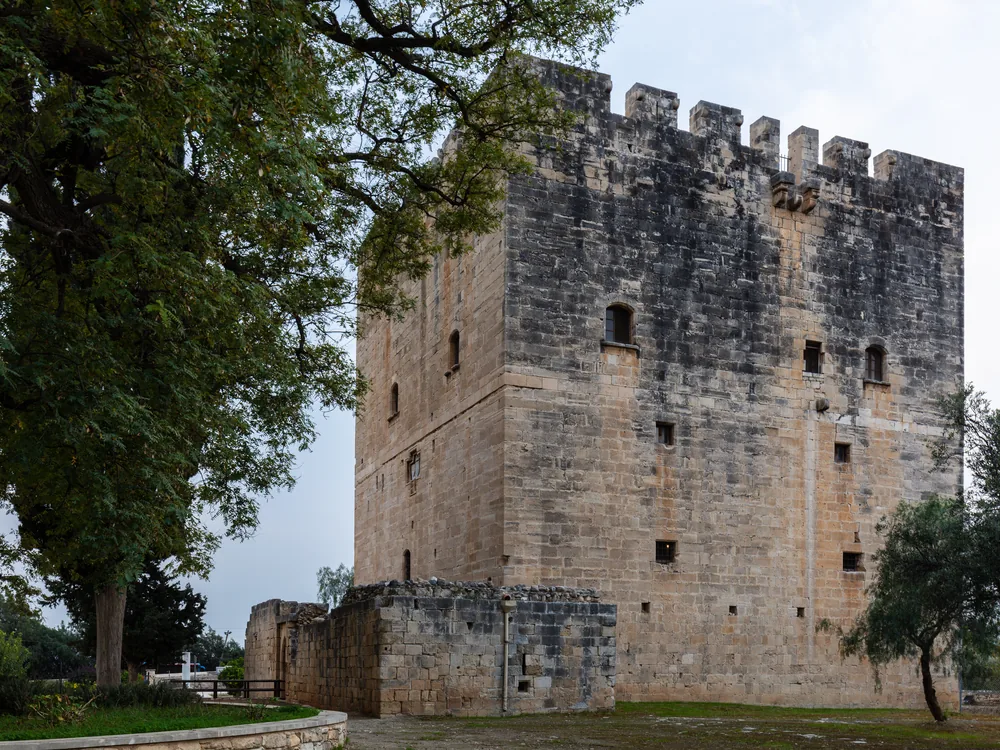
Kolossi Castle is a compact and perfectly preserved Crusader keep — a 21-metre-high square tower of golden limestone rising from citrus groves 14 km west of Limassol. Built by the Knights Hospitaller (Knights of St John) after they inherited Cyprus from the Knights Templar in 1313, the castle served as the Grand Commandery of the Order's Cyprus operation — the administrative headquarters from which the Knights managed their most profitable estate in the eastern Mediterranean.
The keep visible today was built in 1454 under Grand Commander Louis de Magnac, whose coat of arms survives above the entrance doorway in excellent relief — one of the finest examples of medieval heraldic carving in Cyprus. The three-storey tower contained the commander's apartments on the upper floors, storerooms below, and a painted hall with a fireplace whose hood still bears traces of fresco decoration. From the roof, the fertile Akrotiri peninsula and the Troodos Mountains are visible in one direction, the sea in the other.
But Kolossi's greatest legacy is not military — it is viticultural. The Knights' estate produced Commandaria wine from sun-dried Xynisteri and Mavro grapes grown on the surrounding hillsides. Commandaria is documented as far back as the 12th century; Richard I ordered it after conquering Cyprus in 1191; King Philip II of France requested it by name from Cyprus; it was served at the coronation feast of Henry V of England. It remains in production today, available at the castle visitor shop and throughout Cyprus.
History
The Hospitaller presence at Kolossi dates to 1210, when the Order of St John received the estate as part of their Cypriot holdings. Cyprus had been conquered by Richard I of England during the Third Crusade in 1191 and was subsequently ruled by the Lusignan dynasty as a Crusader kingdom. The Knights used the Cyprus estate — one of their richest — to fund their military operations in the Holy Land and, after the fall of Acre in 1291, their operations from Rhodes.
After the dissolution of the Knights Templar in 1312, the Templars' Cyprus properties were transferred to the Hospitallers, making Kolossi the centre of a greatly expanded estate. The current tower was built by Grand Commander Louis de Magnac in 1454 — a period of relative Cypriot stability before the Ottoman conquest. The Knights held Cyprus until 1489, when the last Lusignan queen Catherine Cornaro ceded the island to Venice.
Under Venetian, then Ottoman, then British colonial rule, the castle fell out of active use but survived intact due to the solidity of its 15th-century construction. The Department of Antiquities of Cyprus has managed it as a heritage site since independence in 1960.
How to Visit
Getting there: Kolossi village is 14 km west of Limassol. By car, take the B6 coastal road west toward Paphos and turn north at the Kolossi junction — clearly signposted. Regular buses from Limassol to Episkopi pass through Kolossi village. Taxi from Limassol takes about 20 minutes.
Tickets: Adult €3, child €2. No advance booking required — tickets at the gate. The GetYourGuide "From Paphos: Trip to Limassol with Kourion & Kolossi Castle" combines Kolossi with the clifftop Roman city of Kourion and central Limassol in a 7-hour guided day from Paphos.
Practical tips: Climb to the castle roof — the views over the Akrotiri peninsula, the Troodos Mountains, and the sea are the highlight of the visit. Commandaria wine, produced from grapes grown on the vineyards the Knights managed from this estate, is available at the visitor shop. Avoid the steep tower staircase if you have mobility concerns — the ground floor and courtyard are accessible without it.
Combine with: Limassol Castle is 20 minutes east in the city centre and makes an easy same-day pairing. Kourion (5 km west — a dramatically sited Greco-Roman city with a fully restored theatre) completes a full western Limassol circuit.
Frequently Asked Questions
Commandaria is a sweet amber dessert wine made from sun-dried Xynisteri (white) and Mavro (red) grapes grown in the 14 villages of the Commandaria wine region in the Troodos foothills. It is one of the oldest named wines in continuous production — documented references date to at least the 12th century. Richard I ordered it after his 1191 Cyprus campaign; it was served at medieval royal courts across Europe. Modern Commandaria is produced under a Protected Designation of Origin and is widely available throughout Cyprus.
Location
Kolossi 4610, Cyprus
Nearby Castles
Tours & Tickets
Powered by GetYourGuide
From
€50/ person