
Petra Fortress
პეტრას ციხე (Petra's Tsikhe)
Georgia · Adjara Autonomous Republic — Adjara, Tsikhistsikhe, near Tsikhisdziri, Black Sea coast · Near Batumi
Built 541 · Late-antique Byzantine defensive fortification constructed in 541 CE on a coastal promontory above the Black Sea; the design follows the standard Byzantine programme of curtain walls, rectangular towers at intervals, and rock-cut cisterns for water storage under siege; the promontory's natural cliff faces form the fortification's southern and western perimeters, reducing the required masonry to the northern and eastern approaches; construction materials are local coastal sandstone and rubble-core masonry characteristic of Justinianic-period military engineering on the Caucasian frontier
This page is part of an independent travel guide and is not affiliated with, endorsed by, or operated by Petra Fortress.
© Castles & Palaces
Quick Facts
- Hours
- Mon–Sun Open access
- Guided tour from
- €36
- Duration
- 1 hour (fortress ruins)
- Best time
- April to October
- Nearest city
- Batumi
Featured Tour
Black Sea Empires: Fortress & Living Landscapes
Cancellation available · Instant confirmation
Highlights
- ✦Justinianic curtain walls — long sections of 6th-century Byzantine masonry survive on the promontory, including sections of the original curtain wall and tower bases that demonstrate the scale of the imperial fortification programme under Justinian I
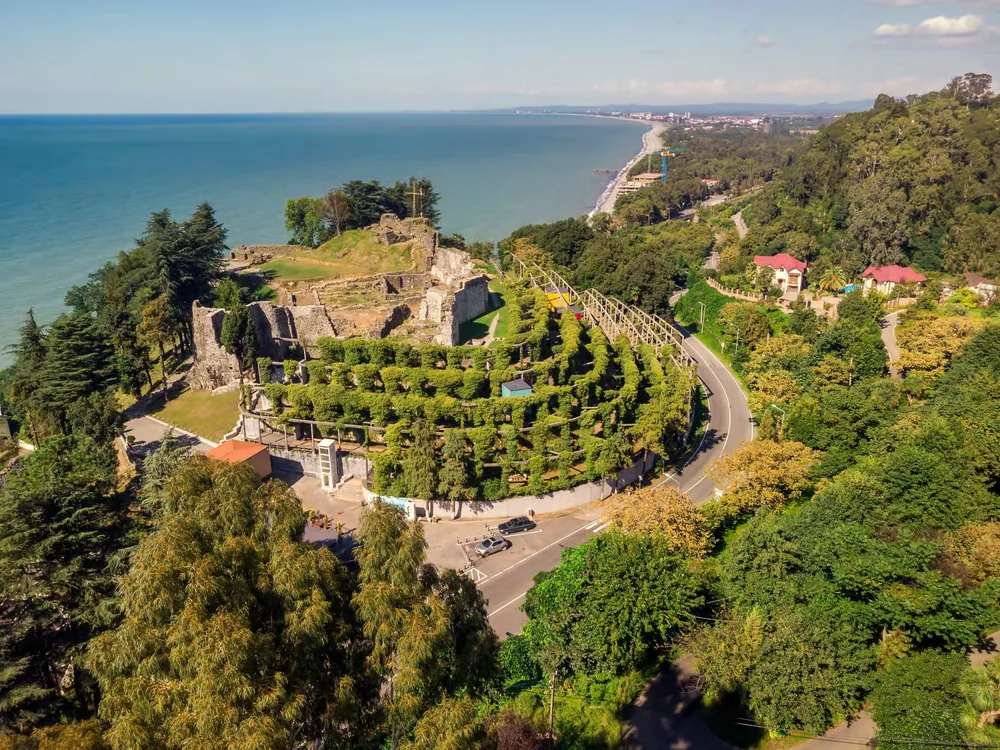
- ✦Cliff-top Black Sea panorama — the fortress occupies a natural promontory with unobstructed views along the coast in both directions; the landscape context explains immediately why the site was worth building, fighting over, and partially demolishing to deny to an enemy
- ✦Rock-cut cisterns — Byzantine military engineers cut water cisterns into the promontory's bedrock to sustain the garrison during siege; several cisterns survive and are visible during a circuit of the ruins
- ✦Lazic War historical significance — Petra was the principal military objective of the Lazic War (541–562), one of the defining conflicts of late antiquity between the Byzantine Empire and Sassanid Persia; the scars of that contest are embedded in the fortress's partially demolished walls
- ✦GetYourGuide coastal day programme — a 6-hour circuit from Batumi combining Petra Fortress with Shekvetili Dendrological Park and Georgia in Miniatures Park along the Black Sea coastal highway; the practical way to understand the breadth of the Adjaran coast in a single day
Skip the queue with a guided tour
Skip-the-line tickets & expert guides
Petra Fortress rises from a cliff above the Black Sea coast near Tsikhisdziri in the Adjara Autonomous Republic — a late-antique stronghold whose walls and towers have held the Colchian shoreline for nearly fifteen hundred years. Emperor Justinian I of Byzantium ordered the fortress constructed in 541 as part of his programme to assert Byzantine control over the eastern Black Sea coast and secure the route between Trabzon and the Colchis plain against both Persian expansion and the ambitions of local Georgian kingdoms. Petra, meaning 'stone' in Greek, was aptly named: the fortress was built on a steep coastal promontory, its natural cliff faces supplemented by substantial masonry curtain walls, defensive towers, and rock-cut cisterns capable of sustaining a garrison under siege.
The fortress's strategic importance — and the ferocity of the competition for it — defined its first century of existence. Sassanid Persian forces captured Petra from the Byzantines as part of the Lazic War, one of the defining conflicts of the mid-6th century. Byzantine forces conducted multiple campaign seasons of siege to retake it; when they eventually succeeded, the walls were partially demolished to prevent future reoccupation. This cycle of construction, capture, and partial destruction reflects the pattern of contested frontier fortifications across the Caucasus in the late antique and early medieval periods.
What survives today is substantial: long sections of Byzantine-period curtain wall, the bases of defensive towers, cisterns cut into the rock, and the commanding promontory itself — a natural theatre above the Black Sea with unobstructed views along the coast in both directions. The fortress does not offer a conventional museum experience. There are no reconstructed interiors, no on-site exhibition, and no formal visitor infrastructure. What Petra Fortress offers instead is landscape and atmosphere: the physical experience of standing inside a Byzantine defensive system of the Justinianic period, above one of the most historically contested coastlines in the Caucasus.
The site remains largely unexcavated, and archaeological investigation of the stratified occupation layers — Byzantine, Sassanid, Arab, and medieval Georgian — has been limited. The relationship between the surviving masonry and the documented events of the Lazic War is still being worked out by specialists. For the non-specialist visitor, the value is the experience of the cliff-top setting and the immediacy of the late-antique walls in their landscape.
The practical approach for most visitors is through the GetYourGuide coastal day programme from Batumi, which combines Petra Fortress as its historical centrepiece with Shekvetili Dendrological Park and Georgia in Miniatures Park along the Black Sea coastal highway — a six-hour circuit that makes geographical and logistical sense for travellers based in Batumi who want to understand the breadth of the Adjaran coast.
History
The fortress at Petra was one of several large-scale construction projects that Justinian I initiated along the Caucasian frontier in the 6th century — a programme of fortification designed to hold the Black Sea coastal corridor against Sassanid Persia and to project Byzantine power into the Lazic kingdom of approximate modern western Georgia. The construction in 541 established Petra as the largest Byzantine fortification on this section of the coast, a statement of imperial intent rather than a merely tactical installation.
The Lazic War (541–562) placed Petra at the centre of one of late antiquity's most sustained frontier conflicts. Persian forces captured the fortress early in the war, and Byzantine attempts to retake it involved sieges that multiple commanders prosecuted across several campaigning seasons. When Byzantine forces eventually retook Petra, the walls were partially demolished to deny the site to future adversaries. This cycle — construction, capture, partial destruction — reflects the broader pattern of contested fortifications across the Caucasian frontier.
Subsequent Arab, Byzantine, and early Georgian rulers all occupied or controlled the site at various points. Medieval Georgian rulers of the Adjaran region incorporated the promontory into their coastal defensive network, and the Byzantine-period walls were repaired and reused across several centuries of occupation. The fortress's later history is less well documented than its dramatic 6th-century debut, but the site's position on the Black Sea coastal highway ensured its continued relevance to whoever controlled the Adjaran littoral.
How to Visit
Getting there: Petra Fortress is located near Tsikhisdziri village on the Black Sea coastal highway (S1) between Batumi and Kobuleti, approximately 30 kilometres north of Batumi. By car from Batumi, follow the S1 coastal highway north; the fortress promontory is signposted from the Tsikhisdziri turn. There is no direct public bus to the fortress itself; the nearest marshrutka stop (Batumi–Kobuleti route) deposits passengers on the main road approximately 1 kilometre from the fortress access path. The most practical option for visitors without a rental car is the GetYourGuide coastal programme, which includes hotel pickup and transport.
Tickets: Entry to Petra Fortress is free. The GetYourGuide tour — a 6-hour coastal programme from Batumi with hotel pickup, visiting Petra Fortress (approximately 1 hour at the fortress), Shekvetili Dendrological Park, and Georgia in Miniatures Park — is the practical way to combine the fortress with the surrounding Black Sea coastal route; book in advance.
Practical tips: Wear sturdy footwear — the approach to the fortress involves an uphill path over uneven ground and the ruins themselves are partly collapsed. There is no fencing or formal visitor infrastructure at the site; take care near the cliff edges. The Black Sea coastal views from the promontory are panoramic and best photographed in clear weather. Bring water, especially in summer, as there are no refreshment facilities at the site.
Combine with: Rabati Castle — the large partially restored Georgian-Ottoman fortress complex in Akhaltsikhe, approximately 3 hours inland from Batumi; Petra and Rabati together make a strong multi-day Adjaran circuit for visitors based in Batumi.
Frequently Asked Questions
The ruins are substantial rather than reconstructed. Long sections of Byzantine-period curtain wall survive, along with tower bases, rock-cut cisterns, and the promontory itself — a cliff above the Black Sea. There are no reconstructed buildings, no exhibition spaces, and no on-site interpretation boards. The value of the visit is the physical presence of a major Justinianic fortification in its landscape context, with panoramic sea views; visitors who arrive expecting a museum-style experience will find an open archaeological site. Allow approximately 1 hour to walk the accessible sections of the walls and the promontory perimeter.
Location
Petra Fortress, Tsikhisdziri, Adjara, Georgia
Nearby Castles
Tours & Tickets
Powered by GetYourGuide
From
€36/ person